Problems
Filters
1 problem found
2002 Paper 1 Q12
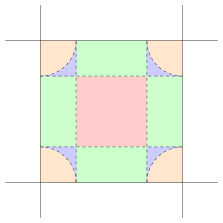
Harry the Calculating Horse will do any mathematical problem I set him, providing the answer is 1, 2, 3 or 4. When I set him a problem, he places a hoof on a large grid consisting of unit squares and his answer is the number of squares partly covered by his hoof. Harry has circular hoofs, of radius \(1/4\) unit. After many years of collaboration, I suspect that Harry no longer bothers to do the calculations, instead merely placing his hoof on the grid completely at random. I often ask him to divide 4 by 4, but only about \(1/4\) of his answers are right; I often ask him to add 2 and 2, but disappointingly only about \(\pi/16\) of his answers are right. Is this consistent with my suspicions? I decide to investigate further by setting Harry many problems, the answers to which are 1, 2, 3, or 4 with equal frequency. If Harry is placing his hoof at random, find the expected value of his answers. The average of Harry's answers turns out to be 2. Should I get a new horse?
Solution: Without loss of generality, let's assume that Harry is putting the center of his hoof within one square.