Problems
Filters
3 problems found
2018 Paper 3 Q3
Show that the second-order differential equation \[ x^2y''+(1-2p) x\, y' + (p^2-q^2) \, y= \f(x) \,, \] where \(p\) and \(q\) are constants, can be written in the form \[ x^a \big(x^b (x^cy)'\big)' = \f(x) \,, \tag{\(*\)} \] where \(a\), \(b\) and \(c\) are constants.
- Use \((*)\) to derive the general solution of the equation \[ x^{2}y''+(1-2p)xy'+(p^2-q^{2})y=0 \] in the different cases that arise according to the values of \(p\) and \(q\).
- Use \((*)\) to derive the general solution of the equation \[ x^{2}y''+(1-2p)xy'+p^2y=x^{n} \] in the different cases that arise according to the values of \(p\) and \(n\).
Solution: Consider $x^a \big(x^b (x^cy)'\big)'$ then \begin{align*} x^a \big(x^b (x^cy)'\big)' &= x^a \big (bx^{b-1}(x^c y)'+x^b(x^cy)'' \big ) \\ &= x^a \big (bx^{b-1} (cx^{c-1}y + x^c y') + x^b(c(c-1)x^{c-2}y + 2cx^{c-1}y' + x^cy'') \\ &= x^{a+b+c}y'' + (2cx^{c-1+b+a}+bx^{c+b-1+a})y'+(c(b+c-1))x^{a+b+c-2} y \end{align*} So we need: \begin{align*} &&& \begin{cases} a+b+c &= 2 \\ 2c+b &= 1-2p \\ c(b+c-1) &= p^2-q^2 \end{cases} \\ \Rightarrow && c((1-2p)-2c+c-1) &=p^2-q^2 \\ \Rightarrow && c^2+2pc &= q^2-p^2 \end{align*}
2015 Paper 3 Q8
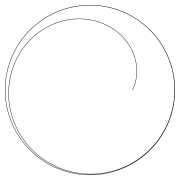
- Show that under the changes of variable \(x= r\cos\theta\) and \(y = r\sin\theta\), where \(r\) is a function of \(\theta\) with \(r>0\), the differential equation \[ (y+x)\frac{\d y}{\d x} = y-x \] becomes \[ \frac{\d r}{\d\theta} + r=0 \,. \] Sketch a solution in the \(x\)-\(y\) plane.
- Show that the solutions of \[ \left( y+x -x(x^2+y^2) \right) \, \frac{\d y }{\d x} = y-x - y(x^2+y^2) \] can be written in the form \\ \[ r^2 = \dfrac 1 {1+A\e^{2\theta}}\, \]\\ and sketch the different forms of solution that arise according to the value of \(A\).
Solution:
- \begin{align*}
&& (y+x)\frac{\d y}{\d x} &= y-x \\
\Rightarrow && (r \sin \theta + r \cos\theta) \frac{\frac{dy}{d\theta}}{\frac{dx}{d\theta}} &= (r \sin\theta - r \cos\theta) \\
\Rightarrow && ( \sin \theta + \cos\theta) \frac{dy}{d\theta} &= (\sin\theta - \cos\theta){\frac{dx}{d\theta}} \\
\Rightarrow && ( \sin \theta + \cos\theta) \left ( \frac{dr}{d\theta} \cos \theta - r \sin \theta\right ) &= (\sin\theta - \cos\theta)\left ( \frac{dr}{d\theta} \sin\theta + r \cos \theta\right) \\
\Rightarrow && \frac{dr}{d\theta} \left (\sin \theta \cos \theta + \cos^2 \theta - \sin^2 \theta + \sin \theta \cos \theta \right)&= r \left (\sin \theta \cos \theta - \cos^2 \theta + \sin^2 \theta + \sin\theta \cos \theta\right) \\
\Rightarrow && \frac{dr}{d\theta}&= -r \\
\end{align*}
Therefore \(r = Ae^{-\theta}\)

- \begin{align*}
&& \left( y+x -x(x^2+y^2) \right) \, \frac{\d y }{\d x} &= y-x - y(x^2+y^2) \\
\Rightarrow && \left( r \sin \theta+r\cos \theta -r^3\cos \theta \right) \, \frac{\d y }{\d \theta} &= \left ( r \sin \theta- r \cos \theta- r^3\sin \theta \right)\frac{\d x }{\d \theta} \\
\Rightarrow && \left( r \sin \theta+r\cos \theta -r^3\cos \theta \right) \, \left (\frac{\d r}{\d \theta} \sin \theta + r \cos \theta \right) &= \\
&& \left ( r \sin \theta- r \cos \theta- r^3\sin \theta \right)&\left (\frac{\d r}{\d \theta} \cos \theta - r \sin \theta \right) \\
\Rightarrow && \frac{\d r}{\d \theta} \left (\sin \theta ( \sin \theta + \cos \theta - r^2 \cos \theta) - \cos \theta (\sin \theta - \cos \theta - r^2 \sin \theta) \right) &= \\
&& r ( -\sin \theta (\sin \theta - \cos \theta - r^2 \sin \theta) - \cos \theta ( \sin \theta + \cos \theta &- r^2 \cos \theta)) \\
\Rightarrow && \frac{\d r}{\d \theta} &= r ( -1 +r^2) \\
\Rightarrow && \int \frac{1}{r(r-1)(r+1)} \d r &= \int \d \theta \\
\Rightarrow && \int \l \frac{-1}{r} + \frac{1}{2(r-1)} + \frac{1}{2(r+1)} \r \d r &= \int \d \theta \\
\Rightarrow && \l -\log r+ \frac12 \log (1+r)+ \frac12 \log (1-r)\r + C &= \theta \\
\Rightarrow && \frac12 \log \left (\frac{1-r^2}{r^2} \right) + C &= \theta \\
\Rightarrow && \log \left (\frac{1}{r^2}-1 \right) + C &= 2\theta \\
\Rightarrow && r &= \frac{1}{1 + Ae^{2\theta}} \\
\end{align*}


1993 Paper 2 Q10
Verify that if \[ \mathbf{P}=\begin{pmatrix}1 & 2\\ 2 & -1 \end{pmatrix}\qquad\mbox{ and }\qquad\mathbf{A}=\begin{pmatrix}-1 & 8\\ 8 & 11 \end{pmatrix} \] then \(\mathbf{PAP}\) is a diagonal matrix. Put $\mathbf{x}=\begin{pmatrix}x\\ y \end{pmatrix}\( and \)\mathbf{x}_{1}=\begin{pmatrix}x_{1}\\ y_{1} \end{pmatrix}.$ By writing \[ \mathbf{x}=\mathbf{P}\mathbf{x}_{1}+\mathbf{a} \] for a suitable vector \(\mathbf{a},\) show that the equation \[ \mathbf{x}^{\mathrm{T}}\mathbf{Ax}+\mathbf{b}^{\mathrm{T}}\mathbf{x}-11=0, \] where $\mathbf{b}=\begin{pmatrix}18\\ 6 \end{pmatrix}\( and \) \mathbf{x}^{\mathrm{T}} \( is the transpose of \)\mathbf{x},$ becomes \[ 3x_{1}^{2}-y_{1}^{2}=c \] for some constant \(c\) (which you should find).
Solution: \begin{align*} \mathbf{PAP} &= \begin{pmatrix}1 & 2\\ 2 & -1 \end{pmatrix}\begin{pmatrix}-1 & 8\\ 8 & 11 \end{pmatrix}\begin{pmatrix}1 & 2\\ 2 & -1 \end{pmatrix} \\ &= \begin{pmatrix}1 & 2\\ 2 & -1 \end{pmatrix}\begin{pmatrix}15 & -10\\ 30 & 5 \end{pmatrix} \\ &= \begin{pmatrix}75 & 0\\ 0 & -25 \end{pmatrix} \end{align*} Which is diagonal as required. Letting \(\mathbf{x}=\mathbf{P}\mathbf{x}_{1}+\mathbf{a}\) \begin{align*} && \mathbf{x}^{\mathrm{T}}\mathbf{Ax}+\mathbf{b}^{\mathrm{T}}\mathbf{x}-11&=0 \\ \Leftrightarrow && (\mathbf{P}\mathbf{x}_{1}+\mathbf{a})^T\mathbf{A}(\mathbf{P}\mathbf{x}_{1}+\mathbf{a}) + \mathbf{b}^T(\mathbf{P}\mathbf{x}_{1}+\mathbf{a}) - 11 &= 0 \\ \Leftrightarrow && \mathbf{x}_{1}^T\mathbf{PAP}\mathbf{x}_1 + \mathbf{x}_{1}^T\mathbf{PAa} + \mathbf{a}^T\mathbf{AP}\mathbf{x}_{1}+\mathbf{a}^T\mathbf{Aa} + \mathbf{b}^T(\mathbf{P}\mathbf{x}_{1}+\mathbf{a}) - 11 &= 0 \\ \Leftrightarrow && \mathbf{x}_{1}^T\mathbf{PAP}\mathbf{x}_1 +(2\mathbf{a}^T\mathbf{A}+\mathbf{b}^T)\mathbf{P}\mathbf{x}_{1}+\mathbf{a}^T\mathbf{Aa} + \mathbf{b}^T\mathbf{a} - 11 &= 0 \\ \end{align*} It would be nice if we picked \(\mathbf{a}\) such that \(2\mathbf{a}^T\mathbf{A}+\mathbf{b}^T = 0\), if \(\mathbf{a} = \begin{pmatrix} a_1 \\a_2 \end{pmatrix}\) then this equation becomes: \begin{align*} && 2\begin{pmatrix}-a_1 + 8a_2 & 8a_1+11a_2 \end{pmatrix} + \begin{pmatrix}18 & 6 \end{pmatrix} &= 0 \\ \Rightarrow && a_1 = 1, a_2 = -1 \end{align*} So our equation is now \begin{align*} && \mathbf{x}_{1}^T\mathbf{PAP}\mathbf{x}_1 +(2\mathbf{a}^T\mathbf{A}+\mathbf{b}^T)\mathbf{P}\mathbf{x}_{1}+\mathbf{a}^T\mathbf{Aa} + \mathbf{b}^T\mathbf{a} - 11 &= 0 \\ \Leftrightarrow && \mathbf{x}_{1}^T\mathbf{PAP}\mathbf{x}_1-6 +12 - 11 &= 0 \\ \Leftrightarrow && 25(3x_1^2 - y_1^2) &= 5 \\ \Leftrightarrow && 3x_1^2 - y_1^2 &= \frac{1}{5} \end{align*}