Problems
Filters
1 problem found
2014 Paper 1 Q10
D: 1500.0
B: 1500.0
momentum
collisions
coefficient of restitution
energy conservation
bouncing ball
stacked balls
free fall
conservation of momentum
- A uniform spherical ball of mass \(M\) and radius \(R\) is released from rest with its centre a distance \(H+R\) above horizontal ground. The coefficient of restitution between the ball and the ground is \(e\). Show that, after bouncing, the centre of the ball reaches a height \(R+He^2\) above the ground.
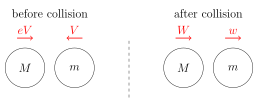
- A second uniform spherical ball, of mass \(m\) and radius \(r\), is now released from rest together with the first ball (whose centre is again a distance \(H+R\) above the ground when it is released). The two balls are initially one on top of the other, with the second ball (of mass \(m\)) above the first. The two balls separate slightly during their fall, with their centres remaining in the same vertical line, so that they collide immediately after the first ball has bounced on the ground. The coefficient of restitution between the balls is also \(e\). The centre of the second ball attains a height \(h\) above the ground. Given that \(R=0.2\), \(r=0.05\), \(H=1.8\), \(h=4.5\) and \(e=\frac23\), determine the value of \(M/m\).
Solution:
- The story for first ball (before it collides with the second ball) will be exactly the same, ie it rebounds with speed \(eV\).
For the second ball, it will also have fallen a distance \(H\) and will be travelling with the same speed \(V\). Their speed of approach therefore will be \((1+e)V\), and the speed of separating therefore must be \(e(1+e)V\)
Given the centre of the second ball reaches a height of \(h\) (from a position of height) \(2R+r\), we must have:
\begin{align*}
&& v^2 &= u^2 + 2as \\
&& 0 &= w^2 - 2g(h - 2R-r) \\
\Rightarrow && w^2 &= 2g(h-2R-r)
\end{align*}
Taking upwards to be positive, then we have:
\begin{align*} \text{COM}: && MeV + m(-V) &= M(w-e(1+e)V) + mw \\ \Rightarrow && V(Me-m)+e(1+e)MV &= w(M+m) \\ \Rightarrow && w &= \frac{2Me+e^2M-m}{M+m} V \\ \Rightarrow && w^2 &= \left ( \frac{M/m(2e+e^2)-1}{M/m+1}\right)^2 V^2 \\ \Rightarrow && 2g(h-2R-r) &= \left ( \frac{M/m(2e+e^2)-1}{M/m+1}\right)^2 2gH \\ \Rightarrow && \left ( \frac{M/m(2e+e^2)-1}{M/m+1}\right)^2 &= \frac{h-2R-r}{H} \\ &&&= \frac{4.5-0.4-0.05}{1.8} \\ &&&= \frac{9}{4} \\ \Rightarrow && \frac{M/m(\frac43+\frac49)-1}{M/m+1} &= \frac32 \\ \Rightarrow && \frac{16}9M/m-1 &= \frac32 M/m+\frac32 \\ \Rightarrow && \frac{5}{18}M/m &= \frac{5}{2} \\ \Rightarrow && M/m &= 9 \end{align*}