Problems
Filters
4 problems found
2025 Paper 3 Q7
Let \(f(x) = \sqrt{x^2 + 1} - x\).
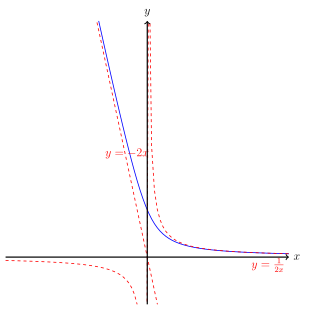
- Using a binomial series, or otherwise, show that, for large \(|x|\), \(\sqrt{x^2 + 1} \approx |x| + \frac{1}{2|x|}\). Sketch the graph \(y = f(x)\).
- Let \(g(x) = \tan^{-1} f(x)\) and, for \(x \neq 0\), let \(k(x) = \frac{1}{2}\tan^{-1}\frac{1}{x}\).
- Show that \(g(x) + g(-x) = \frac{1}{2}\pi\).
- Show that \(k(x) + k(-x) = 0\).
- Show that \(\tan k(x) = \tan g(x)\) for \(x > 0\).
- Sketch the graphs \(y = g(x)\) and \(y = k(x)\) on the same axes.
- Evaluate \(\int_0^1 k(x) \, dx\) and hence write down the value of \(\int_{-1}^0 g(x) \, dx\).
Solution:
- \begin{align*}
\sqrt{x^2+1} &= |x|\sqrt{1+\frac{1}{x^2}} \\
&=|x| \left (1 + \frac12 \frac{1}{x^2} + \cdots \right) & \text{if } \left (\frac{1}{x^2} < 1 \right) \\
&= |x| + \frac12 \frac{1}{|x|} + \cdots \\
&\approx |x| + \frac{1}{2|x|}
\end{align*}
- \begin{align*} && \tan( g(x) + g(-x)) &= \tan \left ( \tan^{-1}(\sqrt{x^2+1}-x) + \tan^{-1}(\sqrt{x^2+1}+x) \right) \\ &&&= \frac{\sqrt{x^2+1}-x+\sqrt{x^2+1}+x}{1-1} \\ \Rightarrow && g(x) + g(-x) &\in \left \{\cdots, -\frac{\pi}{2}, \frac{\pi}{2}, \cdots \right\} \end{align*} But \(g(x), g(-x) > 0\) and \(g(x), g(-x) \in (-\frac{\pi}{2}, \frac{\pi}{2})\), therefore it must be \(\frac{\pi}{2}\).
- \begin{align*} && \tan(2(k(x) + k(-x))) &= \tan(\tan^{-1}x + \tan^{-1}(-x)) \\ &&&= 0 \\ \Rightarrow && k(x)+k(-x) &\in \left \{\cdots, -\frac{\pi}{2}, 0, \frac{\pi}{2}, \cdots \right\} \\ \end{align*} But \(k(x) \in (-\frac{\pi}{4}, \frac{\pi}{4})\), therefore \(k(x) + k(-x) = 0\).
- Let \(t = \tan k(x)\). \begin{align*} && \tan \left ( \tan^{-1} \frac{1}{x} \right) &= \frac{2 \tan\left ( \frac12 \tan^{-1} \frac1x \right)}{ 1-\tan^2\left ( \frac12 \tan^{-1} \frac1x \right)} \\ \Rightarrow && \frac1x &= \frac{2t}{1-t^2} \\ \Rightarrow && 1-t^2 &= 2tx \\ \Rightarrow && 0 &= t^2+2tx - 1 \\ \Rightarrow && 0 &= (t+x)^2 - 1-x^2 \\ \Rightarrow && t &= -x \pm \sqrt{1+x^2} \end{align*} Since \(t > 0\), \(t = \sqrt{1+x^2}-x = f(x) = \tan g(x)\)
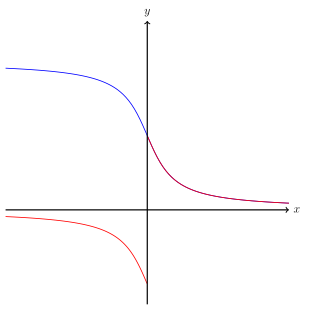
- \begin{align*} \int_0^1 k(x) \d x &= \int_0^1 \frac12 \tan^{-1} \left ( \frac1x \right) \d x \\ &= \left [ \frac{x}{2} \tan^{-1}\left ( \frac1x \right) \right]_0^1 - \int_0^1 \frac{x}{2} \frac{-1/x^2}{1+1/x^2} \d x \\ &= \left [ \frac{x}{2} \tan^{-1}\left ( \frac1x \right) \right]_0^1 + \frac14 \int_0^1 \frac{2x}{1+x^2} \d x \\ &= \frac12 \frac{\pi}{4} + \frac14 \ln(2) \\ &= \frac{\pi + \ln 4}{8}\end{align*} Therefore \(\displaystyle \int_{-1}^0 g(x) \d x = -\frac{\pi + \ln 4}{8}\)
2016 Paper 1 Q8
Given an infinite sequence of numbers \(u_0\), \(u_1\), \(u_2\), \(\ldots\,\), we define the generating function, \(\f\), for the sequence by \[ \f(x) = u_0 + u_1x +u_2 x^2 +u_3 x^3 + \cdots \,. \] Issues of convergence can be ignored in this question.
- Using the binomial series, show that the sequence given by \(u_n=n\,\) has generating function \(x(1-x)^{-2}\), and find the sequence that has generating function \(x(1-x)^{-3}\). Hence, or otherwise, find the generating function for the sequence \(u_n =n^2\). You should simplify your answer.
- \(\bf (a)\) The sequence \(u_0\), \(u_1\), \(u_2\), \(\ldots\,\) is determined by \(u_{n} = ku_{n-1}\) (\(n\ge1\)), where \(k\) is independent of \(n\), and \(u_0=a\). By summing the identity \(u_{n}x^n \equiv ku_{n-1}x^n\), or otherwise, show that the generating function, f, satisfies \[ \f(x) = a + kx \f(x) \] Write down an expression for \(\f(x)\).
- \(\bf (b)\) The sequence \(u_0, u_1, u_2, \ldots\,\) is determined by \(u_{n} = u_{n-1}+ u_{n-2}\) (\(n\ge2\)) and \(u_0=0\), \(u_1=1\). Obtain the generating function.
Solution:
- \(\,\) \begin{align*} && x(1-x)^{-2} &= x \left (1 + (-2)(-x) + \frac{(-2)(-3)}{2!}x^2 + \cdots + \frac{(-2)(-3)\cdots(-2-(k-1))}{k!} (-x)^k + \cdots \right) \\ &&&= x(1 + 2x + 3x^2 + \cdots + \frac{(-2)(-3)\cdots(-(k+1))}{k!}(-1)^k x^k + \cdots ) \\ &&&= x+2x^2 + 3x^3 + \cdots + (k+1)x^{k+1} + \cdots \\ \Rightarrow && u_n &= n \end{align*} \begin{align*} && x(1-x)^{-3} &= x \left (1 + 3x + 6x^2 + \cdots + \frac{(-3)(-4)\cdots(-k-2)}{k!}(-x)^k + \cdots \right) \\ &&&= x \left (1 + 3x + 6x^2 + \cdots + \frac{(k+2)(k+1)}{2}x^k + \cdots \right) \\ &&&= x + 3x^2 + 6x^3 + \cdots + \binom{k+2}{2}x^{k+1} + \cdots \\ && u_n &= \binom{n+1}{2} = \frac{n^2+n}{2} \\ \\ \Rightarrow && 2x(1-x)^{-3} - x(1-x)^{-2} &= (1-x)^{-3}(2x-x(1-x)) \\ &&&= (1-x)^{-3}(x+x^2) \end{align*}
- \(u_n = ku_{n-1} \Rightarrow u_nx^n = ku_{n-1}x^n\) so \begin{align*} && \sum_{n=1}^\infty u_n x^n &= \sum_{n=1}^\infty k u_{n-1}x^n \\ && \sum_{n=0}^\infty u_n x^n - a &= x\sum_{n=0}^\infty k u_{n}x^n \\ \Rightarrow && f(x)-a &= kx f(x) \\ \Rightarrow && f(x) &= a + kxf(x) \\ \Rightarrow && f(x) &= \frac{a}{1-kx} \end{align*}
- Suppose \(\displaystyle f(x) = \sum_{n=0}^\infty u_n x^n\) so \begin{align*} && x^n u_n &= x^n u_{n-1} + x^n u_{n-2} \\ \Rightarrow && \sum_{n=2}^\infty x^n u_n &= \sum_{n=2}^\infty x^n u_{n-1} + \sum_{n=2}^\infty x^n u_{n-2} \\ && \sum_{n=0}^\infty x^n u_n - u_0 - u_1 x &= \left ( \sum_{n=0}^\infty x^{n+1} u_{n} -xu_0 \right) + \sum_{n=0}^\infty x^{n+2} u_{n} \\ && f(x) - x &= xf(x) +x^2f(x) \\ \Rightarrow && f(x) &= \frac{x}{1-x-x^2} \end{align*}
2003 Paper 3 Q2
Show that $\ds ^{2r} \! {\rm C}_r =\frac{1\times3\times\dots\times (2r-1)}{r!} \, \times 2^r \;, $ for \(r\ge1\,\).
- Give the first four terms of the binomial series for \(\l 1 - p \r^{-\frac12}\). By choosing a suitable value for \(p\) in this series, or otherwise, show that $$ \displaystyle \sum_{r=0}^\infty \frac{ {\vphantom {\A}}^{2r} \! {\rm C}_r }{ 8^r} = \sqrt 2 \; .$$
- Show that $$ \displaystyle \sum_{r=0}^\infty \frac{\l 2r + 1 \r \; {\vphantom{A}}^{2r} \! {\rm C} _r }{ 5^r} =\big( \sqrt 5\big)^3 \;. $$
Solution: \begin{align*} \binom{2r}{r} &= \frac{(2r)!}{r!r!} \\ &= \frac{1 \cdot 2 \cdot 3 \cdot 4 \cdots (2r-1)(2r)}{r! r!} \\ &= \frac{1 \cdot 3 \cdot 5 \cdots (2r-1) \cdot (2 \cdot 1) \cdot (2 \cdot 2) \cdots (2 \cdot r)}{r!}{r!} \\ &= \frac{1\cdot 3 \cdots (2r-1) \cdot 2^r \cdot 1 \cdot 2 \cdots r}{r!r!} \\ &= \frac{1\cdot 3 \cdots (2r-1) \cdot 2^r \cdot r!}{r!r!} \\ &= \frac{1\cdot 3 \cdots (2r-1)}{r!} \cdot 2^r \end{align*} which is what we wanted to show
- \begin{align*} (1 - p)^{-\frac12} &= 1 + \left ( -\frac12 \right )(-p) + \frac{1}{2!} \left (-\frac12 \right )\left (-\frac32 \right )(-p)^2 + \ldots \\ & \quad \quad \quad \cdots +\frac{1}{3!} \left (-\frac12 \right )\left (-\frac32 \right )\left (-\frac52 \right )(-p)^3 + O(p^4) \\ &= \boxed{1 + \frac{1}{2}p + \frac{3}{8}p^2 + \frac{5}{16}p^3} + O(p^4) \end{align*} More generally: \begin{align*} \binom{-\frac{1}{2}}{k} &=\frac{(-\frac{1}{2})\cdot(-\frac{1}{2} -1)\cdots(-\frac12 -k+1)}{k!} \\ &= \frac{(-1)(-3)(-5)\cdots(-(2k-1))}{k!2^k} \\ &= \frac{(-1)^k(1)(3)(5)\cdots((2k-1))}{k!2^k} \\ &= (-1)^k \frac{1}{4^k}\binom{2k}{k} \\ \end{align*} Therefore, \begin{align*} \sqrt{2} = \left (1-\frac12 \right)^{-\frac12} &= \sum_{r=0}^{\infty} \binom{-\frac12}{r} \left (-\frac12 \right )^r \tag{\(\frac12 < 1\) so series is valid} \\ &= \sum_{r=0}^{\infty} (-1)^r \frac{1}{4^r}\binom{2r}{r} \left (-\frac12 \right )^r \\ &= \sum_{r=0}^{\infty} \frac{1}{8^r}\binom{2r}{r} \end{align*}, which is what we wanted to show.
- \begin{align*} p(1-p^2)^{-\frac12} &= \sum_{r=0}^{\infty} \binom{-\frac12}{r} \left (-p^2 \right )^rp \\ &= \sum_{r=0}^{\infty} \frac{1}{4^r}\binom{2r}{r} p^{2r+1} \end{align*} Differentiating with respect to \(p\), \begin{align*} (1-p^2)^{-\frac12} +p^2(1-p^2)^{-\frac32} &= \sum_{r=0}^{\infty} \frac{1}{4^r}(2r+1)\binom{2r}{r} p^{2r} \\ (1-p^2)^{-\frac32} &= \sum_{r=0}^{\infty} \frac{1}{4^r}(2r+1)\binom{2r}{r} p^{2r} \end{align*} Letting \(p = \frac{2}{\sqrt{5}}\), and \(|\frac2{\sqrt{5}}| < 1\) we have \begin{align*} \left (1-\frac45 \right )^{-\frac32} &= \sum_{r=0}^{\infty} \frac{1}{5^r}(2r+1)\binom{2r}{r} \\ (\sqrt{5})^3 &= \sum_{r=0}^{\infty} \frac{1}{5^r}(2r+1)\binom{2r}{r} \end{align*} (Alternative) \begin{align*} (\sqrt5)^3 &= \left ( \frac{1}{5} \right )^{-\frac32} \\ &= \left ( 1- \frac{4}{5} \right )^{-\frac32} \\ &= \sum_{r=0}^{\infty} \binom{-\frac32}{r} \left (-\frac45 \right)^r \\ &= \sum_{r=0}^{\infty} \binom{-\frac12}{r} \frac{-\frac32-(r-1)}{-\frac12} \left (-\frac45 \right)^r \\ &= \sum_{r=0}^{\infty} \binom{-\frac12}{r} (2r+1) \left (-\frac45 \right)^r \\ &= \sum_{r=0}^{\infty} (-1)^r \frac{1}{4^r}\binom{2r}{r} (2r+1) \left (-\frac45 \right)^r \\ &= \sum_{r=0}^{\infty}(2r+1)\binom{2r}{r} \left (\frac15 \right)^r \\ (\sqrt{5})^3 &= \sum_{r=0}^{\infty}\frac{1}{5^r}(2r+1)\binom{2r}{r} \\ \end{align*}
1989 Paper 3 Q9
Obtain the sum to infinity of each of the following series.
- \(1{\displaystyle +\frac{2}{2}+\frac{3}{2^{2}}+\frac{4}{2^{3}}+\cdots+\frac{r}{2^{r-1}}+\cdots;}\)
- \(1{\displaystyle +\frac{1}{2}\times\frac{1}{2}+\frac{1}{3}\times\frac{1}{2^{2}}+\cdots+\frac{1}{r}\times\frac{1}{2^{r-1}}+\cdots;}\)
- \({\displaystyle \dfrac{1\times3}{2!}\times\frac{1}{3}+\frac{1\times3\times5}{3!}\frac{1}{3^{2}}+\cdots+\frac{1\times3\times\cdots\times(2k-1)}{k!}\times\frac{1}{3^{k-1}}+\cdots.}\)
Solution:
- \begin{align*} && \frac1{1-x} &= \sum_{r=0}^{\infty} x^r \\ \underbrace{\Rightarrow}_{\frac{\d}{\d x}} && \frac{1}{(1-x)^2} &= \sum_{r=0}^\infty rx^{r-1} \\ \underbrace{\Rightarrow}_{x = \frac12} && 4 &= \sum_{r=0}^{\infty} \frac{r}{2^{r-1}} \end{align*}
- \begin{align*} && \frac1{1-x} &= \sum_{r=1}^{\infty} x^{r-1} \\ \underbrace{\Rightarrow}_{\int} && -\ln (1-x) &= \sum_{r=1}^{\infty} \frac1{r} x^r \\ \underbrace{\Rightarrow}_{x = \frac12} && \ln 2 &= \sum_{r=1}^{\infty} \frac1{r } \times \frac{1}{ 2^{r}} \\ \Rightarrow && 2 \ln 2 &= \sum_{r=1}^{\infty} \frac1{r } \times \frac{1}{ 2^{r-1}} \\ \end{align*}
- \begin{align*} && (1-x)^{-1/2} &= 1 + \frac{(-\tfrac12)}{1!} (-x) +\frac{(-\tfrac12)(-\tfrac32)}{2!}(-x)^2 + \cdots \\ &&&= \sum_{r=0}^{\infty} \frac{1 \cdot 3 \cdot 5 \cdots \cdot (2r-1)}{2^rr!} x^r \\ \underbrace{\Rightarrow}_{x = \frac23} && \sqrt{3} &= \sum_{r=0}^{\infty} \frac{1 \cdot 3 \cdot 5 \cdots \cdot (2r-1)}{r!} \frac1{3^r} \\ &&&= 1 + \frac{1}{1!} \frac23 + \frac13 \sum_{r=2}^{\infty} \frac{1 \cdot 3 \cdot 5 \cdots \cdot (2r-1)}{r!} \frac1{3^{r-1}} \\ \Rightarrow && 3\sqrt{3}-5 &= \sum_{r=2}^{\infty} \frac{1 \cdot 3 \cdot 5 \cdots \cdot (2r-1)}{r!} \frac1{3^{r-1}} \\ \end{align*}