Problems
Filters
45 problems found
2024 Paper 2 Q11
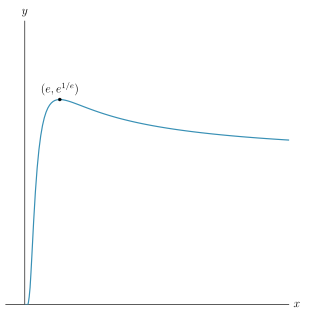
- Sketch a graph of \(y = x^{\frac{1}{x}}\) for \(x > 0\), showing the location of any turning points. Find the maximum value of \(n^{\frac{1}{n}}\), where \(n\) is a positive integer.
- The people to be tested are split into \(r\) groups of size \(k\), with \(k > 1\) and \(rk = N\).
- In every group, a sample from each person in that group is mixed into one large sample, which is then tested.
- If the enzyme is not present in the combined sample from a group, no further testing of the people in that group is needed.
- If the enzyme is present in the combined sample from a group, a second sample from each person in that group is tested separately.
- Find, in terms of \(N\), \(k\) and \(p\), the expected number of tests.
- Given that \(N\) is a multiple of \(3\), find the largest value of \(p\) for which it is possible to find an integer value of \(k\) such that \(k > 1\) and the expected number of tests is at most \(N\). Show that this value of \(p\) is greater than \(\frac{1}{4}\).
- Show that, if \(pk\) is sufficiently small, the expected number of tests is approximately \[ N\!\left(\frac{1}{k} + pk\right). \] In the case where \(p = 0.01\), show that choosing \(k = 10\) gives an expected number of tests which is only about \(20\%\) of \(N\).
Solution:
- \(\,\)
\begin{align*} && y & = x^{1/x} = \exp \left ( \tfrac1x \ln x \right ) \\ \Rightarrow && y' &= \exp \left ( \tfrac1x \ln x \right ) \cdot \left ( \frac{1}{x^2} - \frac{\ln x}{x^2} \right ) \\ &&&= \frac{\exp \left ( \tfrac1x \ln x \right ) }{x^2}(1 - \ln x) \\ y' =0: && x &= e \end{align*} Therefore the largest integer values will be \(2\) or \(3\). Comparing \((2^{\frac12})^6 = 8 < 9 = (3^{1/3})^6\) we see the maximum value of \(n^{1/n}\) where \(n\) is an integer is \(\sqrt[3]{3}\)
- The number of tests is \(r\) plus however many groups fail times \(k\). The probability of a group failing is \(g = 1-(1-p)^k\) and the number of failing groups is \(\sim B(r, g)\) so the expected number of additional groups is \(rg\) and the expected total number of tests is \[ \frac{N}{k} + N(1-(1-p)^k) \]
- \(\,\) \begin{align*} && N &\geq E = \frac{N}{k} + N(1-(1-p)^k) \\ \Rightarrow && 1 &\geq \frac{1}{k} + 1-(1-p)^k \\ \Rightarrow && (1-p)^k &\geq \frac1k \\ \Rightarrow && k \ln(1-p) &\geq - \ln k \\ \Rightarrow && \ln(1 - p) &\geq -\frac{1}{k} \ln k \geq -\frac13 \ln 3 \\ \Rightarrow && 1-p &\geq \frac{1}{\sqrt[3]{3}} \\ \Rightarrow && p &\leq 1-\frac{1}{\sqrt[3]{3}} \end{align*} (taking \(k=3\)) Claim: \(1 - \frac{1}{\sqrt[3]{3}} > \frac14\) Proof: This is equivalent to \(\sqrt[3]{3} > \frac43\) or \(81 > 4^3 = 64\) which is clearly true.
- If \(pk\) is small then \((1-p)^k \approx 1 - pk\) and so we obtain \(N \left ( \frac1k +pk \right)\) as required. If \(p = 0.01\) and \(k = 10\) then \(\frac{1}{10} + 0.01 \cdot 10 = 0.2\) so the expected number of tests is \(\sim 20\%\) of \(N\)
2024 Paper 3 Q11
In this question, you may use without proof the results \[\sum_{r=0}^{n} \binom{n}{r} = 2^n \quad \text{and} \quad \sum_{r=0}^{n} r\binom{n}{r} = n\,2^{n-1}.\]
- Show that \[r\binom{2n}{r} = (2n+1-r)\binom{2n}{2n+1-r}\] for \(1 \leqslant r \leqslant 2n\). Hence show that \[\sum_{r=0}^{2n} r\binom{2n}{r} = 2\sum_{r=n+1}^{2n} r\binom{2n}{r}.\]
- A fair coin is tossed \(2n\) times. The value of the random variable \(X\) is whichever is the larger of the number of heads and the number of tails shown. If \(n\) heads and \(n\) tails are shown, then \(X = n\). Show that \[\mathrm{E}(X) = n\left(1 + \frac{1}{2^{2n}}\binom{2n}{n}\right).\]
- Show that \(\dfrac{1}{2^{2n}}\dbinom{2n}{n}\) decreases as \(n\) increases.
- In a game, you choose a value of \(n\) and pay \(\pounds n\); then a fair coin is tossed \(2n\) times. You win an amount in pounds equal to the larger of the number of heads and the number of tails shown. If \(n\) heads and \(n\) tails are shown, then you win \(\pounds n\). How should you choose \(n\) to maximise your expected winnings per pound paid?
2023 Paper 2 Q11
- \(X_1\) and \(X_2\) are both random variables which take values \(x_1, x_2, \ldots, x_n\), with probabilities \(a_1, a_2, \ldots, a_n\) and \(b_1, b_2, \ldots, b_n\) respectively. The value of random variable \(Y\) is defined to be that of \(X_1\) with probability \(p\) and that of \(X_2\) with probability \(q = 1-p\). If \(X_1\) has mean \(\mu_1\) and variance \(\sigma_1^2\), and \(X_2\) has mean \(\mu_2\) and variance \(\sigma_2^2\), find the mean of \(Y\) and show that the variance of \(Y\) is \(p\sigma_1^2 + q\sigma_2^2 + pq(\mu_1 - \mu_2)^2\).
- To find the value of random variable \(B\), a fair coin is tossed and a fair six-sided die is rolled. If the coin shows heads, then \(B = 1\) if the die shows a six and \(B = 0\) otherwise; if the coin shows tails, then \(B = 1\) if the die does not show a six and \(B = 0\) if it does. The value of \(Z_1\) is the sum of \(n\) independent values of \(B\), where \(n\) is large. Show that \(Z_1\) is a Binomial random variable with probability of success \(\frac{1}{2}\). Using a Normal approximation, show that the probability that \(Z_1\) is within \(10\%\) of its mean tends to \(1\) as \(n \longrightarrow \infty\).
- To find the value of random variable \(Z_2\), a fair coin is tossed and \(n\) fair six-sided dice are rolled, where \(n\) is large. If the coin shows heads, then the value of \(Z_2\) is the number of dice showing a six; if the coin shows tails, then the value of \(Z_2\) is the number of dice not showing a six. Use part (i) to write down the mean and variance of \(Z_2\). Explain why a Normal distribution with this mean and variance will not be a good approximation to the distribution of \(Z_2\). Show that the probability that \(Z_2\) is within \(10\%\) of its mean tends to \(0\) as \(n \longrightarrow \infty\).
2022 Paper 2 Q11
A batch of \(N\) USB sticks is to be used on a network. Each stick has the same unknown probability \(p\) of being infected with a virus. Each stick is infected, or not, independently of the others. The network manager decides on an integer value of \(T\) with \(0 \leqslant T < N\). If \(T = 0\) no testing takes place and the \(N\) sticks are used on the network, but if \(T > 0\), the batch is subject to the following procedure.
- Each of \(T\) sticks, chosen at random from the batch, undergoes a test during which it is destroyed.
- If any of these \(T\) sticks is infected, all the remaining \(N - T\) sticks are destroyed.
- If none of the \(T\) sticks is infected, the remaining \(N - T\) sticks are used on the network.
- Find an expression in terms of \(N\), \(T\), \(D\) and \(q\), where \(q = 1 - p\), for the expected net loss.
- Let \(\alpha = \dfrac{DT}{N(N - T + D)}\). Show that \(0 \leqslant \alpha < 1\). Show that, for fixed values of \(N\), \(D\) and \(T\), the greatest value of the expected net loss occurs when \(q\) satisfies the equation \(q^{N-T} = \alpha\). Show further that this greatest value is \(\pounds\dfrac{D(N-T)\,\alpha^k}{N}\), where \(k = \dfrac{T}{N-T}\).
- For fixed values of \(N\) and \(D\), show that there is some \(\beta > 0\) so that for all \(p < \beta\), the expression for the expected loss found in part (i) is an increasing function of \(T\). Deduce that, for small enough values of \(p\), testing no sticks minimises the expected net loss.
2022 Paper 3 Q11
A fair coin is tossed \(N\) times and the random variable \(X\) records the number of heads. The mean deviation, \(\delta\), of \(X\) is defined by \[ \delta = \mathrm{E}\big(|X - \mu|\big) \] where \(\mu\) is the mean of \(X\).
- Let \(N = 2n\) where \(n\) is a positive integer.
- Show that \(\mathrm{P}(X \leqslant n-1) = \frac{1}{2}\big(1 - \mathrm{P}(X=n)\big)\).
- Show that \[ \delta = \sum_{r=0}^{n-1}(n-r)\binom{2n}{r}\frac{1}{2^{2n-1}}\,. \]
- Show that for \(r > 0\), \[ r\binom{2n}{r} = 2n\binom{2n-1}{r-1}\,. \] Hence show that \[ \delta = \frac{n}{2^{2n}}\binom{2n}{n}\,. \]
- Find a similar expression for \(\delta\) in the case \(N = 2n+1\).
Solution:
- When \(N = 2n+1\), \(\mu = n +\frac12\) and so \begin{align*} && \delta &= \E[|X-\mu|] \\ &&&= \sum_{i=0}^n (n + \tfrac12 - i) \frac{1}{2^{2n+1}} \binom{2n+1}{i} + \sum_{i=n+1}^{2n+1} (i-n - \tfrac12) \frac{1}{2^{2n+1}} \binom{2n+1}{i} \\ &&&= 2\sum_{i=0}^n (n + \tfrac12 - i) \frac{1}{2^{2n+1}} \binom{2n+1}{i} \\ &&&= \frac{(2n +1)}{2^{2n+1}}\sum_{i=0}^n \binom{2n+1}i - \frac{2}{2^{2n+1}}\sum_{i=0}^n i \binom{2n+1}{i} \\ &&&= \frac{(2n +1)}{2^{2n+1}}\sum_{i=0}^n \binom{2n+1}i - \frac{2}{2^{2n+1}}\sum_{i=1}^n (2n+1) \binom{2n}{i-1} \\ &&&= \frac{(2n +1)}{2^{2n+1}}2^{2n} - \frac{2(2n+1)}{2^{2n+1}}\sum_{i=0}^{n-1} \binom{2n}{i} \\ &&&= \frac{(2n +1)}{2} - \frac{2(2n+1)}{2^{2n+1}} \frac12\left (2^{2n} - \binom{2n}{n} \right) \\ &&&= \frac{2n+1}{2^{2n+1}}\binom{2n}{n} \end{align*}
2018 Paper 1 Q12
A multiple-choice test consists of five questions. For each question, \(n\) answers are given (\(n\ge2\)) only one of which is correct and candidates either attempt the question by choosing one of the \(n\) given answers or do not attempt it. For each question attempted, candidates receive two marks for the correct answer and lose one mark for an incorrect answer. No marks are gained or lost for questions that are not attempted. The pass mark is five. Candidates A, B and C don't understand any of the questions so, for any question which they attempt, they each choose one of the \(n\) given answers at random, independently of their choices for any other question.
- Candidate A chooses in advance to attempt exactly \(k\) of the five questions, where \(k=0, 1, 2, 3, 4\) or \(5\). Show that, in order to have the greatest probability of passing the test, she should choose \(k=4\,\).
- Candidate B chooses at random the number of questions he will attempt, the six possibilities being equally likely. Given that Candidate B passed the test find, in terms of \(n\), the probability that he attempted exactly four questions. [Not on original test: Show that this probability is an increasing function of \(n\).]
- For each of the five questions Candidate C decides whether to attempt the question by tossing a biased coin. The coin has a probability of \(\frac n{n+1}\) of showing a head, and she attempts the question if it shows a head. Find the probability, in terms of \(n\), that Candidate C passes the test.
Solution:
- Her probability of passing if she answers \(k \leq 2\) is \(0\), since she can attain at most \(4\) marks. If she attempts \(3\) questions, she needs to get all of them right, hence \(\mathbb{P}(\text{gets all }3\text{ correct}) = \frac{1}{n^3}\). If she attempts \(4\) questions, we can afford to get one wrong \begin{align*} && \mathbb{P}(\text{passes}|\text{attempts }4) &=\mathbb{P}(4/4) +\mathbb{P}(3/4) \\ &&&= \frac{1}{n^4} + 4\cdot\frac{1}{n^3} \cdot \frac{n-1}{n} \\ &&&= \frac{4n-3}{n^4} \end{align*} If she attempts \(5\) questions she can get \(5\) right (10), \(4\) right, \(1\) wrong (7), but \(3\) right will not work (\(6 - 2 = 4< 5\)), hence: \begin{align*} && \mathbb{P}(\text{passes}|\text{attempts }5) &=\mathbb{P}(5/5) +\mathbb{P}(4/5) \\ &&&= \frac{1}{n^5} + 5\cdot\frac{1}{n^4} \cdot \frac{n-1}{n} \\ &&&= \frac{5n-4}{n^5} \end{align*} If \(4n-3 > n \Leftrightarrow n \geq 2\) then \(4\) attempts is better than \(3\). If \(4n^2-3n > 5n-4 \Leftrightarrow 4n^2-8n+4 = 4(n-1)^2 > 0 \Leftrightarrow n \geq\) then \(4\) is better than \(5\), but \(n\) is \(\geq 2\) so, \(4\) is the best option.
- \(\,\) \begin{align*} && \mathbb{P}(\text{passes}) &= \frac16 \cdot 0 + \frac16 \cdot 0 + \frac16 \cdot 0 + \frac16 \cdot \frac1{n^3} + \frac16 \frac{4n-3}{n^4} + \frac16 \frac{5n-4}{n^5} \\ &&&= \frac{n^2+4n^2-3n+5n-4}{6n^5} \\ &&&= \frac{5n^2+2n-4}{6n^5} \\ && \mathbb{P}(\text{answered }4|\text{passes}) &= \frac{\mathbb{P}(\text{answered }4\text{ and passes})}{ \mathbb{P}(\text{passes})} \\ &&&= \frac{\frac16 \cdot \frac{4n-3}{n^4}}{\frac{5n^2-2n-4}{6n^5} } \\ &&&= \frac{4n^2-3n}{5n^2+2n-4} \end{align*} Notice that the function takes all values for \(n\) between the roots of the denominator (which are either side of \(0\) and below \(3/4\). Therefore after \(3/4\) the function must be increase since otherwise we would have a quadratic equation with more than \(2\) roots.
- \(\,\) \begin{align*} &&\mathbb{P}(C \text{ passes}) &= \binom{5}{3} \left ( \frac{n}{n+1} \right)^3 \left ( \frac{1}{n+1}\right)^2 \frac{1}{n^3} + \binom{5}{4} \left ( \frac{n}{n+1} \right)^4 \left ( \frac{1}{n+1}\right) \frac{4n-3}{n^4} +\\ &&&\quad \quad + \binom{5}{5} \left ( \frac{n}{n+1} \right)^5 \frac{5n-4}{n^5} \\ &&&= \frac{10}{(n+1)^5} + \frac{5(4n-3)}{(n+1)^5} + \frac{(5n-4)}{(n+1)^5} \\ &&&= \frac{10+20n-15+5n-4}{(n+1)^5}\\ &&&= \frac{25n-9}{(n+1)^5}\\ \end{align*}
2017 Paper 1 Q12
In a lottery, each of the \(N\) participants pays \(\pounds c\) to the organiser and picks a number from \(1\) to \(N\). The organiser picks at random the winning number from \(1\) to \(N\) and all those participants who picked this number receive an equal share of the prize, \(\pounds J\).
- The participants pick their numbers independently and with equal probability. Obtain an expression for the probability that no participant picks the winning number, and hence determine the organiser's expected profit. Use the approximation \[ \left( 1 - \frac{a}{N} \right)^N \approx \e^{-a} \tag{\(*\)} \] to show that if \(2Nc = J\) then the organiser will expect to make a loss. Note: \(\e > 2\).
- Instead of the numbers being equally popular, a fraction \(\gamma\) of the numbers are popular and the rest are unpopular. For each participant, the probability of picking any given popular number is \(\dfrac{a}{N}\) and the probability of picking any given unpopular number is \(\dfrac{b}{N}\,\). Find a relationship between \(a\), \(b\) and \(\gamma\). Show that, using the approximation \((*)\), the organiser's expected profit can be expressed in the form \[ A\e^{-a} + B\e^{-b} +C \,, \] where \(A\), \(B\) and \(C\) can be written in terms of \(J\), \(c\), \(N\) and \(\gamma\). In the case \(\gamma = \frac18\) and \(a=9b\), find \(a\) and \(b\). Show that, if \(2Nc = J\), then the organiser will expect to make a profit. Note: \(\e < 3\).
Solution:
- The probability no-one picks the winning number is \(\left ( 1 - \frac{1}{N}\right)^N \approx \frac1e\). \begin{align*} && \mathbb{E}(\text{profit}) &= Nc - (1-e^{-1})J \\ &&& < Nc -(1- \tfrac12 )J \\ &&& < Nc - \frac12 J \\ &&&= \frac{2Nc-J}{2} \end{align*} Therefore if \(J = 2Nc\) the expected profit is negative.
- \(\,\) \begin{align*} && 1 &= \sum_{\text{all numbers}} \mathbb{P}(\text{pick }i) \\ &&&= \sum_{\text{popular numbers}} \mathbb{P}(\text{pick }i)+\sum_{\text{unpopular numbers}} \mathbb{P}(\text{pick }i) \\ &&&=\gamma N \frac{a}{N} + (1-\gamma)N \frac{b}{N} \\ &&&= \gamma a + (1-\gamma)b \end{align*} \begin{align*} && \mathbb{P}(\text{no-one picks winning number}) &= \mathbb{P}(\text{no-one picks winning number} | \text{winning number is popular})\mathbb{P})(\text{winning number is popular}) + \\ &&&\quad + \mathbb{P}(\text{no-one picks} | \text{unpopular})\mathbb{P}(\text{unpopular}) \\ &&&= \left (1 - \frac{a}{N} \right)^N \gamma + \left (1 - \frac{b}{N} \right)^N (1-\gamma) \\ &&&\approx \gamma e^{-a} + (1-\gamma)e^{-b} \\ \\ && \mathbb{E}(\text{profit}) &= Nc - (1-\gamma e^{-a} - (1-\gamma)e^{-b})J \\ &&&= Nc-J+J\gamma e^{-a} +J(1-\gamma)e^{-b} \end{align*} If \(\gamma = \frac18\) and \(a=9b\), then \(1=\frac18 a + \frac78b = 2b \Rightarrow b = \frac12, a = \frac92\) and \begin{align*} && \mathbb{E}(\text{profit}) &= Nc-J +J\tfrac18e^{-9/2}+J\tfrac78e^{-1/2} \\ &&&= Nc-J+\tfrac18Je^{-1/2}(e^{-4}+7) \end{align*} If we can show \(e^{-1/2}\frac{e^{-4}+7}{8} > \frac12\) we'd be done, so \begin{align*} && e^{-1/2}\frac{e^{-4}+7}{8} &> \frac12 \\ \Leftrightarrow && e^{-4}+7 &>4e^{1/2} \\ \Leftrightarrow && 49+14e^{-4}+e^{-8} &>16e \\ \end{align*} But clearly the LHS \(>49\) and the RHS \(<48\) so we're done
2017 Paper 2 Q12
Adam and Eve are catching fish. The number of fish, \(X\), that Adam catches in any time interval is Poisson distributed with parameter \(\lambda t\), where \(\lambda\) is a constant and \(t\) is the length of the time interval. The number of fish, \(Y\), that Eve catches in any time interval is Poisson distributed with parameter \(\mu t\), where \(\mu\) is a constant and \(t\) is the length of the time interval The two Poisson variables are independent. You may assume that the expected time between Adam catching a fish and Adam catching his next fish is \(\lambda^{-1}\), and similarly for Eve.
- By considering \(\P( X + Y = r)\), show that the total number of fish caught by Adam and Eve in time \(T\) also has a Poisson distribution.
- Given that Adam and Eve catch a total of \(k\) fish in time \(T\), where \(k\) is fixed, show that the number caught by Adam has a binomial distribution.
- Given that Adam and Eve start fishing at the same time, find the probability that the first fish is caught by Adam.
- Find the expected time from the moment Adam and Eve start fishing until they have each caught at least one fish.
Solution:
- \(\,\) \begin{align*} && \mathbb{P}(X+Y=r) &= \sum_{k=0}^r \mathbb{P}(X = k, Y = r-k) \\ &&&= \sum_{k=0}^r \mathbb{P}(X = k)\mathbb{P}( Y = r-k) \\ &&&= \sum_{k=0}^r \frac{e^{-\lambda T} (\lambda T)^k}{k!}\frac{e^{-\mu T} (\mu T)^{r-k}}{(r-k)!}\\ &&&= \frac{e^{-(\mu+\lambda)T}}{r!}\sum_{k=0}^r \binom{r}{k}(\lambda T)^k (\mu T)^{r-k}\\ &&&= \frac{e^{-(\mu+\lambda)T}((\mu+\lambda)T)^r}{r!} \end{align*} Therefore \(X+Y \sim Po \left ( (\mu+\lambda)T \right)\)
- \(\,\) \begin{align*} && \mathbb{P}(X = r | X+Y = k) &= \frac{\mathbb{P}(X=r, Y = k-r)}{\mathbb{P}(X+Y=k)} \\ &&&= \frac{\frac{e^{-\lambda T} (\lambda T)^r}{r!}\frac{e^{-\mu T} (\mu T)^{k-r}}{(k-r)!}}{\frac{e^{-(\mu+\lambda)T}((\mu+\lambda)T)^k}{k!}} \\ &&&= \binom{k}{r} \left ( \frac{\lambda}{\lambda + \mu} \right)^r \left ( \frac{\mu}{\lambda + \mu} \right)^{k-r} \end{align*} Therefore \(X|X+Y=k \sim B(k, \frac{\lambda}{\lambda + \mu})\)
- \(P(X=1|X+Y = 1) = \frac{\lambda}{\lambda + \mu}\)
- Let \(X_1, Y_1\) be the time to the first fish are caught by Adam and Eve, then \begin{align*} && \mathbb{P}(X_1, Y_1 > t) &= \mathbb{P}(X_1> t) \mathbb{P}( Y_1 > t) \\ &&&= e^{-\lambda t}e^{-\mu t} \\ &&&= e^{-(\lambda+\mu)t} \\ \Rightarrow && f_{\max(X_1,Y_1)}(t) &= (\lambda+\mu)e^{-(\lambda+\mu)} \end{align*} Therefore the expected time is \(\frac1{\mu+\lambda}\)
2016 Paper 1 Q12
- Alice tosses a fair coin twice and Bob tosses a fair coin three times. Calculate the probability that Bob gets more heads than Alice.
- Alice tosses a fair coin three times and Bob tosses a fair coin four times. Calculate the probability that Bob gets more heads than Alice.
- Let \(p_1\) be the probability that Bob gets the same number of heads as Alice, and let~\(p_2\) be the probability that Bob gets more heads than Alice, when Alice and Bob each toss a fair coin \(n\) times. Alice tosses a fair coin \(n\) times and Bob tosses a fair coin \(n+1\) times. Express the probability that Bob gets more heads than Alice in terms of \(p_1\) and \(p_2\), and hence obtain a generalisation of the results of parts (i) and (ii).
Solution:
- There are several possibilities \begin{array}{c|c|c} \text{Alice} & \text{Bob} & P \\ \hline 0 & 1 & \frac1{2^2} \cdot 3 \cdot \frac{1}{2^3} = \frac{3}{2^5} \\ 0 & 2 & \frac1{2^2} \cdot 3 \cdot \frac{1}{2^3} = \frac{3}{2^5} \\ 0 & 3 & \frac1{2^2} \cdot \frac{1}{2^3} = \frac{1}{2^5} \\ 1 & 2 & 2 \cdot \frac1{2^2} \cdot 3 \cdot \frac{1}{2^3} = \frac{6}{2^5} \\ 1 & 3 & 2\cdot \frac1{2^2} \cdot \frac{1}{2^3} = \frac{2}{2^5} \\ 2 & 3 & \frac1{2^2} \cdot \frac{1}{2^3} = \frac{1}{2^5} \\ \hline && \frac{1}{2^5}(3+3+1+6+2+1) = \frac{16}{2^5} = \frac12 \end{array}
- There are several possibilities \begin{array}{c|c|c} A & B & \text{count} \\ \hline 0 & 1 & 4 \\ 0 & 2 & 6 \\ 0 & 3 & 4 \\ 0 & 4 & 1 \\ 1 & 2 & 3\cdot6 \\ 1 & 3 & 3\cdot4 \\ 1 & 4 & 3 \\ 2 & 3 & 3\cdot4 \\ 2 & 4 & 3 \\ 3 & 4 & 1 \\ \hline && 64 \end{array} Therefore the total probability is \(\frac12\)
- \(\mathbb{P}(\text{Bob more than Alice}) = p_1 \cdot \underbrace{\frac12}_{\text{he wins by breaking the tie on his last flip}} + p_2\) If \(p_3\) is the probability that Alice gets more heads than Bob, then by symmetry \(p_3 = p_2\) and \(p_1 + p_2 + p_3 = 1\). Therefore \(p_1 + 2p_2 = 1\). ie \(\frac12 p_1 + p_2 = \frac12\) therefore the answer is always \(\frac12\) for all values of \(n\).
2016 Paper 2 Q13
- The random variable \(X\) has a binomial distribution with parameters \(n\) and \(p\), where \(n=16\) and \(p=\frac12\). Show, using an approximation in terms of the standard normal density function $\displaystyle \tfrac{1}{\sqrt{2\pi}} \, \e ^{-\frac12 x^2} $, that \[ \P(X=8) \approx \frac 1{2\sqrt{2\pi}} \,. \]
- By considering a binomial distribution with parameters \(2n\) and \(\frac12\), show that \[ (2n)! \approx \frac {2^{2n} (n!)^2}{\sqrt{n\pi}} \,. \]
- By considering a Poisson distribution with parameter \(n\), show that \[ n! \approx \sqrt{2\pi n\, } \, \e^{-n} \, n^n \,. \]
Solution:
- \(X \sim B(16, \tfrac12)\), then \(X \approx N(8, 2^2)\), in particular \begin{align*} && \mathbb{P}(X = 8) &\approx \mathbb{P} \left ( 8 - \frac12 \leq 2Z + 8 \leq 8 + \frac12 \right) \\ &&&= \mathbb{P} \left (-\frac14 \leq Z \leq \frac14 \right) \\ &&&= \int_{-\frac14}^{\frac14} \frac{1}{\sqrt{2 \pi}}e^{-\frac12 x^2} \d x \\ &&&\approx \frac{1}{\sqrt{2\pi}} \int_{-\frac14}^{\frac14} 1\d x\\ &&&= \frac{1}{2 \sqrt{2\pi}} \end{align*}
- Suppose \(X \sim B(2n, \frac12)\) then \(X \approx N(n, \frac{n}{2})\), and \begin{align*} && \mathbb{P}(X = n) &\approx \mathbb{P} \left ( n - \frac12 \leq \sqrt{\frac{n}{2}} Z + n \leq n + \frac12 \right) \\ &&&= \mathbb{P} \left ( - \frac1{\sqrt{2n}} \leq Z \leq \frac1{\sqrt{2n}}\right) \\ &&&= \int_{-\frac1{\sqrt{2n}}}^{\frac1{\sqrt{2n}}} \frac{1}{\sqrt{2 \pi}} e^{-\frac12 x^2} \d x \\ &&&\approx \frac{1}{\sqrt{n\pi}}\\ \Rightarrow && \binom{2n}{n}\frac1{2^n} \frac{1}{2^n} & \approx \frac{1}{\sqrt{n \pi}} \\ \Rightarrow && (2n)! &\approx \frac{2^{2n}(n!)^2}{\sqrt{n\pi}} \end{align*}
- \(X \sim Po(n)\), then \(X \approx N(n, (\sqrt{n})^2)\), therefore \begin{align*} && \mathbb{P}(X = n) &\approx \mathbb{P} \left (-\frac12 \leq \sqrt{n} Z \leq \frac12 \right) \\ &&&= \int_{-\frac{1}{2 \sqrt{n}}}^{\frac{1}{2 \sqrt{n}}} \frac{1}{\sqrt{2\pi}}e^{-\frac12 x^2} \d x \\ &&&\approx \frac{1}{\sqrt{2 \pi n}} \\ \Rightarrow && e^{-n} \frac{n^n}{n!} & \approx \frac{1}{\sqrt{2 \pi n}} \\ \Rightarrow && n! &\approx \sqrt{2 \pi n} e^{-n}n^n \end{align*}
2016 Paper 3 Q12
Let \(X\) be a random variable with mean \(\mu\) and standard deviation \(\sigma\). Chebyshev's inequality, which you may use without proof, is \[ \P\left(\vert X-\mu\vert > k\sigma\right) \le \frac 1 {k^2} \,, \] where \(k\) is any positive number.
- The probability of a biased coin landing heads up is \(0.2\). It is thrown \(100n\) times, where \(n\) is an integer greater than 1. Let \(\alpha \) be the probability that the coin lands heads up \(N\) times, where \(16n \le N \le 24n\). Use Chebyshev's inequality to show that \[ \alpha \ge 1-\frac 1n \,. \]
- Use Chebyshev's inequality to show that \[ 1+ n + \frac{n^2}{ 2!} + \cdots + \frac {n^{2n}}{(2n)!} \ge \left(1-\frac1n\right) \e^n \,. \]
Solution:
- Let \(N\) be the number of times the coin lands heads up, ie \(N \sim Binomial(100n, 0.2)\), then \(\mathbb{E}(N) = \mu = 20n, \mathrm{Var}(N) = \sigma^2 = 100n \cdot 0.2 \cdot 0.8 = 16n \Rightarrow \sigma = 4\sqrt{n}\). \begin{align*} && \mathbb{P}(|X - \mu| > k\sigma) &\leq \frac{1}{k^2} \\ \Rightarrow && 1 - \mathbb{P}(|X - \mu| \leq k\sigma) &\leq \frac1{k^2} \\ \Rightarrow && 1 - \mathbb{P}(|X - 20n| \leq \sqrt{n} \cdot 4\sqrt{n}) &\leq \frac1{{\sqrt{n}}^2} \\ \Rightarrow && 1 - \mathbb{P}(16n \leq N \leq 24n) &\leq \frac{1}{n} \\ \Rightarrow && 1 - \frac1n &\leq \alpha \end{align*}
- Suppose \(X \sim Pois(n)\), then \(\mathbb{E}(X) = n, \mathrm{Var}(X) = n\). Therefore \begin{align*} && \mathbb{P}(|X - \mu| > k\sigma) &\leq \frac{1}{k^2} \\ \Rightarrow && 1-\mathbb{P}(|X - n| \leq \sqrt{n} \cdot \sqrt{n}) &> \frac{1}{\sqrt{n}^2} \\ \Rightarrow && 1 - \sum_{i=0}^{2n} \mathbb{P}(X = i) & \leq \frac{1}{n} \\ \Rightarrow && \sum_{i=0}^{2n} e^{-n} \frac{n^i}{i!} \geq 1 - \frac{1}{n} \\ \Rightarrow && \sum_{i=0}^{2n} \frac{n^i}{i!} \geq \left ( 1 - \frac1n \right)e^n \end{align*}
2015 Paper 1 Q12
The number \(X\) of casualties arriving at a hospital each day follows a Poisson distribution with mean 8; that is, \[ \P(X=n) = \frac{ \e^{-8}8^n}{n!}\,, \ \ \ \ n=0, \ 1, \ 2, \ \ldots \ . \] Casualties require surgery with probability \(\frac14\). The number of casualties arriving on any given day is independent of the number arriving on any other day and the casualties require surgery independently of one another.
- What is the probability that, on a day when exactly \(n\) casualties arrive, exactly \(r\) of them require surgery?
- Prove (algebraically) that the number requiring surgery each day also follows a Poisson distribution, and state its mean.
- Given that in a particular randomly chosen week a total of 12 casualties require surgery on Monday and Tuesday, what is the probability that 8 casualties require surgery on Monday? You should give your answer as a fraction in its lowest terms.
Solution:
- \(\mathbb{P}(r \text{ need surgery}|n \text{ casualties}) = \binom{n}{r} \left ( \frac14\right)^r \left ( \frac34\right)^{n-r}\)
- \(\,\) \begin{align*} && \mathbb{P}(r \text{ need surgery}) &= \sum_{n=r}^{\infty} \mathbb{P}(r \text{ need surgery} |n \text{ casualties}) \mathbb{P}(n \text{ casualties}) \\ &&&= \sum_{n=r}^{\infty} \binom{n}{r}\left ( \frac14\right)^r \left ( \frac34\right)^{n-r} \frac{e^{-8} 8^n}{n!} \\ &&&= \sum_{n=r}^{\infty} \frac{n!}{(n-r)!r!}\left ( \frac14\right)^r \left ( \frac34\right)^{n-r} \frac{e^{-8} 8^n}{n!} \\ &&&= \frac{e^{-8}8^r}{r!}\left ( \frac14\right)^r \sum_{n=r}^{\infty} \frac{8^{n-r}}{(n-r)} \left ( \frac34\right)^{n-r} \\ &&&= \frac{e^{-8}8^r}{r!}\left ( \frac14\right)^r \sum_{n=r}^{\infty} \frac{6^{n-r}}{(n-r)} \\ &&&= \frac{e^{-8}2^r}{r!} e^6 \\ &&&= \frac{e^{-2}2^r}{r!} \end{align*} Therefore the number requiring surgery is \(Po(2)\) with mean \(2\).
- \(\,\) \begin{align*} && \mathbb{P}(X_1 = 8| X_1 + X_2 =12) &= \frac{\mathbb{P}(X_1 = 8,X_2 =4)} {\mathbb{P}(X_1+X_2 = 12)}\\ &&&= \frac{\frac{e^{-2}2^8}{8!} \cdot \frac{e^{-2}2^4}{4!}}{\frac{e^{-4}4^{12}}{12!}} \\ &&&= \frac{12!}{8!4!} \frac{1}{2^{12}} \\ &&&= \binom{12}4 \left ( \frac12 \right)^4\left ( \frac12 \right)^8 \\ &&&= \frac{495}{4096} \end{align*}
2012 Paper 2 Q12
A modern villa has complicated lighting controls. In order for the light in the swimming pool to be on, a particular switch in the hallway must be on and a particular switch in the kitchen must be on. There are four identical switches in the hallway and four identical switches in the kitchen. Guests cannot tell whether the switches are on or off, or what they control. Each Monday morning a guest arrives, and the switches in the hallway are either all on or all off. The probability that they are all on is \(p\) and the probability that they are all off is \(1-p\). The switches in the kitchen are each on or off, independently, with probability \(\frac12\).
- On the first Monday, a guest presses one switch in the hallway at random and one switch in the kitchen at random. Find the probability that the swimming pool light is on at the end of this process. Show that the probability that the guest has pressed the swimming pool light switch in the hallway, given that the light is on at the end of the process, is \(\displaystyle \frac{1-p}{1+2p}\).
- On each of seven Mondays, guests go through the above process independently of each other, and each time the swimming pool light is found to be on at the end of the process. Given that the most likely number of days on which the swimming pool light switch in the hallway was pressed is 3, show that \(\frac14 < p < \frac{5}{14}\).
Solution:
- \(\,\) \begin{align*} && \mathbb{P}(\text{hall switch on}) &= \underbrace{p \cdot \frac34 }_{\text{already on and not flipped}}+ \underbrace{(1-p) \cdot \frac14}_{\text{not on and flipped}} \\ &&&= \frac14 +\frac12 p\\ && \mathbb{P}(\text{kitchen on}) &= \frac12 \\ \Rightarrow && \mathbb{P}(\text{pool is on}) &= \frac18 + \frac14p \end{align*} \begin{align*} && \mathbb{P}(\text{flipped hall switch} | \text{pool on}) &= \frac{\mathbb{P}(\text{flipped hall and pool on})}{\mathbb{P}(\text{pool on})} \\ &&&= \frac{(1-p)\frac14 \cdot \frac 12}{\frac18 + \frac14 p} \\ &&&= \frac{1-p}{1+2p} \end{align*}
- The number of days the swimming pool light was pressed is \(X = B\left (7, \frac{1-p}{1+2p} \right)\), and we have that \(\mathbb{P}(X = 2) < \mathbb{P}(X = 3) > \mathbb{P}(X=4)\) (since the binomial is unimodal). Let \(q = \frac{1-p}{1+2p} \) \begin{align*} && \mathbb{P}(X = 2) &< \mathbb{P}(X = 3) \\ \Rightarrow && \binom{7}{2} q^2(1-q)^5 &< \binom{7}{3}q^3(1-q)^4 \\ \Rightarrow && 21(1-q) &< 35q \\ \Rightarrow && 21 &< 56q \\ \Rightarrow && \frac{3}{8} &< \frac{1-p}{1+2p} \\ \Rightarrow && 3+6p &< 8-8p \\ \Rightarrow && 14p &< 5\\ \Rightarrow && p &< \frac5{14} \\ \\ && \mathbb{P}(X = 3) &> \mathbb{P}(X = 4) \\ \Rightarrow && \binom{7}{3} q^3(1-q)^4 &> \binom{7}{4}q^4(1-q)^3 \\ \Rightarrow &&(1-q)&> q \\ \Rightarrow && \frac12 &> q \\ \Rightarrow && \frac12 &> \frac{1-p}{1+2p} \\ \Rightarrow && 1+2p &> 2-2p \\ \Rightarrow && 4p &> 1\\ \Rightarrow && p &> \frac1{4} \end{align*} Therefore \(\frac14 < p < \frac{5}{14}\) as required.
2011 Paper 3 Q12
The random variable \(N\) takes positive integer values and has pgf (probability generating function) \(\G(t)\). The random variables \(X_i\), where \(i=1\), \(2\), \(3\), \(\ldots,\) are independently and identically distributed, each with pgf \({H}(t)\). The random variables \(X_i\) are also independent of \(N\). The random variable \(Y\) is defined by \[ Y= \sum_{i=1}^N X_i \;. \] Given that the pgf of \(Y\) is \(\G(H(t))\), show that \[ \E(Y) = \E(N)\E(X_i) \text{ and } \var(Y) = \var(N)\big(\E(X_i)\big)^2 + \E(N) \var(X_i) \,.\] A fair coin is tossed until a head occurs. The total number of tosses is \(N\). The coin is then tossed a further \(N\) times and the total number of heads in these \(N\) tosses is \(Y\). Find in this particular case the pgf of \(Y\), \(\E(Y)\), \(\var(Y)\) and \(\P(Y=r)\).
Solution: Recall that for a random variable \(Z\) with pgf \(F(t)\) we have \(F(1) = 1\), \(\E[Z] = F'(1)\) and \(\E[Z^2] = F''(1) +F'(1)\) so \begin{align*} && \E[Y] &= G'(H(1))H'(1) \\ &&&= G'(1)H'(1) \\ &&&= \E[N]\E[X_i] \\ \\ && \E[Y^2] &= G''(H(1))(H'(1))^2+G'(H(1))H''(1) + G'(H(1))H'(1) \\ &&&= G''(1)(H'(1))^2+G'(1)H''(1) + G'(1)H'(1) \\ &&&= (\E[N^2]-\E[N])(\E[X_i])^2 + \E[N](\E[X_i^2]-\E[X_i]) + \E[N]\E[X_i] \\ &&&= (\E[N^2]-\E[N])(\E[X_i])^2 + \E[N]\E[X_i^2] \\ && \var[Y] &= (\E[N^2]-\E[N])(\E[X_i])^2 + \E[N]\E[X_i^2] - (\E[N])^2(\E[X_i])^2\\ &&&= (\var[N]+(\E[N])^2-\E[N])(\E[X_i])^2 + \E[N](\var[X_i]+\E[X_i]^2) - (\E[N])^2(\E[X_i])^2\\ &&&= \var[N](\E[X_i])^2 + \E[N]\var[X_i] \end{align*} Notice that \(N \sim Geo(\tfrac12)\) and \(Y = \sum_{i=1}^N X_i\) where \(X_i\) are Bernoulli. We have that \(G(t) = \frac{\frac12}{1-\frac12z}\) and \(H(t) = \frac12+\frac12p\) so the pgf of \(Y\) is \(G(H(t) = \frac{\frac12}{1 - \frac14-\frac14p} = \frac{2}{3-p}\). \begin{align*} && \E[X_i] &= \frac12\\ && \var[X_i] &= \frac14 \\ && \E[N] &= 2 \\ && \var[N] &= 2 \\ \\ && \E[Y] &= 2 \cdot \frac12 = 1 \\ && \var[Y] &= 2 \cdot \frac14 + 2 \frac14 = 1 \\ && \mathbb{P}(Y=r) &= \tfrac23 \left ( \tfrac13 \right)^r \end{align*}
2011 Paper 3 Q13
In this question, the notation \(\lfloor x \rfloor\) denotes the greatest integer less than or equal to \(x\), so for example \(\lfloor \pi\rfloor = 3\) and \(\lfloor 3 \rfloor =3\).
- A bag contains \(n\) balls, of which \(b\) are black. A sample of \(k\) balls is drawn, one after another, at random with replacement. The random variable \(X\) denotes the number of black balls in the sample. By considering \[ \frac{\P(X=r+1)}{\P(X=r)}\,, \] show that, in the case that it is unique, the most probable number of black balls in the sample is \[ \left\lfloor \frac{(k+1)b}{n}\right\rfloor. \] Under what circumstances is the answer not unique?
- A bag contains \(n\) balls, of which \(b\) are black. A sample of \(k\) balls (where \(k\le b\)) is drawn, one after another, at random without replacement. Find, in the case that it is unique, the most probable number of black balls in the sample. Under what circumstances is the answer not unique?
Solution:
- \(\mathbb{P}(X = r) = \binom{k}{r}p^rq^{k-r}\) where \(p = \frac{b}{n}, q = 1-p\). Therefore \begin{align*} && \frac{\mathbb{P}(X=r+1)}{\mathbb{P}(X=r)} &= \frac{\binom{k}{r+1}p^{r+1}q^{k-r-1}}{\binom{k}{r}p^rq^{k-r}} \\ &&&= \frac{(k-r)p}{(r+1)q} \\ &&&= \frac{(k-r)b}{(r+1)(n-b)} \end{align*} Comparing this to \(1\) we find: \begin{align*} && 1 & < \frac{\mathbb{P}(X=r+1)}{\mathbb{P}(X=r)} \\ \Leftrightarrow && 1 &< \frac{(k-r)b}{(r+1)(n-b)} \\ \Leftrightarrow && (r+1)(n-b) &<(k-r)b \\ \Leftrightarrow && rn& < (k+1)b - n \\ \Leftrightarrow && r &< \frac{(k+1)b}{n} - 1\\ \end{align*} If this equation is true, then \(\mathbb{P}(X=r+1)\) is larger, so \(r_{max} = \left \lfloor \frac{(k+1)b}{n} \right \rfloor\)
- Let \(Y\) be the number of black balls in our sample, ie \(\mathbb{P}(Y = r) = \binom{b}{r}\binom{n-b}{k-r}/\binom{n}{k}\), so \begin{align*} && \frac{\mathbb{P}(Y = r+1)}{\mathbb{P}(Y=r)} &= \frac{\binom{b}{r+1}\binom{n-b}{k-(r+1)}/\binom{n}{k}}{\binom{b}{r}\binom{n-b}{k-r}/\binom{n}{k}} \\ &&&= \frac{b-r}{r+1} \frac{k-r}{n-b-k+r+1} \\ && 1 &< \frac{\mathbb{P}(Y = r+1)}{\mathbb{P}(Y=r)} \\ \Leftrightarrow && (r+1)(n-b-k+r+1) &< (b-r)(k-r) \\ \Leftrightarrow &&r(n-b-k+1)+(n-b-k+1) &< -r(b+k)+bk \\ \Leftrightarrow &&r(n+1) &< bk+b+k+1-n \\ \Leftrightarrow && r &< \frac{(b+1)(k+1)}{n+1} - \frac{n}{n+1} \end{align*} Therefore \(r = \left \lfloor \frac{ (b+1)(k+1)}{n+1}\right \rfloor\), it is not unique if \(n+1\) divides \((b+1)(k+1)\)