Problems
Filters
1 problem found
2008 Paper 2 Q10
The lengths of the sides of a rectangular billiards table \(ABCD\) are given by \(AB = DC = a\) and \(AD=BC = 2b\). There are small pockets at the midpoints \(M\) and \(N\) of the sides \(AD\) and \(BC\), respectively. The sides of the table may be taken as smooth vertical walls. A small ball is projected along the table from the corner \(A\). It strikes the side \(BC\) at \(X\), then the side \(DC\) at \(Y\) and then goes directly into the pocket at \(M\). The angles \(BAX\), \(CXY\) and \(DY\!M\) are \(\alpha\), \(\beta\) and \(\gamma\) respectively. On each stage of its path, the ball moves with constant speed in a straight line, the speeds being \(u\), \(v\) and \(w\) respectively. The coefficient of restitution between the ball and the sides is \(e\), where \(e>0\).
- Show that \(\tan\alpha \tan \beta = e\) and find \(\gamma\) in terms of \(\alpha\).
- Show that \(\displaystyle \tan\alpha = \frac {(1+2e)b} {(1+e)a}\) and deduce that the shot is possible whatever the value of \(e\).
- Find an expression in terms of \(e\) for the fraction of the kinetic energy of the ball that is lost during the motion.
Solution:
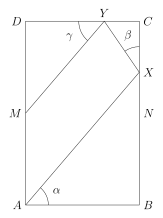
- The initial velocity is \(u = \binom{u \cos\alpha}{u \sin \alpha}\), therefore \(v = \binom{v_x}{u \sin \alpha}\). Newton's experimental law tells us \(v_x = -e u_x = -eu \cos\alpha\), therefore \(v = \binom{-eu \cos \alpha}{u \sin \alpha} = \binom{-v \sin \beta}{v\cos \beta} \Rightarrow -\tan \beta = -e \cot \alpha \Rightarrow \tan \alpha \tan \beta = e\). There is nothing special about the result here, and so it must also be the case that \(\tan \beta \tan \gamma = e \Rightarrow \tan \gamma = \tan \alpha\)
- \(\tan \alpha = \frac{XB}{BA}\) so the point \(X\) is at \((a, \tan \alpha a)\). The point \(Y\) satisfies \(\tan \beta = \frac{CY}{CX} = \frac{CY}{2b - \tan \alpha a}\) so the point \(Y\) is \((a-(2b - a \tan \alpha)\tan \beta,2b) = (a - 2b\tan \beta + ea, 2b) = ((1+e)a-2b\tan \beta, 2b)\). Finally, the point \(M\) is the midpoint, so \(\tan \gamma = \frac{DM}{DY}\) so \(M\) is the point \((0, 2b - ((1+e)a-2b\tan \beta)\tan \gamma) = (0, 2b - (1+e)a \tan \gamma - 2b e) = (0, (2b(1-e) - (1+e)a \tan \gamma)\), but \(M\) is the point \((0, b)\), ie \begin{align*} && b &= 2b(1-e) - (1+e)a \tan \gamma \\ \Rightarrow && b+2eb &= (1+e)a \tan \gamma \\ \Rightarrow && \tan \gamma &= \frac{(1+2e)b}{(1+e)a} \\ \Rightarrow && \tan \alpha &= \frac{(1+2e)b}{(1+e)a} \end{align*} Since \( \frac{(1+2e)b}{(1+e)a} = \frac{b}{a} + \frac{e}{1+e}b\) which is clearly an increasing function of \(e\) on \([0,1]\), so \(\tan \alpha \in \left [\frac{b}{a}, \frac{3b}{2a} \right]\) which are all all angles which place \(X\) in sensible places, therefore we can always hit the middle pocket. (Except \(e = 0\), where we would put the ball in \(N\), but we are given \(e > 0\)).
- After the first collision the velocity is \(\binom{-eu \cos \alpha}{u \sin \alpha}\) after the second collision the velocity is \(\binom{-eu \cos \alpha}{-eu \sin \alpha}\). Initial kinetic energy is therefore \(\frac12 m u^2\) and final kinetic energy is \(\frac12 m e^2u^2\) therefore the fraction lost is \(\frac{\frac12 m u^2 - \frac12 m e^2u^2}{\frac12 m u^2} = 1-e^2\)