Problems
Filters
2 problems found
2025 Paper 3 Q5
Three points, \(A\), \(B\) and \(C\), lie in a horizontal plane, but are not collinear. The point \(O\) lies above the plane. Let \(\overrightarrow{OA} = \mathbf{a}\), \(\overrightarrow{OB} = \mathbf{b}\) and \(\overrightarrow{OC} = \mathbf{c}\). \(P\) is a point with \(\overrightarrow{OP} = \alpha\mathbf{a} + \beta\mathbf{b} + \gamma\mathbf{c}\), where \(\alpha\), \(\beta\) and \(\gamma\) are all positive and \(\alpha + \beta + \gamma < 1\). Let \(k = 1 - (\alpha + \beta + \gamma)\).
- The point \(L\) is on \(OA\), the point \(X\) is on \(BC\) and \(LX\) passes through \(P\). Determine \(\overrightarrow{OX}\) in terms of \(\beta\), \(\gamma\), \(\mathbf{b}\) and \(\mathbf{c}\) and show that \(\overrightarrow{OL} = \frac{\alpha}{k+\alpha}\mathbf{a}\).
- Let \(M\) and \(Y\) be the unique pair of points on \(OB\) and \(CA\) respectively such that \(MY\) passes through \(P\), and let \(N\) and \(Z\) be the unique pair of points on \(OC\) and \(AB\) respectively such that \(NZ\) passes through \(P\). Show that the plane \(LMN\) is also horizontal if and only if \(OP\) intersects plane \(ABC\) at the point \(G\), where \(\overrightarrow{OG} = \frac{1}{3}(\mathbf{a} + \mathbf{b} + \mathbf{c})\). Where do points \(X\), \(Y\) and \(Z\) lie in this case?
- State what the condition \(\alpha + \beta + \gamma < 1\) tells you about the position of \(P\) relative to the tetrahedron \(OABC\).
1987 Paper 1 Q9
\(ABC\) is a triangle whose vertices have position vectors \(\mathbf{a,b,c}\)brespectively, relative to an origin in the plane \(ABC\). Show that an arbitrary point \(P\) on the segment \(AB\) has position vector \[ \rho\mathbf{a}+\sigma\mathbf{b}, \] where \(\rho\geqslant0\), \(\sigma\geqslant0\) and \(\rho+\sigma=1\). Give a similar expression for an arbitrary point on the segment \(PC\), and deduce that any point inside \(ABC\) has position vector \[ \lambda\mathbf{a}+\mu\mathbf{b}+\nu\mathbf{c}, \] where \(\lambda\geqslant0\), \(\mu\geqslant0\), \(\nu\geqslant0\) and \(\lambda+\mu+\nu=1\). Sketch the region of the plane in which the point \(\lambda\mathbf{a}+\mu\mathbf{b}+\nu\mathbf{c}\) lies in each of the following cases:
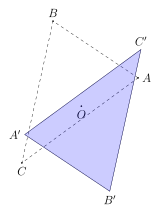
- \(\lambda+\mu+\nu=-1\), \(\lambda\leqslant0\), \(\mu\leqslant0\), \(\nu\leqslant0\);
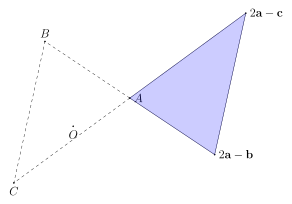
- \(\lambda+\mu+\nu=1\), \(\mu\leqslant0\), \(\nu\leqslant0\).
Solution:

- This is equivalent to the area inside the triangle where every point (\(\mathbf{a}, \mathbf{b}, \mathbf{c}\)) has been send to it's negative (\(-\mathbf{a}, -\mathbf{b}, -\mathbf{c}\)),
ie
- Writing points as:
\begin{align*}
\lambda\mathbf{a}+\mu\mathbf{b}+\nu\mathbf{c} &= (1-\mu - \nu)\mathbf{a}+\mu\mathbf{b}+\nu\mathbf{c} \\
&= \mathbf{a} + (-\mu)(\mathbf{a}-\mathbf{b}) + (-\nu)(\mathbf{a} - \mathbf{c}) \\
&= \mathbf{a} + (-\mu)(\mathbf{a}-\mathbf{b}) + (-\nu)(\mathbf{a} - \mathbf{c}) + (1+\mu+\nu)\mathbf{0}\\
\end{align*}
So this is a translation of \(\mathbf{a}\) of the triangle with vertices at \(\mathbf{0}, \mathbf{a-b}, \mathbf{a-c}\), or a triangle with vertices \(\mathbf{a}, 2\mathbf{a-b}, 2\mathbf{a-c}\).