Problems
Filters
7 problems found
2019 Paper 3 Q1
The coordinates of a particle at time \(t\) are \(x\) and \(y\). For \(t \geq 0\), they satisfy the pair of coupled differential equations \[ \begin{cases} \dot{x} &= -x -ky \\ \dot{y} &= x - y \end{cases}\] where \(k\) is a constant. When \(t = 0\), \(x = 1\) and \(y = 0\).
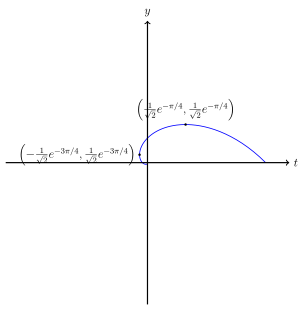
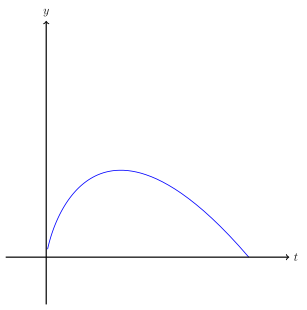
- Let \(k = 1\). Find \(x\) and \(y\) in terms of \(t\) and sketch \(y\) as a function of \(t\). Sketch the path of the particle in the \(x\)-\(y\) plane, giving the coordinates of the point at which \(y\) is greatest and the coordinates of the point at which \(x\) is least.
- Instead, let \(k = 0\). Find \(x\) and \(y\) in terms of \(t\) and sketch the path of the particle in the \(x\)-\(y\) plane.
Solution:
- Let \(k = 1\), then
\begin{align*}
\dot{x} &= - x - y \\
\dot{y} &= x - y \\
\dot{x}-\dot{y} &= -2x \\
\ddot{x} &= -\dot{x}-\dot{y} \\
&= -\dot{x} - (\dot{x}+2x) \\
&= -2\dot{x}- 2x \\
\dot{x}+\dot{y} &= -2y \\
\ddot{y} &= \dot{x}-\dot{y} \\
&= -2y-2\dot{y}
\end{align*}
So we have an auxiliary equation for \(x\) and \(y\) which is \(\lambda^2 + 2 \lambda+2 = 0 \Rightarrow \lambda = -1 \pm i\).
Therefore \(x = Ae^{-t} \cos t + B e^{-t} \sin t, y = Ce^{-t}\cos t + De^{-t} \sin t\). We also must have that, \(A = 1, C = 0\), so \(x = e^{-t} \cos t + Be^{-t} \sin t\) and \(y = De^{-t} \sin x\).
\begin{align*}
\dot{y} &= -De^{-t} \sin t +De^{-t} \cos t \\
&= e^{-t} \cos x + Be^{-t} \sin t- De^{-t} \sin t \\
\end{align*}
therefore \(B = 0, D = 1\) and \(x = e^{-t} \cos t, y = e^{-t} \sin t\)
\begin{align*} y &= e^{-t} \sin t \\ \dot{y} &= -e^{-t} \sin t + e^{-t} \cos t \\ \dot{x} &= e^{-t} \cos t -e^{-t} \sin t \end{align*}

- \begin{align*}
\dot{x} = -x \\
\dot{y} = x-y
\end{align*}
So \(x = e^{-t}\). \(\dot{y} + y = e^{-t}\) so \(y = (t+B)e^{-t}\) and so \(y =te^{-t}\).
2012 Paper 3 Q7
A pain-killing drug is injected into the bloodstream. It then diffuses into the brain, where it is absorbed. The quantities at time \(t\) of the drug in the blood and the brain respectively are \(y(t)\) and \(z(t)\). These satisfy \[ \dot y = - 2(y-z)\,, \ \ \ \ \ \ \ \dot z = - \dot y -3z\, , \] where the dot denotes differentiation with respect to \(t\). Obtain a second order differential equation for \(y\) and hence derive the solution \[ y= A\e^{-t} + B\e ^{-6t}\,, \ \ \ \ \ \ \ z= \tfrac12 A \e^{-t} - 2 B \e^{-6t}\,, \] where \(A\) and \(B\) are arbitrary constants. \begin{questionparts} \item Obtain the solution that satisfies \(z(0)=0\) and \(y(0)= 5\). The quantity of the drug in the brain for this solution is denoted by \(z_1(t)\). \item Obtain the solution that satisfies $ z(0)=z(1)= c$, where \(c\) is a given constant. %\[ %C=2(1-\e^{-1})^{-1} - 2(1-\e^{-6})^{-1}\,. %\] The quantity of the drug in the brain for this solution is denoted by \(z_2(t)\). \item Show that for \(0\le t \le 1\), \[ z_2(t) = \sum _{n=-\infty}^{0} z_1(t-n)\,, \] provided \(c\) takes a particular value that you should find. \end {questionparts}
2000 Paper 3 Q8
The sequence \(a_n\) is defined by \(a_0 = 1\) , \(a_1 = 1\) , and $$ a_n = {1 + a_{n - 1}^2 \over a_{n - 2} } \ \ \ \ \ \ \ \ \ \ \ \ \ \ \ ( n \ge 2 ) . $$ Prove by induction that $$ a_n = 3 a_{n - 1} - a_{n - 2} \ \ \ \ \ \ \ \ \ \ \ ( n \ge2 ) . $$ Hence show that $$ a_n = {\alpha^{2 n - 1} + \alpha^{- ( 2 n - 1 )} \over \sqrt 5} \ \ \ \ \ \ (n\ge1), $$ where \(\displaystyle{\alpha = {1 + \sqrt 5 \over 2}}\).
1995 Paper 3 Q3
What is the general solution of the differential equation \[ \frac{\mathrm{d}^{2}x}{\mathrm{d}t^{2}}+2k\frac{\mathrm{d}x}{\mathrm{d}t}+x=0 \] for each of the cases: (i) \(k>1;\) (ii) \(k=1\); (iii) \(0 < x < 1\)? In case (iii) the equation represents damped simple harmonic motion with damping factor \(k\). Let \(x(0)=0\) and let \(x_{1},x_{2},\ldots,x_{n},\ldots\) be the sequence of successive maxima and minima, so that if \(x_{n}\) is a maximum then \(x_{n+1}\) is the next minimum. Show that \(\left|x_{n+1}/x_{n}\right|\) takes a value \(\alpha\) which is independent of \(n\), and that \[ k^{2}=\frac{(\ln\alpha)^{2}}{\pi^{2}+(\ln\alpha)^{2}}. \]
Solution: The auxiliary equation is \(\lambda^2 + 2k\lambda + 1 = (\lambda + k)^2+1-k^2 = 0\) (i) If \(k > 1\) then the solution is \(A\exp \left ({(-k + \sqrt{k^2-1})t} \right)+B\exp\left((-k-\sqrt{k^2-1})t \right)\). (ii) If \(k = 1\) then the solution is \(x = (A+Bt)e^{-kt}\) (iii) If \(k < 1\) then the solution is \(x = Ae^{-kt} \sin \left ( \sqrt{1-k^2} t \right)+Be^{-kt} \cos \left ( \sqrt{1-k^2} t \right)\) If \(x(0) = 0\) then \begin{align*} && x &= Ae^{-kt} \sin(\sqrt{1-k^2}t)\\ && \dot{x} &= Ae^{-kt} \left (-k \sin(\sqrt{1-k^2}t)+\sqrt{1-k^2} \cos(\sqrt{1-k^2}t) \right) \\ (\dot{x} =0): && \tan (\sqrt{1-k^2}t) &= \frac{\sqrt{1-k^2}}{k}\\ \end{align*} Therefore maxima and minima occur every \(\frac{\pi}{\sqrt{1-k^2}}\), so \begin{align*} && \frac{x_{n+1}}{x_n} &= \exp\left ( -\frac{k\pi}{\sqrt{1-k^2}} \right) \frac{\sin\left (\sqrt{1-k^2}\left(t+\frac{\pi}{\sqrt{1-k^2}}\right)\right)}{\sin(\sqrt{1-k^2}t)} \\ &&&= \exp\left ( -\frac{k\pi}{\sqrt{1-k^2}} \right) \left (-1+0 \right)\\ &&&= -\exp\left ( -\frac{k\pi}{\sqrt{1-k^2}} \right) \\ \Rightarrow && \ln \alpha &= - \frac{k\pi}{\sqrt{1-k^2}} \\ \Rightarrow && (\ln \alpha)^2 &= \frac{k^2\pi^2}{1-k^2} \\ \Rightarrow && (1-k^2)(\ln \alpha)^2 &= k^2 \pi^2 \\ \Rightarrow && k^2(\pi^2+(\ln \alpha)^2) &= (\ln \alpha)^2 \\ \Rightarrow && k^2 &= \frac{(\ln \alpha)^2}{\pi^2 + (\ln \alpha)^2} \end{align*}
1991 Paper 3 Q5
The curve \(C\) has the differential equation in polar coordinates \[ \frac{\mathrm{d}^{2}r}{\mathrm{d}\theta^{2}}+4r=5\sin3\theta,\qquad\text{for }\quad\frac{\pi}{5}\leqslant\theta\leqslant\frac{3\pi}{5}, \] and, when \(\theta=\dfrac{\pi}{2},\) \(r=1\) and \(\dfrac{\mathrm{d}r}{\mathrm{d}\theta}=-2.\) Show that \(C\) forms a closed loop and that the area of the region enclosed by \(C\) is \[ \frac{\pi}{5}+\frac{25}{48}\left[\sin\left(\frac{\pi}{5}\right)-\sin\left(\frac{2\pi}{5}\right)\right]. \]
Solution: First we seek the complementary function. \begin{align*} && \frac{\mathrm{d}^{2}r}{\mathrm{d}\theta^{2}}+4r &= 0 \\ \Rightarrow && r &= A \sin 2\theta + B \cos 2 \theta \end{align*} Next we seek a particular integral, of the form \(r = C \sin 3 \theta\). \begin{align*} && \frac{\mathrm{d}^{2}r}{\mathrm{d}\theta^{2}}+4r &= 5 \sin 3 \theta \\ \Rightarrow && -9C \sin 3 \theta + 4C \sin 3 \theta &= 5 \sin 3 \theta \\ \Rightarrow && C &= -1 \\ \end{align*} So our general solution is \(A \sin 2\theta + B \cos 2 \theta -\sin 3 \theta\). Plugging in boundary conditions we obtain: \begin{align*} \theta = \frac{\pi}{2}, r = 1: &&1 &= -B +1 \\ \Rightarrow && B &= 0 \\ \theta = \frac{\pi}{2}, \frac{\d r}{\d \theta} = -2: && -2 &= -2A \\ \Rightarrow && A &= 1 \end{align*} So the general solution is \(r = \sin 2 \theta - \sin 3 \theta = 2 \sin \left ( \frac{-\theta}{2} \right) \cos \left (\frac{5 \theta}{2} \right)\) First notice that for \(\theta \in \left [\frac{\pi}{5}, \frac{3 \pi}{5} \right]\) this is positive, and it is zero on the end points, therefore we are tracing out a a loop. The area of the loop will be: \begin{align*} A &= \int_{\pi/5}^{3\pi/5} \frac12 \left ( \sin 2 \theta - \sin 3 \theta \right)^2 \d \theta \\ &= \frac12\int_{\pi/5}^{3\pi/5} \sin^2 2\theta + \sin^2 3 \theta - 2 \sin 2 \theta \cos 3 \theta \d \theta \\ &= \frac12\int_{\pi/5}^{3\pi/5} \frac{1-2 \cos 4 \theta}{2} + \frac{1-2 \cos6 \theta}{2} - \sin5 \theta-\cos\theta \d \theta \\ &= \frac12 \left [\theta - \frac14 \sin 4 \theta-\frac16 \sin 6 \theta + \frac15 \cos 5 \theta - \sin \theta \right]_{\pi/5}^{3\pi/5} \\ &= \frac{\pi}{5} +\frac{25}{48}\left [ \sin\left(\frac{\pi}{5}\right)-\sin\left(\frac{2\pi}{5}\right) \right] \end{align*}
1988 Paper 3 Q2
The real numbers \(u_{0},u_{1},u_{2},\ldots\) satisfy the difference equation \[ au_{n+2}+bu_{n+1}+cu_{n}=0\qquad(n=0,1,2,\ldots), \] where \(a,b\) and \(c\) are real numbers such that the quadratic equation \[ ax^{2}+bx+c=0 \] has two distinct real roots \(\alpha\) and \(\beta.\) Show that the above difference equation is satisfied by the numbers \(u_{n}\) defined by \[ u_{n}=A\alpha^{n}+B\beta^{n}, \] where \[ A=\frac{u_{1}-\beta u_{0}}{\alpha-\beta}\qquad\mbox{ and }\qquad B=\frac{u_{1}-\alpha u_{0}}{\beta-\alpha}. \] Show also, by induction, that these numbers provide the only solution. Find the numbers \(v_{n}\) \((n=0,1,2,\ldots)\) which satisfy \[ 8(n+2)(n+1)v_{n+2}-2(n+3)(n+1)v_{n+1}-(n+3)(n+2)v_{n}=0 \] with \(v_{0}=0\) and \(v_{1}=1.\)
Solution: First notice that \(u_n = \alpha^n\) and \(u_n = \beta^n\) both satisfy the recurrence, since: \begin{align*} && a \alpha^2 + b \alpha + c &= 0 \\ \Rightarrow && a \alpha^{n+2} + b \alpha^{n+1} + c \alpha^n &= 0 \\ \Rightarrow && a u_{n+2} + bu_{n+1} + cu_n &=0 \end{align*} Notice also that if \(u_n\) and \(v_n\) both satisfy the recurrence, then any linear combination of them will satisfy the recurrence: \begin{align*} && \begin{cases} au_{n+2} + bu_{n+1} + cu_n &= 0 \\ av_{n+2} + bv_{n+1} + cv_n &= 0 \\ \end{cases} \\ \Rightarrow && a (\lambda u_{n+2}+ \mu v_{n+2}) + b (\lambda u_{n+1}+ \mu v_{n+1}) + c (\lambda u_{n}+ \mu v_{n}) &= 0 \end{align*} by adding a linear combination of the top two equations. Therefore it suffices to check that the constants \(A\) and \(B\) are such that we match \(u_0\) and \(u_1\). \(\frac{u_1 - \beta u_0}{\alpha - \beta} + \frac{u_1 - \alpha u_0}{\beta - \alpha} = u_0\) and \(\frac{u_1 - \beta u_0}{\alpha - \beta}\alpha + \frac{u_1 - \alpha u_0}{\beta - \alpha}\beta = u_1\). So we are done. Suppose we have another sequence, then we first notice that the first and second terms must be identical to each other. Suppose the first \(k\) terms are identical, then since the \(k+1\)th term depends only on the \(k\) and \(k-1\)th terms (both of which are equal) the \(k+1\)th term is the same. Therefore, by the principle of mathematical induction, all terms are the same. First notice that if you put \(v_n = (n+1)w_n\) we have \begin{align*} && 8(n+3)(n+2)(n+1)w_{n+2} - 2(n+3)(n+2)(n+1)w_{n+1} - (n+3)(n+2)(n+1)w_n &= 0 \\ \Rightarrow && 8w_{n+2}-2w_{n+1}-w_n &= 0 \end{align*} This has characteristic equation \(8\lambda^2 - 2\lambda - 1 = 0 \Rightarrow \lambda = \frac12, -\frac14\). Therefore the general solution is \(w_n = A \l \frac12 \r^n + B \l -\frac14\r^n\) and \(v_n = (n+1)\l A \l \frac12 \r^n + B \l -\frac14\r^n \r\). When \(n = 0\) we have \(A+B = 0 \Rightarrow B =-A\). When \(n=1\) we have \(1 = 2 \l \frac{A}{2} + \frac{A}{4} \r \Rightarrow A = \frac{4}{3}\), therefore \[ v_n = \frac{4}{3}(n+1) \l \frac{1}{2^n} + \l -\frac14\r^n \r\]
1987 Paper 3 Q6
The functions \(x(t)\) and \(y(t)\) satisfy the simultaneous differential equations \begin{alignat*}{1} \dfrac{\mathrm{d}x}{\mathrm{d}t}+2x-5y & =0\\ \frac{\mathrm{d}y}{\mathrm{d}t}+ax-2y & =2\cos t, \end{alignat*} subject to \(x=0,\) \(\dfrac{\mathrm{d}y}{\mathrm{d}t}=0\) at \(t=0.\) Solve these equations for \(x\) and \(y\) in the case when \(a=1\). Without solving the equations explicitly, state briefly how the form of the solutions for \(x\) and \(y\) if \(a>1\) would differ from the form when \(a=1.\)
Solution: Letting \(\mathbf{x} =\begin{pmatrix} x(t) \\ y(t) \end{pmatrix}\) and \(\mathbf{A} = \begin{pmatrix} -2 & 5 \\ -a & 2 \end{pmatrix}\) then our differential equation is \(\mathbf{x}' = \mathbf{Ax} + \begin{pmatrix} 0 \\2 \cos t \end{pmatrix}\). Looking at the eigenvalues of \(\mathbf{A}\), we find: \begin{align*} && \det \begin{pmatrix} -2-\lambda & 5 \\ -a & 2 -\lambda \end{pmatrix} &= (\lambda^2-4)+5a\\ &&&= \lambda^2 +5a-4 \end{align*} Therefore if \(a = 1\), \(\lambda = \pm i\). In which case we should expect the complementary solutions to be of the form \(\mathbf{x} = \begin{pmatrix} A \sin t + B \cos t \\ C \sin t + D \cos t \end{pmatrix}\). The first equation tells us that \((A-5D+B)\cos t + (-B+5C)\sin t=0\) so the complementary solution is:\(\mathbf{x} = \begin{pmatrix} 5(D-C) \sin t + 5C \cos t \\ C \sin t + D \cos t \end{pmatrix}\). Looking for a particular integral, we should expect to try something like \(\mathbf{x} = \begin{pmatrix} Et\cos t+Ft\sin t\\ Gt\cos t+Ht \sin t\end{pmatrix}\) and we find