Problems
Filters
9 problems found
2024 Paper 3 Q2
- Solve the inequalities
- \(\sqrt{4x^2 - 8x + 64} \leqslant |x+8|\,\),
- \(\sqrt{4x^2 - 8x + 64} \leqslant |3x-8|\,\).
- Let \(\mathrm{f}(x) = \sqrt{4x^2 - 8x + 64} - 2(x-1)\). Show, by considering \(\bigl(\sqrt{4x^2 - 8x + 64} + 2(x-1)\bigr)\mathrm{f}(x)\) or otherwise, that \(\mathrm{f}(x) \to 0\) as \(x \to \infty\).
- Sketch \(y = \sqrt{4x^2 - 8x + 64}\) and \(y = 2(x-1)\) on the same axes.
- Find a value of \(m\) and the corresponding value of \(c\) such that the solution set of the inequality \[\sqrt{4x^2 - 5x + 4} \leqslant |mx + c|\] is \(\{x : x \geqslant 3\}\).
- Find values of \(p\), \(q\), \(m\) and \(c\) such that the solution set of the inequality \[|x^2 + px + q| \leqslant mx + c\] is \(\{x : -5 \leqslant x \leqslant 1\} \cup \{x : 5 \leqslant x \leqslant 7\}\).
2019 Paper 3 Q7
The Devil's Curve is given by $$y^2(y^2 - b^2) = x^2(x^2 - a^2),$$ where \(a\) and \(b\) are positive constants.
- In the case \(a = b\), sketch the Devil's Curve.
- Now consider the case \(a = 2\) and \(b = \sqrt{5}\), and \(x \geq 0\), \(y \geq 0\).
- Show by considering a quadratic equation in \(x^2\) that either \(0 \leq y \leq 1\) or \(y \geq 2\).
- Describe the curve very close to and very far from the origin.
- Find the points at which the tangent to the curve is parallel to the \(x\)-axis and the point at which the tangent to the curve is parallel to the \(y\)-axis.
- Sketch the Devil's Curve in the case \(a = 2\) and \(b = \sqrt{5}\) again, but with \(-\infty < x < \infty\) and \(-\infty < y < \infty\).
Solution:
- Suppose \(a=b\), ie
\begin{align*}
&& y^2(y^2-a^2) &= x^2(x^2-a^2) \\
\Rightarrow && 0 &= x^4-y^4-a^2(x^2-y^2) \\
&&&= (x^2-y^2)(x^2+y^2-a^2)
\end{align*}
Therefore we have the lines \(y = \pm x\) and a circle radius \(a\).

- Since \(x^4 - 4x^2 - y^2(y^2-5)= 0\), we must have \(0 \leq \Delta = 16 + 4y^2(y^2-5) \Rightarrow y^4-5y^2+4 = (y^2-4)(y^2-1) \geq 0\), therefore \(0 \leq y \leq 1\) or \(y \geq 2\) (since we are only considering positive values of \(y\)).
- When \((x, y) \approx 0\) the equation is more like \(4x^2 \approx 5y^2\) or \(y \approx \frac{2}{\sqrt{5}}x\) If \(|x|, |y|\) are very large, it is more like \(x^4 \approx y^4\), ie \(y \approx x\)
- \(\,\) \begin{align*} && (2y(y^2-5)+y^2(2y))y' &= 2x(x^2-4)+2x^3 \\ \Rightarrow && (4y^3-10y)y' &= 4x^3-8x \end{align*} Therefore the gradient is parallel to the \(x\)-axis when \(x = 0, x = \sqrt{2}\). We need \(x = 0, y \neq 0\), ie \(y = \sqrt{5}\), so \((0, \sqrt{5})\) and \((\sqrt{2}, 0)\) It is parallel to the \(y\)-axis when \(y = 0\) or \(y = \sqrt{\frac52}\), ie \((2, 0)\)

- \(\,\)

2003 Paper 1 Q8
A liquid of fixed volume \(V\) is made up of two chemicals \(A\) and \(B\,\). A reaction takes place in which \(A\) converts to \(B\,\). The volume of \(A\) at time \(t\) is \(xV\) and the volume of \(B\) at time \(t\) is \(yV\) where \(x\) and \(y\) depend on \(t\) and \(x+y=1\,\). The rate at which \(A\) converts into \(B\) is given by \(kVxy\,\), where \(k\) is a positive constant. Show that if both \(x\) and \(y\) are strictly positive at the start, then at time \(t\) \[ y= \frac {D\e^{kt}}{1+D \e^{kt}} \;, \] where \(D\) is a constant. Does \(A\) ever completely convert to \(B\,\)? Justify your answer.
Solution: We have \(\dot{A} = -kVxy\) or \(\dot{x}V = -kVxy\), ie \(\dot{x} = -kxy\) and similarly \(\dot{y} = kxy = k(1-y)y\). \begin{align*} && \frac{\d y}{\d t} &= ky(1-y) \\ \Rightarrow && \int k \d t &= \int \frac{1}{y(1-y)} \d y \\ \Rightarrow && kt &= \int \left ( \frac{1}{y} + \frac{1}{1-y} \right) \d y \\ &&&= \ln y - \ln (1-y) + C\\ \Rightarrow && kt &= \ln \frac{y}{D(1-y)} \\ \Rightarrow && De^{kt} &= \frac{y}{1-y} \\ \Rightarrow && y(1+De^{kt}) &= De^{kt} \\ \Rightarrow && y &= \frac{De^{kt}}{1+De^{kt}} \end{align*} As \(t \to \infty\) \(y \to \frac{D}{D} = 1\) so depending on how fine grained we want to go we might say that 'yes it completely converts' when there is an immeasurably small amount of \(A\) left, or we might say it doesn't since it only tends to \(1\) and never actually reaches it.
2003 Paper 2 Q8
It is given that \(y\) satisfies $$ {{\d y} \over { \d t}} + k\left({{t^2-3t+2} \over {t+1}}\right)y = 0\;, $$ where \(k\) is a constant, and \(y=A \) when \(t=0\,\), where \(A\) is a positive constant. Find \(y\) in terms of \(t\,\), \(k\) and \(A\,\). Show that \(y\) has two stationary values whose ratio is \((3/2)^{6k}\e^{-5{k}/2}.\) Describe the behaviour of \(y\) as \(t \to +\infty\) for the case where \(k> 0\) and for the case where \(k<0\,.\) In separate diagrams, sketch the graph of \(y\) for \(t>0\) for each of these cases.
Solution: \begin{align*} && \frac{\d y}{\d t} &= - k \left (\frac{t^2-3t+2}{t+1} \right) y \\ \Rightarrow && \int \frac1y \d y &= -k\int \left (t-4 + \frac{6}{t+1}\right) \d t \\ \Rightarrow && \ln y &= -k \left ( \frac12 t^2 -4t + 6\ln (t+1) \right) + C \\ (t,y) = (0,A): && \ln A &=C \\ \Rightarrow && \ln y &= -k \left ( \frac12 t^2 -4t + 6\ln (t+1) \right) + \ln A \\ && \ln \left ( \frac{y}{A}(t+1)^{6k} \right) &= -k \l \frac12 t^2 - 4t \r \\ \Rightarrow && y &= A\frac{\exp \l -k(\frac12 t^2-4t)\r}{(t+1)^{6k}} \end{align*} \(y\) wil have stationary values when \(\frac{\d y}{\d t} = 0\), ie \begin{align*} k \left (\frac{t^2-3t+2}{t+1} \right) y &= 0 \\ k \left ( \frac{(t-2)(t-1)}{t+1} \right) y &= 0 \end{align*} ie when \(y = 0, t = 1, t =2\). Clearly \(y = 0\) is not a solution, so \(y\) has the values: \begin{align*} t = 1: && y &= A\frac{\exp \l -k(\frac12 -4)\r}{(2)^{6k}} \\ &&&= A \frac{e^{7/2 k}}{2^{6k}} \\ t = 2: && y &= A\frac{\exp \l -k(2 -8)\r}{(3)^{6k}} \\ &&&= A \frac{e^{6 k}}{3^{6k}} \\ \text{ratio}: && \frac{e^{7/2k}}{2^{6k}} \cdot \frac{3^{6k}}{e^{6k}} &= (3/2)^{6k} e^{-5k/2} \end{align*} If \(k > 0\) as \(t \to \infty\) \(y \to 0\) since the \(e^{-kt^2/2}\) term dominates everything. If \(k < 0\) as \(t \to \infty\) \(y \to \infty\) as since the \(e^{-kt^2}\) term also dominates but now it growing to infinity faster than everything else.

2003 Paper 3 Q10
A particle moves along the \(x\)-axis in such a way that its acceleration is \(kx \dot{x}\,\) where \(k\) is a positive constant. When \(t = 0\), \(x = d\) (where \(d>0\)) and \(\dot{x} =U\,\).
- Find \(x\) as a function of \(t\) in the case \(U = kd^2\) and show that \(x\) tends to infinity as \(t\) tends to \(\displaystyle \frac{\pi }{2 dk}\,\).
- If \(U < 0\), find \(x\) as a function of \(t\) and show that it tends to a limit, which you should state in terms of \(d\) and \(U\,\), as \(t\) tends to infinity.
Solution:
- \(\,\) \begin{align*} && \ddot{x} &= kx \dot{x} \\ \Rightarrow && \frac{\d v}{\d x} \dot{x} &= k x \dot{x} \\ \Rightarrow && \int \d v &= \int k x \d x \\ \Rightarrow && v &= \frac12kx^2 + C \\ t=0, x = d, \dot{x} = kd^2: && kd^2 &= \frac12kd^2 + C \\ \Rightarrow && \dot{x} &= \frac12k(x^2+d^2) \\ \Rightarrow && \frac{\d x}{\d t} &= \frac12k(x^2+d^2) \\ \Rightarrow && \int \d t &= \int \frac{1}{\frac12k(x^2+d^2)} \d x \\ &&&= \frac{2}{kd}\tan^{-1} \frac{x}{d} \\ \Rightarrow && t &= \frac{2}{kd}\tan^{-1} \frac{x}{d} + C' \\ t = 0, x = d: && 0 &= \frac{\pi}{2kd} + C' \\ \Rightarrow && t &= \frac{2}{kd}\tan^{-1} \frac{x}{d}-\frac{\pi}{2kd} \end{align*} As \(x \to \infty\), \(t \to \frac{2}{kd} \frac{\pi}{2} - \frac{\pi}{2kd} = \frac{\pi}{2kd} \)
- \(\,\) \begin{align*} && v &= \frac12kx^2 + C \\ t=0, x = d, \dot{x} = U && U &= \frac12kd^2 + C \\ \Rightarrow && \dot{x} &= \frac12k(x^2-d^2)+U \\ \Rightarrow && \frac{\d x}{\d t} &=\frac12k(x^2-d^2)+U \\ \Rightarrow && \int \d t &= \int \frac{1}{\frac12k(x^2-d^2)+U} \d x \\ && &=\frac{2}{k} \int \frac{1}{x^2-d^2+\frac{2U}k} \d x \\ &&&= \frac2{k} \frac{1}{2\sqrt{d^2-\frac{2U}k}} \ln \frac{ \sqrt{d^2-\frac{2U}k}-x}{x+\sqrt{d^2-\frac{2U}k}} \\ \Rightarrow && t &= \frac2{k} \frac{1}{2\sqrt{d^2-\frac{2U}k}} \ln \frac{ \sqrt{d^2-\frac{2U}k}-x}{x+\sqrt{d^2-\frac{2U}k}} + C'' \\ t = 0, \dot{x} = d: && 0 &= \frac2{k} \frac{1}{2\sqrt{d^2-\frac{2U}k}} \ln \frac{ \sqrt{d^2-\frac{2U}k}-d}{d+\sqrt{d^2-\frac{2U}k}} + C'' \\ \Rightarrow && t &= \frac2{k} \frac{1}{2\sqrt{d^2-\frac{2U}k}} \ln \left ( \frac{ \sqrt{d^2-\frac{2U}k}-x}{x+\sqrt{d^2-\frac{2U}k}} \frac{d+\sqrt{d^2-\frac{2U}k}}{ \sqrt{d^2-\frac{2U}k}-d} \right ) \end{align*} as \(t \to \infty\) the denominator needs to head to \(0\), ie \(x \to -\sqrt{d^2-\frac{2U}k}\)
2000 Paper 2 Q8
- Let \(y\) be the solution of the differential equation \[ \frac{\d y}{\d x} + 4x\e^{-x^2} {(y+3)}^{\frac12} = 0 \qquad (x \ge 0), \] that satisfies the condition \(y=6\) when \(x=0\). Find \(y\) in terms of \(x\) and show that \(y\to1\) as \(x \to \infty\).
- Let \(y\) be any solution of the differential equation \[ \frac{\d y}{\d x} -x\e^{6 x^2} (y+3)^{1-k} = 0 \qquad (x \ge 0). \] %that satisfies the condition \(y=6\) %when \(x=0\). Find a value of \(k\) such that, as \(x \to \infty\), \(\e^{-3x^2}y\) tends to a finite non-zero limit, which you should determine.
1995 Paper 2 Q8
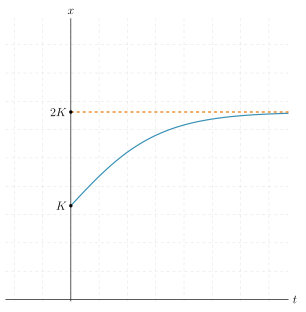
If there are \(x\) micrograms of bacteria in a nutrient medium, the population of bacteria will grow at the rate \((2K-x)x\) micrograms per hour. Show that, if \(x=K\) when \(t=0\), the population at time \(t\) is given by \[ x(t)=K+K\frac{1-\mathrm{e}^{-2Kt}}{1+\mathrm{e}^{-2Kt}}. \] Sketch, for \(t\geqslant0\), the graph of \(x\) against \(t\). What happens to \(x(t)\) as \(t\rightarrow\infty\)? Now suppose that the situation is as described in the first paragraph, except that we remove the bacteria from the nutrient medium at a rate \(L\) micrograms per hour where \(K^{2}>L\). We set \(\alpha=\sqrt{K^{2}-L}.\) Write down the new differential equation for \(x\). By considering a new variable \(y=x-K+\alpha,\) or otherwise, show that, if \(x(0)=K\) then \(x(t)\rightarrow K+\alpha\) as \(t\rightarrow\infty\).
Solution: \begin{align*} && \dot{x} &= (2K-x)x \\ \Rightarrow && \int \d t &= \int \frac{1}{(2K-x)x} \d x \\ &&&= \int \frac1{2K}\left ( \frac{1}{2K-x} + \frac{1}{x} \right) \d x \\ &&&= \frac{1}{2K} \left (\ln x - \ln (2K-x) \right) \\ \Rightarrow && 2Kt+C &= \ln \frac{x}{2K-x} \\ t = 0, x = K: && C &= \ln \frac{K}{2K-K} = 0 \\ \Rightarrow && e^{2Kt} &= \frac{x}{2K-x} \\ \Rightarrow && e^{-2Kt} &= \frac{2K}{x} -1 \\ \Rightarrow && x &= \frac{2K}{1+e^{-2Kt}} \\ &&&= K + K \frac{1-e^{-2Kt}}{1+e^{-2Kt}} \end{align*}
1990 Paper 2 Q7
A damped system with feedback is modelled by the equation \[ \mathrm{f}'(t)+\mathrm{f}(t)-k\mathrm{f}(t-1)=0,\mbox{ }\tag{\(\dagger\)} \] where \(k\) is a given non-zero constant. Show that (non-zero) solutions for \(\mathrm{f}\) of the form \(\mathrm{f}(t)=A\mathrm{e}^{pt},\) where \(A\) and \(p\) are constants, are possible provided \(p\) satisfies \[ p+1=k\mathrm{e}^{-p}.\mbox{ }\tag{*} \] Show also, by means of a sketch, or otherwise, that equation \((*)\) can have \(0,1\) or \(2\) real roots, depending on the value of \(k\), and find the set of values of \(k\) for which such solutions of \((\dagger)\) exist. For what set of values of \(k\) do such solutions tend to zero as \(t\rightarrow+\infty\)?
Solution: Suppose \(f(t) = Ae^{pt}\) is a solution, then \begin{align*} && 0 &= Ape^{pt} + Ae^{pt} - Ake^{p(t-1)} \\ \Leftrightarrow && 0 &= p +1 - ke^{-p} \\ \Leftrightarrow && p+1 &= ke^{-p} \end{align*}

1987 Paper 1 Q3
By substituting \(y(x)=xv(x)\) in the differential equation \[ x^{3}\frac{\mathrm{d}v}{\mathrm{d}x}+x^{2}v=\frac{1+x^{2}v^{2}}{\left(1+x^{2}\right)v}, \] or otherwise, find the solution \(v(x)\) that satisfies \(v=1\) when \(x=1\). What value does this solution approach when \(x\) becomes large?
Solution: Let \(y = xv\) then \(y' = v + xv'\) and so \(x^2y' = x^2v + x^3v'\) Our differential equation is now: \begin{align*} && x^2 y' &= \frac{1+y^2}{(1+x^2)\frac{y}{x}} \\ \Rightarrow && xy' &= \frac{(1+y^2)}{(1+x^2)y} \\ \Rightarrow && \frac{y}{1+y^2} \frac{\d y}{\d x} &= \frac{1}{x(1+x^2)} \\ \Rightarrow && \frac{y}{1+y^2} \frac{\d y}{\d x} &= \frac{1}{x} - \frac{x}{1+x^2} \\ \Rightarrow && \frac12 \ln(1+y^2) &= \ln x - \frac12 \ln(1+x^2) + C \\ \Rightarrow && \frac12 \ln (1 + y^2) &= \frac12 \ln \l \frac{x^2}{1+x^2}\r + C \\ \Rightarrow && 1+y^2 &= \frac{Dx^2}{1+x^2} \\ \Rightarrow && D &= 4 \quad \quad: (x = 1, v = 1, y = 1) \\ \Rightarrow && 1 + x^2v^2&= \frac{4x^2}{1+x^2}\\ \Rightarrow && v^2 &= \frac{3x^2-1}{x^2(1+x^2)} \\ \Rightarrow && v &= \sqrt{\frac{3x^2-1}{x^2(1+x^2)}} \\ \end{align*} As \(x \to \infty\), \(v \to 0\)