Problems
Filters
6 problems found
2002 Paper 3 Q8
Four complex numbers \(u_1\), \(u_2\), \(u_3\) and \(u_4\) have unit modulus, and arguments \(\theta_1\), \(\theta_2\), \(\theta_3\) and \(\theta_4\), respectively, with \(-\pi < \theta_1 < \theta_2 < \theta_3 < \theta_4 < \pi\). Show that \[ \arg \l u_1 - u_2 \r = \tfrac{1}{2} \l \theta_1 + \theta_2 -\pi \r + 2n\pi \] where \(n = 0 \hspace{4 pt} \mbox{or} \hspace{4 pt} 1\,\). Deduce that \[ \arg \l \l u_1 - u_2 \r \l u_4 - u_3 \r \r = \arg \l \l u_1 - u_4 \r \l u_3 - u_2 \r \r + 2n\pi \] for some integer \(n\). Prove that \[ | \l u_1 - u_2 \r \l u_4 - u_3 \r | + | \l u_1 - u_4 \r \l u_3 - u_2 \r | = | \l u_1 - u_3 \r \l u_4 - u_2 \r |\;. \]
2001 Paper 3 Q8
- Prove that the equations $$ \left|z - (1 + \mathrm{i}) \right|^2 = 2 \eqno(*) $$ and $$ \qquad \quad \ \left|z - (1 - \mathrm{i}) \right|^2 = 2 \left|z - 1 \right|^2 $$ describe the same locus in the complex \(z\)--plane. Sketch this locus.
- Prove that the equation $$ \arg \l {z - 2 \over z} \r = {\pi \over 4} \eqno(**) $$ describes part of this same locus, and show on your sketch which part.
- The complex number \(w\) is related to \(z\) by \[ w = {2 \over z}\;. \] Determine the locus produced in the complex \(w\)--plane if \(z\) satisfies \((*)\). Sketch this locus and indicate the part of this locus that corresponds to \((**)\).
1995 Paper 3 Q6
The variable non-zero complex number \(z\) is such that \[ \left|z-\mathrm{i}\right|=1. \] Find the modulus of \(z\) when its argument is \(\theta.\) Find also the modulus and argument of \(1/z\) in terms of \(\theta\) and show in an Argand diagram the loci of points which represent \(z\) and \(1/z\). Find the locus \(C\) in the Argand diagram such that \(w\in C\) if, and only if, the real part of \((1/w)\) is \(-1\).
Solution:

1993 Paper 2 Q9
\textit{In this question, the argument of a complex number is chosen to satisfy \(0\leqslant\arg z<2\pi.\)} Let \(z\) be a complex number whose imaginary part is positive. What can you say about \(\arg z\)? The complex numbers \(z_{1},z_{2}\) and \(z_{3}\) all have positive imaginary part and \(\arg z_{1}<\arg z_{2}<\arg z_{3}.\) Draw a diagram that shows why \[ \arg z_{1}<\arg(z_{1}+z_{2}+z_{3})<\arg z_{3}. \] Prove that \(\arg(z_{1}z_{2}z_{3})\) is never equal to \(\arg(z_{1}+z_{2}+z_{3}).\)
1992 Paper 2 Q10
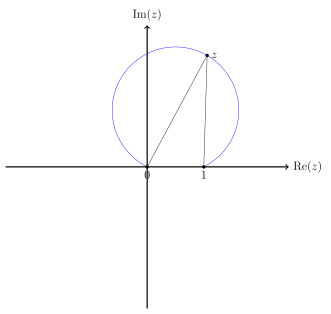
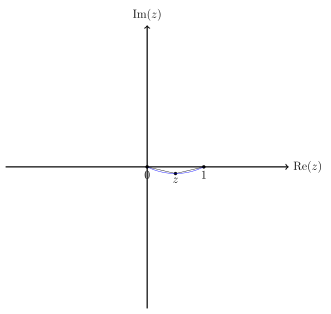
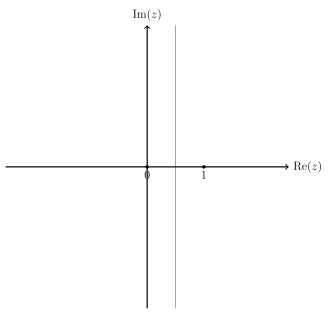
Let \(\alpha\) be a fixed angle, \(0 < \alpha \leqslant\frac{1}{2}\pi.\) In each of the following cases, sketch the locus of \(z\) in the Argand diagram (the complex plane):
- \({\displaystyle \arg\left(\frac{z-1}{z}\right)=\alpha,}\)
- \({\displaystyle \arg\left(\frac{z-1}{z}\right)=\alpha-\pi,}\)
- \(|\dfrac{z-1}{z}|=1.\)
Solution:
1987 Paper 3 Q3
- If \(z=x+\mathrm{i}y,\) with \(x,y\) real, show that \[ \left|x\right|\cos\alpha+\left|y\right|\sin\alpha\leqslant\left|z\right|\leqslant\left|x\right|+\left|y\right| \] for all real \(\alpha.\)
- By considering \((5-\mathrm{i})^{4}(1+\mathrm{i}),\) show that \[ \frac{\pi}{4}=4\tan^{-1}\left(\frac{1}{5}\right)-\tan^{-1}\left(\frac{1}{239}\right). \] Prove similarly that \[ \frac{\pi}{4}=3\tan^{-1}\left(\frac{1}{4}\right)+\tan^{-1}\left(\frac{1}{20}\right)+\tan^{-1}\left(\frac{1}{1985}\right). \]
Solution:
- If \(z=x+iy\) then \(|z|^2 = x^2 + y^2 \leq x^2 + y^2 + 2|x||y| \leq (|x|+|y|)^2\). The LHS is Cauchy-Schwarz with the vectors \(\begin{pmatrix} |x| \\ |y| \end{pmatrix}\) and \(\begin{pmatrix} \cos \alpha \\ \sin \alpha \end{pmatrix}\), although that's not in the spirit of the question. Consider \(e^{i \alpha}z = (\cos \alpha x - \sin \alpha y) + i(\sin \alpha x + \cos \alpha y)\) then \(\left | \textrm{Re}(e^{i \alpha} z) \right | \leq |z|\) for all values of \(\alpha\) and in particular we can choose \(\alpha\) to match the signs of the \(x\) and \(y\) to prove the result in question.
- Consider \((5-\mathrm{i})^{4}(1+\mathrm{i})\), then \begin{align*} \arg \l (5-\mathrm{i})^{4}(1+\mathrm{i}) \r &= \arg (5-i)^4 + \arg (1+i) \\ &= 4 \arg (5-i) + \arg (1+i) \\ &= -4 \tan^{-1} \frac{1}{5} + \tan^{-1} 1 \\ \\ &= \arg ( (24 - 10i)^2 (1+i)) \\ &= \arg (4 (12 - 5i)^2(1+i)) \\ &= \arg ((119 - 120i)(1+i)) \\ &= \arg (239 - i) \\ &= -\tan^{-1} \frac{1}{239} \end{align*} Therefore \(\displaystyle \frac{\pi}{4} =4 \tan^{-1} \frac{1}{5}- \tan^{-1} \frac{1}{239}\) Consider \((4-i)^3(1+i)(20-i)\) then \begin{align*} \arg \l(4-i)^3(1+i)(20-i) \r &= -3 \tan^{-1} \frac14 + \tan^{-1} 1 -\tan^{-1} \frac1{20} \\ \\ &= \arg \l(15-8i)(4-i)(1+i)(20-i) \r \\ &= \arg \l (52 - 47i)(1+i)(20-i) \r \\ &= \arg \l (99 + 5i)(20-i) \r \\ &= \arg (1985+i) \\ &= \tan^{-1} \frac1{1985} \end{align*} Therefore \(\displaystyle \frac{\pi}{4}=3\tan^{-1}\frac{1}{4}+\tan^{-1}\frac{1}{20}+\tan^{-1}\frac{1}{1985}\)