Problems
Filters
27 problems found
2023 Paper 3 Q3
- Show that, if \(a\) and \(b\) are complex numbers, with \(b \neq 0\), and \(s\) is a positive real number, then the points in the Argand diagram representing the complex numbers \(a + sbi\), \(a - sbi\) and \(a + b\) form an isosceles triangle. Given three points which form an isosceles triangle in the Argand diagram, explain with the aid of a diagram how to determine the values of \(a\), \(b\) and \(s\) so that the vertices of the triangle represent complex numbers \(a + sbi\), \(a - sbi\) and \(a + b\).
- Show that, if the roots of the equation \(z^3 + pz + q = 0\), where \(p\) and \(q\) are complex numbers, are represented in the Argand diagram by the vertices of an isosceles triangle, then there is a non-zero real number \(s\) such that \[\frac{p^3}{q^2} = \frac{27(3s^2 - 1)^3}{4(9s^2 + 1)^2}\,.\]
- Sketch the graph \(y = \dfrac{(3x-1)^3}{(9x+1)^2}\), identifying any stationary points.
- Show that if the roots of the equation \(z^3 + pz + q = 0\) are represented in the Argand diagram by the vertices of an isosceles triangle then \(\dfrac{p^3}{q^2}\) is a real number and \(\dfrac{p^3}{q^2} > -\dfrac{27}{4}\).
2020 Paper 2 Q7
In this question, \(w = \dfrac{2}{z-2}\).
- Let \(z\) be the complex number \(3 + t\mathrm{i}\), where \(t \in \mathbb{R}\). Show that \(|w - 1|\) is independent of \(t\). Hence show that, if \(z\) is a complex number on the line \(\operatorname{Re}(z) = 3\) in the Argand diagram, then \(w\) lies on a circle in the Argand diagram with centre \(1\). Let \(V\) be the line \(\operatorname{Re}(z) = p\), where \(p\) is a real constant not equal to \(2\). Show that, if \(z\) lies on \(V\), then \(w\) lies on a circle whose centre and radius you should give in terms of \(p\). For which \(z\) on \(V\) is \(\operatorname{Im}(w) > 0\)?
- Let \(H\) be the line \(\operatorname{Im}(z) = q\), where \(q\) is a non-zero real constant. Show that, if \(z\) lies on \(H\), then \(w\) lies on a circle whose centre and radius you should give in terms of \(q\). For which \(z\) on \(H\) is \(\operatorname{Re}(w) > 0\)?
2019 Paper 3 Q6
The point \(P\) in the Argand diagram is represented by the the complex number \(z\), which satisfies $$zz^* - az^* - a^*z + aa^* - r^2 = 0.$$ Here, \(r\) is a positive real number and \(r^2 \neq a^*a\). By writing \(|z - a|^2\) as \((z - a)(z - a)^*\), show that the locus of \(P\) is a circle, \(C\), the radius and the centre of which you should give.
- The point \(Q\) is represented by \(\omega\), and is related to \(P\) by \(\omega = \frac{1}{z}\). Let \(C'\) be the locus of \(Q\). Show that \(C'\) is also a circle, and give its radius and centre. If \(C\) and \(C'\) are the same circle, show that $$(|a|^2 - r^2)^2 = 1$$ and that either \(a\) is real or \(a\) is imaginary. Give sketches to indicate the position of \(C\) in these two cases.
- Suppose instead that the point \(Q\) is represented by \(\omega\), where \(\omega = \frac{1}{z^*}\). If the locus of \(Q\) is \(C\), is it the case that either \(a\) is real or \(a\) is imaginary?
Solution: \begin{align*} && |z-a|^2 &= (z-a)(z-a)^* \\ &&&= (z-a)(z^*-a^*) \\ &&&= zz^*-az^*-a^*z+aa^* \\ &&&= r^2 \end{align*} Therefore the locus of \(P\) is a circle centre \(a\) radius \(r\).
- \begin{align*} && 0 &= zz^* - az^* - a^*z + aa^* - r^2 \\ &&&= \frac{1}{\omega \omega^{*}} - \frac{a}{\omega^*} - \frac{a^*}{\omega} + aa^*-r^2 \\ \Rightarrow && 0 &= 1-a\omega-a^*\omega^*+(|a|^2-r^2)\omega\omega^* \\ \Rightarrow && 0 &= \omega\omega^* - \left ( \frac{a^*}{|a|^2-r^2}\right)^*\omega - \left ( \frac{a^*}{|a|^2-r^2}\right)\omega^*+\left ( \frac{a^*}{|a|^2-r^2}\right)\left ( \frac{a}{|a|^2-r^2}\right)-\left ( \frac{a^*}{|a|^2-r^2}\right)\left ( \frac{a}{|a|^2-r^2}\right)+ \frac{1}{|a|^2-r^2} \\ &&&= \omega\omega^* - \left ( \frac{a^*}{|a|^2-r^2}\right)^*\omega - \left ( \frac{a^*}{|a|^2-r^2}\right)\omega^*+\frac{|a|^2}{(|a|^2-r^2)^2}-\frac{|a|^2}{(|a|^2-r^2)^2}+ \frac{1}{|a|^2-r^2} \\ &&&=\omega\omega^* - \left ( \frac{a^*}{|a|^2-r^2}\right)^*\omega - \left ( \frac{a^*}{|a|^2-r^2}\right)\omega^*+\frac{|a|^2}{(|a|^2-r^2)^2}- \frac{r^2}{(|a|^2-r^2)^2} \end{align*} Therefore \(\displaystyle \left|\omega-\left ( \frac{a^*}{|a|^2-r^2}\right)\right|^2 = \frac{r^2}{(|a|^2-r^2)^2}\) ie \(\omega\) lies on a circle centre \(\frac{a^*}{|a|^2-r^2}\), radius \(\frac{r}{||a|^2-r^2|}\). If these are the same circle then \(r = \frac{r}{||a|^2-r^2|} \Rightarrow (|a|^2-r^2)^2 = 1\) and \(a = \frac{a^*}{|a|^2-r^2} \Rightarrow a = \pm a^*\), ie \(a\) is purely real or imaginary.
- This is the same story, except we end up with centre \(\frac{a}{|a|^2-r^2}\), so we do not end up with the same conditions
2018 Paper 3 Q6
- The distinct points \(A\), \(Q\) and \(C\) lie on a straight line in the Argand diagram, and represent the distinct complex numbers \(a\), \(q\) and \(c\), respectively. Show that \(\dfrac {q-a}{c-a}\) is real and hence that \((c-a)(q^*-a^*) = (c^*-a^*)(q-a)\,\). Given that \(aa^* = cc^* = 1\), show further that \[ q+ ac q^* = a+c \,. \]
- The distinct points \(A\), \(B\), \(C\) and \(D\) lie, in anticlockwise order, on the circle of unit radius with centre at the origin (so that, for example, \(aa^* =1\)). The lines \(AC\) and \(BD\) meet at \(Q\). Show that \[ (ac-bd)q^* = (a+c)-(b+d) \,, \] where \(b\) and \(d\) are complex numbers represented by the points \(B\) and \(D\) respectively, and show further that \[ (ac-bd) (q+q^*) = (a-b)(1+cd) +(c-d)(1+ab) \,. \]
- The lines \(AB\) and \(CD\) meet at \(P\), which represents the complex number \(p\). Given that \(p\) is real, show that \(p(1+ab)=a+b\,\). Given further that \(ac-bd \ne 0\,\), show that \[ p(q+q^*) = 2 \,. \]
Solution:
- \(A\), \(Q\), \(C\) lie on a straight line if \(q = \lambda a + (1-\lambda)c\) for some \(\lambda \in \mathbb{R}\), \begin{align*} && q &= \lambda a + (1-\lambda)c \\ \Leftrightarrow && q - a &= (\lambda - 1)a + (1-\lambda)c \\ \Leftrightarrow && q - a &= (\lambda - 1)(a-c) \\ \Leftrightarrow && \frac{q - a}{c-a} &= 1-\lambda \\ \end{align*} therefore \(\frac{q-a}{c-a} \in \mathbb{R}\) \begin{align*} && \frac{q-a}{c-a} & \in \mathbb{R} \\ \Leftrightarrow && \left (\frac{q-a}{c-a} \right)^* &= \frac{q-a}{c-a} \\ \Leftrightarrow && (q^*-a^*)(c-a) &= (q-a)(c^*-a^*) \\ \end{align*} Given \(aa^* = cc^* = 1\), \begin{align*} && (q^*-a^*)(c-a) &= (q-a)(c^*-a^*) \\ \Leftrightarrow && q^*(c-a) - \frac{c}{a}+1 &= q \frac{a-c}{ca} - \frac{a}{c}+1 \\ \Leftrightarrow && (c-a)\l q^* +\frac{q}{ca}\r &= \frac{c}{a} - \frac{a}{c} \\ &&&= \frac{c^2-a^2}{ac} \\ \Leftrightarrow && q^* +\frac{q}{ca} &= \frac{c+a}{ac} \\ \Leftrightarrow && q^*ac +q &= a+c \end{align*}
- Since \(Q\) lies on \(AC\) and \(BD\) we must have \begin{align*} &&& \begin{cases} q^*ac +q &= a+c \\ q^*bd +q &= b+d \\ \end{cases} \\ \Rightarrow && q^*(ac-bd) &= (a+c)-(b+d) \\ \Rightarrow && q(ac-bd) &= (b+d)ac-(a+c)bd \\ \Rightarrow && (q+q^*)(ac-bd) &= (a+c)(1-bd)+(b+d)(ac-1) \\ &&&=a-abd+c-bcd+abc-b+acd-d \\ &&&= a(1+cd)-b(1+cd)+c(1+ab)-d(1+ab) \\ &&&= (a-b)(1+cd)+(c-d)(1+ab) \end{align*}
- If \(AB\) and \(CD\) meet at \(p\) we must have \(p^*ab + p = a+b\), ie \(p(1+ab) = a+b\) amd \(p(1+cd) = c+d\), so \begin{align*} && (q+q^*)(ac-bd) &= (a-b) \frac{c+d}{p} + (c-d) \frac{a+b}{p} \\ \Leftrightarrow && p(q+q^*)(ac-bd) &= (a-b)(c+d)+(c-d)(a+b) \\ &&&= ac+ad-bc-bd+ac+bc-ad-bd \\ &&&= 2(ac-bd) \\ \Leftrightarrow && p(q+q^*) &= 2 \end{align*}
2014 Paper 3 Q5
A quadrilateral drawn in the complex plane has vertices \(A\), \(B\), \(C\) and \(D\), labelled anticlockwise. These vertices are represented, respectively, by the complex numbers \(a\), \(b\), \(c\) and \(d\). Show that \(ABCD\) is a parallelogram (defined as a quadrilateral in which opposite sides are parallel and equal in length) if and only if \(a+c =b+d\,\). Show further that, in this case, \(ABCD\) is a square if and only if \({\rm i}(a-c)=b-d\). Let \(PQRS\) be a quadrilateral in the complex plane, with vertices labelled anticlockwise, the internal angles of which are all less than \(180^\circ\). Squares with centres \(X\), \(Y\), \(Z\) and \(T\) are constructed externally to the quadrilateral on the sides \(PQ\), \(QR\), \(RS\) and \(SP\), respectively.
- If \(P\) and \(Q\) are represented by the complex numbers \(p\) and \(q\), respectively, show that \(X\) can be represented by \[ \tfrac 12 \big( p(1+{\rm i} ) + q (1-{\rm i})\big) \,. \]
- Show that \(XY\!ZT\) is a square if and only if \(PQRS\) is a parallelogram.
Solution: The vector representing the side \(AB\) is \(b - a\) and the vector representing the side \(DC\) is \(c - d\). \(ABCD\) is a parallelogram if and only if these opposite sides are parallel and equal in length, which is given by \(b - a = c - d\), or equivalently \(a + c = b + d\). Similarly, if \(a + c = b + d\), then \(c - b = d - a\), so the side \(BC\) is parallel and equal in length to the side \(AD\). Thus, \(a + c = b + d\) is the necessary and sufficient condition for \(ABCD\) to be a parallelogram. In a parallelogram, the shape is a square if and only if the diagonals are equal in length and perpendicular to each other. The diagonals are represented by the vectors \(c - a\) and \(d - b\). For these to be equal in length and perpendicular, one must be a \(90^\circ\) rotation of the other. Since \(A, B, C, D\) are labeled anticlockwise, a \(90^\circ\) anticlockwise rotation of the vector \(\vec{AC}\) (which is \(c-a\)) would point in the direction of \(\vec{DB}\) (which is \(b-d\) if we consider the relative orientation). Specifically: \(i(c - a) = d - b \implies -i(a - c) = d - b \implies i(a - c) = b - d\). Thus, \(ABCD\) is a square if and only if \(i(a - c) = b - d\).
- The midpoint of the side \(PQ\) is \(\frac{1}{2}(p + q)\). To find the centre \(X\) of the square built externally on \(PQ\), we start at the midpoint and move a distance equal to half the side length in a direction perpendicular to \(PQ\). Since \(P, Q, R, S\) are anticlockwise, the outward direction is a \(90^\circ\) clockwise rotation of the vector \(\vec{PQ}\). A clockwise rotation of \(90^\circ\) corresponds to multiplication by \(-i\). \[ x = \frac{p+q}{2} + (-i)\left(\frac{q-p}{2}\right) = \frac{p + q - iq + ip}{2} = \frac{1}{2} \big( p(1+i) + q(1-i) \big) \]
- From part (i), we have the representations for the centres: \begin{align*} x &= \tfrac{1}{2}(p(1+i) + q(1-i)) \\ y &= \tfrac{1}{2}(q(1+i) + r(1-i)) \\ z &= \tfrac{1}{2}(r(1+i) + s(1-i)) \\ t &= \tfrac{1}{2}(s(1+i) + p(1-i)) \end{align*} As shown in the first part of the problem, \(XYZT\) is a square if and only if: (1) \(x+z = y+t\) (it is a parallelogram) (2) \(i(x-z) = y-t\) (it is a square) First, examine condition (1): \begin{align*} x+z - (y+t) &= \tfrac{1}{2} \big[ (p+r)(1+i) + (q+s)(1-i) - (q+s)(1+i) - (r+p)(1-i) \big] \\ &= \tfrac{1}{2} \big[ (p+r)(1+i - (1-i)) - (q+s)(1+i - (1-i)) \big] \\ &= \tfrac{1}{2} \big[ (p+r)(2i) - (q+s)(2i) \big] \\ &= i(p+r - (q+s)) \end{align*} Thus, \(x+z = y+t\) if and only if \(p+r = q+s\), which is the condition that \(PQRS\) is a parallelogram. Next, examine condition (2): \begin{align*} i(x-z) &= \tfrac{1}{2} i \big[ p(1+i) + q(1-i) - r(1+i) - s(1-i) \big] \\ &= \tfrac{1}{2} \big[ p(i-1) + q(i+1) - r(i-1) - s(i+1) \big] \\ y-t &= \tfrac{1}{2} \big[ q(1+i) + r(1-i) - s(1+i) - p(1-i) \big] \\ \text{So, } i(x-z) - (y-t) &= \tfrac{1}{2} \big[ p(i-1 + 1-i) + q(i+1 - 1-i) + r(-i+1 - 1+i) + s(-i-1 + 1+i) \big] \\ &= 0 \end{align*} Since \(i(x-z) = y-t\) is an identity (always true for any \(PQRS\)), \(XYZT\) is a square if and only if it is a parallelogram. As established above, this occurs if and only if \(PQRS\) is a parallelogram.
2013 Paper 3 Q6
Let \(z\) and \(w\) be complex numbers. Use a diagram to show that \(\vert z-w \vert \le \vert z\vert + \vert w \vert\,.\) For any complex numbers \(z\) and \(w\), \(E\) is defined by \[ E = zw^* + z^*w +2 \vert zw \vert\,. \]
- Show that \(\vert z-w\vert^2 = \left( \vert z \vert + \vert w\vert\right)^2 -E\,\), and deduce that \(E\) is real and non-negative.
- Show that \(\vert 1-zw^*\vert^2 = \left ( 1 +\vert zw \vert \right)^2 -E\,\).
Solution:
- \(\,\) \begin{align*} && |z-w|^2 &= (z-w)(z^*-w^*) \\ &&&= zz^* - wz^*-zw^* + ww^* \\ &&&= |z|^2+|w|^2 - E + 2|zw| \\ &&&= (|z|+|w|)^2 - E \\ \Rightarrow && E &= (|z|+|w|)^2 - |z-w|^2 &\in \mathbb{R} \end{align*} and by the triangle inequality \(|z|+|w| \geq |z-w|\), so \(E \geq 0\)
- \(\,\) \begin{align*} && |1-zw^*|^2 &= (1-zw^*)(1-z^*w) \\ &&&= 1 - zw^*-z^*w + |zw|^2 \\ &&&= 1 - E + 2|zw| + |zw|^2 \\ &&&= (1+|zw|)^2 - E \end{align*} \begin{align*} && \frac{|z-w|^2}{|1-zw^*|^2} &= \frac{(|z|+|w|)^2-E}{(1+|zw|)^2-E} \\ \Leftrightarrow && (1+|zw|^2)|z-w|^2 -E|z-w|^2 &= (|z|+|w|)^2|1-zw^*|^2-E|1-zw^*|^2\\ \Leftrightarrow && (1+|zw|^2)|z-w|^2-(|z|+|w|)^2|1-zw^*|^2 &= E(|z-w|^2-|1-zw^*|^2)\\ &&&= E(|z|^2-zw^*-z^*w+|w|^2-1+zw^*+z^*w-|z|^2|w|^2) \\ &&&= E(|z|^2+|w|^2-1-|z|^2|w|^2) \\ &&&= -E(1-|z|^2)(1-|w|^2) \\ &&&\leq 0 \\ \Leftrightarrow&& (1+|zw|^2)|z-w|^2& \leq (|z|+|w|)^2|1-zw^*|^2\\ \Leftrightarrow&& \frac{|z-w|^2}{|1-zw^*|^2} &\leq \frac{(|z|+|w|)^2}{(1+|zw|)^2}\\ \Leftrightarrow && \frac{|z-w|}{|1-zw^*|} &\leq \frac{(|z|+|w|)}{(1+|zw|)}\\ \end{align*} Yes, this inequality holds if \(|z|, |w|\) are the same side of \(1\) and is reversed otherwise.
2012 Paper 3 Q6
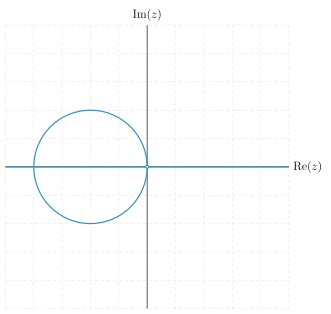
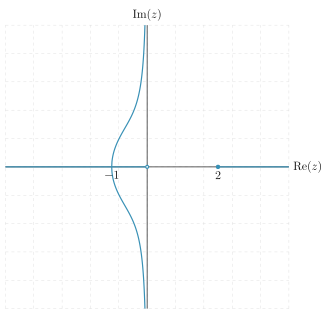
Let \(x+{\rm i} y\) be a root of the quadratic equation \(z^2 + pz +1=0\), where \(p\) is a real number. Show that \(x^2-y^2 +px+1=0\) and \((2x+p)y=0\). Show further that either \(p=-2x\) or \(p=-(x^2+1)/x\) with \(x\ne0\). Hence show that the set of points in the Argand diagram that can (as \(p\) varies) represent roots of the quadratic equation consists of the real axis with one point missing and a circle. This set of points is called the root locus of the quadratic equation. Obtain and sketch in the Argand diagram the root locus of the equation \[ pz^2 +z+1=0\, \] and the root locus of the equation \[ pz^2 + p^2z +2=0\,.\]
Solution: \begin{align*} && 0 &= z^2 + pz + 1\\ &&&= (x+iy)^2 + (x+iy)p + 1 \\ &&& = (x^2-y^2+px+1) + (2xy+py)i \\ \Rightarrow && 0 &= x^2 - y^2 + px + 1 \\ && 0 &= (2x+p)y \\ \Rightarrow && p &= -2x \\ \text{ or } && y &= 0 \\ \Rightarrow && p &= -(x^2+1)/x \end{align*} Therefore as \(p\) varies with either have \(y = 0\) and \(x\) taking any real value except \(0\) ie the real axis minus the origin. Or \(p = -2x\) and \(-y^2-x^2+1 = 0 \Rightarrow x^2 + y^2 = 1\) which is a circle. Suppose \(pz^2 + z + 1 = 0\) \begin{align*} && 0 &= pz^2 + z +1\\ &&&= p(x+iy)^2 + (x+iy) + 1\\ &&&= (px^2-py^2+x+1) + (2xyp + y) i \\ \Rightarrow && 0 &= (2xp+1)y \\ \Rightarrow && y & = 0, p = \frac{-(x+1)}{x^2}, x \neq 0 \\ \text{ or } && p &= -\frac{1}{2x}\\ \Rightarrow && 0 &= -\frac{1}{2}x + \frac{y^2}{2x} + x + 1 \\ &&&= \frac{y^2 - x^2 +2x^2 + 2x}{2x} \\ &&&= \frac{(x+1)^2+y^2-1}{2x} \end{align*} So we either have the real axis (except \(0\)) or a circle radius \(1\) centre \((-1, 0)\) (excluding \(x = 0\)).
2008 Paper 3 Q7
The points \(A\), \(B\) and \(C\) in the Argand diagram are the vertices of an equilateral triangle described anticlockwise. Show that the complex numbers \(a\), \(b\) and \(c\) representing \(A\), \(B\) and \(C\) satisfy \[2c= (a+b) +\mathrm{i}\sqrt3(b-a).\] Find a similar relation in the case that \(A\), \(B\) and \(C\) are the vertices of an equilateral triangle described clockwise.
- The quadrilateral \(DEFG\) lies in the Argand diagram. Show that points \(P\), \(Q\), \(R\) and \(S\) can be chosen so that \(PDE\), \(QEF\), \(RFG\) and \(SGD\) are equilateral triangles and \(PQRS\) is a parallelogram.
- The triangle \(LMN\) lies in the Argand diagram. Show that the centroids \(U\), \(V\) and \(W\) of the equilateral triangles drawn externally on the sides of \(LMN\) are the vertices of an equilateral triangle. \noindent [{\bf Note:} The {\em centroid} of a triangle with vertices represented by the complex numbers \(x\),~\(y\) and~\(z\) is the point represented by \(\frac13(x+y+z)\,\).]
2007 Paper 3 Q6
The distinct points \(P\), \(Q\), \(R\) and \(S\) in the Argand diagram lie on a circle of radius \(a\) centred at the origin and are represented by the complex numbers \(p\), \(q\), \(r\) and \(s\), respectively. Show that \[ pq = -a^2 \frac {p-q}{p^*-q^*}\,. \] Deduce that, if the chords \(PQ\) and \(RS\) are perpendicular, then \(pq+rs=0\). The distinct points \(A_1\), \(A_2\), \(\ldots\), \(A_n\) (where \(n\ge3\)) lie on a circle. The points \hbox{\(B_1\), \(B_2\), \(\ldots\), \(B_{n}\)} lie on the same circle and are chosen so that the chords \(B_1B_2\), \(B_2B_3\), \(\ldots\), \(B_nB_{1}\) are perpendicular, respectively, to the chords \(A_1A_2\), \(A_2A_3\), \(\ldots\), \(A_nA_1\). Show that, for \(n=3\), there are only two choices of \(B_1\) for which this is possible. What is the corresponding result for \(n=4\)? State the corresponding results for values of \(n\) greater than 4.
2005 Paper 3 Q8
In this question, \(a\) and \(c\) are distinct non-zero complex numbers. The complex conjugate of any complex number \(z\) is denoted by \(z^*\). Show that \[ |a - c|^2 = aa^* + cc^* -ac^* - ca^* \] and hence prove that the triangle \(OAC\) in the Argand diagram, whose vertices are represented by \(0\), \(a\) and \(c\) respectively, is right angled at \(A\) if and only if \(2aa^* = ac^*+ca^*\,\). Points \(P\) and \(P'\) in the Argand diagram are represented by the complex numbers \(ab\) and \(\ds \frac{a}{b^*}\,\), where \(b\) is a non-zero complex number. A circle in the Argand diagram has centre \(C\) and passes through the point \(A\), and is such that \(OA\) is a tangent to the circle. Show that the point \(P\) lies on the circle if and only if the point \(P'\) lies on the circle. Conversely, show that if the points represented by the complex numbers \(ab\) and \(\ds \frac{a}{b^*}\), for some non-zero complex number \(b\) with \(bb^* \ne 1\,\), both lie on a circle centre \(C\) in the Argand diagram which passes through \(A\), then \(OA\) is a tangent to the circle.
2001 Paper 2 Q7
In an Argand diagram, \(O\) is the origin and \(P\) is the point \(2+0\mathrm{i}\). The points \(Q\), \(R\) and \(S\) are such that the lengths \(OP\), \(PQ\), \(QR\) and \(RS\) are all equal, and the angles \(OPQ\), \(PQR\) and \(QRS\) are all equal to \({5{\pi}}/6\), so that the points \(O\), \(P\), \(Q\), \(R\) and \(S\) are five vertices of a regular 12-sided polygon lying in the upper half of the Argand diagram. Show that \(Q\) is the point \(2 + \sqrt 3 + \mathrm{i}\) and find \(S\). The point \(C\) is the centre of the circle that passes through the points \(O\), \(P\) and \(Q\). Show that, if the polygon is rotated anticlockwise about \(O\) until \(C\) first lies on the real axis, the new position of \(S\) is $$ - \tfrac{1}{2} (3\sqrt 2+ \sqrt6)(\sqrt3-\mathrm{i})\;. $$
2000 Paper 3 Q3
Given that \(\alpha = \e^{\mathrm{i} \pi/3}\) , prove that \(1 + \alpha^2 = \alpha\). A triangle in the Argand plane has vertices \(A\), \(B\), and \(C\) represented by the complex numbers \(p\), \(q\alpha^2\) and \(- r\alpha\) respectively, where \(p\), \(q\) and \(r\) are positive real numbers. Sketch the triangle~\(ABC\). Three equilateral triangles \(ABL\), \(BCM\) and \(CAN\) (each lettered clockwise) are erected on sides \(AB\), \(BC\) and \(CA\) respectively. Show that the complex number representing \(N\) is \mbox{\(( 1 - \alpha) p- \alpha^2 r\)} and find similar expressions for the complex numbers representing \(L\) and \(M\). Show that lines \(LC\), \(MA\) and \(NB\) all meet at the origin, and that these three line segments have the common length \(p+q+r\).
1998 Paper 1 Q5
- In the Argand diagram, the points \(Q\) and \(A\) represent the complex numbers \(4+6i\) and \(10+2i\). If \(A\), \(B\), \(C\), \(D\), \(E\), \(F\) are the vertices, taken in clockwise order, of a regular hexagon (regular six-sided polygon) with centre \(Q\), find the complex number which represents \(B\).
- Let \(a\), \(b\) and \(c\) be real numbers. Find a condition of the form \(Aa+Bb+Cc=0\), where \(A\), \(B\) and \(C\) are integers, which ensures that \[\frac{a}{1+i}+\frac{b}{1+2i}+\frac{c}{1+3i}\] is real.
Solution:
- We are looking for \((10+2i) - (4+6i) = 6 - 4i\) rotated by \(\frac{\pi}{3}\) and then added to \(4+6i\), which is \begin{align*} (6-4i)(\cos \frac{\pi}{3} + i \sin \frac{\pi}{3}) &= (6-4i)\left(\tfrac12 +\tfrac{\sqrt{3}}2i\right) \\ &= 3+2\sqrt{3} + (3\sqrt{3}-2)i \end{align*}

- \begin{align*} &&& \frac{a}{1+i}+\frac{b}{1+2i}+\frac{c}{1+3i} &\in \mathbb{R} \\ \Longleftrightarrow && \frac{a}{1+i}+\frac{b}{1+2i}+\frac{c}{1+3i} &= \frac{a}{1-i}+\frac{b}{1-2i}+\frac{c}{1-3i} \\ && 0 &= a\left ( \frac{1}{1+i} - \frac{1}{1-i} \right)+ b\left ( \frac{1}{1+2i} - \frac{1}{1-2i} \right)+ c\left ( \frac{1}{1+3i} - \frac{1}{1-3i} \right) \\ &&&= a\left ( \frac{(1-i)-(1+i)}{1^2+1^2} \right) + b\left ( \frac{(1-2i)-(1+2i)}{1^2+2^2} \right) + c\left ( \frac{(1-3i)-(1+3i)}{1^2+3^2} \right) \\ &&&= -\frac{2i}{2}a-\frac{4i}{5}b-\frac{-6i}{10}c \\ \Longleftrightarrow && 0 &= a+\tfrac45b+\tfrac35c \end{align*}
1995 Paper 3 Q6
The variable non-zero complex number \(z\) is such that \[ \left|z-\mathrm{i}\right|=1. \] Find the modulus of \(z\) when its argument is \(\theta.\) Find also the modulus and argument of \(1/z\) in terms of \(\theta\) and show in an Argand diagram the loci of points which represent \(z\) and \(1/z\). Find the locus \(C\) in the Argand diagram such that \(w\in C\) if, and only if, the real part of \((1/w)\) is \(-1\).
Solution:

1994 Paper 3 Q6
The four points \(A,B,C,D\) in the Argand diagram (complex plane) correspond to the complex numbers \(a,b,c,d\) respectively. The point \(P_{1}\) is mapped to \(P_{2}\) by rotating about \(A\) through \(\pi/2\) radians. Then \(P_{2}\) is mapped to \(P_{3}\) by rotating about \(B\) through \(\pi/2\) radians, \(P_{3}\) is mapped to \(P_{4}\) by rotating about \(C\) through \(\pi/2\) radians and \(P_{4}\) is mapped to \(P_{5}\) by rotating about \(D\) through \(\pi/2\) radians, each rotation being in the positive sense. If \(z_{i}\) is the complex number corresponding to \(P_{i},\) find \(z_{5}\) in terms of \(a,b,c,d\) and \(z_{1}.\) Show that \(P_{5}\) will coincide with \(P_{1},\) irrespective of the choice of the latter if, and only if \[a-c=\mathrm{i}(b-d)\] and interpret this condition geometrically. The points \(A,B\) and \(C\) are now chosen to be distinct points on the unit circle and the angle of rotation is changed to \(\theta,\) where \(\theta\neq0,\) on each occasion. Find the necessary and sufficient condition on \(\theta\) and the points \(A,B\) and \(C\) for \(P_{4}\) always to coincide with \(P_{1}.\)