Problems
Filters
3 problems found
2017 Paper 1 Q3
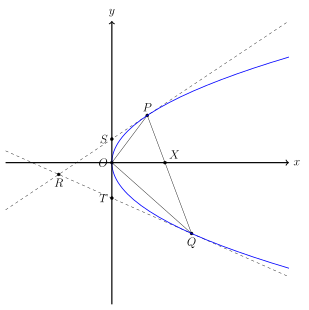
The points \(P(ap^2, 2ap)\) and \(Q(aq^2, 2aq)\), where \(p>0\) and \(q<0\), lie on the curve \(C\) with equation $$y^2= 4ax\,,$$ where \(a>0\,\). Show that the equation of the tangent to \(C\) at \(P\) is $$y= \frac 1 p \, x +ap\,.$$ The tangents to the curve at \(P\) and at \(Q \) meet at \(R\). These tangents meet the \(y\)-axis at \(S\) and \(T\) respectively, and \(O\) is the origin. Prove that the area of triangle \(OPQ\) is twice the area of triangle \(RST\).
Solution: \begin{align*} && 2yy' &= 4a \\ \Rightarrow && y' &= \frac{2a}{y} = \frac{2a}{2ap} = \frac1p \\ \Rightarrow && \frac{y-2ap}{x-ap^2} &= \frac1p \\ \Rightarrow && y &= \frac1p x +ap \end{align*} The other tangent will be \(y = \frac1qx+aq\) \begin{align*} &&& \begin{cases} py-x &= ap^2 \\ qy - x &= aq^2 \end{cases} \\ \Rightarrow && y(p-q) &= a(p^2-q^2) \\ \Rightarrow && y &= a(p+q) \\ && x &= apq \end{align*} Therefore \(R(apq, a(p+q)), S(0, ap), T(0, aq)\).
1995 Paper 2 Q7
The diagram shows a circle, of radius \(r\) and centre \(I\), touching the three sides of a triangle \(ABC\). We write \(a\) for the length of \(BC\) and \(\alpha\) for the angle \(\angle BAC\) and so on. Let \(s=\frac{1}{2}\left(a+b+c\right)\) and let \(\triangle\) be the area of the triangle.

- By considering the area of the triangles \(AIB,\) \(BIC\) and \(CIA\), or otherwise, show that \(\Delta=rs\).
- By using the formula \(\Delta=\frac{1}{2}bc\sin\alpha\), show that \[ \Delta^{2}=\tfrac{1}{16}[4b^{2}c^{2}-\left(2bc\cos\alpha\right)^{2}]. \] Now use the formula \(a^{2}=b^{2}+c^{2}-2bc\cos\alpha\) to show that \[ \Delta^{2}=\tfrac{1}{16}[(a^{2}-\left(b-c\right)^{2})(\left(b+c\right)^{2}-a^{2})] \] and deduce that \[ \Delta=\sqrt{s\left(s-a\right)\left(s-b\right)\left(s-c\right)}. \]
- A hole in the shape of the triangle \(ABC\) is cut in the top of a level table. A sphere of radius \(R\) rests in the hole. Find the height of the centre of the sphere above the level of the table top, expressing your answer in terms of \(a,b,c,s\) and \(R\).
Solution:
- \([AIB] = \frac12br\), \([BIC] = \frac12ar\), \([CIA] = \frac12 rc\), therefore \(\Delta = [AIB] +[BIC] + [CIA] = \frac12r(a+b+c) = sr\)
- \(\,\) \begin{align*} && \Delta &= \frac12 bc \sin \alpha \\ \Rightarrow && \Delta^2 &= \frac14 b^2c^2 \sin^2 \alpha \\ &&&= \frac14 \left (b^2c^2 - b^2c^2\cos^2 \alpha \right) \\ &&&= \frac1{16} \left (4b^2c^2 - (2bc\cos \alpha )^2\right) \\ \\ \Rightarrow && \Delta^2 &= \frac1{16} \left (4b^2c^2 - (b^2+c^2-a^2 )^2\right) \\ &&&= \frac1{16} (2bc-b^2-c^2+a^2)(2bc+b^2+c^2-a^2) \\ &&&= \frac{1}{16}(a^2-(b-c)^2)((b+c)^2-a^2) \\ &&&= \frac1{16}(a-b+c)(a+b-c)(b+c-a)(b+c+a) \\ &&&= (s - b)(s-c)(s-a)s \\ \Rightarrow && \Delta &= \sqrt{s(s-a)(s-b)(s-c)} \end{align*}
- We have the setting like this,
so \begin{align*} && h & = \sqrt{R^2-r^2} \\ &&&= \sqrt{R^2-\frac{\Delta^2}{s^2}} \\ &&&= \sqrt{R^2 - \frac{(s-a)(s-b)(s-c)}{s}} \end{align*}

1988 Paper 3 Q8
Find the equations of the tangent and normal to the parabola \(y^{2}=4ax\) at the point \((at^{2},2at).\) For \(i=1,2,\) and 3, let \(P_{i}\) be the point \((at_{i}^{2},2at_{i}),\) where \(t_{1},t_{2}\) and \(t_{3}\) are all distinct. Let \(A_{1}\) be the area of the triangle formed by the tangents at \(P_{1},P_{2}\) and \(P_{3},\) and let \(A_{2}\) be the area of the triangle formed by the normals at \(P_{1},P_{2}\) and \(P_{3}.\) Using the fact that the area of the triangle with vertices at \((x_{1},y_{1}),(x_{2},y_{2})\) and \((x_{3},y_{3})\) is the absolute value of \[ \tfrac{1}{2}\det\begin{pmatrix}x_{1} & y_{1} & 1\\ x_{2} & y_{2} & 1\\ x_{3} & y_{3} & 1 \end{pmatrix}, \] show that \(A_{3}=(t_{1}+t_{2}+t_{3})^{2}A_{1}.\) Deduce a necessary and sufficient condition in terms of \(t_{1},t_{2}\) and \(t_{3}\) for the normals at \(P_{1},P_{2}\) and \(P_{3}\) to be concurrent.
Solution: \(\frac{dy}{dt} = 2a, \frac{dx}{dt} = 2at \Rightarrow \frac{dy}{dx} = \frac{1}{t}\). Therefore the equation of the tangent will be \(\frac{y - 2at}{x-at^2} = \frac{1}{t} \Rightarrow y = \frac1tx +at\) and normal will be \(\frac{y-2at}{x-at^2} = -t \Rightarrow y = t(at^2-x+2a)\). The tangents will meet when: \begin{align*} && \begin{cases} t_iy -x &= at_i^2 \\ t_j y - x &= at_j^2 \\ \end{cases} \\ \Rightarrow &&(t_i - t_j)y &= a(t_i-t_j)(t_i+t_j) \\ \Rightarrow && y &= a(t_i+t_j) \\ && x &= at_it_j \end{align*} The normals will meet when: \begin{align*} && \begin{cases} y +t_i x &= at_i^3+2at_i \\ y +t_j x &= at_j^3+2at_j \\ \end{cases} \\ \Rightarrow &&(t_i - t_j)x &= a(t_i-t_j)(t_i^2+t_it_j+t_j^2+2) \\ \Rightarrow && x&= a(t_i^2+t_it_j+t_j^2+2) \\ && y &= -at_it_j(t_i+t_j) \end{align*} Therefore the area of our triangles will be: \begin{align*} \tfrac{1}{2}\det\begin{pmatrix}at_1t_2 & a(t_1+t_2) & 1\\ at_2t_3 & a(t_2+t_3) & 1\\ at_3t_1 & a(t_3+t_1) & 1 \end{pmatrix} &= \frac{a^2}{2}\det\begin{pmatrix}t_1t_2 & (t_1+t_2) & 1\\ t_2t_3 & (t_2+t_3) & 1\\ t_3t_1 & (t_3+t_1) & 1 \end{pmatrix} \\ &= \frac{a^2}{2}\det\begin{pmatrix}t_1t_2 & (t_1+t_2) & 1\\ t_2(t_3-t_1) & (t_3-t_1) & 0\\ t_1(t_3-t_2) & (t_3-t_2) & 0 \end{pmatrix} \\ &= \frac{a^2}{2}|(t_2-t_1)(t_3-t_2)(t_1-t_3)| \end{align*} and \begin{align*} \tfrac{1}{2}\det\begin{pmatrix}a(t_1^2+t_1t_2+t_2^2+2) & -at_1t_2(t_1+t_2) & 1\\ a(t_2^2+t_2t_3+t_3^2+2) & -at_2t_3(t_2+t_3) & 1\\ a(t_3^2+t_3t_1+t_1^2+2) & -at_3t_1(t_3+t_1) & 1\\ \end{pmatrix} &= \frac{a^2}{2}\det\begin{pmatrix}(t_1^2+t_1t_2+t_2^2+2) & -t_1t_2(t_1+t_2) & 1\\ (t_2^2+t_2t_3+t_3^2+2) & -t_2t_3(t_2+t_3) & 1\\ (t_3^2+t_3t_1+t_1^2+2) & -t_3t_1(t_3+t_1) & 1\\ \end{pmatrix} \\ &= \frac{a^2}{2}\det\begin{pmatrix}(t_1^2+t_1t_2+t_2^2+2) & -t_1t_2(t_1+t_2) & 1\\ t_3^2-t_1^2+t_2(t_3-t_1) & t_2(t_1^2+t_1t_2-t_2t_3-t_3^2) & 0\\ t_3^2-t_2^2+t_1(t_3-t_2) & t_1(t_2^2+t_2t_1-t_1t_3-t_3^2) & 0\\ \end{pmatrix} \\ &= \frac{a^2}{2}\det\begin{pmatrix}(t_1^2+t_1t_2+t_2^2+2) & -t_1t_2(t_1+t_2) & 1\\ (t_3-t_1)(t_3+t_2+t_1) & t_2(t_1-t_3)(t_1+t_3+t_2) & 0\\ (t_3-t_2)(t_3+t_2+t_1) & t_1(t_2-t_3)(t_1+t_2+t_3)& 0\\ \end{pmatrix} \\ &= \frac{a^2}{2}(t_1+t_2+t_3)^2|(t_2-t_1)(t_3-t_2)(t_1-t_3)| \end{align*} as required. The normals will be concurrent iff the area of their triangle is \(0\). This is certainly true if \(t_1+t_2+t_3 = 0\). In fact the only if is also true, since no \(3\) tangents can be concurrent.