Problems
Filters
6 problems found
2023 Paper 3 Q2
The polar curves \(C_1\) and \(C_2\) are defined for \(0 \leqslant \theta \leqslant \pi\) by \[r = k(1 + \sin\theta)\] \[r = k + \cos\theta\] respectively, where \(k\) is a constant greater than \(1\).
- Sketch the curves on the same diagram. Show that if \(\theta = \alpha\) at the point where the curves intersect, \(\tan\alpha = \dfrac{1}{k}\).
- The region A is defined by the inequalities \[0 \leqslant \theta \leqslant \alpha \quad \text{and} \quad r \leqslant k(1+\sin\theta)\,.\] Show that the area of A can be written as \[\frac{k^2}{4}(3\alpha - \sin\alpha\cos\alpha) + k^2(1 - \cos\alpha)\,.\]
- The region B is defined by the inequalities \[\alpha \leqslant \theta \leqslant \pi \quad \text{and} \quad r \leqslant k + \cos\theta\,.\] Find an expression in terms of \(k\) and \(\alpha\) for the area of B.
- The total area of regions A and B is denoted by \(R\). The area of the region enclosed by \(C_1\) and the lines \(\theta = 0\) and \(\theta = \pi\) is denoted by \(S\). The area of the region enclosed by \(C_2\) and the lines \(\theta = 0\) and \(\theta = \pi\) is denoted by \(T\). Show that as \(k \to \infty\), \[\frac{R}{T} \to 1\] and find the limit of \[\frac{R}{S}\] as \(k \to \infty\).
2020 Paper 3 Q6
- Sketch the curve \(y = \cos x + \sqrt{\cos 2x}\) for \(-\frac{1}{4}\pi \leqslant x \leqslant \frac{1}{4}\pi\).
- The equation of curve \(C_1\) in polar co-ordinates is \[ r = \cos\theta + \sqrt{\cos 2\theta} \qquad -\tfrac{1}{4}\pi \leqslant \theta \leqslant \tfrac{1}{4}\pi. \] Sketch the curve \(C_1\).
- The equation of curve \(C_2\) in polar co-ordinates is \[ r^2 - 2r\cos\theta + \sin^2\theta = 0 \qquad -\tfrac{1}{4}\pi \leqslant \theta \leqslant \tfrac{1}{4}\pi. \] Find the value of \(r\) when \(\theta = \pm\frac{1}{4}\pi\). Show that, when \(r\) is small, \(r \approx \frac{1}{2}\theta^2\). Sketch the curve \(C_2\), indicating clearly the behaviour of the curve near \(r=0\) and near \(\theta = \pm\frac{1}{4}\pi\). Show that the area enclosed by curve \(C_2\) and above the line \(\theta = 0\) is \(\dfrac{\pi}{2\sqrt{2}}\).
2015 Paper 3 Q3
In this question, \(r\) and \(\theta\) are polar coordinates with \(r \ge0\) and \(- \pi < \theta\le \pi\), and \(a\) and \(b\) are positive constants. Let \(L\) be a fixed line and let \(A\) be a fixed point not lying on \(L\). Then the locus of points that are a fixed distance (call it \(d\)) from \(L\) measured along lines through \(A\) is called a conchoid of Nicomedes.
- Show that if \[ \vert r- a \sec\theta \vert = b\,, \tag{\(*\)} \] where \(a>b\), then \(\sec\theta >0\). Show that all points with coordinates satisfying (\(*\)) lie on a certain conchoid of Nicomedes (you should identify \(L\), \(d\) and \(A\)). Sketch the locus of these points.
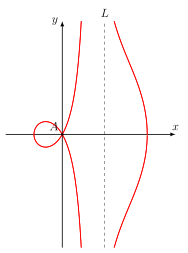
- In the case \(a < b\), sketch the curve (including the loop for which \(\sec\theta<0\)) given by \[ \vert r- a \sec\theta \vert = b\, . \] Find the area of the loop in the case \(a=1\) and \(b=2\). [Note: $ %\displaystyle \int \! \sec\theta \,\d \theta = \ln \vert \sec\theta + \tan\theta \vert + C \,. $]
Solution:
- \(r = a \sec \theta \pm b\). The points on \(r = a \sec \theta \Leftrightarrow r \cos \theta = a \Leftrightarrow x = a\) are points on the line \(x = a\). Therefore points on the curve \(r = a \sec \theta \pm b\) are points which are a distance \(b\) from the line \(x = a\) measured towards \(O\). So \(A\) is the origin and \(d = b\).
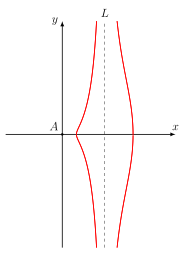
- The loop starts and ends when \(r = a \sec \theta - b = 0 \Rightarrow \cos \theta = \frac{a}{b}\), so when \(a = 1, b = 2\), this is \(-\frac{\pi}{3}\) to \(\frac{\pi}{3}\) \begin{align*} && A &= \frac12 \int r^2 \d \theta \\ &&&= \frac12 \int_{-\pi/3}^{\pi/3} \left ( \sec \theta - 2 \right)^2 \d \theta \\ &&&= \frac12 \int_{-\pi/3}^{\pi/3} \left (\sec^2 \theta - 4 \sec \theta + 4\right)\d \theta \\ &&&= \frac12 \left [ \tan \theta -4 \ln | \sec \theta + \tan \theta| + 4 \theta \right]_{-\pi/3}^{\pi/3} \\ &&&= \frac12 \left (\left (\tan \frac{\pi}3 - 4 \ln | \sec \frac{\pi}3 + \tan \frac{\pi}3 | + 4\left ( \frac{\pi}3 \right)\right) - \left (\tan \left (-\frac{\pi}3 \right) - 4 \ln | \sec \left (-\frac{\pi}3 \right)+ \tan\left ( -\frac{\pi}3 \right) | + 4\left ( -\frac{\pi}3 \right)\right) \right) \\ &&&= \frac12 \left ( 2\sqrt{3} - 4 \ln |2 + \sqrt{3}| + 4 \ln |2-\sqrt{3}| + \frac{8\pi}3 \right) \\ &&&= \sqrt{3} + 2\ln \frac{2-\sqrt{3}}{2+\sqrt{3}} + \frac{4\pi}3 \\ &&&= \sqrt{3} + 4 \ln (2 - \sqrt{3})+ \frac{4\pi}3 \end{align*}
1998 Paper 3 Q4
Show that the equation (in plane polar coordinates) \(r=\cos\theta\), for $-\frac{1}{2}\pi \le \theta \le \frac{1}{2}\pi$, represents a circle. Sketch the curve \(r=\cos2\theta\) for \(0\le\theta\le 2\pi\), and describe the curves \(r=\cos2n\theta\), where \(n\) is an integer. Show that the area enclosed by such a curve is independent of \(n\). Sketch also the curve \(r=\cos3\theta\) for \(0\le\theta\le 2\pi\).
1993 Paper 3 Q2
The curve \(C\) has the equation \(x^3+y^3 = 3xy\).
- Show that there is no point of inflection on \(C\). You may assume that the origin is not a point of inflection.
- The part of \(C\) which lies in the first quadrant is a closed loop touching the axes at the origin. By converting to polar coordinates, or otherwise, evaluate the area of this loop.
1991 Paper 3 Q5
The curve \(C\) has the differential equation in polar coordinates \[ \frac{\mathrm{d}^{2}r}{\mathrm{d}\theta^{2}}+4r=5\sin3\theta,\qquad\text{for }\quad\frac{\pi}{5}\leqslant\theta\leqslant\frac{3\pi}{5}, \] and, when \(\theta=\dfrac{\pi}{2},\) \(r=1\) and \(\dfrac{\mathrm{d}r}{\mathrm{d}\theta}=-2.\) Show that \(C\) forms a closed loop and that the area of the region enclosed by \(C\) is \[ \frac{\pi}{5}+\frac{25}{48}\left[\sin\left(\frac{\pi}{5}\right)-\sin\left(\frac{2\pi}{5}\right)\right]. \]
Solution: First we seek the complementary function. \begin{align*} && \frac{\mathrm{d}^{2}r}{\mathrm{d}\theta^{2}}+4r &= 0 \\ \Rightarrow && r &= A \sin 2\theta + B \cos 2 \theta \end{align*} Next we seek a particular integral, of the form \(r = C \sin 3 \theta\). \begin{align*} && \frac{\mathrm{d}^{2}r}{\mathrm{d}\theta^{2}}+4r &= 5 \sin 3 \theta \\ \Rightarrow && -9C \sin 3 \theta + 4C \sin 3 \theta &= 5 \sin 3 \theta \\ \Rightarrow && C &= -1 \\ \end{align*} So our general solution is \(A \sin 2\theta + B \cos 2 \theta -\sin 3 \theta\). Plugging in boundary conditions we obtain: \begin{align*} \theta = \frac{\pi}{2}, r = 1: &&1 &= -B +1 \\ \Rightarrow && B &= 0 \\ \theta = \frac{\pi}{2}, \frac{\d r}{\d \theta} = -2: && -2 &= -2A \\ \Rightarrow && A &= 1 \end{align*} So the general solution is \(r = \sin 2 \theta - \sin 3 \theta = 2 \sin \left ( \frac{-\theta}{2} \right) \cos \left (\frac{5 \theta}{2} \right)\) First notice that for \(\theta \in \left [\frac{\pi}{5}, \frac{3 \pi}{5} \right]\) this is positive, and it is zero on the end points, therefore we are tracing out a a loop. The area of the loop will be: \begin{align*} A &= \int_{\pi/5}^{3\pi/5} \frac12 \left ( \sin 2 \theta - \sin 3 \theta \right)^2 \d \theta \\ &= \frac12\int_{\pi/5}^{3\pi/5} \sin^2 2\theta + \sin^2 3 \theta - 2 \sin 2 \theta \cos 3 \theta \d \theta \\ &= \frac12\int_{\pi/5}^{3\pi/5} \frac{1-2 \cos 4 \theta}{2} + \frac{1-2 \cos6 \theta}{2} - \sin5 \theta-\cos\theta \d \theta \\ &= \frac12 \left [\theta - \frac14 \sin 4 \theta-\frac16 \sin 6 \theta + \frac15 \cos 5 \theta - \sin \theta \right]_{\pi/5}^{3\pi/5} \\ &= \frac{\pi}{5} +\frac{25}{48}\left [ \sin\left(\frac{\pi}{5}\right)-\sin\left(\frac{2\pi}{5}\right) \right] \end{align*}