Problems
Filters
18 problems found
2017 Paper 2 Q1
Note: In this question you may use without proof the result \( \dfrac{\d \ }{\d x}\big(\!\arctan x \big) = \dfrac 1 {1+x^2}\,\). Let \[ I_n = \int_0^1 x^n \arctan x \, \d x \;, \] where \(n=0\), 1, 2, 3, \(\ldots\) .
- Show that, for \(n\ge0\,\), \[ (n+1) I_n = \frac \pi 4 - \int _0^1 \frac {x^{n+1}}{1+x^2} \, \d x \, \] and evaluate \(I_0\).
- Find an expression, in terms of \(n\), for \((n+3)I_{n+2}+(n+1)I_{n}\,\). Use this result to evaluate \(I_4\).
- Prove by induction that, for \(n\ge1\), \[ (4n+1) I_{4n} =A - \frac12 \sum_{r=1}^{2n} (-1)^r \frac 1 {r} \,, \] where \(A\) is a constant to be determined.
Solution:
- \(\,\) \begin{align*} && I_n &= \int_0^1 x^n \arctan x \d x \\ &&&= \left [ \frac{x^{n+1}}{n+1} \arctan x\right]_0^1 - \int_0^1 \frac{x^{n+1}}{n+1} \frac{1}{1+x^2} \d x \\ &&&= \frac{1}{n+1} \frac{\pi}{4} - \frac{1}{n+1} \int_0^1 \frac{x^{n+1}}{1+x^2}\d x \\ \Rightarrow && (n+1)I_n &= \frac{\pi}{4} - \int_0^1 \frac{x^{n+1}}{1+x^2}\d x \\ && I_0 &= \frac{\pi}{4} - \int_0^1 \frac{x}{1+x^2} \d x \\ &&&= \frac{\pi}{4} - \left [\frac12 \ln(1+x^2) \right]_0^1 \\ &&&= \frac{\pi}{4} - \frac12 \ln 2 \end{align*}
- \(\,\) \begin{align*} && (n+3)I_{n+2} + (n+1)I_n &=\left ( \frac{\pi}{4} - \int_0^1 \frac{x^{n+3}}{1+x^2} \d x \right)+ \left (\frac{\pi}{4} - \int_0^1 \frac{x^{n+1}}{1+x^2} \d x \right) \\ &&&=\frac{\pi}{2}+ \int_0^1 \frac{x^{n+1}+x^{n+3}}{1+x^2} \d x \\ &&&=\frac{\pi}{2}+ \int_0^1 x^{n+1} \d x \\ &&&= \frac{\pi}{2} + \frac{1}{n+2} \\ && 3I_2 + I_0 &= \frac{\pi}{2} + \frac{1}{2} \\ \Rightarrow && 3I_2 &=\frac{\pi}{4} + \frac12 \ln 2 + \frac12 \\ && 5I_4 + 3I_2 &= \frac{\pi}{2} + \frac14 \\ \Rightarrow && 5I_4 &= \frac{\pi}{2} + \frac14 - \left ( \frac{\pi}{4} + \frac12 \ln 2 + \frac12\right) \\ &&&= \frac{\pi}4-\frac12 \ln 2-\frac14 \\ \Rightarrow && I_4 &= \frac15 \left (\frac{\pi}4-\frac12 \ln 2-\frac14 \right) \\ &&&= \frac1{20} \left (\pi - 2\ln 2 -1 \right) \end{align*}
- Claim: \[ (4n+1) I_{4n} =\frac{\pi}4-\frac12 \ln 2 - \frac12 \sum_{r=1}^{2n} (-1)^r \frac 1 {r} \,, \] Proof: Base case we have just shown above Assume true for \(n = k\), consider \(n = k+1\), then \begin{align*} && (4(k+1)+1) I_{4(k+1)} &= \frac{\pi}{2} + \frac{1}{4(k+1)} - (4k+3)I_{4k+2} \\ &&&= \frac{\pi}{2} + \frac{1}{4(k+1)} - \left (\frac{\pi}{2} + \frac{1}{2(2k+1)} - (4k+1)I_{4k} \right)\\ &&&= (4k+1)I_{4k} - \frac12 \left ( \frac{1}{2k+2} - \frac{1}{2k+1}\right) \\ &&&= \frac{\pi}4-\frac12 \ln 2 - \frac12 \sum_{r=1}^{2k} (-1)^r \frac 1 {r} - \frac12 \left ( \frac{1}{2k+2} - \frac{1}{2k+1}\right)\\ &&&= \frac{\pi}4-\frac12 \ln 2 - \frac12 \sum_{r=1}^{2(k+1)} (-1)^r \frac 1 {r} \\ \end{align*} as required.
2015 Paper 2 Q4
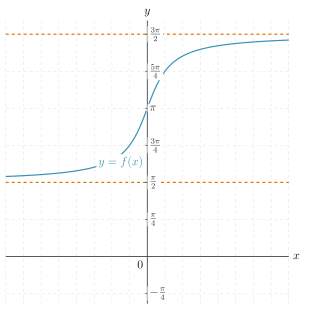
- The continuous function \(\f\) is defined by \[ \tan \f(x) = x \ \ \ \ \ (-\infty < x <\infty) \] and \(\f(0)=\pi\). Sketch the curve \(y=\f(x)\).
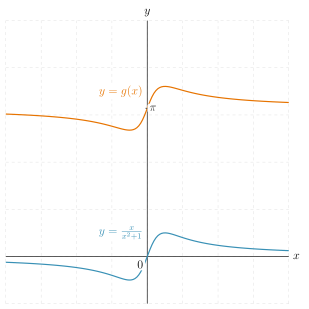
- The continuous function \(\g\) is defined by \[ \tan \g(x) = \frac x {1+x^2} \ \ \ \ \ \ (-\infty < x <\infty) \] and \(\g(0)=\pi\). Sketch the curves \(y= \dfrac x {1+x^2} \ \) and \(y=\g(x)\).
- The continuous function \(\h \) is defined by \(\h (0)=\pi\) and \[ \tan \h (x)= \frac x {1-x^2}\, \ \ \ \ \ (x \ne \pm 1) \,. \] (The values of \(\h (x)\) at \(x=\pm1\) are such that \(\h (x)\) is continuous at these points.) Sketch the curves \(y= \dfrac x {1-x^2} \ \) and \(y=\h (x)\).
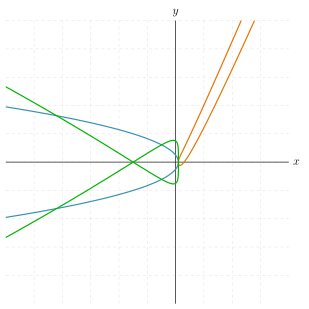
- [Not on original exam] The continuous functions \(\h_1\) and \(\h_2\) are defined by: \(\h_1(0)=\h_2(0)=\pi \), \[ \tan \h_1(x) = \frac {x+x^4} {1+x^2+x^4} \ \ \ \ \ \text{and} \ \ \ \ \ \ \tan \h_2(x) = \frac {4x-x^3} {1-x^4} \,. \] for values of \(x\) at which the right hand sides are defined. Find \(\lim\limits_{x\to\infty}\h_1(x)\) and \(\lim\limits_{x\to\infty}\h_2(x)\,\).
Solution:
- \(\,\)
- \(\,\)
- \(\,\)
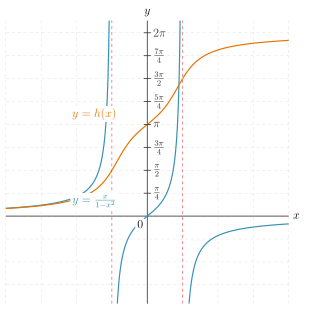
- Note that \(\frac{x+x^4}{1+x^2+x^4}\) is continuous, and nicely behaved on \((-\infty, \infty)\) so we can see that \(\lim_{x \to \infty} h_1(x) = \pi + \frac{\pi}{4} = \frac{5\pi}{4}\). \(\frac{4x-x^3}{1-x^4}\) on the other hand has asymptotes at \(\pm 1\). So as as \(x \to 1\), \(h_1(x) \to \pi + \frac{\pi}{2} = \frac{3\pi}{2}\). Then as \(x \to \infty\) we increase by another \(\frac{\pi}{2}\), so \(\lim_{x \to \infty} h_2(x) = 2\pi\)
2015 Paper 2 Q5
In this question, the \(\mathrm{arctan}\) function satisfies \(0\le \arctan x <\frac12 \pi\) for \(x\ge0\,\).
- Let \[ S_n= \sum_{m=1}^n \arctan \left(\frac1 {2m^2}\right) \,, \] for \(n=1, 2, 3, \ldots\) . Prove by induction that \[ \tan S_n = \frac n {n+1} \,. \] Prove also that \[ S_n = \arctan \frac n {n+1} \,. \]
- In a triangle \(ABC\), the lengths of the sides \(AB\) and \(BC\) are \(4n^2\) and \(4n^4-1\), respectively, and the angle at \(B\) is a right angle. Let \(\angle BCA = 2\alpha_n\). Show that \[ \sum_{n=1}^\infty \alpha_n = \tfrac14\pi \,. \]
Solution:
- Claim: \(\tan S_n = \frac n {n+1}\) Proof: (By Induction) Base case: (\(n=1\)): \begin{align*} && \tan \left ( \sum_{m=1}^1 \arctan \left ( \frac{1}{2m^2} \right) \right) &= \tan \left ( \arctan \left ( \frac{1}{2} \right) \right) \\ &&&= \frac12 = \frac{1}{1+1} \end{align*} Therefore the base case is true. Inductive step: Suppose our statement is true for some \(n = k\), ie \begin{align*} && \frac{k}{k+1} &= \tan \left ( \sum_{m=1}^k \arctan \left ( \frac{1}{2m^2} \right) \right) \\ \Rightarrow && \tan S_{k+1} &= \tan \left ( \sum_{m=1}^k \arctan \left ( \frac{1}{2m^2} \right) + \arctan \left ( \frac{1}{2 (k+1)^2} \right) \right) \\ &&&= \frac{\tan S_k + \tan \left ( \arctan \left ( \frac{1}{2 (k+1)^2} \right) \right)}{1-\tan S_k \tan \left ( \arctan \left ( \frac{1}{2 (k+1)^2} \right) \right)} \\ &&&= \frac{\frac{k}{k+1} + \frac{1}{2(k+1)^2}}{1-\frac{k}{k+1} \frac{1}{2(k+1)^2}} \\ &&&= \frac{2k(k+1)^2+(k+1)}{2(k+1)^3-k} \\ &&&= \frac{k+1}{(k+1)+1} \end{align*} Therefore it is true for \(n=k+1\). Conclusion: Therefore by the principle of mathematical induction since our statement is true for \(n=1\) and if it is true for \(n=k\) it is true for \(n=k+1\) it is true for all \(n\geq1\) Since \(S_n < \frac12 \pi\) for all \(n\), we must have \(\arctan \frac{n}{n+1} = S_n\)
- \(\tan (2\alpha_n) = \frac{4n^2}{4n^4-1} = \frac{2n^2+2n^2}{(2n^2)(2n^2)-1} = \frac{\frac{1}{2n^2}+\frac{1}{2n^2}}{1-\frac{1}{2n^2}\frac{1}{2n^2}} \Rightarrow \tan (\alpha_n) = \arctan \frac{1}{2n^2}\). In particular \(\displaystyle \sum_{n=1}^{N} \alpha_n = \arctan \frac{n}{n+1} \Rightarrow \sum_{n=1}^{\infty} \alpha_n \to \arctan 1 = \frac{\pi}{4} \)
2014 Paper 2 Q4
- By using the substitution \(u=1/x\), show that for \(b>0\) \[ \int_{1/b}^b \frac{x \ln x}{(a^2+x^2)(a^2x^2+1)} \d x =0 \,. \]
- By using the substitution \(u=1/x\), show that for \(b>0\), \[ \int_{1/b}^b \frac{\arctan x}{x} \d x = \frac{\pi \ln b} 2\,. \]
- By using the result \( \displaystyle \int_0^\infty \frac 1 {a^2+x^2} \d x = \frac {\pi}{2 a} \) (where \(a > 0\)),and a substitution of the form \(u=k/x\), for suitable \(k\), show that \[ \int_0^\infty \frac 1 {(a^2+x^2)^2} \d x = \frac {\pi}{4a^3 } \, \ \ \ \ \ \ (a > 0). \]
Solution:
- \begin{align*} && I &= \int_{1/b}^b \frac{x \ln x}{(a^2+x^2)(a^2x^2+1} \d x \\ u = 1/x, \d u = -1/x^2 \d x: &&&= \int_{u=b}^{u=1/b} \frac{1/u \ln(1/u)}{(a^2+u^{-2})(a^2u^{-2}+1)} (- \frac{1}{u^2}) \d u \\ &&&= \int_{1/b}^b \frac{-u\ln u}{(a^2u^2+1)(a^2+u^2)} \d u \\ &&&= -I \\ \Rightarrow && I &= 0 \end{align*}
- \(\,\) \begin{align*} && I &= \int_{1/b}^b \frac{\arctan x}{x} \d x \\ u = 1/x, \d x = -1/u^2 \d u: &&&= \int_{u=b}^{u=1/b} \frac{\arctan \frac1u}{\frac1u} \frac{-1}{u^2} \d u \\ &&&= \int_{1/b}^b \frac{\arctan \frac1u}{u} \d u \\ \Rightarrow && 2I &= \int_{1/b}^b \frac{\arctan x + \arctan \frac1x}{x} \d x \\ &&&= \int_{1/b}^b \frac{\frac{\pi}2}{x} \d x \\ &&&= \pi \ln b \\ \Rightarrow && I &= \frac{\pi}{2} \ln b \end{align*}
- \(\,\) \begin{align*} && I_a &= \int_0^{\infty} \frac{1}{(a^2+x^2)^2} \d x \\ u = a/x, \d x = -a/u^2 \d u:&&&= \int_{u=0}^{u=\infty} \frac{1}{\left (a^2+\frac{a^2}{u^2} \right)^2} \frac{a}{u^2} \d u \\ &&&= \frac1{a^3}\int_0^{\infty} \frac{1}{(u+1/u)^2} \d u \\ &&&= \frac{1}{a^3} \int_0^{\infty} \frac{u^2}{(u^2+1)^2} \d u \\ &&&= \frac{1}{a^3} \int_0^{\infty} \frac{u^2+1-1}{(u^2+1)^2} \d u \\ &&&= \frac{1}{a^3} \int_0^{\infty} \frac{1}{(u^2+1)} - \frac{1}{(u^2+1)^2} \d u \\ &&&= \frac1{a^3} \frac{\pi}{2} - \frac{1}{a^3} I_1 \\ \Rightarrow && 2I_1 &= \frac{\pi}{2} \\ \Rightarrow && I_1 &= \frac{\pi}{4} \\ \Rightarrow && I_a &= \frac{\pi}{4a^3} \end{align*}
2013 Paper 3 Q1
Given that \(t= \tan \frac12 x\), show that \(\dfrac {\d t}{\d x} = \frac12(1+t^2)\) and \( \sin x = \dfrac {2t}{1+t^2}\,\). Hence show that \[ \int_0^{\frac12\pi} \frac 1{1+a \sin x}\, \d x = \frac2 {\sqrt{1-a^2}} \arctan \frac{\sqrt{1-a}}{\sqrt{1+a}}\, \qquad \quad (0 < a < 1). \] Let \[ I_n = \int_0^{\frac12\pi} \frac{ \sin ^nx}{2+\sin x} \, \d x \qquad \quad (n\ge0). \] By considering \(I_{n+1}+2I_{n}\,\), or otherwise, evaluate \(I_3\).
Solution: Let \(t = \tan \frac12 x\), then \begin{align*} \frac{\d t}{\d x} &= \tfrac12 \sec^2 \tfrac12 t \\ &= \tfrac12 (1 + \tan^2 \tfrac12 ) \\ &= \tfrac12 (1 + t^2) \\ \\ \sin x &= 2 \sin \tfrac12 x \cos \tfrac12 \\ &= \frac{2 \frac{\sin \tfrac12 x}{ \cos \tfrac12x}}{\frac{1}{\cos^2 \tfrac12 x}} \\ &= \frac{2 \tan \tfrac12 x}{\sec^2 \tfrac12 } \\ &= \frac{2t }{1+t^2} \end{align*} Now consider \begin{align*} t = \tan \tfrac12 x: && \int_0^{\frac12\pi} \frac 1{1+a \sin x}\, \d x &= \int_{t=0}^{t = 1} \frac{1}{1 + a \frac{2t}{1+t^2}} \frac{2}{1+t^2} \d t \\ &&&= \int_0^1 \frac{2}{1+2at+t^2} \d t \\ &&&= \int_0^1 \frac{2}{(t+a)^2 + 1-a^2} \d t \\ (1-a^2) > 0: &&&= \left [ \frac{2}{\sqrt{1-a^2}} \arctan \frac{t+a}{\sqrt{1-a^2}} \right]_0^1 \\ &&&= \frac{2}{\sqrt{1-a^2}} \left ( \arctan \frac{1+a}{\sqrt{1-a^2}} - \arctan \frac{a}{\sqrt{1-a^2}} \right) \\ &&&= \frac{2}{\sqrt{1-a^2}} \arctan \left ( \frac{\frac{1+a}{\sqrt{1-a^2}}-\frac{a}{\sqrt{1-a^2}}}{1+\frac{1+a}{\sqrt{1-a^2}}\frac{a}{\sqrt{1-a^2}}} \right) \\ &&&= \frac{2}{\sqrt{1-a^2}} \arctan \left ( \frac{\frac{1}{\sqrt{1-a^2}}}{\frac{1+a}{1-a^2}} \right) \\ &&&= \frac{2}{\sqrt{1-a^2}} \arctan \left ( \frac{\sqrt{1-a}}{\sqrt{1+a}} \right) \end{align*} as required. Let \[ I_n = \int_0^{\frac12\pi} \frac{ \sin ^nx}{2+\sin x} \, \d x \qquad \quad (n\ge0). \] and consider \begin{align*} I_{n+1} + 2I_n &= \int_0^{\frac12\pi} \frac{ \sin ^{n+1}x+2\sin^{n} x}{2+\sin x} \, \d x \\ &= \int_0^{\frac12\pi} \frac{ \sin^n x (2 + \sin x)}{2+\sin x} \, \d x \\ &= \int_0^{\frac12\pi} \sin^n x \d x \end{align*} Therefore we can compute \begin{align*} I_0 &= \int_0^{\pi/2} \frac{1}{2 + \sin x} \d x \\ &= \frac12 \int_0^{\pi/2} \frac{1}{1 + \frac12 \sin x} \d x \\ &= \frac{1}{\sqrt{3/4}} \arctan \frac{\sqrt{1/2}}{\sqrt{3/2}} \\ &= \frac{2}{\sqrt{3}} \arctan \frac{1}{\sqrt{3}} \\ &= \frac{\pi}{3\sqrt{3}} \\ \\ I_1 &= \int_0^{\pi/2} 1 \d x - 2 I_0 \\ &= \frac{\pi}{2} - \frac{2\pi}{3\sqrt{3}} \\ I_2 &= \int_0^{\pi/2} \sin x \d x - 2I_1 \\ &= 1 - \pi + \frac{4\pi}{3\sqrt{3}} \\ I_3 &= \int_0^{\pi/2} \sin^2 x \d x - 2I_2 \\ &= \frac12 \int_0^{\pi/2} \sin^2 + \cos^2 x \d x - 2I_2 \\ &= \frac{\pi}{4} - 2 + 2\pi - \frac{8\pi}{3\sqrt{3}} \\ &= -2 + \frac{9\pi}{4} - \frac{8\pi}{3\sqrt{3}} \end{align*}
2012 Paper 3 Q8
The sequence \(F_0\), \(F_1\), \(F_2\), \(\ldots\,\) is defined by \(F_0=0\), \(F_1=1\) and, for \(n\ge0\), \[ F_{n+2} = F_{n+1} + F_n \,. \]
- Show that \(F_0F_3-F_1F_2 = F_2F_5- F_3F_4\,\).
- Find the values of \(F_nF_{n+3} - F_{n+1}F_{n+2}\) in the two cases that arise.
- Prove that, for \(r=1\), \(2\), \(3\), \(\ldots\,\), \[ \arctan \left( \frac 1{F_{2r}}\right) =\arctan \left( \frac 1{F_{2r+1}}\right)+ \arctan \left( \frac 1{F_{2r+2}}\right) \] and hence evaluate the following sum (which you may assume converges): \[ \sum_{r=1}^\infty \arctan \left( \frac 1{F_{2r+1}}\right) \,. \]
2011 Paper 2 Q3
In this question, you may assume without proof that any function \(\f\) for which \(\f'(x)\ge 0\) is increasing; that is, \(\f(x_2)\ge \f(x_1)\) if \(x_2\ge x_1\,\).
- Let \(\f(x) =\sin x -x\cos x\). Show that \(\f(x)\) is increasing for \(0\le x \le \frac12\pi\,\) and deduce that \(\f(x)\ge 0\,\) for \(0\le x \le \frac12\pi\,\).
- Given that \(\dfrac{\d}{\d x} (\arcsin x) \ge1\) for \(0\le x< 1\), show that \[ \arcsin x\ge x \quad (0\le x < 1). \]
- Let \(\g(x)= x\cosec x\, \text{ for }0< x < \frac12\pi\). Show that \(\g\) is increasing and deduce that \[ ({\arcsin x})\, x^{-1} \ge x\,{\cosec x} \quad (0 < x < 1). \]
- Given that $\dfrac{\d}{\d x} (\arctan x)\le 1\text{ for }x\ge 0$, show by considering the function \(x^{-1} \tan x\) that \[ (\tan x)( \arctan x) \ge x^2 \quad (0< x < \tfrac12\pi). \]
Solution:
- Given \(\frac{\d}{\d x} (\arctan x) \leq 1\) we must have \(\frac{\d}{ \d x} (x-\arctan x) \geq 0\) for \(x \geq 0\), but since \( 0 - \arctan 0 = 0\) this means that \(x - \arctan x \geq 0\), ie \( \arctan x \geq x\) for \(x \geq 0\) \(g(x) = x^{-1} \tan x \Rightarrow g'(x) = -x^{-2}\tan x +x^{-1} \sec^2 x\). If we can show \(f(x) = x \sec ^2 x - \tan x\) is positive that would be great. However \(f'(x) = x 2 \tan x \sec^2 x \geq 0\) and \(f(0) = 0\) so \(f(x)\) is positive and \(g'(x)\) is positive and hence increasing, therefore \(g(x) \geq g(\arctan x) \Rightarrow \frac{\tan x}{x} \geq \frac{x}{\arctan x}\) from which the result follows.
2007 Paper 1 Q2
- Given that \(A = \arctan \frac12\) and that \(B = \arctan\frac13\,\) (where \(A\) and \(B\) are acute) show, by considering \(\tan \left( A + B \right)\), that \(A + B = {\frac{1}{4}\pi }\). The non-zero integers \(p\) and \(q\) satisfy \[ \displaystyle \arctan {\frac1 p} + \arctan {\frac1 q} = {\frac\pi 4}\,. \] Show that \( \left ( p-1 \right) \left(q-1 \right) = 2\) and hence determine \(p\) and \(q\).
- Let \(r\), \(s\) and \(t\) be positive integers such that the highest common factor of \(s\) and \(t\) is \(1\). Show that, if \[ \arctan {\frac1 r} + \arctan \frac s {s+t} = {\frac\pi 4}\,, \] then there are only two possible values for \(t\), and give \(r\) in terms of \(s\) in each case.
Solution:
- \begin{align*} && \tan (A+B) &= \frac{\tan A + \tan B}{1-\tan A \tan B}\\ &&&= \frac{\tan \arctan \frac12 + \tan \arctan \frac13}{1-\tan \arctan \frac12 \tan \arctan \frac13}\\ &&&= \frac{\frac12+\frac13}{1-\frac16} \\ &&&= \frac{3+2}{5} \\ &&&= 1 \\ \Rightarrow && A+B &= \frac{\pi}{4} + n \pi \end{align*} but since \(A,B\) are acute \(0 < A+B < \pi\), so \(A+B = \frac{\pi}{4}\) \begin{align*} && 1 &= \tan \frac{\pi}{4} \\ &&&= \tan \left ( \arctan {\frac1 p} + \arctan {\frac1 q}\right) \\ &&&= \frac{\frac1p + \frac1q}{1-\frac1{pq}} \\ &&&= \frac{q+p}{pq-1} \\ \Rightarrow && pq-1 &= q+p \\ \Rightarrow && 0 &= pq-q-p-q \\ &&&= (p-1)(q-1)-2 \\ \Rightarrow && 2 &= (p-1)(q-1) \end{align*} But \(p\),\(q\) are integers, so \(p-1 \in \{-2,-1,1,1\} \Rightarrow p \in \{-1,0,2,3\}\) but we cannot have \(p= 0\), so we must have \((p,q) = (2,3), (3,2)\)
- \begin{align*} && 1 &= \tan \frac{\pi}{4} \\ &&&= \tan \left ( \arctan {\frac1 r} + \arctan \frac s {s+t} \right) \\ &&&= \frac{\frac1r + \frac{s}{s+t}}{1-\frac{s}{r(s+t)}} \\ &&&= \frac{s+t+sr}{r(s+t)-s} \\ \Rightarrow && rs+rt-s &= s+t + sr \\ \Rightarrow && 0 &= rt-2s-t \\ &&2s&= t(r-1) \end{align*} Since \((s,t) =1\), we must have \(t \mid 2\), so \( t = 1,2\) and \(r = 2s+1\) or \(r=s+1\) respectively.
2007 Paper 2 Q3
By writing \(x=a\tan\theta\), show that, for \(a\ne0\), $\displaystyle \int \frac 1 {a^2+x^2}\, \d x =\frac 1 a \arctan \frac x a + \text{constant}\,$.
- Let $\displaystyle I=\int_0^{\frac{1}{2}\pi}
\frac {\cos x}{1+\sin^2 x} \, \d x\,$.
- Evaluate \(I\).
- Use the substitution \(t=\tan \frac12 x\) to show that \(\displaystyle \int_0^1 \frac {1-t^2}{1+6t^2+t^4} \, \d t = \tfrac12 I\,\).
- Evaluate \(\displaystyle \int_0^1 \frac {1-t^2}{1+14t^2+t^4} \, \d t \,\).
Solution: \begin{align*} && I &= \int \frac{1}{a^2+x^2} \d x\\ x = a \tan \theta, \d x =a \sec^2 \theta \d \theta &&&= \int \frac{1}{a^2+a^2\tan^2 x} a \sec^2 \theta \d \theta \\ &&&=\int \frac{\sec^2 \theta}{a \sec^2 \theta} \d \theta \\ &&&= \frac1a \theta + C \\ &&&= \frac1a \arctan \frac{x}{a} + C \end{align*}
- \(\,\) \begin{align*} && I &= \int_0^{\frac{1}{2}\pi} \frac {\cos x}{1+\sin^2 x} \d x \\ &&&= \left [ \arctan (\sin x) \right]_0^{\pi/2} \\ &&&= \arctan(1) - \arctan(0) = \frac{\pi}{4} \end{align*}
- \(\,\) \begin{align*} && t &= \tan \frac{x}{2} \\ \Rightarrow && \sin x &= \frac{2t}{1+t^2} \\ && \cos x &= \frac{1-t^2}{1+t^2} \\ && \d x &= \frac{2}{1+t^2} \d t \\ \Rightarrow && I &= \int_0^{\pi/2} \frac{\cos x}{1 + \sin^2 x } \d x \\ &&&= \int_{t=0}^{t = 1} \frac{\frac{1-t^2}{1+t^2}}{1 + \left (\frac{2t}{1+t^2} \right)^2} \frac{2}{1+t^2} \d t \\ &&&= 2 \int_0^1 \frac{1-t^2}{(1+t^2)^2+(2t)^2} \d t\\ &&&= 2 \int_0^1 \frac{1-t^2}{1+6t^2+t^4} \d t\\ \end{align*} From which the conclusion follows
- \(\,\) \begin{align*} && J &= \int_0^1 \frac {1-t^2}{1+14t^2+t^4} \, \d t \\ &&&= \int_0^1 \frac {\frac{1-t^2}{1+t^2}}{\frac{1+14t^2+t^4}{(1+t^2)^2}} \frac{1}{1+t^2} \, \d t \\ &&&= \int_0^1 \frac {\frac{1-t^2}{1+t^2}}{\frac{(t^2+1)^2+3(2t)^2}{(1+t^2)^2}} \frac{1}{1+t^2} \, \d t \\ &&&= \frac12\int_{x=0}^{x=\pi/2} \frac {\cos x}{1+3 \sin^2 x} \d x \\ &&&= \frac{1}{6}\left[ \sqrt{3} \arctan(\sin \sqrt{3}x)\right]_0^{\pi/2} \\ &&&= \frac16 \sqrt{3} \frac{\pi}{3} \\ &&&= \frac{\sqrt{3}\pi}{18} \end{align*}
2005 Paper 2 Q4
The positive numbers \(a\), \(b\) and \(c\) satisfy \(bc=a^2+1\). Prove that $$ \arctan\left(\frac1 {a+b}\right)+ \arctan\left(\frac1 {a+c}\right)= \arctan\left(\frac1 a \right). $$ The positive numbers \(p\), \(q\), \(r\), \(s\), \(t\), \(u\) and \(v\) satisfy $$ st = (p+q)^2 + 1 \;, \ \ \ \ \ \ uv=(p+r)^2 + 1 \;, \ \ \ \ \ \ qr = p^2+1\;. $$ Prove that $$ \arctan \! \!\left(\!\frac1 {p+q+s}\!\right) + \arctan \! \!\left(\!\frac 1{p+q+t}\!\right) + \arctan \! \!\left(\!\frac 1 {p+r+u}\!\right) + \arctan \! \!\left(\!\frac1 {p+r+v}\!\right) =\arctan \! \!\left( \! \frac1 p \! \right) . $$ Hence show that $$ \arctan\left(\frac1 {13}\right) +\arctan\left(\frac1 {21}\right) +\arctan\left(\frac1 {82}\right) +\arctan\left(\frac1 {187}\right) =\arctan\left(\frac1 {7}\right). $$ [Note that \(\arctan x\) is another notation for \( \tan^{-1}x \,.\,\)]
Solution: \begin{align*} && \tan \left (\arctan\left(\frac1 {a+b}\right)+ \arctan\left(\frac1 {a+c}\right) \right) &= \frac{\frac1{a+b}+\frac1{a+c}}{1-\frac{1}{(a+b)(a+c)}} \\ &&&= \frac{a+c+a+b}{(a+b)(a+c)-1} \\ &&&= \frac{2a+b+c}{a^2+ab+ac+bc-1} \\ &&&= \frac{2a+b+c}{2a^2+ab+ac} \\ &&&= \frac{1}{a} \\ &&&= \tan \arctan \frac1a\\ \Rightarrow && \arctan\left(\frac1 {a+b}\right)+ \arctan\left(\frac1 {a+c}\right) &= \arctan \frac{1}{a} + n \pi \end{align*} Since \(\arctan x \in (-\frac{\pi}{2}, \frac{\pi}{2})\) the LHS \(\in (0, \pi)\) so \(n = 0\). \begin{align*} a=p+q, b = s, c = t:&& \arctan \! \!\left(\!\frac1 {p+q+s}\!\right) + \arctan \! \!\left(\!\frac 1{p+q+t}\!\right) &= \arctan \left ( \frac{1}{p+q} \right) \\ a=p+r, b= u, c = v && \arctan \! \!\left(\!\frac 1 {p+r+u}\!\right) + \arctan \! \!\left(\!\frac1 {p+r+v}\!\right) &= \arctan \! \!\left(\!\frac1 {p+r}\!\right) \\ a = p, b = q, c = r:&& \arctan \left ( \frac{1}{p+q} \right) +\arctan \! \!\left(\!\frac1 {p+r}\!\right) &= \arctan \left ( \frac1p \right) \end{align*} and the result follows. Taking \(p = 7\) we need to solve \[ \begin{cases} q+s &= 6 \\ q+t &= 14 \\ r+u &= 75 \\ r+v &= 180 \end{cases} \] also satisfying \(qr = 50\) etc, so say \(q = 1, r = 50, s = 5, v=25\)
2005 Paper 2 Q11
A plane is inclined at an angle \(\arctan \frac34\) to the horizontal and a small, smooth, light pulley~\(P\) is fixed to the top of the plane. A string, \(APB\), passes over the pulley. A particle of mass~\(m_1\) is attached to the string at \(A\) and rests on the inclined plane with \(AP\) parallel to a line of greatest slope in the plane. A particle of mass \(m_2\), where \(m_2>m_1\), is attached to the string at \(B\) and hangs freely with \(BP\) vertical. The coefficient of friction between the particle at \(A\) and the plane is \( \frac{1}{2}\). The system is released from rest with the string taut. Show that the acceleration of the particles is \(\ds \frac{m_2-m_1}{m_2+m_1}g\). At a time \(T\) after release, the string breaks. Given that the particle at \(A\) does not reach the pulley at any point in its motion, find an expression in terms of \(T\) for the time after release at which the particle at \(A\) reaches its maximum height. It is found that, regardless of when the string broke, this time is equal to the time taken by the particle at \(A\) to descend from its point of maximum height to the point at which it was released. Find the ratio \(m_1 : m_2\). \noindent [Note that \(\arctan \frac34\) is another notation for \(\tan^{-1} \frac34\,\).]
2004 Paper 1 Q9
A particle is projected over level ground with a speed \(u\) at an angle \(\theta\) above the horizontal. Derive an expression for the greatest height of the particle in terms of \(u\), \(\theta\) and \(g\). A particle is projected from the floor of a horizontal tunnel of height \({9\over 10}d\). Point \(P\) is \({1\over 2}d\) metres vertically and \(d\) metres horizontally along the tunnel from the point of projection. The particle passes through point \(P\) and lands inside the tunnel without hitting the roof. Show that \[ \arctan \textstyle {3 \over 5} < \theta < \arctan \, 3 \;. \]
Solution: \begin{align*} && v^2 &= u^2 + 2as \\ (\uparrow): && 0 &= (u \sin \theta)^2 - 2gh \\ \Rightarrow && h &= \frac{u^2 \sin^2 \theta}{2g} \end{align*} To avoid hitting the ceiling \begin{align*} && \frac9{10}d &>\frac{u^2 \sin^2 \theta}{2g} \\ \Rightarrow && \frac{gd}{u^2}&>\frac{5\sin^2 \theta}{9} \\ \end{align*} In order to pass through \(P\) we need \begin{align*} && d &= u \cos \theta t \\ && \frac12 d &= u \sin \theta t - \frac12 g t^2 \\ \Rightarrow && \frac12 &= \tan \theta - \frac12 \frac{g d}{u^2} \sec^2 \theta \\ &&&<\tan \theta - \frac12 \frac{5 \sin^2 \theta}{9\cos^2 \theta} \\ \Rightarrow && 0 & >5 \tan^2 \theta -18\tan \theta +9 \\ &&&= (5\tan \theta - 3)(\tan \theta - 3) \\ \\ \Rightarrow && \tan \theta &\in \left ( \frac35, 3\right) \\ && \theta &= \left (\arctan \tfrac35, \arctan 3 \right) \end{align*}
2003 Paper 2 Q2
Write down a value of \(\theta\,\) in the interval \(\frac{1}{4}\pi< \theta <\frac{1}{2}\pi\) that satisfies the equation \[ 4\cos\theta+ 2\sqrt3\, \sin\theta = 5 \;. \] Hence, or otherwise, show that \[ \pi=3\arccos(5/\sqrt{28}) + 3\arctan(\sqrt3/2)\;. \] Show that \[ \pi=4\arcsin(7\sqrt2/10) - 4\arctan(3/4)\;. \]
Solution: If \(\theta = \frac{\pi}{3}\) then \(\cos \theta = \frac12, \sin \theta = \frac{\sqrt{3}}{2}\) and clearly the equation is satisfied. We can also solve this equation using the harmonic formulae, namely: \begin{align*} && 5 &= 4 \cos \theta + 2\sqrt{3} \sin \theta \\ &&&= \sqrt{4^2+2^2 \cdot 3} \cos \left (\theta -\tan^{-1} \left (\frac{2\sqrt{3}}{4}\right) \right) \\ \Rightarrow && \frac{5}{\sqrt{28}} &= \cos \left ( \frac{\pi}{3} - \tan^{-1} \left (\frac{\sqrt{3}}{2}\right) \right) \\ \Rightarrow && \frac{\pi}{3} &= \arccos\left( \frac{5}{\sqrt{28}}\right) + \arctan \left (\frac{\sqrt{3}}{2}\right) \end{align*} From which the result follows. Similarly, notice that \(3 \cos \theta + 4 \sin \theta = \frac{7}{\sqrt{2}}\) is clearly solved by \(\frac{\pi}{4}\), but also writing it in harmonic form, we have \begin{align*} &&\frac{7}{\sqrt{2}} &= 5 \sin \left (\theta + \tan^{-1} \left ( \frac{3}{4} \right) \right) \\ \Rightarrow && \frac{7\sqrt{2}}{10} &= \sin \left ( \frac{\pi}{4} + \tan^{-1} \left ( \frac{3}{4} \right) \right) \\ \Rightarrow && \frac{\pi}{4} &= \arcsin \left ( \frac{7\sqrt{2}}{10} \right) - \arctan \left ( \frac{3}{4} \right) \end{align*} as required.
2001 Paper 2 Q6
Show that \[ \int_0^1 \frac{x^4}{1+x^2} \, \d x = \frac \pi {4} - \frac 23 \;. \] Determine the values of
- \(\displaystyle \int_0^1 x^3 \; \tan ^{-1} \left(\frac {1-x} {1+x} \right) \,\d x \)
- \(\displaystyle \int_0^1 \frac {(1-y)^3} {(1+y)^5} \; {{\tan}^{-1} y}\, \d y\)
Solution: \begin{align*} && \int_0^1 \frac{x^4}{1+x^2} \d x &= \int_0^1 \frac{(x^2-1)(1+x^2)+1}{x^2+1} \d x\\ &&&= \int_0^1 \frac{1}{1+x^2} \d x -\int_0^1 (1-x^2) \d x \\ &&&= \left [\tan^{-1}x \right]_0^1 - \left [x - \tfrac13x^3 \right]_0^1 \\ &&&= \frac{\pi}{4} - \frac23 \end{align*}
- \(\,\) \begin{align*} && I &= \int_0^1 x^3 \; \tan ^{-1} \left(\frac {1-x} {1+x} \right) \,\d x \\ &&&= \left [ \frac{x^4}{4}\tan ^{-1} \left(\frac {1-x} {1+x} \right) \right]_0^1 -\int_0^1 \frac{x^4}{4} \frac{1}{1 +\left(\frac {1-x} {1+x} \right) ^2 } \cdot \frac{-2}{(1+x)^2} \d x \\ &&&= \frac{1}{2} \int_0^1 \frac{x^4}{(1+x)^2+(1-x)^2} \d x \\ &&&= \frac{1}{4} \int_0^1 \frac{x^4}{1+x^2} \d x \\ &&&= \frac{\pi}{16} - \frac{1}{6} \end{align*}
- \(\,\) \begin{align*} && J &= \int_0^1 \frac {(1-y)^3} {(1+y)^5} \; {{\tan}^{-1} y}\, \d y \\ &&&= \left [ \frac {(y(1+y^2)} {(1+y)^4} \tan^{-1}y \right]_0^1 - \int_0^1 \frac {(y(1+y^2)} {(1+y)^4} \frac{1}{1+y^2} \d y \\ &&&= \frac{\pi}{32} - \int_0^1 \frac{y}{(1+y)^4} \d y \\ &&&= \frac{\pi}{32} - \left[ - \frac{3y+1}{6(1+y)^3} \right]_0^1 \\ &&&= \frac{\pi}{32} +\frac{4}{6 \cdot 8} - \frac{1}{6} \\ &&&= \frac{\pi}{32} - \frac{1}{12} \end{align*}
2001 Paper 3 Q4
In this question, the function \(\sin^{-1}\) is defined to have domain \( -1\le x \le 1\) and range \linebreak \( - \frac{1}{2}\pi \le x \le \frac{1}{2}\pi\) and the function \(\tan^{-1}\) is defined to have the real numbers as its domain and range \( - \frac{1}{2}\pi < x < \frac{1}{2}\pi\).
- Let
$$
\g(x) = \displaystyle {2x \over 1 + x^2}\;, \ \ \ \ \ \ \ \ \ \ -\infty
- Let \[ \displaystyle \f \l x \r = \sin^{-1} \l {2x \over 1 + x^2} \r \;,\ \ \ \ \ \ \ \ \ -\infty < x < \infty\;. \] Show that $ \f(x ) = 2 \tan^{-1} x\( for \) -1 \le x \le 1\,\( and \)\f(x) = \pi - 2 \tan^{-1} x \( for \)x\ge1\,$. Sketch the graph of \(\f(x)\).