Problems
Filters
4 problems found
2016 Paper 3 Q6
Show, by finding \(R\) and \(\gamma\), that \(A \sinh x + B\cosh x \) can be written in the form \(R\cosh (x+\gamma)\) if \(B>A>0\). Determine the corresponding forms in the other cases that arise, for \(A>0\), according to the value of \(B\). Two curves have equations \(y = \textrm{sech} x\) and \(y = a\tanh x + b\,\), where \(a>0\).
- In the case \(b>a\), show that if the curves intersect then the \(x\)-coordinates of the points of intersection can be written in the form \[ \pm\textrm{arcosh} \left( \frac 1 {\sqrt{b^2-a^2}}\right) - {\rm artanh \,} \frac a b .\]
- Find the corresponding result in the case \(a>b>0\,\).
- Find necessary and sufficient conditions on \(a\) and \(b\) for the curves to intersect at two distinct points.
- Find necessary and sufficient conditions on \(a\) and \(b\) for the curves to touch and, given that they touch, express the \(y\)-coordinate of the point of contact in terms of \(a\).
Solution: \begin{align*} && R\cosh(x + \gamma) &=R \cosh x \cosh \gamma + R \sinh x \sinh \gamma \\ \Rightarrow && R \cosh \gamma &= B \\ && R \sinh \gamma &= A \\ \Rightarrow && R^2 &= B^2 - A^2 \\ \Rightarrow && \tanh \gamma &= \frac{A}{B} \\ \end{align*} Therefore it is possible, by writing \(R = \sqrt{B^2-A^2}\) and \(\gamma = \textrm{artanh} \left ( \frac{A}{B} \right)\). This works as long as \(|B| > A > 0\). Supposing \(A >|B| \), try \(S \sinh (x + \delta) = S \sinh x \cosh \delta +S \cosh x \sinh \delta\) \begin{align*} && S \cosh \delta &= A \\ && -S \sinh \delta &= B \\ \Rightarrow && S^2 &= A^2 - B^2 \\ \Rightarrow && \tanh \delta &= \frac{B}{A} \\ \end{align*} Therefore in this case we can write \(\sqrt{A^2-B^2} \sinh \left (x + \tanh^{-1} \left ( \frac{B}{A} \right) \right)\) If \(A = \pm B > 0\) we can we have \(A \sinh x + B \cosh x = \pm Ae^{\pm x}\)
- Suppose \(y \cosh x = 1\) and \(y \cosh x = a \sinh x +b \cosh x\) so \begin{align*} && 1 & = a \sinh x + b \cosh x \\ &&&= \sqrt{b^2-a^2} \cosh(x + \textrm{artanh} \frac{a}{b} ) \\ \Rightarrow && x + \textrm{artanh} \frac{a}{b} &= \pm \textrm{arcosh} \left ( \frac{1}{\sqrt{b^2-a^2}} \right) \\ \Rightarrow && x &= \pm \textrm{arcosh} \left ( \frac{1}{\sqrt{b^2-a^2}} \right) -\textrm{artanh} \frac{a}{b} \end{align*}
- If \( a > b > 0\) we have \begin{align*} && 1 & = \sqrt{a^2-b^2} \sinh \left ( x - \textrm{artanh} \frac{b}{a} \right) \\ \Rightarrow && x &= \textrm{arsinh} \left ( \frac{1}{\sqrt{a^2-b^2}} \right) + \textrm{artanh} \left ( \frac{b}{a} \right) \end{align*}
- To intersect at distinct points we must have \(b > a\) and \(\textrm{arcosh} \left ( \frac{1}{\sqrt{b^2-a^2}} \right) \neq 0\) which is always true.
- For the curves to touch, we need them to intersect and have matching derivatives, ie \begin{align*} && -\tanh x \cdot \textrm{sech}x &= a\textrm{sech}^2 x \\ \Rightarrow && 0 &= \textrm{sech}^2 x (a + \sinh x) \\ \Rightarrow && x &= -\textrm{arsinh} \, a\\ \Rightarrow && \sinh x &= - a\\ \Rightarrow &&\cosh x &= \sqrt{1 + a^2} \\ \end{align*} So if the curves touch, we must have \(1 = -a^2+b\sqrt{1+a^2} \Rightarrow b = \sqrt{1+a^2}\) and since this does work it is a necessary and sufficient condition. We will also have the \(y\) coordinate is \(\frac{1}{\sqrt{1+a^2}}\)
2008 Paper 3 Q4
- Show, with the aid of a sketch, that \(y> \tanh (y/2)\) for \(y>0\) and deduce that \begin{equation} \textrm{arcosh} x > \dfrac{x-1}{\sqrt{x^2-1}} \text{ for } x>1. \tag{\(*\)} \end{equation}
- By integrating \((*)\), show that $\textrm{arcosh} x > 2 \dfrac{{x-1}}{\sqrt{x^2-1}} \( for \)x>1$.
- Show that $\textrm{arcosh} x >3 \dfrac{\sqrt{x^2-1}}{{x+2}} \( for \)x>1$.
Solution:
- If \(y = \textrm{arcosh} x \), then \(\tanh\textrm{arcosh} x/2 = \sqrt{\frac{\cosh \textrm{arcosh} x-1}{\cosh \textrm{arcosh} x+1}} = \sqrt{\frac{x-1}{x+1}} = \frac{x-1}{\sqrt{x^2-1}}\)
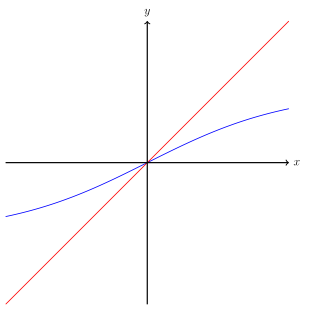
- \begin{align*} \int \textrm{arcosh} x \d x &= \left [x \textrm{arcosh} x \right] - \int \frac{x}{\sqrt{x^2-1}} \d x \\ &= x \textrm{arcosh} x - \sqrt{x^2-1}+C \\ \int \frac{x-1}{\sqrt{x^2-1}} &= \sqrt{x^2-1} - \textrm{arcosh} x +C \end{align*} Therefore \begin{align*} && \int_1^x \textrm{arcosh} t \d t &> \int_1^x \frac{t-1}{\sqrt{t^2-1}} \d t \\ \Rightarrow && x \textrm{arcosh} x - \sqrt{x^2-1} - 0 &> \sqrt{x^2-1} - \textrm{arcosh} x - 0 \\ \Rightarrow && (x+1) \textrm{arcosh} x &> 2\sqrt{x^2-1} \\ \Rightarrow && \textrm{arcosh} x & > 2\frac{\sqrt{x^2-1}}{x+1} \\ &&&= 2 \frac{\sqrt{x-1}}{\sqrt{x+1}} \\ &&&= 2 \frac{x-1}{\sqrt{x^2-1}} \end{align*}
- Integrating both sides again, \begin{align*} && \int_1^x \textrm{arcosh} t \d t &> 2 \int_1^x \frac{t-1}{\sqrt{t^2-1}} \d t \\ \Rightarrow && x \textrm{arcosh} x - \sqrt{x^2-1} &> 2\left (\sqrt{x^2-1} - \textrm{arcosh}x \right) \\ \Rightarrow && (x+2)\textrm{arcosh} x &> 3 \sqrt{x^2-1} \\ \Rightarrow && \textrm{arcosh} x &> 3 \frac{\sqrt{x^2-1}}{x+2} \end{align*}
2005 Paper 3 Q6
In this question, you may use without proof the results \[ 4 \cosh^3 y - 3 \cosh y = \cosh (3y) \ \ \ \ \text{and} \ \ \ \ \mathrm{arcosh} \, y = \ln ( y+\sqrt{y^2-1}). \] \noindent[ {\bf Note: } \(\mathrm{arcosh}y\) is another notation for \(\cosh^{-1}y\,\)] Show that the equation \(x^3 - 3a^2x = 2a^3 \cosh T\) is satisfied by \( 2a \cosh \l \frac13 T \r\) and hence that, if \(c^2\ge b^3>0\), one of the roots of the equation \(x^3-3bx=2c\) is \(\ds u+\frac{b}{u}\), where \(u = (c+\sqrt{c^2-b^3})^{\frac13}\;\). Show that the other two roots of the equation \(x^3-3bx=2c\) are the roots of the quadratic equation \[\ds x^2 + \Big( u+\frac{b}{u}\Big) x + u^2+\frac{b^2}{u^2}-b=0\, ,\] and find these roots in terms of \(u\), \(b\) and \(\omega\), where \(\omega = \frac{1}{2}(-1 + \mathrm{i}\sqrt{3})\). Solve completely the equation \(x^3-6x=6\,\).
2003 Paper 3 Q1
Given that \(x+a>0\) and \(x+b>0\,\), and that \(b>a\,\), show that \[ \frac{\mathrm{d} \ }{\mathrm{d} x} \arcsin \left ( \frac{x + a }{ \ x + b} \right) = \frac{ \sqrt{\;b - a\;}} {( x + b ) \sqrt{ a + b + 2x} \ \ } \] and find $\displaystyle \frac{\mathrm{d} \ }{ \mathrm{d} x} \; \mathrm{arcosh} \left ( \frac{x + b }{ \ x + a} \right)$. Hence, or otherwise, integrate, for \(x > -1\,\),
- \[ \int \frac{1}{ ( x + 1) \sqrt{x + 3} } \mathrm{d} x \]
- \[ \int \frac{1} {( x + 3 ) \sqrt{x + 1} } \mathrm{d} x \] .
Solution: \begin{align*} \frac{\mathrm{d} \ }{\mathrm{d} x} \arcsin \left ( \frac{x + a }{ \ x + b} \right ) &= \frac{1}{\sqrt{1-\left ( \frac{x + a }{ \ x + b} \right )^2}} \left ( \frac{b-a}{(x+b)^2} \right) \\ &= \frac{b-a}{(x+b)\sqrt{(x+b)^2-(x+a)^2}} \\ &= \frac{b-a}{(x+b)\sqrt{(b-a)(2x+b+a)}} \\ &= \frac{\sqrt{b-a}}{(x+b)\sqrt{a+b+2x}} \\ \\ \frac{\mathrm{d} \ }{ \mathrm{d} x} \; \mathrm{arcosh} \left ( \frac{x + b }{ \ x + a} \right) &= \frac{1}{\sqrt{\left ( \frac{x + b }{ \ x + a} \right)^2-1}} \left ( -\frac{b-a}{(x+a)^2} \right) \\ &= -\frac{b-a}{(x+a)\sqrt{(x+b)^2-(x+a)^2}} \\ &= -\frac{b-a}{(x+a)\sqrt{(b-a)(a+b+2x)}} \\ &= -\frac{\sqrt{b-a}}{(x+a)\sqrt{a+b+2x}} \end{align*}
- \begin{align*} \int \frac{1}{ ( x + 1) \sqrt{x + 3} } \mathrm{d} x &= \int \frac{1}{(x+1)\sqrt{\frac12 (2x+6)}} \d x\\ &= \int \frac{\sqrt{2}}{(x+1)\sqrt{2x+1+5}} \d x \\ &= \frac{\sqrt{2}}{2}\int \frac{\sqrt{5-1}}{(x+1)\sqrt{2x+1+5}} \d x \\ &= - \frac{\sqrt{2}}{2}\textrm{arcosh} \left ( \frac{x+5}{x+1} \right) + C \end{align*}
- \begin{align*} \int \frac{1}{(x+3)\sqrt{x+1}} \d x &= \int \frac{1}{(x+3)\sqrt{\tfrac12(2x+2)}} \d x + C \\ &= \int \frac{\sqrt{3-1}}{(x+3)\sqrt{2x+3-1}} \d x \\ &= \textrm{arcsin} \left ( \frac{x-1}{x+3} \right) \end{align*}