Problems
Filters
8 problems found
2024 Paper 2 Q4
In this question, if \(O\), \(C\) and \(D\) are non-collinear points in three dimensional space, we will call the non-zero vector \(\mathbf{v}\) a \emph{bisecting vector} for angle \(COD\) if \(\mathbf{v}\) lies in the plane \(COD\), the angle between \(\mathbf{v}\) and \(\overrightarrow{OC}\) is equal to the angle between \(\mathbf{v}\) and \(\overrightarrow{OD}\), and both angles are less than \(90^\circ\).
- Let \(O\), \(X\) and \(Y\) be non-collinear points in three-dimensional space, and define \(\mathbf{x} = \overrightarrow{OX}\) and \(\mathbf{y} = \overrightarrow{OY}\).
Let \(\mathbf{b} = |\mathbf{x}|\mathbf{y} + |\mathbf{y}|\mathbf{x}\).
- Show that \(\mathbf{b}\) is a bisecting vector for angle \(XOY\). Explain, using a diagram, why any other bisecting vector for angle \(XOY\) is a positive multiple of \(\mathbf{b}\).
- Find the value of \(\lambda\) such that the point \(B\), defined by \(\overrightarrow{OB} = \lambda\mathbf{b}\), lies on the line \(XY\). Find also the ratio in which the point \(B\) divides \(XY\).
- Show, in the case when \(OB\) is perpendicular to \(XY\), that the triangle \(XOY\) is isosceles.
- Let \(O\), \(P\), \(Q\) and \(R\) be points in three-dimensional space, no three of which are collinear. A bisecting vector is chosen for each of the angles \(POQ\), \(QOR\) and \(ROP\). Show that the three angles between them are either all acute, all obtuse or all right angles.
2021 Paper 3 Q4
Let \(\mathbf{n}\) be a vector of unit length and \(\Pi\) be the plane through the origin perpendicular to \(\mathbf{n}\). For any vector \(\mathbf{x}\), the projection of \(\mathbf{x}\) onto the plane \(\Pi\) is defined to be the vector \(\mathbf{x} - (\mathbf{x} \cdot \mathbf{n})\,\mathbf{n}\). The vectors \(\mathbf{a}\) and \(\mathbf{b}\) each have unit length and the angle between them is \(\theta\), which satisfies \(0 < \theta < \pi\). The vector \(\mathbf{m}\) is given by \(\mathbf{m} = \tfrac{1}{2}(\mathbf{a} + \mathbf{b})\).
- Show that \(\mathbf{m}\) bisects the angle between \(\mathbf{a}\) and \(\mathbf{b}\).
- The vector \(\mathbf{c}\) also has unit length. The angle between \(\mathbf{a}\) and \(\mathbf{c}\) is \(\alpha\), and the angle between \(\mathbf{b}\) and \(\mathbf{c}\) is \(\beta\). Both angles are acute and non-zero. Let \(\mathbf{a}_1\) and \(\mathbf{b}_1\) be the projections of \(\mathbf{a}\) and \(\mathbf{b}\), respectively, onto the plane through the origin perpendicular to \(\mathbf{c}\). Show that \(\mathbf{a}_1 \cdot \mathbf{c} = 0\) and, by considering \(|\mathbf{a}_1|^2 = \mathbf{a}_1 \cdot \mathbf{a}_1\), show that \(|\mathbf{a}_1| = \sin\alpha\). Show also that the angle \(\varphi\) between \(\mathbf{a}_1\) and \(\mathbf{b}_1\) satisfies \[ \cos\varphi = \frac{\cos\theta - \cos\alpha\cos\beta}{\sin\alpha\sin\beta}. \]
- Let \(\mathbf{m}_1\) be the projection of \(\mathbf{m}\) onto the plane through the origin perpendicular to \(\mathbf{c}\). Show that \(\mathbf{m}_1\) bisects the angle between \(\mathbf{a}_1\) and \(\mathbf{b}_1\) if and only if \[ \alpha = \beta \qquad \text{or} \qquad \cos\theta = \cos(\alpha - \beta). \]
Solution:
- \(\,\) \begin{align*} && \cos \angle MOB &= \frac{\mathbf{m} \cdot \mathbf{b}}{|\mathbf{m}||\mathbf{b}|} \\ &&&= \frac{\cos \theta + 1}{2\sqrt{\frac14(\mathbf{a}+\mathbf{b})\cdot(\mathbf{a}+\mathbf{b})}} \\ &&&= \frac{\cos \theta + 1}{\sqrt{1+1+2\cos \theta}} \\ &&&= \frac{1 + \cos \theta}{\sqrt{2(1+\cos \theta})} \\ &&&= \frac1{\sqrt{2}} \sqrt{1+\cos \theta} \\ &&&= \cos \tfrac{\theta}{2} \end{align*} Since \(0 < \theta < \pi\) we must have \(\angle MOB = \tfrac{\theta}{2}\) ie it is the angle bisector.
- The plane through the origin perpendicular to \(\mathbf{c}\) has \(\mathbf{x} \cdot \mathbf{c} = 0\), so \begin{align*} && \mathbf{a}_1 \cdot \mathbf{c} &= (\mathbf{a} - (\mathbf{a} \cdot \mathbf{c}) \mathbf{c}) \cdot \mathbf{c} \\ &&&= \mathbf{a} \cdot \mathbf{c} - \mathbf{a} \cdot \mathbf{c} \\ &&&= 0 \\ \\ && |\mathbf{a}_1|^2 &= \mathbf{a}_1 \cdot \mathbf{a}_1 \\ &&&= (\mathbf{a} - (\mathbf{a} \cdot \mathbf{c}) \mathbf{c}) \cdot (\mathbf{a} - (\mathbf{a} \cdot \mathbf{c}) \mathbf{c}) \\ &&&= 1 - 2(\mathbf{a} \cdot \mathbf{c})^2 + \mathbf{a} \cdot \mathbf{c} \\ &&&= (1-\cos^2 \alpha) \\ &&&= \sin^2 \alpha \\ \Rightarrow && |\mathbf{a}_1| &= \sin \alpha \\ \Rightarrow && |\mathbf{b}_1| &= \sin \beta \tag{changing a and b} \\ \\ && \cos \phi &= \frac{\mathbf{a}_1 \cdot \mathbf{b}_1}{|\mathbf{a}_1||\mathbf{b}_1|} \\ &&&= \frac{(\mathbf{a} - (\mathbf{a} \cdot \mathbf{c}) \mathbf{c}) \cdot (\mathbf{b} - (\mathbf{b} \cdot \mathbf{c}) \mathbf{c})}{\sin \alpha \sin \beta} \\ &&&= \frac{\mathbf{a} \cdot \mathbf{b} - 2(\mathbf{a} \cdot \mathbf{c}) \cdot (\mathbf{b} \cdot \mathbf{c})+(\mathbf{a} \cdot \mathbf{c}) \cdot (\mathbf{b} \cdot \mathbf{c})}{\sin \alpha \sin \beta} \\ &&&= \frac{\cos \theta - \cos \alpha \cos \beta}{\sin \alpha \sin \beta} \end{align*}
- Note that \(\mathbf{m}_1 = \tfrac12(\mathbf{a}_1 + \mathbf{b}_1)\) either by expanding or by noting that projection is linear \begin{align*} && \cos \angle M_1OB_1 &= \frac{\mathbf{m}_1 \cdot \mathbf{b}_1}{|\mathbf{m}_1||\mathbf{b}_1|} \\ &&&= \frac{(\mathbf{a}_1 + \mathbf{b}_1) \cdot \mathbf{b}_1}{2|\mathbf{m}_1||\mathbf{b}_1|} \\ &&&= \frac{\mathbf{a}_1 \cdot \mathbf{b}_1 + |\mathbf{b}_1|^2}{2|\mathbf{m}_1||\mathbf{b}_1|} \\ &&&= \frac{|\mathbf{a}_1 || \mathbf{b}_1| \cos \phi + |\mathbf{b}_1|^2}{2|\mathbf{m}_1||\mathbf{b}_1|} \\ &&&= \frac{|\mathbf{a}_1 |\cos \phi + |\mathbf{b}_1|}{2|\mathbf{m}_1|} \\ &&&= \frac{\sin \alpha \cos \phi + \sin \beta}{2\sin \frac{\theta}{2}} \\ &&&= \frac{\sin \alpha \frac{\cos \theta - \cos \alpha \cos \beta}{\sin \alpha \sin \beta} + \sin \beta}{2\sin \frac{\theta}{2}} \\ &&&= \frac{\cos \theta - \cos \alpha \cos \beta+ \sin^2 \beta}{2\sin \frac{\theta}{2} \sin \beta} \\ \Rightarrow && \cos \angle M_1OA_1 &= \frac{\cos \theta - \cos \beta \cos \alpha+ \sin^2 \alpha}{2\sin \frac{\theta}{2} \sin \alpha} \end{align*} \(M_1\) is a bisector iff these two cosines are equal, ie \begin{align*} && \cos \angle M_1OB_1 &= \cos \angle M_1OA_1 \\ \Leftrightarrow && \frac{\cos \theta - \cos \alpha \cos \beta+ \sin^2 \beta}{2\sin \frac{\theta}{2} \sin \beta} &= \frac{\cos \theta - \cos \beta \cos \alpha+ \sin^2 \alpha}{2\sin \frac{\theta}{2} \sin \alpha} \\ \Leftrightarrow && \cos \theta (\sin \alpha - \sin \beta) &= \cos \alpha \cos \beta(\sin \alpha - \sin \beta) + \sin \alpha \sin \beta (\sin \alpha - \sin \beta) \\ \Leftrightarrow &&0 &= (\sin \alpha - \sin \beta)( \cos \theta - (\cos \alpha \cos \beta + \sin \alpha \sin \beta)) \\ &&&= (\sin \alpha - \sin \beta) (\cos \theta - \cos (\alpha - \beta)) \end{align*} From which the result immediately follows
2015 Paper 2 Q2
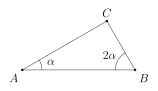
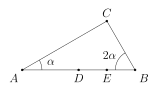
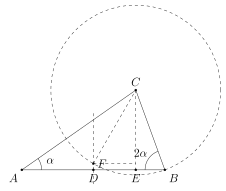
In the triangle \(ABC\), angle \(BAC = \alpha\) and angle \(CBA= 2\alpha\), where \(2\alpha\) is acute, and \(BC= x\). Show that \(AB = (3-4 \sin^2\alpha)x\). The point \(D\) is the midpoint of \(AB\) and the point \(E\) is the foot of the perpendicular from \(C\) to \(AB\). Find an expression for \(DE\) in terms of \(x\). The point \(F\) lies on the perpendicular bisector of \(AB\) and is a distance \(x\) from \(C\). The points \(F\) and \(B\) lie on the same side of the line through \(A\) and \(C\). Show that the line \(FC\) trisects the angle \(ACB\).
Solution:
2011 Paper 1 Q4
The distinct points \(P\) and \(Q\), with coordinates \((ap^2,2ap)\) and \((aq^2,2aq)\) respectively, lie on the curve \(y^2=4ax\). The tangents to the curve at \(P\) and \(Q\) meet at the point \(T\). Show that \(T\) has coordinates \(\big(apq, a(p+q)\big)\). You may assume that \(p\ne0\) and \(q\ne0\). The point \(F\) has coordinates \((a,0)\) and \(\phi\) is the angle \(TFP\). Show that \[ \cos\phi = \frac{pq+1}{\sqrt{(p^2+1)(q^2+1)}\ } \] and deduce that the line \(FT\) bisects the angle \(PFQ\).
Solution: The tangent at \((at^2, 2at)\) can be found \begin{align*} && \frac{\d y}{\d x} &= \frac{\dot{y}}{\dot{x}} \\ &&&= \frac{2a}{2at} = \frac1t \\ \Rightarrow && \frac{y-2at}{x-at^2} &= \frac1t \\ \Rightarrow && ty -x &= at^2 \\ \\ PT: && py - x &= ap^2 \\ QT: && qy - x &= aq^2 \\ \Rightarrow && (p-q)y &= a(p^2-q^2) \\ \Rightarrow && y &= a(p+q) \\ && x &= aq(p+q) - aq^2 \\ &&&= apq \end{align*} By the cosine rule: \begin{align*} && TP^2 &= FT^2 + FP^2 - 2 \cdot FT \cdot FP \cdot \cos \phi \\ && (apq - ap^2)^2 + (a(p+q)-2ap)^2 &= (a-apq)^2+(a(p+q))^2 + \\ &&&\quad + (a-ap^2) + (2ap)^2 - 2 \cdot FT \cdot FP \cdot \cos \phi \\ \Rightarrow && a^2p^2(q-p)^2 + a^2(q-p)^2 &= a^2(1-pq)^2+a^2(p+q)^2 + \\ &&&\quad + a^2(1-p^2)^2+4a^2p^2 - 2 \cdot FT \cdot FP \cdot \cos \phi \\ && a^2(p^2+1)(q-p)^2 &= a^2(1+p^2)(1+q^2) + a^2(1+p^2)^2 + \\ &&&\quad - 2 \cdot a^2(1+p^2)\sqrt{(1+p^2)(1+q^2)} \cos \phi \\ \Rightarrow && \cos \phi &= \frac{a^2(1+p^2)(2+q^2+p^2-(q-p)^2)}{2 a^2 (1+p^2)\sqrt{(1+p^2)(1+q^2)}} \\ &&&= \frac{1+pq}{\sqrt{(1+p^2)(1+q^2)}} \end{align*} As required. Notice that by symmetry, \(\cos \angle TFQ = \frac{1+qp}{\sqrt{(1+q^2)(1+p^2)}} = \cos \phi\). Therefore they have the same angle and \(FT\) bisects \(PFQ\)
2010 Paper 2 Q5
The points \(A\) and \(B\) have position vectors \(\bf i +j+k\) and \(5{\bf i} - {\bf j} -{\bf k}\), respectively, relative to the origin \(O\). Find \(\cos2\alpha\), where \(2\alpha\) is the angle \(\angle AOB\).
- The line \(L _1\) has equation \({\bf r} =\lambda(m{\bf i}+n {\bf j} + p{\bf k})\). Given that \(L _1\) is inclined equally to \(OA\) and to \(OB\), determine a relationship between \(m\), \(n\) and~\(p\). Find also values of \(m\), \(n\) and~\(p\) for which \(L _1\) is the angle bisector of \(\angle AOB\).
- The line \(L _2\) has equation \({\bf r} =\mu(u{\bf i}+v {\bf j} + w{\bf k})\). Given that \( L _2\) is inclined at an angle \(\alpha\) to \(OA\), where \(2\alpha = \angle AOB\), determine a relationship between \(u\), \(v\) and \(w\). Hence describe the surface with Cartesian equation \(x^2+y^2+z^2 =2(yz+zx+xy)\).
2008 Paper 2 Q8
The points \(A\) and \(B\) have position vectors \(\bf a\) and \(\bf b\), respectively, relative to the origin \(O\). The points \(A\), \(B\) and \(O\) are not collinear. The point \(P\) lies on \(AB\) between \(A\) and \(B\) such that \[ AP : PB = (1-\lambda):\lambda\,. \] Write down the position vector of \(P\) in terms of \(\bf a\), \(\bf b\) and \(\lambda\). Given that \(OP\) bisects \(\angle AOB\), determine \(\lambda\) in terms of \(a\) and \(b\), where \(a=\vert \bf a\vert\) and $b=\vert \mathbf{b}\vert\(. The point \)Q\( also lies on \)AB\( between \)A\( and \)B\(, and is such that \)AP=BQ$. Prove that $$OQ^2-OP^2=(b-a)^2\,.$$
Solution:

1991 Paper 2 Q2
The equation of a hyperbola (with respect to axes which are displaced and rotated with respect to the standard axes) is \[ 3y^{2}-10xy+3x^{2}+16y-16x+15=0.\tag{\(\dagger\)} \] By differentiating \((\dagger)\), or otherwise, show that the equation of the tangent through the point \((s,t)\) on the curve is \[ y=\left(\frac{5t-3s+8}{3t-5s+8}\right)x-\left(\frac{8t-8s+15}{3t-5s+8}\right). \] Show that the equations of the asymptote (the limiting tangents as \(s\rightarrow\infty\)) are \[ y=3x-4\qquad\mbox{ and }\qquad3y=x-4. \] {[}Hint: You will need to find a relationship between \(s\) and \(t\) which is valid in the limit as \(s\rightarrow\infty.\){]} Show that the angle between one asymptote and the \(x\)-axis is the same as the angle between the other asymptote and the \(y\)-axis. Deduce the slopes of the lines that bisect the angles between the asymptotes and find the equations of the axes of the hyperbola.
Solution: \begin{align*} && 0 &= 3y^{2}-10xy+3x^{2}+16y-16x+15 \\ \Rightarrow && 0 &= 6y \frac{\d y}{\d x} - 10x \frac{\d y}{\d x} - 10y + 6x+ 16 \frac{\d y}{\d x } - 16 \\ &&&= \frac{\d y}{\d x} \left (6y - 10x +16 \right) - (10y-6x+16) \\ \Rightarrow && \frac{\d y}{\d x} &= \frac{5y-3x+8}{3y-5x+8} \\ \Rightarrow && \frac{y-t}{x-s} &= \frac{5t-3s+8}{3t-5s+8} \\ && y &= \left(\frac{5t-3s+8}{3t-5s+8}\right)x -\left(\frac{5t-3s+8}{3t-5s+8}\right)s + t \\ &&&= \left(\frac{5t-3s+8}{3t-5s+8}\right)x - \frac{(5ts-3s^2+8s)-(3t^2-5st+8t)}{3t-5s+8} \\ &&&= \left(\frac{5t-3s+8}{3t-5s+8}\right)x - \frac{(5ts-3s^2+8s)-(3t^2-5st+8t)}{3t-5s+8} \\ &&&= \left(\frac{5t-3s+8}{3t-5s+8}\right)x - \frac{8s-8t-(3s^2+3t^2-10st)}{3t-5s+8} \\ &&&= \left(\frac{5t-3s+8}{3t-5s+8}\right)x - \frac{8s-8t-(16s-16t-15)}{3t-5s+8} \\ &&&= \left(\frac{5t-3s+8}{3t-5s+8}\right)x - \frac{8t-8s+15}{3t-5s+8} \\ \end{align*} While \(x \to \infty\) we still have \(3 \frac{y^2}{x^2} - 10 \frac{y}{x} + 3 + 16 \frac{y}{x^2} - 16\frac{1}{x} + 15 \frac{1}{x^2} = 0\), ie if \(\frac{y}{x} = k\), then \(3k^2 - 10k + 3 \to 0 \Rightarrow k \to 3, \frac13\). Therefore, as \(s \to \infty\) we can write \begin{align*} && y &= \left(\frac{5\frac{t}{s}-3+8\frac{1}{s}}{3\frac{t}{s}-5+8\frac1{s}}\right)x - \frac{8\frac{t}s-8+15\frac{1}{s}}{3\frac{t}{s}-5+8\frac{1}{s}} \\ k \to 3: &&& \to \left(\frac{15-3}{9-5}\right)x - \frac{24-8}{9-5} \\ &&&= 3x - 4 \\ k \to \frac13: && &\to \left(\frac{\frac53-3}{1-5}\right)x - \frac{\frac83-8}{1-5} \\ &&&= \frac13 x - \frac43 \end{align*} Therefore the equations are \(y = 3x-4\) and \(3y=x-4\) The lines are parallel to \(y = 3x\) and \(y = \frac13x\), so by considering the triangles formed with the origin and a point \(1\) along the \(x\) or \(y\) axis we can see the angles are identical. This means the line \(y = x\) is parallel to one axis and \(y = -x\) is parallel to the other. They must meet where our two lines meet which is \((1,-1)\), so our lines are \(y = x-2\) and \(y = -x\)
1989 Paper 3 Q6
Show that, for a given constant \(\gamma\) \((\sin\gamma\neq0)\) and with suitable choice of the constants \(A\) and \(B\), the line with cartesian equation \(lx+my=1\) has polar equations \[ \frac{1}{r}=A\cos\theta+B\cos(\theta-\gamma). \] The distinct points \(P\) and \(Q\) on the conic with polar equations \[ \frac{a}{r}=1+e\cos\theta \] correspond to \(\theta=\gamma-\delta\) and \(\theta=\gamma+\delta\) respectively, and \(\cos\delta\neq0.\) Obtain the polar equation of the chord \(PQ.\) Hence, or otherwise, obtain the equation of the tangent at the point where \(\theta=\gamma.\) The tangents at \(L\) and \(M\) to a conic with focus \(S\) meet at \(T.\) Show that \(ST\) bisects the angle \(LSM\) and find the position of the intersection of \(ST\) and \(LM\) in terms of your chosen parameters for \(L\) and \(M.\)
Solution: \begin{align*} && \frac1{r} &= A \cos \theta + B \cos (\theta - \gamma) \\ &&&= A \cos \theta + B \cos \theta \cos \gamma + B \sin \theta \sin \gamma \\ &&&= (A+B \cos \gamma) \cos \theta + B \sin \gamma \sin \theta \\ \Longleftrightarrow && 1 &= (A+B \cos \gamma) x + B \sin \gamma y \end{align*} So if we choose \(B = \frac{m}{\sin \gamma}\) and \(A = l-m \cot \gamma\) we have the desired result. \begin{align*} && \frac{1 + e \cos (\gamma -\delta)}a &= A \cos (\gamma - \delta) + B \cos (\gamma - \delta - \gamma) \\ &&&= A \cos(\gamma-\delta) +B \cos \delta\\ && \frac{1 + e \cos (\gamma +\delta)}{a} &= A \cos (\gamma + \delta) + B \cos (\gamma + \delta - \gamma) \\ &&&= A \cos(\gamma + \delta) + B \cos \delta\\ \Rightarrow && \frac1{r} &= \frac{e}{a} \cos \theta + \frac{1}{a \cos \delta} \cos (\theta - \gamma) \\ \lim{\delta \to 0} &&\frac1{r} &= \frac{e}{a} \cos \theta+ \frac{1}{a} \cos (\theta - \gamma) \end{align*} Suppose we have have points \(L\) and \(M\) with \(\theta = \gamma_L, \gamma_M\) then our tangents are: \begin{align*} && \frac{a}{r} &= \cos \theta + \cos (\theta - \gamma_L) \\ && \frac{a}{r} &= \cos \theta + \cos (\theta - \gamma_M) \\ \Rightarrow && 0 &= \cos (\theta - \gamma_L) -\cos(\theta - \gamma_M) \\ &&&= - 2 \sin \frac{(\theta - \gamma_L)+(\theta - \gamma_M)}{2} \sin \frac{(\theta - \gamma_L)-(\theta - \gamma_M)}{2} \\ &&&= -2 \sin \left ( \theta - \frac{\gamma_L+\gamma_M}2 \right) \sin \left ( \frac{\gamma_M - \gamma_L}{2}\right) \\ \Rightarrow && \theta &= \frac{\gamma_L+\gamma_M}{2} \end{align*} Therefore clearly \(ST\) bisects \(LSM\). The line \(LM\) can be seen as the chord from the points \(\frac{\gamma_L+\gamma_M}{2} \pm \frac{\gamma_L-\gamma_M}{2}\), so the line is: \begin{align*} && \frac{a}{r} &= e \cos \theta + \frac{1}{\cos \left ( \frac{\gamma_L-\gamma_M}{2}\right)} \cos \left (\theta - \frac{\gamma_L+\gamma_M}{2} \right) \end{align*} and we want the point on the line where \(\theta =\frac{\gamma_L+\gamma_M}{2}\) so \begin{align*} && \frac{a}{r} &= e \cos \left ( \frac{\gamma_L+\gamma_M}{2} \right) + \frac{1}{\cos \left ( \frac{\gamma_L-\gamma_M}{2}\right)} \\ \Rightarrow && r &= \frac{a}{e \cos \left ( \frac{\gamma_L+\gamma_M}{2} \right) + \frac{1}{\cos \left ( \frac{\gamma_L-\gamma_M}{2}\right)}} \end{align*}