Problems
Filters
3 problems found
2007 Paper 1 Q5
Note: a regular octahedron is a polyhedron with eight faces each of which is an equilateral triangle.
- Show that the angle between any two faces of a regular octahedron is \(\arccos \left( -{\frac1 3} \right)\).
- Find the ratio of the volume of a regular octahedron to the volume of the cube whose vertices are the centres of the faces of the octahedron.
Solution:
- Suppose the vertices are \((\pm1, 0,0), (0,\pm1,0), (0,0,\pm1)\), then clearly this is an octahedron. We can measure the angle between the faces, by looking at vectors in the same plane and also in two of the faces: \(\langle \frac12, \frac12, - 1\rangle\) and \(\langle \frac12, \frac12, 1\rangle\), then by considering the dot product: \begin{align*} && \cos \theta &= \frac{\frac14+\frac14-1}{\frac14+\frac14+1} \\ &&&= \frac{-2}{6} = -\frac13 \end{align*}
- The volume of our octahedron is \(2 \cdot \frac13 \cdot \underbrace{\sqrt{2}^2}_{\text{base}} \cdot \underbrace{1}_{\text{height}} = \frac43\). The centre of two touching faces are \(\langle \frac13, \frac13, \frac13 \rangle\) and \(\langle \frac13, \frac13, -\frac13 \rangle\) and so the length of the side of the cube is \(\frac23\) and so the volume of the cube is \(\frac8{27}\). Therefore the ratio is \(\frac{2}{9}\)
2002 Paper 1 Q6
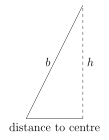
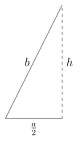
A pyramid stands on horizontal ground. Its base is an equilateral triangle with sides of length~\(a\), the other three sides of the pyramid are of length \(b\) and its volume is \(V\). Given that the formula for the volume of any pyramid is $ \textstyle \frac13 \times \mbox{area of base} \times \mbox {height} \,, $ show that \[ V= \frac1{12} {a^2(3b^2-a^2)}^{\frac12}\;. \] The pyramid is then placed so that a non-equilateral face lies on the ground. Show that the new height, \(h\), of the pyramid is given by \[ h^2 = \frac{a^2(3b^2-a^2)}{4b^2-a^2}\;. \] Find, in terms of \(a\) and \(b\,\), the angle between the equilateral triangle and the horizontal.
Solution: First let's consider the area of the base. It is an equilateral triangle with side length \(a\), so \(\frac12 a^2 \sin 60^\circ = \frac{\sqrt{3}}4a^2\).
1989 Paper 3 Q2
The points \(A,B\) and \(C\) lie on the surface of the ground, which is an inclined plane. The point \(B\) is 100m due north of \(A,\) and \(C\) is 60m due east of \(B\). The vertical displacements from \(A\) to \(B,\) and from \(B\) to \(C\), are each 5m downwards. A plane coal seam lies below the surface and is to be located by making vertical bore-holes at \(A,B\) and \(C\). The bore-holes strike the coal seam at 95m, 45m and 76m below \(A,B\) and \(C\) respectively. Show that the coal seam is inclined at \(\cos^{-1}(\frac{4}{5})\) to the horizontal. The coal seam comes to the surface along a line. Find the bearing of this line.
Solution: Set up a coordinate system so that \(x\) is E-W, \(y\) is N-S and \(z\) is the vertical direction. Also assume \(B\) is the origin, then, \(A = \begin{pmatrix} 0 \\ -100 \\ 5\end{pmatrix}, B = \begin{pmatrix} 0 \\ 0 \\ 0\end{pmatrix}, C= \begin{pmatrix} 60 \\ 0\\ -5\end{pmatrix},\). The coal seam has points: \(\begin{pmatrix} 0 \\ -100 \\ -90\end{pmatrix}, \begin{pmatrix} 0 \\ 0 \\ -45\end{pmatrix}, \begin{pmatrix} 60 \\ 0\\ -81\end{pmatrix},\) Therefore we can find the normal to the coal seam: \begin{align*} \mathbf{n} &= \left (\begin{pmatrix} 0 \\ -100 \\ -90\end{pmatrix} - \begin{pmatrix} 0 \\ 0 \\ -45\end{pmatrix}\right ) \times \left ( \begin{pmatrix} 60 \\ 0\\ -81\end{pmatrix} - \begin{pmatrix} 0 \\ 0 \\ -45\end{pmatrix}\right ) \\ &= \begin{pmatrix} 0 \\ - 100 \\ -45\end{pmatrix} \times \begin{pmatrix} 60 \\ 0 \\ -36\end{pmatrix} \\ &= \begin{pmatrix} 3600 \\ -60 \cdot 45 \\ 60 \cdot 100 \end{pmatrix} \\ &= 300\begin{pmatrix} 12 \\ -9 \\ 20\end{pmatrix} \end{align*} To measure the incline \(\theta\) to the horizontal we can take a dot with \(\hat{\mathbf{k}}\), to see: \begin{align*} \cos \theta &= \frac{20}{\sqrt{12^2+(-9)^2+20^2} \sqrt{1^2+0^2+0^2}} \\ &= \frac{20}{25} \\ &= \frac{4}{5} \end{align*} Therefore the angle is \(\cos^{-1} \tfrac 45\) The equation of the seam is \(12x - 9y + 20z = -900\). The equation of the surface is \(5x + 3y + 60z = 0\) We can compute the direction of the overlap again with a cross product: \begin{align*} \mathbf{d} &= \begin{pmatrix} 12 \\ -9 \\ 20\end{pmatrix} \times \begin{pmatrix} 5 \\ 3 \\ 60\end{pmatrix} \\ &= \begin{pmatrix} -600 \\ -620 \\ 81 \end{pmatrix} \end{align*} To get the bearing of this vector we just need to look at the \(x\) and \(y\) components, so it will be \(\tan^{-1} \frac{600}{620} = \tan^{-1} \frac{30}{31}\)