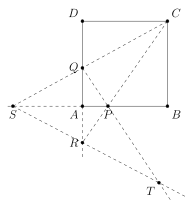
The vertices \(A\), \(B\), \(C\) and \(D\) of a square have coordinates \((0,0)\), \((a,0)\), \((a,a)\) and \((0,a)\), respectively.
The points \(P\) and \(Q\) have coordinates \((an,0)\) and \((0,am)\) respectively, where \(0 < m < n < 1\).
The line \(CP\) produced meets \(DA\) produced at \(R\) and the line \(CQ\) produced meets \(BA\) produced at \(S\). The line \(PQ\) produced meets the line \(RS\) produced at \(T\).
Show that \(TA\) is perpendicular to \(AC\).
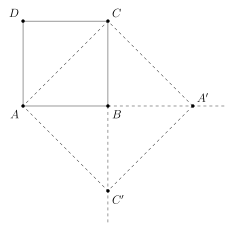
Explain how, given a square of area \(a^2\), a square of area \(2a^2\) may be constructed using only a straight-edge.
[Note: a straight-edge is a ruler with no markings on it;
no measurements (and no use of compasses) are allowed in the construction.]
Solution:
Note that \(CP\) has equation \(\frac{y-0}{x-an} = \frac{a-0}{a-an} = \frac{1}{1-n} \Rightarrow y = \frac{x-an}{1-n}\)
Therefore \(R = (0, -\frac{an}{1-n})\)
Note that \(CQ\) has equation \(\frac{y-am}{x} = \frac{a-am}{a} = 1-m \Rightarrow y = (1-m)x + am\)
Therefore \(S = (-\frac{am}{1-m}, 0)\)
\(PQ\) has equation \(\frac{y}{x-an} = \frac{am-0}{0-an} \Rightarrow y = -\frac{m}{n}x +am\)
\(SR\) has equation \(\frac{y}{x+\frac{am}{1-m}} = \frac{-\frac{an}{1-n}}{\frac{am}{1-m}} = -\frac{n(1-m)}{m(1-n)} \Rightarrow y =-\frac{n(1-m)}{m(1-n)} x -a\frac{n}{1-n}\)
So \(PQ \cap SR\) has
\begin{align*}
&& -\frac{m}{n}x +am &= -\frac{n(1-m)}{m(1-n)} x -a\frac{n}{1-n} \\
&& x \left (\frac{n(1-m)}{m(1-n)} - \frac{m}{n} \right) &= -am - \frac{an}{1-n} \\
\Rightarrow && x \left ( \frac{n^2(1-m)-m^2(1-n)}{nm(1-n)} \right) &= -\frac{a(m(1-n)+n)}{1-n} \\
\Rightarrow && x \left ( \frac{(m-n)(mn-n-m)}{mn(1-n)} \right) &= \frac{a(mn-m-n)}{1-n} \\
\Rightarrow && x &= \frac{amn}{m-n} \\
&& y &= -\frac{amn}{m-n}
\end{align*}
Therefore clearly \(TA\) is perpendicular to \(AC\) since they are the lines \(y = -x\) and \(y = x\)
Given this method we can construct the perpendicular to the diagonal through the vertex. Doing this at \(A\) we can construct \(C'\) the reflection of \(C\) in \(AB\).
We can do the same to find the reflection of \(A\) and so we have a square with sidelengths \(\sqrt{2}a\) and hence area \(2a^2\)