Problems
Filters
87 problems found
2025 Paper 2 Q5
You need not consider the convergence of the improper integrals in this question.
- Use the substitution \(x = u^{-1}\) to show that \[\int_0^{\infty} \frac{\sqrt{x}-1}{\sqrt{x(x^3+1)}} \, dx = 0.\]
- Use the substitution \(x = u^{-2}\) to show that \[\int_0^{\infty} \frac{1}{\sqrt{x^3+1}} \, dx = 2\int_0^{\infty} \frac{1}{\sqrt{x^6+1}} \, dx.\]
- Find, in terms of \(p\) and \(s\), a value of \(r\) for which \[\int_0^{\infty} \frac{x^r - 1}{\sqrt{x^s(x^p+1)}} \, dx = 0,\] given that \(p\) and \(s\) are fixed values for which the required integrals converge.
- Show that, for any positive value of \(k\), it is possible to find values of \(p\) and \(q\) for which \[\int_0^{\infty} \frac{1}{\sqrt{x^p+1}} \, dx = k\int_0^{\infty} \frac{1}{\sqrt{x^q+1}} \, dx.\]
Solution:
- \begin{align*} && I &= \int_0^{\infty} \frac{\sqrt{x}-1}{\sqrt{x(x^3+1)}} \, dx \\ x = u^{-1}, \d x = -u^{-2} \d u: && &= \int_{u=\infty}^{u = 0} \frac{u^{-1/2} - 1}{\sqrt{u^{-1}(u^{-3}+1)}} (-u^{-2}) \d u \\ &&&= \int_0^\infty \frac{u^{-1/2} -1}{\sqrt{1+u^3}} \d u \\ &&&= \int_0^\infty \frac{1-\sqrt{u}}{\sqrt{u(u^3+1)}} \d u \\ &&&= -I \\ \Rightarrow && I &= 0 \end{align*}
- \begin{align*} && I &= \int_0^{\infty} \frac{1}{\sqrt{x^3+1}} \, dx \\ x = u^{-2}, \d x = -2u^{-3} \d u: && &= \int_{u = \infty}^{u = 0} \frac{1}{\sqrt{u^{-6}+1}} (-2u^{-3}) \d u \\ &&&= \int_0^\infty \frac{2}{\sqrt{1+u^6}} \d u \\ &&&= 2\int_0^{\infty} \frac{1}{\sqrt{x^6+1}} \, \d x \end{align*}
- \begin{align*} && I &= \int_0^{\infty} \frac{x^r - 1}{\sqrt{x^s(x^p+1)}} \, dx \\ x = u^{-1}, \d x = - u^{-2} \d t: &&&= \int_{u=\infty}^{u = 0} \frac{u^{-r}-1}{\sqrt{u^{-s}(u^{-p}+1)}} (- u^{-2}) \d u \\ &&&= \int_0^\infty \frac{u^{-r}-1}{\sqrt{u^{4-s}(u^{-p}+1)}} \d u \\ &&&= \int_0^\infty \frac{1-u^{r}}{\sqrt{u^{4-s+2r}(u^{-p}+1)}} \d u \\ &&&= \int_0^\infty \frac{1-u^{r}}{\sqrt{u^{4-s+2r-p}(1+u^p)}} \d u \\ \end{align*} Therefore if \(4-s+2r-p = s\) or \(r = \frac{p}2+s-2\) we have \(I = -I\), ie \(I = 0\).
- \begin{align*} && I &= \int_0^{\infty} \frac{1}{\sqrt{x^p+1}} \, dx \\ x = u^{-t}, \d x = -t u^{-t-1}:&&&= \int_{u = -\infty}^{u = 0} \frac{1}{\sqrt{u^{-pt}+1}} (-t u^{-t-1}) \d u \\ &&&= t \int_0^\infty \frac1{\sqrt{u^{-pt+2t+2}+u^{2t+2}}} \d u \end{align*} Therefore if \(\begin{cases} 2t+2 &= q \\ 2t+2 -pt &= 0 \end{cases}\), ie \(q = 2t+2, p = 2 + 2/t\) we will have found the \(p, q\) desired for any \(t\) (or \(k\)). [Alternatively] Let \(\displaystyle I(p) =\int_0^{\infty} \frac{1}{\sqrt{x^p+1}} \, dx\), then clearly \(I(p)\) is decreasing and as \(p \to \infty\) \(I(p) \to 1\), so our integral can take any values on \((1, \infty)\) and so for any positive value we can find two values with a given ratio. In particular given \(k\) and \(p\) we can find a suitable \(q\).
2024 Paper 2 Q1
In the equality \[ 4 + 5 + 6 + 7 + 8 = 9 + 10 + 11, \] the sum of the five consecutive integers from 4 upwards is equal to the sum of the next three consecutive integers. Throughout this question, the variables \(n\), \(k\) and \(c\) represent positive integers.
- Show that the sum of the \(n + k\) consecutive integers from \(c\) upwards is equal to the sum of the next \(n\) consecutive integers if and only if \[ 2n^2 + k = 2ck + k^2. \]
- Find the set of possible values of \(n\), and the corresponding values of \(c\), in each of the cases
- \(k = 1\)
- \(k = 2\).
- Show that there are no solutions for \(c\) and \(n\) if \(k = 4\).
- Consider now the case where \(c = 1\).
- Find two possible values of \(k\) and the corresponding values of \(n\).
- Show, given a possible value \(N\) of \(n\), and the corresponding value \(K\) of \(k\), that \[ N' = 3N + 2K + 1 \] will also be a possible value of \(n\), with \[ K' = 4N + 3K + 1 \] as the corresponding value of \(k\).
- Find two further possible values of \(k\) and the corresponding values of \(n\).
Solution:
- Suppose the sum of the \(n + k\) consecutive integers from \(c\) upwards is equal to the sum of the next \(n\) consecutive integers then \begin{align*} && \sum_{i=c}^{i=c+n+k-1} i &= \sum_{i=c+n+k}^{c+2n+k-1} i \\ \Leftrightarrow && \frac{(c+n+k-1)(c+n+k)}{2} - \frac{(c-1)c}{2} &= \frac{(c+2n+k-1)(c+2n+k)}{2} - \frac{(c+n+k-1)(c+n+k)}{2} \\ \Leftrightarrow && 2(c+n+k-1)(c+n+k) &= (c+2n+k-1)(c+2n+k) + c(c-1) \\ \Leftrightarrow && 2c^2+4cn+4ck+2n^2+4kn+2k^2-2c-2n-2k&=2c^2+4cn+2ck+4n^2+4nk+k^2-2c-2n-k \\ \Leftrightarrow && 2ck+k^2&=2n^2+k \\ \end{align*}
- If \(k=1\) then \begin{align*} && 2n^2 + 1 &= 2c + 1 \\ \Rightarrow && c &= n^2 \end{align*} So \(n\) can take any value and \(c = n^2\)
- If \(k=2\) then \begin{align*} && 2n^2+2&= 4c+4 \\ \Rightarrow && n^2-1 &=2c \end{align*} So \(n\) must be odd, and \(c = \frac12(n^2-1)\)
- Suppose \(k=4\) then \(2n^2+4 = 8c+16\) or \(n^2-6 = 4c\) but then the left hand side is \(2, 3 \pmod{4}\) which is a contradiction.
- Suppose \(c =1\)
- Since \(2n^2+k = 2k + k^2\) or \(2n^2 = k^2+k\) we can have \(k = 1, n = 1\) or \(k = 8, n = 6\)
- Suppose \(2N^2 = K^2 + K\) then consider \begin{align*} && 2(N')^2 &= 2(3N+2K+1)^2 \\ &&&= 2(9N^2+4K^2+1+12NK+6N+4K) \\ &&&= 18N^2+8K^2+24NK+12N+8K+2 \\ && (K')^2+K' &= (4N+3K+1)^2 + (4N+3K+1) \\ &&&= 16N^2 + 9K^2+1+24NK+12N+9K+1 \\ &&&= 16N^2+9K^2+24NK+12N+9K+2 \\ \Rightarrow && 2(N')^2-(K')^2-K' &= 2N^2-K^2-K \\ &&&= 0 \end{align*} as required.
- So consider \((k,n) = (1,1), (8,6), (49, 35), (288,204)\)
2023 Paper 2 Q4
- Show that, if \((x-\sqrt{2})^2 = 3\), then \(x^4 - 10x^2 + 1 = 0\). Deduce that, if \(\mathrm{f}(x) = x^4 - 10x^2 + 1\), then \(\mathrm{f}(\sqrt{2}+\sqrt{3}) = 0\).
- Find a polynomial \(\mathrm{g}\) of degree 8 with integer coefficients such that \(\mathrm{g}(\sqrt{2}+\sqrt{3}+\sqrt{5}) = 0\). Write your answer in a form without brackets.
- Let \(a\), \(b\) and \(c\) be the three roots of \(t^3 - 3t + 1 = 0\). Find a polynomial \(\mathrm{h}\) of degree 6 with integer coefficients such that \(\mathrm{h}(a+\sqrt{2}) = 0\), \(\mathrm{h}(b+\sqrt{2}) = 0\) and \(\mathrm{h}(c+\sqrt{2}) = 0\). Write your answer in a form without brackets.
- Find a polynomial \(\mathrm{k}\) with integer coefficients such that \(\mathrm{k}(\sqrt[3]{2}+\sqrt[3]{3}) = 0\). Write your answer in a form without brackets.
Solution:
- \(\,\) \begin{align*} && 3 &= (x-\sqrt2)^2 \\ &&&= x^2 - 2\sqrt2 x + 2 \\ \Rightarrow && 2\sqrt2 x &= x^2-1 \\ \Rightarrow && 8x^2 &= x^4 - 2x^2 + 1 \\ \Rightarrow && 0 &= x^4 - 10x^2 + 1 \end{align*} Noticing that \((\sqrt2+\sqrt3-\sqrt2)^2 = 3\) we note that \(\sqrt2 + \sqrt3\) is a root of our quartic.
- Suppose \(x = \sqrt2 + \sqrt3 + \sqrt5\) then \begin{align*} && 0 &= (x - \sqrt5)^4 - 10(x-\sqrt5)^2 + 1 \\ &&&= x^4 - 4\sqrt5x^3 + 30x^2-20\sqrt5 x +25 - 10x^2+20\sqrt5x -50 + 1\\ &&&= (x^4+20x^2- 24) - 4\sqrt5 x^3 \\ \Rightarrow && 80x^6 &= (x^4+20x^2-24)^2 \\ &&&= x^8 + 40x^6 + 352x^4 - 960x^2+576 \\ \Rightarrow && 0 &= x^8-40x^6 + 352x^4-960x^2+576 \end{align*} So take \(g(x) = x^8-40x^6 + 352x^4-960x^2+576\).
- Notice that if \(p(t) = t^3-3t+1\) then \(p(t -\sqrt2) = 0\) for \(t = a,b,c\) so \begin{align*} && 0 &= (t - \sqrt2)^3 -3(t - \sqrt2) + 1 \\ &&&= t^3-3\sqrt2 t^2 + 6t - 2\sqrt2 - 3t + 3\sqrt 2 + 1 \\ &&&= (t^3+3t+1) - \sqrt2 (3t^2+1) \\ \Rightarrow && 2(3t^2+1)^2 &= (t^3+3t+1)^2 \\ \Rightarrow && 2(9t^4+6t^2+1) &= t^6 + 6t^4+2t^3+9t^2+6t+1 \\ \Rightarrow && 0 &= t^6-12t^4+2t^3-3t^2+6t-1 \end{align*}
- \(\,\) \begin{align*} && t &= \sqrt[3]{2} + \sqrt[3]{3} \\ \Rightarrow && t^3 &= 2 + 3\sqrt[3]{12} + 3\sqrt[3]{18} + 3 \\ &&&= 5 + 3 \sqrt[3]{6}(\sqrt[3]{2} + \sqrt[3]{3}) \\ &&&= 5 + 3\sqrt[3]{6}t \\ \Rightarrow && 162t^3 &= (t^3-5)^3 \\ &&&= t^9-15t^6+75t^3 -125 \\ \Rightarrow && 0 &= t^9-15t^6-87t^3-125 \end{align*} so \(k(x) = x^9 - 15x^6-87x^3-125\)
2022 Paper 2 Q1
- By integrating one of the two terms in the integrand by parts, or otherwise, find \[\int \left(2\sqrt{1+x^3} + \frac{3x^3}{\sqrt{1+x^3}}\right)\,\mathrm{d}x\,.\]
- Find \[\int (x^2+2)\frac{\sin x}{x^3}\,\mathrm{d}x\,.\]
- Sketch the graph with equation \(y = \dfrac{\mathrm{e}^x}{x}\), giving the coordinates of any stationary points.
- Find \(a\) if \[\int_a^{2a} \frac{\mathrm{e}^x}{x}\,\mathrm{d}x = \int_a^{2a} \frac{\mathrm{e}^x}{x^2}\,\mathrm{d}x\,.\]
- Show that it is not possible to find distinct integers \(m\) and \(n\) such that \[\int_m^n \frac{\mathrm{e}^x}{x}\,\mathrm{d}x = \int_m^n \frac{\mathrm{e}^x}{x^2}\,\mathrm{d}x\,.\]
2021 Paper 2 Q2
In this question, the numbers \(a\), \(b\) and \(c\) may be complex.
- Let \(p\), \(q\) and \(r\) be real numbers. Given that there are numbers \(a\) and \(b\) such that \[ a + b = p, \quad a^2 + b^2 = q \quad \text{and} \quad a^3 + b^3 = r, \qquad (*) \] show that \(3pq - p^3 = 2r\).
- Conversely, you are given that the real numbers \(p\), \(q\) and \(r\) satisfy \(3pq - p^3 = 2r\). By considering the equation \(2x^2 - 2px + (p^2 - q) = 0\), show that there exist numbers \(a\) and \(b\) such that the three equations \((*)\) hold.
- Let \(s\), \(t\), \(u\) and \(v\) be real numbers. Given that there are distinct numbers \(a\), \(b\) and \(c\) such that \[ a + b + c = s, \quad a^2 + b^2 + c^2 = t, \quad a^3 + b^3 + c^3 = u \quad \text{and} \quad abc = v, \] show, using part~(i), that \(c\) is a root of the equation \[ 6x^3 - 6sx^2 + 3(s^2 - t)x + 3st - s^3 - 2u = 0 \] and write down the other two roots. Deduce that \(s^3 - 3st + 2u = 6v\).
- Find numbers \(a\), \(b\) and \(c\) such that \[ a + b + c = 3, \quad a^2 + b^2 + c^2 = 1, \quad a^3 + b^3 + c^3 = -3 \quad \text{and} \quad abc = 2, \qquad (**) \] and verify that your solution satisfies the four equations \((**)\).
2021 Paper 3 Q2
- Let \[ x = \frac{a}{b - c}, \qquad y = \frac{b}{c - a} \qquad \text{and} \qquad z = \frac{c}{a - b}, \] where \(a\), \(b\) and \(c\) are distinct real numbers. Show that \[ \begin{pmatrix} 1 & -x & x \\ y & 1 & -y \\ -z & z & 1 \end{pmatrix} \begin{pmatrix} a \\ b \\ c \end{pmatrix} = \begin{pmatrix} 0 \\ 0 \\ 0 \end{pmatrix} \] and use this result to deduce that \(yz + zx + xy = -1\). Hence show that \[ \frac{a^2}{(b-c)^2} + \frac{b^2}{(c-a)^2} + \frac{c^2}{(a-b)^2} \geqslant 2. \]
- Let \[ x = \frac{2a}{b+c}, \qquad y = \frac{2b}{c+a} \qquad \text{and} \qquad z = \frac{2c}{a+b}, \] where \(a\), \(b\) and \(c\) are positive real numbers. Using a suitable matrix, show that \(xyz + yz + zx + xy = 4\). Hence show that \[ (2a + b + c)(a + 2b + c)(a + b + 2c) > 5(b+c)(c+a)(a+b). \] Show further that \[ (2a + b + c)(a + 2b + c)(a + b + 2c) > 7(b+c)(c+a)(a+b). \]
Solution:
- \(\,\) \begin{align*} && \begin{pmatrix} 1 & -x & x \\ y & 1 & -y \\ -z & z & 1 \end{pmatrix} \begin{pmatrix} a \\ b \\ c \end{pmatrix} &= \begin{pmatrix} a-xb+xc \\ ay+b-yc \\ -za+zb+c \end{pmatrix} \\ &&&= \begin{pmatrix} a-x(b-c) \\ b-y(c-a) \\ c-z(a-b) \end{pmatrix} \\ &&&= \begin{pmatrix} 0 \\ 0 \\ 0 \end{pmatrix} \end{align*} Notice since \(a,b\) and \(c\) are distinct real numbers the vector \(\langle a,b,c \rangle\) cannot be the zero vector, so the determinant of the matrix is zero, ie \(0= 1(1+yz)+x(y-yz)+x(yz+z) = 1 +yz+yx+zx\). Notice also then that \begin{align*} && \frac{a^2}{(b-c)^2} + \frac{b^2}{(c-a)^2} + \frac{c^2}{(a-b)^2} &= x^2+y^2+z^2 \\ &&&= (x+y+z)^2 - 2(xy+yz+zx) \\ &&&= 2 + (x+y+z)^2 \geq 2 \end{align*}
- \(\,\) \begin{align*} && \begin{pmatrix} 2 & -x & -x \\ -y & 2 & -y \\ -z & -z & 2 \end{pmatrix} \begin{pmatrix} a \\ b \\ c \end{pmatrix} &= \begin{pmatrix} 2a-xb-xc \\ -ay+2b-yc \\ -za-zb+2c \end{pmatrix} \\ &&&= \begin{pmatrix} 2a-x(b+c) \\ 2b-y(c+a) \\ 2c-z(a+b) \end{pmatrix} \\ &&&= \begin{pmatrix} 0 \\ 0 \\ 0 \end{pmatrix} \\ \Rightarrow && 0 &= \det \begin{pmatrix} 2 & -x & -x \\ -y & 2 & -y \\ -z & -z & 2 \end{pmatrix} \\ &&&= 2(4 -yz)+x(-2y-yz)-x(yz+2z) \\ &&&= 8 - 2yz-2yx-2xyz-2zx\\ \Rightarrow && 4 &= xyz+xy+yz+zx \end{align*} \begin{align*} && (2a + b + c)(a + 2b + c)(a + b + 2c) &> 5(b+c)(c+a)(a+b) \\ \Leftrightarrow && \left ( \frac{2a}{b+c}+1 \right)\left ( \frac{2b}{c+a}+1 \right)\left ( \frac{2c}{a+b}+1 \right) &> 5 \\ \Leftrightarrow && \left ( x+1 \right)\left ( y+1 \right)\left ( x+1 \right) &> 5 \\ \Leftrightarrow && xyz+xy+yz+zx+x+y+z+1 &> 5 \\ \Leftrightarrow && 5+x+y+z&> 5 \\ \end{align*} Which is clearly true since if \(a,b,c\) are positve real numbers so are \(x,y,z\). This final inequality is equivalent to showing \(x+y+z > 2\) ie \begin{align*} && x+y+z &> 2 \\ \Leftrightarrow && \frac{a}{b+c} + \frac{b}{c+a} + \frac{c}{a+b} &> 1 \\ \\ && \frac{a}{b+c} + \frac{b}{c+a} + \frac{c}{a+b} & > \frac{a}{a+b+c} + \frac{b}{a+b+c} + \frac{c}{a+b+c} = 1 \end{align*} So we're done.
2020 Paper 2 Q1
- Use the substitution \(x = \dfrac{1}{1-u}\), where \(0 < u < 1\), to find in terms of \(x\) the integral \[\int \frac{1}{x^{\frac{3}{2}}(x-1)^{\frac{1}{2}}}\,\mathrm{d}x \quad \text{(where } x > 1\text{).}\]
- Find in terms of \(x\) the integral \[\int \frac{1}{(x-2)^{\frac{3}{2}}(x+1)^{\frac{1}{2}}}\,\mathrm{d}x \quad \text{(where } x > 2\text{).}\]
- Show that \[\int_2^{\infty} \frac{1}{(x-1)(x-2)^{\frac{1}{2}}(3x-2)^{\frac{1}{2}}}\,\mathrm{d}x = \tfrac{1}{3}\pi.\]
Solution:
- \(\,\) \begin{align*} && x &= \frac1{1-u} \\ \Rightarrow && \d x &= \frac{1}{(1-u)^2} \d u \\ && I &= \int \frac{1}{x^{\frac32}(x-1)^{\frac12} } \d x \\ &&&= \int \frac1{(1-u)^{-\frac32}u^{\frac12}(1-u)^{-\frac12}} (1-u)^{-2} \d u \\ &&&= \int u^{-\frac12} \d u \\ &&&= 2\sqrt{u} + C \\ &&&= 2\sqrt{1-\frac{1}{x}} + C \end{align*}
- \(\,\) \begin{align*} && J &= \int \frac{1}{(x-2)^{\frac32}(x+1)^{\frac12}} \d x \\ y = x+1: &&&= \int \frac{1}{(y-3)^{\frac32}y^{\frac12}} \d y \\ y = 9(3-u)^{-1}: &&&= \int \frac1{\left (9(3-u)^{-1}-3 \right)^{\frac32}3(3-u)^{-\frac12}} \frac{9}{(3-u)^2} \d u \\ &&&= \int \frac1{\left (3u(3-u)^{-1} \right)^{\frac32}3(3-u)^{-\frac12}} \frac{9}{(3-u)^2} \d u \\ &&&= \frac{1}{\sqrt3} \int u^{-\frac32} \d u \\ &&&= -\frac2{\sqrt3} u^{-\frac12} + C \\ &&&= -\frac2{\sqrt3} \sqrt{\frac{y}{3(y-3)}} + C \\ &&&= -\frac2{3} \sqrt{\frac{x+1}{x-2}} + C \\ \end{align*}
- \(\,\) \begin{align*} && K &= \int_2^{\infty} \frac{1}{(x-1)(x-2)^{\frac12}(3x-2)^{\frac12}} \d x \\ y = x - 1: &&&=\int_{y=1}^{\infty} \frac{1}{y(y-1)^{\frac12}(3y+1)^{\frac12}} \d y \\ y = (1-u)^{-1}: &&&= \int_{u=0}^{u=1} \frac{1}{(1-u)^{-1}(u(1-u)^{-1})^{\frac12}((4-u)(1-u)^{-1})^{\frac12}} \frac{1}{(1-u)^2} \d u \\ &&&= \int_0^1 \frac{1}{u^{\frac12}(4-u)^{\frac12}} \d u \\ &&&= \int_0^1 \frac{1}{\sqrt{4-(u-2)^2}} \d u \\ &&&= \left [-\sin^{-1} \left ( \frac{2-u}{2} \right) \right]_0^1 \\ &&&= \sin^{-1} 1 - \sin^{-1} \tfrac12 \\ &&&= \frac{\pi}{2} - \frac{\pi}{6} = \frac{\pi}{3} \end{align*}
2019 Paper 1 Q3
By first multiplying the numerator and the denominator of the integrand by \((1 - \sin x)\), evaluate $$\int_0^{\frac{1}{4}\pi} \frac{1}{1 + \sin x} dx.$$ Evaluate also: $$\int_{\frac{1}{4}\pi}^{\frac{1}{3}\pi} \frac{1}{1 + \sec x} dx \quad \text{and} \quad \int_0^{\frac{1}{3}\pi} \frac{1}{(1 + \sin x)^2} dx.$$
Solution: \begin{align*} \int_0^{\frac{1}{4}\pi} \frac{1}{1 + \sin x} dx &= \int_0^{\frac{1}{4}\pi} \frac{1-\sin x}{1 - \sin^2 x} dx \\ &= \int_0^{\frac{1}{4}\pi} \frac{1-\sin x}{\cos^2 x} dx \\ &= \int_0^{\frac{1}{4}\pi} \sec^2 x - \sec x \tan x dx \\ &= \left [\tan x-\sec x \right]_0^{\frac{1}{4}\pi} \\ &= 2 - \frac{1}{\sqrt{2}} \end{align*} \begin{align*} \int_{\frac{1}{4}\pi}^{\frac{1}{3}\pi} \frac{1}{1 + \sec x} \d x &= \int_{\frac{1}{4}\pi}^{\frac{1}{3}\pi} \frac{1-\sec x}{1 - \sec^2 x} \d x \\ &= \int_{\frac{1}{4}\pi}^{\frac{1}{3}\pi} \frac{\sec x-1}{\tan^2 x} \d x \\ &= \int_{\frac{1}{4}\pi}^{\frac{1}{3}\pi} \cot x \cosec x-\cot^2 x\d x \\ &= \left [ -\cosec x +x+\cot x\right]_{\frac{1}{4}\pi}^{\frac{1}{3}\pi} \\ &= \l -\frac{2}{\sqrt3}+\frac{\pi}{3}+\frac{1}{\sqrt{3}}\r - \l-\sqrt{2}+\frac{\pi}{4}+1 \r \\ &= \frac{\pi}{12}-\frac{1}{\sqrt{3}}+\sqrt{2}-1 \end{align*} \begin{align*} \int_0^{\frac{1}{3}\pi} \frac{1}{(1 + \sin x)^2} \d x &= \int_0^{\frac{1}{3}\pi} \frac{1-2\sin x+\sin^2x}{(1-\sin^2 x)^2} \d x \\ &= \int_0^{\frac{1}{3}\pi} \frac{1-2\sin x+\sin^2x}{\cos^4 x} \d x \\ \end{align*} Splitting this up into: \begin{align*} \int_0^{\frac{1}{3}\pi} \frac{-2\sin x}{\cos^4 x} \d x &= -\frac23 \left [ \frac{1}{\cos^3 x}\right]_0^{\frac{1}{3}\pi} \\ &= -\frac{16}3+\frac23 \\ &= -\frac{14}3 \end{align*} and \begin{align*} && \int_0^{\frac{1}{3}\pi} \frac{1+\sin^2x}{\cos^4 x} \d x &= \int_0^{\frac{1}{3}\pi} (\sec^2 x + \tan^2 x) \sec^2 x \d x \\ &&&= \int_0^{\frac{1}{3}\pi} (1+ 2\tan^2 x) \sec^2 x \d x \\ u = \tan x, \d u = \sec^2 x \d x&&&= \int_0^{\sqrt{3}}(1+2u^2) \d u \\ &&&= \left [u + \frac23 u^3 \right]_0^{\sqrt{3}} \\ &&&= \sqrt{3} + 2\sqrt{3} \\ &&&= 3\sqrt{3} \end{align*} And so our complete integral is: \[ \int_0^{\frac{1}{3}\pi} \frac{1}{(1 + \sin x)^2} \d x = 3\sqrt{3} - \frac{14}3\]
2019 Paper 1 Q8
The function \(f\) is defined, for \(x > 1\), by $$f(x) = \int_1^x \sqrt{\frac{t-1}{t+1}} dt.$$ Do not attempt to evaluate this integral.
- Show that, for \(x > 2\), $$\int_2^x \sqrt{\frac{u-2}{u+2}} du = 2f\left(\frac{1}{2}x\right).$$
- Evaluate in terms of \(f\), for \(x > 0\), $$\int_0^x \sqrt{\frac{u}{u+4}} du.$$
- Evaluate in terms of \(f\), for \(x > 5\), $$\int_5^x \sqrt{\frac{u-5}{u+1}} du.$$
- Evaluate in terms of \(f\) $$\int_1^2 \frac{u^2}{\sqrt{u^2+4}} du.$$
Solution:
- Let \(2t = u\), \begin{align*} \int_2^x \sqrt{\frac{u-2}{u+2}} du &= \int_{t=1}^{t=x/2} \sqrt{\frac{2t-2}{2t+2}}2 \d t \\ &= 2\int_{t=1}^{x/2} \sqrt{\frac{t-1}{t+1}} \d t \\ &= 2f\l\frac{x}{2}\r \end{align*}
- Let \(v = u-2\), \begin{align*} \int_0^x \sqrt{\frac{u}{u+4}} du &= \int_{v = 2}^{x+2} \sqrt{\frac{v-2}{v+2}} \d v \\ &= 2 f \l \frac{x+2}{2} \r \end{align*}
- Let \(v = u-2, \d v = \d u\) \begin{align*} \int_5^x \frac{u-5}{u+1} du &= \int_3^{x-2} \frac{v-3}{v+3} \d v \\ &= \int_1^{\frac{x-2}{3}} \frac{3t - 3}{3t+3} 3 \d t \\ &= 3 f \l \frac{x-2}{3} \r \end{align*}
- Let \(v = u^2, \d v = 2u \d u\)\begin{align*}\int_1^2 \frac{u^2}{\sqrt{u^2+4}} du &= \int_1^2 \sqrt{\frac{u^2}{u^2+4}} u \d u \\ &= \int_1^4 \sqrt{\frac{v}{v+4}} \frac12 \d v \\ &= f \l \frac{4+2}{2} \r - f \l \frac{3}{2} \r \\ &= f(3) - f(\frac32) \end{align*}
2019 Paper 3 Q5
- Let $$f(x) = \frac{x}{\sqrt{x^2 + p}},$$ where \(p\) is a non-zero constant. Sketch the curve \(y = f(x)\) for \(x \geq 0\) in the case \(p > 0\).
- Let $$I = \int \frac{1}{(b^2 - y^2)\sqrt{c^2 - y^2}} \, dy,$$ where \(b\) and \(c\) are positive constants. Use the substitution \(y = \frac{cx}{\sqrt{x^2 + p}}\), where \(p\) is a suitably chosen constant, to show that $$I = \int \frac{1}{b^2 + (b^2 - c^2)x^2} \, dx.$$ Evaluate $$\int_1^{\sqrt{2}} \frac{1}{(3 - y^2)\sqrt{2 - y^2}} \, dy.$$ [ Note: \(\int \frac{1}{a^2 + x^2} \, dx = \frac{1}{a} \tan^{-1} \frac{x}{a} + \text{constant.}\) ] Hence evaluate $$\int_{\frac{1}{\sqrt{2}}}^1 \frac{y}{(3y^2 - 1)\sqrt{2y^2 - 1}} \, dy.$$
- By means of a suitable substitution, evaluate $$\int_{\frac{1}{\sqrt{2}}}^1 \frac{1}{(3y^2 - 1)\sqrt{2y^2 - 1}} \, dy.$$
Solution:
- \(\,\)
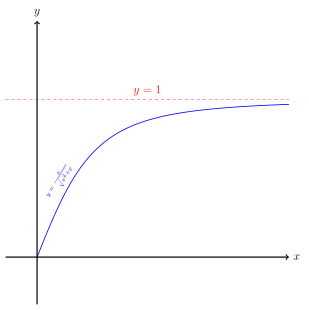
- \(\,\) \begin{align*} && y &= \frac{cx}{\sqrt{x^2+p}} \\ && \d y &= \frac{c(x^2+p)-cx^2}{(x^2+p)^{3/2}} \d x \\ &&&= \frac{cp^2}{(x^2+p)^{3/2}} \d x\\ && I &= \int \frac1{(b^2-y^2)\sqrt{c^2-y^2}} \d y \\ &&&= \int \frac{1}{\left ( b^2 - \frac{c^2x^2}{x^2+p} \right) \sqrt{c^2 - \frac{c^2x^2}{x^2+p} }} \d y \\ &&&= \int \frac{(x^2+p)^{3/2}}{((b^2-c^2)x^2+pb^2)\sqrt{c^2p}}\frac{cp}{(x^2+p)^{3/2}} \d x \\ &&&= \int \frac{\sqrt{p}}{((b^2-c^2)x^2+pb^2)} \d x \\ p=1: &&&= \int \frac{1}{(b^2-c^2)x^2+b^2} \d x \end{align*} When \(b = \sqrt{3}, c = \sqrt{2}\) \begin{align*} && I_1 &= \int_1^{\sqrt{2}} \frac{1}{(3 - y^2)\sqrt{2 - y^2}} \d y\\ &&&= \int_{x =1 }^{x=\infty} \frac{1}{3+x^2} \d x \\ &&&= \left [ \frac{1}{\sqrt{3}} \tan^{-1} \frac{x}{\sqrt{3}} \right]_1^\infty \\ &&&= \frac{\pi}{2\sqrt{3}} - \frac{1}{\sqrt{3}} \frac{\pi}{6} \\ &&&= \frac{\pi}{3\sqrt{3}} \end{align*} \begin{align*} && I_2 &= \int_{\frac{1}{\sqrt{2}}}^1 \frac{y}{(3y^2 - 1)\sqrt{2y^2 - 1}} \d y \\ x = \frac1y, \d x = -\frac1{y^2} \d y &&&= \int_{x=\sqrt{2}}^{x=1} \frac{x^2}{(3-x^2)\sqrt{2-x^2}}\cdot \left ( -\frac{1}{x^2} \right ) \d x \\ &&&= \int_1^{\sqrt{2}} \frac{1}{(3-x^2)\sqrt{2-x^2}} \d x \\ &&&= I_1 = \frac{\pi}{3\sqrt{3}} \end{align*}
- \(\,\) \begin{align*} && I_3 &= \int_{\frac{1}{\sqrt{2}}}^1 \frac{1}{(3y^2 - 1)\sqrt{2y^2 - 1}} \d y \\ x = 1/y, \d x = -1/y^2 \d y &&&= \int_{x=1}^{x=\sqrt{2}} \frac{x}{(3-x^2)\sqrt{2-x^2}} \d x \\ u = x^2, \d u = 2x \d x &&&= \int_{u=1}^{u=2} \frac{\frac12}{(3-u)\sqrt{2-u}} \d u \\ v=2-u, \d v = -\d u &&&= \frac12\int_{v=0}^{v=1} \frac{1}{(1+v)\sqrt{v}} \d v \\ &&&=\left [\tan^{-1}\sqrt{v}\right]_0^1 \\ &&&= \frac{\pi}{4} \end{align*}
2018 Paper 1 Q7
- In the cubic equation \(x^3-3pqx+pq(p+q)=0\,\), where \(p\) and \(q\) are distinct real numbers, use the substitution \[ x=\frac{pz+q}{z+1} \] to show that the equation reduces to \(az^3+b = 0\,\), where \(a\) and \(b\) are to be expressed in terms of \(p\) and \(q\).
- Show further that the equation \(x^3 - 3cx + d = 0\,\), where \(c\) and \(d\) are non-zero real numbers, can be written in the form \(x^3-3pqx+pq(p+q)=0\,\), where \(p\) and \(q\) are distinct real numbers, provided \(d^2 > 4c^3\,\).
- Find the real root of the cubic equation \(x^3+6x-2=0\,\).
- Find the roots of the equation \(x^3 - 3p^2x +2p^3=0\,\), and hence show how the equation \(x^3 - 3cx + d = 0\) can be solved in the case \(d^2 = 4c^3\,\).
Solution:
- Let \(x = \frac{pz+q}{z+1}\) then \begin{align*} && 0 &= x^3-3pqx+pq(p+q) \\ &&&= \left ( \frac{pz+q}{z+1} \right)^3 - 3pq \left ( \frac{pz+q}{z+1} \right) + pq(p+q) \\ &&&= \frac{(pz+q)^3-3pq(pz+q)(z+1)^2+pq(p+q)(z+1)^3}{(z+1)^3} \\ &&&= \frac{1}{(z+1)^3} \Big ((p^3+pq(p+q)-3p^2q)z^3 + (3p^2q-6p^2q+3pq^2+3p^2q+3pq^2)z^2 + \\ &&&\qquad \qquad\quad\quad +(3pq^2-3p^2q-6pq^2+3p^2q+3qp^2)z+(q^3-3pq^2+p^2q+pq^2) \Big ) \\ &&&= \frac{(p^3+pq^2-2p^2q)z^3+(q^3+p^2q-2pq^2)}{(z+1)^3} \\ \Rightarrow && 0 &= (p^3+pq^2-2p^2q)z^3+(q^3+p^2q-2pq^2) \\ &&&= p(p-q)^2z^3 + q(p-q)^2 \\ \Rightarrow && 0 &= pz^3 + q \end{align*}
- We would like to find \(pq = c\) and \(pq(p+q) = d\), so \(p\) and \(q\) are roots of the quadratic \(x^2-\frac{d}{c}x + c = 0\), which has distinct real roots if \(\Delta = \frac{d^2}{c^2}-4c > 0 \Rightarrow d^2>4c^3\)
- Note that \(c = -2, d = -2\) so \begin{align*} && 0 &= x^3+6x-2 \\ \text{consider} && 0 &= X^2-X-2 \\ && &= (X+1)(X-2) \\ \Rightarrow && p = -1, &q = 2\\ \Rightarrow && 0 &= x^3-3\cdot 2 \cdot(-1) x + 2\cdot(-1) \cdot(-2+1) \\ \Rightarrow && 0 &= -z^3+2 \\ \Rightarrow && z &= \sqrt[3]{2} \\ \Rightarrow && \frac{-z+2}{z+1} &= \sqrt[3]{2} \\ \Rightarrow && -z+2 &= \sqrt[3]{2} z + \sqrt[3]{2} \\ \Rightarrow && z &= \frac{2-\sqrt[3]{2}}{\sqrt[3]{2}+1} \end{align*}
- \(\,\) \begin{align*} && 0 &= x^3 - 3p^2x + 2p^3 \\ &&&= (x-p)(x^2+px-2p^2) \\ &&&=(x-p)^2(x+2p)\\ \Rightarrow && x &= p, p, -2p \end{align*} Therefore if we have a repeated root to our associated quadratic we can find a cubic of the form \(x^3-3p^2x+2p^3\), but we know this has roots we can find.
2017 Paper 2 Q2
The sequence of numbers \(x_0\), \(x_1\), \(x_2\), \(\ldots\) satisfies \[ x_{n+1} = \frac{ax_n-1}{x_n+b} \,. \] (You may assume that \(a\), \(b\) and \(x_0\) are such that \(x_n+b\ne0\,\).) Find an expression for \(x_{n+2}\) in terms of \(a\), \(b\) and \(x_n\).
- Show that \(a+b=0\) is a necessary condition for the sequence to be periodic with period 2. Note: The sequence is said to be periodic with period \(k\) if \(x_{n+k} = x_n\) for all \(n\), and there is no integer \(m\) with \(0 < m < k\) such that \(x_{n+m} = x_n\) for all \(n\).
- Find necessary and sufficient conditions for the sequence to have period 4.
Solution: \begin{align*} x_{n+2} &= \frac{ax_{n+1}-1}{x_{n+1}+b} \\ &= \frac{a \frac{ax_n - 1}{x_n+b}-1}{\frac{ax_n - 1}{x_n+b}+b} \\ &= \frac{a(ax_n-1)-(x_n+b)}{ax_n-1+b(x_n+b)} \\ &= \frac{(a^2-1)x_n-(a+b)}{(a+b)x_n+b^2-1} \end{align*}
- If \(x_{n+2} = x_n\) then \begin{align*} && x_n &= \frac{(a^2-1)x_n-(a+b)}{(a+b)x_n+b^2-1} \\ \Rightarrow && 0 &=(a+b)x_n^2+(b^2-a^2)x_n+(a+b) \\ &&&= (a+b)(x_n^2+(a-b)x_n + 1) \end{align*} If \(x_{n+1} = x_n\) then \(x_n^2+(a-b)x_n + 1\) and since our sequence has period \(2\) rather than \(1\) it must be the case this is non-zero. Therefore \(a+b =0\).
- \begin{align*} x_{n+4} &= \frac{(a^2-1)x_{n+2}-(a+b)}{(a+b)x_{n+2}+b^2-1} \\ &= \frac{(a^2-1)\frac{(a^2-1)x_{n}-(a+b)}{(a+b)x_{n}+b^2-1} -(a+b)}{(a+b)\frac{(a^2-1)x_{n}-(a+b)}{(a+b)x_{n}+b^2-1} +b^2-1} \\ &= \frac{((a^2-1)^2-(a+b)^2)x_n -(a^2+b^2-2)(a+b)}{(a^2+b^2-2)(a+b)x_n + (b^2-1)^2-(a+b)^2} \end{align*} If \(x_{n+4} = x_n\) then \begin{align*} x_n &=\frac{((a^2-1)^2-(a+b)^2)x_n -(a^2+b^2-2)(a+b)}{(a^2+b^2-2)(a+b)x_n + (b^2-1)^2-(a+b)^2} \\ 0 &= (a^2+b^2-2)(a+b)x_n^2 + \l (b^2-1)^2-(a^2-1)^2 \r x_n+(a^2+b^2-2)(a+b) \\ &= (a^2+b^2-2)(a+b)x_n^2+(b^2-a^2)(a^2+b^2-2)x_n + (a^2+b^2-2)(a+b) \\ &= (a^2+b^2-2)(a+b)(x_n^2+(b-a)x_n + 1) \end{align*} Since we do not want \(x_n\) to be periodic with period \(1\) we must have the quadratic in \(x_n\) \(\neq 0\). If \(a+b = 0\) then \(x_n\) is periodic with period \(2\) since \(x_{n+2} = \frac{(a^2-1)x_n}{((-a)^2-1)} = x_n\). Therefore it is necessary that \(a^2+b^2-2 = 0\). If \(a^2+b^2-2= 0\) then \begin{align*} x_{n+4} &= \frac{((a^2-1)^2-(a+b)^2)x_n}{(b^2-1)^2-(a+b)^2} \\ &=\frac{((a^2-1)^2-(a+b)^2)x_n}{((2-a^2)-1)^2-(a+b)^2} \\ &=\frac{((a^2-1)^2-(a+b)^2)x_n}{((1-a^2)^2-(a+b)^2} \\ &= x_n \end{align*} Therefore it is sufficient too. So our conditions are \(a+b \neq 0, \, \, x_n^2+(a-b)x_n + 1 \neq 0\) and \(a^2+b^2-2 = 0\)
2017 Paper 2 Q6
Let \[ S_n = \sum_{r=1}^n \frac 1 {\sqrt r \ } \,, \] where \(n\) is a positive integer.
- Prove by induction that \[ S_n \le 2\sqrt n -1\, . \]
- Show that \((4k+1)\sqrt{k+1} > (4k+3)\sqrt k\,\) for \(k\ge0\,\). Determine the smallest number \(C\) such that \[ S_n \ge 2\sqrt n + \frac 1 {2\sqrt n} -C \,.\]
Solution:
- Claim: \(S_n \leq 2\sqrt{n} -1\). Proof: (By induction) (Base case: \(n = 1\)). \(\frac{1}{\sqrt{1}} \leq 1 = 2 \cdot \sqrt1 - 1\). Therefore the base case is true. (Inductive step): Suppose our result is true for \(n = k\). Then consider \(n = k+1\). \begin{align*} && \sum_{r=1}^{k+1} \frac{1}{\sqrt{r}} &=\sum_{r=1}^{k} \frac{1}{\sqrt{r}} + \frac{1}{\sqrt{k+1}} \\ &&&\leq 2\sqrt{k} - 1 + \frac{1}{\sqrt{k+1}} \\ &&&= \frac{2 \sqrt{k}\sqrt{k+1}+1}{\sqrt{k+1}} - 1 \\ &&&\underbrace{\leq}_{AM-GM} \frac{(k+k+1)+1}{\sqrt{k+1}} - 1 \\ &&&=\frac{2(k+1)}{\sqrt{k+1}} - 1 \\ &&&= 2\sqrt{k+1}-1 \end{align*} Therefore, since if our statement is true for \(n = k\), it is also true for \(n = k+1\). By the principle of mathematical induction we can say that it is true for all \(n \geq 1, n \in \mathbb{Z}\)
- Claim: \((4k+1)\sqrt{k+1} > (4k+3)\sqrt k\,\) for \(k\ge0\,\) Proof: \begin{align*} && (4k+1)\sqrt{k+1} &> (4k+3)\sqrt k \\ \Leftrightarrow && (4k+1)^2(k+1) &> (4k+3)^2k \\ \Leftrightarrow && (16k^2+8k+1)(k+1) &> (16k^2 + 24k+9)k \\ \Leftrightarrow && 16 k^3 + 24 k^2 + 9 k +1&> 16k^3 + 24k^2+9k \end{align*} But this last inequality is clearly true, hence our original inequality is true. Suppose \(S_n \geq 2\sqrt{n} + \frac{1}{2 \sqrt{n}} - C\), then adding \(\frac{1}{\sqrt{n+1}}\) to both sides we have: \begin{align*} S_{n+1} &\geq 2\sqrt{n} + \frac{1}{2 \sqrt{n}} - C + \frac{1}{\sqrt{n+1}} \\ &= 2\sqrt{n+1} + \frac{1}{2\sqrt{n+1}} - C + \frac{1}{2\sqrt{n+1}} +\frac{1}{2 \sqrt{n}} +2(\sqrt{n} - \sqrt{n+1})\\ &= 2\sqrt{n+1} + \frac{1}{2\sqrt{n+1}} - C + \frac{1}{2\sqrt{n+1}} +\frac{1}{2 \sqrt{n}} -\frac{2}{\sqrt{n+1} + \sqrt{n}}\\ \end{align*} Therefore as long as the inequality is satisfied for \(n=1\), ie \(1 \geq 2\sqrt{1} + \frac{1}{2 \sqrt{1}} - C = \frac52 - C \Rightarrow C \geq \frac32\)
2017 Paper 3 Q6
In this question, you are not permitted to use any properties of trigonometric functions or inverse trigonometric functions. The function \(\T\) is defined for \(x>0\) by \[ \T(x) = \int_0^x \! \frac 1 {1+u^2} \, \d u\,, \] and $\displaystyle T_\infty = \int_0^\infty \!\! \frac 1 {1+u^2} \, \d u\,$ (which has a finite value).
- By making an appropriate substitution in the integral for \(\T(x)\), show that \[\T(x) = \T_\infty - \T(x^{-1})\,.\]
- Let \(v= \dfrac{u+a}{1-au}\), where \(a\) is a constant. Verify that, for \(u\ne a^{-1}\), \[ \frac{\d v}{\d u} = \frac{1+v^2}{1+u^2} \,. \] Hence show that, for \(a>0\) and \(x< \dfrac1a\,\), \[ \T(x) = \T\left(\frac{x+a}{1-ax}\right) -\T(a) \,. \] Deduce that \[ \T(x^{-1}) = 2\T_\infty -\T\left(\frac{x+a}{1-ax}\right) -\T(a^{-1}) \] and hence that, for \(b>0\) and \(y>\dfrac1b\,\), \[ \T(y) =2\T_\infty - \T\left(\frac{y+b}{by-1}\right) - \T(b) \,. \]
- Use the above results to show that \(\T(\sqrt3)= \tfrac23 \T_\infty \,\) and \(\T(\sqrt2 -1)= \frac14 \T_\infty\,\).
Solution:
- \(\,\) \begin{align*} && T(x) &= \int_0^x \! \frac 1 {1+u^2} \, \d u \\ &&&= \int_0^{\infty} \frac{1}{1+u^2} \d u - \int_x^\infty \frac{1}{1+u^2} \d u \\ &&&= T_\infty - \int_x^\infty \frac{1}{1+u^2} \d u \\ u = 1/v, \d u = -1/v^2 \d v: &&&= T_\infty - \int_{v=x^{-1}}^{v=0} \frac{1}{1+v^{-2}} \frac{-1}{v^2} \d v \\ &&&= T_\infty - \int_{0}^{x^{-1}} \frac{1}{1+v^2} \d v \\ &&&= T_\infty - T(x^{-1}) \end{align*}
- Let \(v = \frac{u+a}{1-au}\) then \begin{align*} && \frac{\d v}{\d u} &= \frac{(1-au) \cdot 1 - (u+a)\cdot(-a)}{(1-au)^2} \\ &&&= \frac{1-au+au+a^2}{(1-au)^2} \\ &&&= \frac{1+a^2}{(1-au)^2} \\ \\ && \frac{1+v^2}{1+u^2} &= \frac{1 + \left ( \frac{u+a}{1-ua} \right)^2}{1+u^2} \\ &&&= \frac{(1-ua)^2+(u+a)^2}{(1-ua)^2(1+u^2)} \\ &&&= \frac{1+u^2a^2+u^2+a^2}{(1-ua)^2(1+u^2)} \\ &&&= \frac{(1+u^2)(1+a^2)}{(1-ua)^2(1+u^2)} \\ &&&= \frac{1+a^2}{(1-ua)^2} \end{align*} if \(a > 0, x < \frac1a\) then \begin{align*} && T(x) &= \int_0^x \frac{1}{1+u^2} \d u \\ &&&= \int_{v=a}^{v=\frac{a+x}{1-ax}} \frac{1}{1+u^2} \frac{1+u^2}{1+v^2} \d v \\ &&&= T\left ( \frac{x+a}{1-ax} \right) - T(a) \\ \\ \Rightarrow && T(x^{-1}) &= T_\infty - T(x) \\ &&&= T_\infty - 2T\left ( \frac{x+a}{1-ax} \right) + T(a) \\ &&&= T_\infty - 2T\left ( \frac{x+a}{1-ax} \right) + T_\infty-T(a^{-1}) \\ &&&= 2T_\infty - 2T\left ( \frac{x+a}{1-ax} \right) -T(a^{-1}) \end{align*} \(b > 0, y > \frac1b\) then \(y> 0, b > \frac1y\) (same as letting \(x = \frac1y, a = \frac1b\) \begin{align*} && T(y) &= 2T_\infty - 2T \left ( \frac{\frac1y+\frac1b}{1-\frac1{by}} \right) + T(b) \\ \Rightarrow && T(y) &= 2T_\infty - 2T \left ( \frac{b+y}{by-1} \right) + T(b) \\ \end{align*}
- Letting \(y = b = \sqrt{3}\) in the final equation \begin{align*} && T(\sqrt{3}) &= 2T_{\infty} - T \left ( \frac{\sqrt{3}+\sqrt{3}}{\sqrt{3}\sqrt{3}-1} \right) -T (\sqrt{3}) \\ &&&= 2T_\infty - 2T(\sqrt{3}) \\ \Rightarrow && T(\sqrt{3}) &= \tfrac23 T_\infty \end{align*} Let \(x = \sqrt2 - 1, a = 1\) so, \begin{align*} && T(\sqrt2 -1) &= T \left ( \frac{\sqrt2-1+1}{1-\sqrt2+1} \right)-T(1) \\ &&&= T \left ( \frac{\sqrt{2}}{2-\sqrt{2}} \right) - T(1) \\ &&&= T(\frac{\sqrt{2}(2+\sqrt{2})}{2}) - T(1) \\ &&&= T(\sqrt{2}+1) - T(1) \\ &&&= T_\infty - T(\sqrt2-1)-T(1) \\ \Rightarrow && T(\sqrt{2}-1) &= \frac12T_\infty-\frac12T(1) \\ && T(1) &= T_\infty - T(1) \\ \Rightarrow && T(1) &= \frac12 T_\infty \\ \Rightarrow && T(\sqrt2-1) &= \frac12T_\infty - \frac14T_\infty \\ &&&= \frac14 T_\infty \end{align*}
2016 Paper 1 Q1
- For \(n=1\), \(2\), \(3\) and \(4\), the functions \(\p_n\) and \(\q_n\) are defined by \[ \p_n(x) = (x+1)^{2n} - (2n+1)x (x^2+x+1)^{n-1} \] and \[ \q_n(x) = \frac{x^{2n+1}+1}{x+1} \ \ \ \ \ \ \ \ \ \ \ \ (x\ne -1) \,. \ \ \ \ \ \ \ \ \ \ \] Show that \(\p_n(x)\equiv \q_n(x)\) (for \(x\ne-1\)) in the cases \(n=1\), \(n=2\) and \(n=3\). Show also that this does not hold in the case \(n=4\).
- Using results from part (i):
- \(\bf (a)\) express \( \ \dfrac {300^3 +1}{301}\,\) as the product of two factors (neither of which is 1);
- \(\bf (b)\) express \( \ \dfrac {7^{49}+1}{7^7+1}\,\) as the product of two factors (neither of which is 1), each written in terms of various powers of 7 which you should not attempt to calculate explicitly.
Solution:
- \(n=1\): \begin{align*} && p_1(x) &= (x+1)^2 - 3x(x^2+x+1)^0 \\ &&&= x^2+2x+1-3x \\ &&&= x^2-x+1\\ && q_1(x) &= \frac{x^3+1}{x+1} \\ &&&= x^2-x+1 = p_1(x) \\ \\ && p_2(x) &= (x+1)^4-5x(x^2+x+1)^1 \\ &&&= x^4+4x^3+6x^2+4x+1 - 5x^3-5x^2-5x \\ &&&= x^4-x^3+x^2-x+1 \\ &&q_2(x) &= \frac{x^5+1}{x+1} \\ &&&= x^4-x^3+x^2-x+1 = p_2(x) \\ \\ && p_3(x) &= (x+1)^6-7x(x^2+x+1)^2 \\ &&&= x^6+6x^5+15x^4+20x^3+15x^2+6x+1 - 7x(x^4+2x^3+3x^2+2x+1) \\ &&&= x^6-x^5+x^4-x^3+x^2-x+1 \\ && q_3(x) &= \frac{x^7+1}{x+1} \\ &&&= x^6-x^5+x^4-x^3+x^2-x+1 = p_3(x) \\ \\ && p_4(1) &= 2^8 - 9 \cdot 1 \cdot 3^3 \\ &&&= 256 - 243 = 13 \\ && q_4(1) &= \frac{2}{2} = 1 \neq 13 \end{align*}
- \(\bf (a)\) \(\,\) \begin{align*} && \frac{300^3+1}{300+1} &= (300+1)^2 - 3 \cdot 300 \\ &&&= 301^2 - 30^2 \\ &&&= 271 \cdot 331 \end{align*}
- \(\bf (b)\) \(\,\) \begin{align*} && \dfrac {7^{49}+1}{7^7+1} &= (7^7+1)^6 - 7 \cdot 7^7 \cdot (7^2+7+1)^2 \\ &&&= (7^7+1)^6 - 7^8 \cdot (7^2+7+1)^2 \\ &&&= ((7^7+1)^3 - 7^4(7^2+7+1)) \cdot ((7^7+1)^3 + 7^4(7^2+7+1)) \end{align*}