Problems
Filters
15 problems found
2025 Paper 2 Q8
If we split a set \(S\) of integers into two subsets \(A\) and \(B\) whose intersection is empty and whose union is the whole of \(S\), and such that
- the sum of the elements of \(A\) is equal to the sum of the elements of \(B\)
- and the sum of the squares of the elements of \(A\) is equal to the sum of the squares of the elements of \(B\),
- Find a balanced partition of the set \(\{1, 2, 3, 4, 5, 6, 7, 8\}\) into two subsets \(A\) and \(B\), each of size 4.
- Given that \(a_1, a_2, \ldots, a_m\) and \(b_1, b_2, \ldots, b_m\) are sequences with \[\sum_{k=1}^m a_k = \sum_{k=1}^m b_k \quad \text{and} \quad \sum_{k=1}^m a_k^2 = \sum_{k=1}^m b_k^2,\] show that \[\sum_{k=1}^m a_k^3 + \sum_{k=1}^m (c + b_k)^3 = \sum_{k=1}^m b_k^3 + \sum_{k=1}^m (c + a_k)^3\] for any real number \(c\).
- Find, with justification, a balanced partition of the set \(\{1, 2, 3, \ldots, 16\}\) into two subsets \(A\) and \(B\), each of size 8, which also has the property that
- the sum of the cubes of the elements of \(A\) is equal to the sum of the cubes of the elements of \(B\).
- You are given that the sets \(A = \{1, 3, 4, 5, 9, 11\}\) and \(B = \{2, 6, 7, 8, 10\}\) form a balanced partition of the set \(\{1, 2, 3, \ldots, 11\}\).
Let \(S = \{n^2, (n+1)^2, (n+2)^2, \ldots, (n+11)^2\}\), where \(n\) is any positive integer. Find, with justification, two subsets \(C\) and \(D\) of \(S\) whose intersection is empty and whose union is the whole of \(S\), and such that
- the sum of the elements of \(C\) is equal to the sum of the elements of \(D\).
Solution:
- \(A = \{1,4,6,7 \}, B = \{2,3,5,8 \}\)
- \begin{align*} && \sum_{k=1}^m a_k^3 + \sum_{k=1}^m (c + b_k)^3 &= \sum_{k=1}^m a_k^3 + mc^3 + 3c^2 \sum_{k=1}^m b_k + 3c \sum_{k=1}^m b_k^2 + \sum_{k=1}^m b_k^3 \\ &&&= \sum_{k=1}^m a_k^3 + mc^3 + 3c^2 \sum_{k=1}^m a_k + 3c \sum_{k=1}^m a_k^2 + \sum_{k=1}^m b_k^3 \\ &&&= \sum_{k=1}^m a_k^3 + 3c \sum_{k=1}^m a_k^2+ 3c^2 \sum_{k=1}^m a_k + mc^3 + \sum_{k=1}^m b_k^3 \\ &&&= \sum_{k=1}^m (a_k+c)^3 + \sum_{k=1}^m b_k^3 \end{align*}
- Note that \begin{align*} && \sum_{k=1}^m a_k^2 + \sum_{k=1}^m (c + b_k)^2 &= \sum_{k=1}^m a_k^2 + mc^2 + 2c \sum_{k=1}^m b_k +\sum_{k=1}^m b_k^2 \\ &&&= \sum_{k=1}^m (a_k+c)^2 + \sum_{k=1}^m b_k^2 \end{align*} Therefore if we take our balanced subsets of \(\{1,2,3,4,5,6,7,8\}\) and take \(A \cup (B+8)\) and \(B \cup (A+8)\) they will be balanced (including the cubes) so: \(A = \{1,4,6,7,10,11,13,16\}, B = \{2,3,5,8,9,12,14,15\}\)
- Notice that: \begin{align*} \sum_{a \in A} (n+a)^2 &= |A|n^2 + 2n \sum_{a \in A} a + \sum_{a \in A} a^2 \\ &= 6 n^2 + 2n \sum_{b \in B}b + \sum_{b \in B} b^2 \\ &= n^2 + \sum_{b \in B}(n+b)^2 \\ \end{align*} Therefore consider the sets \(C = \{(n+i)^2 : i \in A\}, D = \{n^2\} \cup \{(n+i)^2 : i \in B\}\)
2025 Paper 3 Q8
- Show that $$z^{m+1} - \frac{1}{z^{m+1}} = \left(z - \frac{1}{z}\right)\left(z^m + \frac{1}{z^m}\right) + \left(z^{m-1} - \frac{1}{z^{m-1}}\right)$$ Hence prove by induction that, for \(n \geq 1\), $$z^{2n} - \frac{1}{z^{2n}} = \left(z - \frac{1}{z}\right)\sum_{r=1}^n \left(z^{2r-1} + \frac{1}{z^{2r-1}}\right)$$ Find similarly \(z^{2n} - \frac{1}{z^{2n}}\) as a product of \((z + \frac{1}{z})\) and a sum.
- By choosing \(z = e^{i\theta}\), show that $$\sin 2n\theta = 2\sin\theta \sum_{r=1}^n \cos(2r-1)\theta$$
- Use this result, with \(n = 2\), to show that \(\cos\frac{2\pi}{5} = \cos\frac{\pi}{5} - \frac{1}{2}\).
- Use this result, with \(n = 7\), to show that \(\cos\frac{2\pi}{15} + \cos\frac{4\pi}{15} + \cos\frac{8\pi}{15} + \cos\frac{16\pi}{15} = \frac{1}{2}\).
- Show that \(\sin\frac{\pi}{14} - \sin\frac{3\pi}{14} + \sin\frac{5\pi}{14} = \frac{1}{2}\).
Solution:
- \begin{align*} RHS &= \left(z - \frac{1}{z}\right)\left(z^m + \frac{1}{z^m}\right) + \left(z^{m-1} - \frac{1}{z^{m-1}}\right) \\ &= z^{m+1} + \frac{1}{z^{m-1}} - z^{m-1} - \frac{1}{z^{m+1}} + z^{m-1} - \frac{1}{z^{m-1}} \\ &= z^{m+1} - \frac{1}{z^{m+1}} \\ &= LHS \end{align*}. Claim: For \(n \geq 1\), $$z^{2n} - \frac{1}{z^{2n}} = \left(z - \frac{1}{z}\right)\sum_{r=1}^n \left(z^{2r-1} + \frac{1}{z^{2r-1}}\right)$$ Proof: (By Induction) Base Case: (\(n=1\)). \begin{align*} LHS &= z^2 - \frac{1}{z^2} \\ &= (z-\frac1z)(z + \frac{1}{z}) \\ &= (z - \frac1z) \sum_{r=1}^1 \left ( z + \frac{1}{z} \right) \\ &= (z - \frac1z) \sum_{r=1}^1 \left ( z^{2r-1} + \frac{1}{z^{2r-1}} \right) \\ &= RHS \end{align*} as required. Inductive step: Suppose our result is true for some \(n=k\), then consider \(n = k+1\). \begin{align*} RHS &= \left(z - \frac{1}{z}\right)\sum_{r=1}^{k+1} \left(z^{2r-1} + \frac{1}{z^{2r-1}}\right) \\ &= \left(z - \frac{1}{z}\right)\sum_{r=1}^{k} \left(z^{2r-1} + \frac{1}{z^{2r-1}}\right) + \left(z - \frac{1}{z}\right)\left(z^{2k+1} + \frac{1}{z^{2k+1}}\right) \\ &= z^{2k} - \frac{1}{z^{2k}} + \left(z - \frac{1}{z}\right)\left(z^{2k+1} + \frac{1}{z^{2k+1}}\right) \\ &= z^{2k+2} - \frac{1}{z^{2k+2}} \\ &= LHS \end{align*}. Therefore if our result is true for \(n=k\) is true, it is true for \(n=k+1\). Since it is also true for \(n=1\) it is true for all \(n \geq 1\) but the principle of mathematical induction. Since \(\displaystyle z^{m+1} - \frac{1}{z^{m+1}} = \left(z + \frac{1}{z}\right)\left(z^m - \frac{1}{z^m}\right) + \left(z^{m-1} - \frac{1}{z^{m-1}}\right)\), we must have \(\displaystyle z^{2n}-\frac{1}{z^{2n}} = \left ( z + \frac{1}{z} \right) \sum_{r=1}^n \left (z^{2r-1}-\frac{1}{z^{2r-1}} \right)\)
- Since $$z^{2n} - \frac{1}{z^{2n}} = \left(z - \frac{1}{z}\right)\sum_{r=1}^n \left(z^{2r-1} + \frac{1}{z^{2r-1}}\right)$$ we have \begin{align*} && e^{2n\theta i} - e^{-2n\theta i} &= \left(e^{\theta i} - e^{-\theta i}\right)\sum_{r=1}^n \left(e^{(2r-1)\theta i} + e^{-(2r-1)\theta i}\right) \\ \Rightarrow && 2i \sin 2n \theta &= 2i \sin \theta \sum_{r=1}^n 2 \cos (2r-1) \theta \\ \Rightarrow && \sin 2n \theta &= 2\sin \theta \sum_{r=1}^n \cos (2r-1) \theta \end{align*}
- When \(n = 2, \theta = \frac{\pi}{5}\) we have: \begin{align*} &&\sin \frac{4\pi}{5} &= 2 \sin \frac{\pi}{5} (\cos \frac{\pi}{5} + \cos \frac{3\pi}{5}) \\ &&\sin \frac{\pi}{5} &= 2 \sin \frac{\pi}{5} (\cos \frac{\pi}{5} - \cos \frac{2\pi}{5}) \\ &&\frac12 &= \cos \frac{\pi}{5} - \cos \frac{2 \pi}{5} \\ \Rightarrow && \cos \frac{2\pi}{5} &= \cos \frac{\pi}{5} - \frac12 \end{align*}
- When \(n = 7, \theta = \frac{\pi}{15}\) we have: \begin{align*} && \sin \frac{14 \pi}{15} &= 2 \sin \frac{\pi}{15} \sum_{r=1}^7 \cos (2r-1) \frac{\pi}{15} \\ \Rightarrow && \frac12 &= \cos \frac{\pi}{15} + \cos \frac{3 \pi}{15} + \cos \frac{5 \pi}{15}+ \cos \frac{7 \pi}{15}+ \cos \frac{9 \pi}{15}+ \cos \frac{11 \pi}{15}+ \cos \frac{13 \pi}{15} \\ &&&= -\cos \frac{16\pi}{15} + \cos \frac{3 \pi}{15} + \cos \frac{5 \pi}{15}- \cos \frac{8 \pi}{15}+ \cos \frac{9 \pi}{15}- \cos \frac{4 \pi}{15}- \cos \frac{2\pi}{15} \\ &&&= - \left ( \cos \frac{2\pi}{15}+\cos \frac{4\pi}{15}+\cos \frac{8\pi}{15}+\cos \frac{16\pi}{15}\right) + \cos \frac{\pi}{5} + \cos \frac{\pi}{3} + \cos \frac{3 \pi}{5} \\ &&&= - \left ( \cos \frac{2\pi}{15}+\cos \frac{4\pi}{15}+\cos \frac{8\pi}{15}+\cos \frac{16\pi}{15}\right) + \frac12 + \frac12 \\ \Rightarrow && \frac12 &= cos \frac{2\pi}{15}+\cos \frac{4\pi}{15}+\cos \frac{8\pi}{15}+\cos \frac{16\pi}{15} \end{align*}
- By using \(z = e^{i \theta}\) we have that: \begin{align*} && z^{2n}-\frac{1}{z^{2n}} &= \left ( z + \frac{1}{z} \right) \sum_{r=1}^n \left (z^{2r-1}-\frac{1}{z^{2r-1}} \right ) \\ \Rightarrow && e^{2n \theta i} - e^{-2n \theta i} &= (e^{\theta i} + e^{-\theta i}) \sum_{r=1}^n (e^{(2r-1)\theta i} - e^{(2r-1) \theta i}) \\ \Rightarrow && 2i \sin 2n \theta &= 2 \cos \theta \sum_{r=1}^n 2i \sin(2r-1) \theta \\ \Rightarrow && \sin 2n \theta &= 2 \cos \theta \sum_{r=1}^n \sin(2r-1) \theta \end{align*} When \(n = 3, \theta = \frac{\pi}{14}\) we must have: \begin{align*} &&\sin \frac{3 \pi}{7} &= 2 \cos \frac{\pi}{14}( \sin \frac{\pi}{14}+\sin \frac{3\pi}{14}+\sin \frac{5\pi}{14}) \\ &&&= 2 \sin \left (\frac{\pi}{2} - \frac{\pi}{14} \right)( \sin \frac{\pi}{14}+\sin \frac{3\pi}{14}+\sin \frac{5\pi}{14}) \\ &&&= 2 \sin \frac{3\pi}{7} ( \sin \frac{\pi}{14}+\sin \frac{3\pi}{14}+\sin \frac{5\pi}{14}) \\ \Rightarrow && \frac12 &= \sin \frac{\pi}{14}+\sin \frac{3\pi}{14}+\sin \frac{5\pi}{14} \end{align*} as required.
2024 Paper 3 Q1
Throughout this question, \(N\) is an integer with \(N \geqslant 1\) and \(S_N = \displaystyle\sum_{r=1}^{N} \frac{1}{r^2}\). You may assume that \(\displaystyle\lim_{N\to\infty} S_N\) exists and is equal to \(\frac{1}{6}\pi^2\).
- Show that \[\frac{1}{r+1} - \frac{1}{r} + \frac{1}{r^2} = \frac{1}{r^2(r+1)}.\] Hence show that \[\sum_{r=1}^{N} \frac{1}{r^2(r+1)} = \sum_{r=1}^{N} \frac{1}{r^2} - 1 + \frac{1}{N+1}.\] Show further that \(\displaystyle\sum_{r=1}^{\infty} \frac{1}{r^2(r+1)} = \frac{1}{6}\pi^2 - 1\).
- Find \(\displaystyle\sum_{r=1}^{N} \frac{1}{r^2(r+1)(r+2)}\) in terms of \(S_N\), and hence evaluate \(\displaystyle\sum_{r=1}^{\infty} \frac{1}{r^2(r+1)(r+2)}\).
- Show that \[\sum_{r=1}^{\infty} \frac{1}{r^2(r+1)^2} = \sum_{r=1}^{\infty} \frac{2}{r^2(r+1)} - 1.\]
Solution:
- \(\,\) \begin{align*} && \frac1{r+1} - \frac1r + \frac1{r^2} &= \frac{-1}{r(r+1)} + \frac{1}{r^2} \\ &&&= \frac{r+1-r}{r^2(r+1)} \\ &&&= \frac{1}{r^2(r+1)} \end{align*} Therefore \begin{align*} && \sum_{r=1}^N \frac1{r^2(r+1)} &= \sum_{r=1}^N \left (\frac1{r+1} - \frac1r + \frac1{r^2} \right) \\ &&&= \sum_{r=1}^N \left (\frac1{r+1} - \frac1r\right) + \sum_{r=1}^N \frac1{r^2} \\ &&&=\frac{1}{N+1} - 1 + \sum_{r=1}^N \frac1{r^2} \\ \end{align*} therefore \begin{align*} && \sum_{r=1}^{\infty} \frac{1}{r^2(r+1)} &= \lim_{N \to \infty } \sum_{r=1}^{N} \frac{1}{r^2(r+1)} \\ &&&= \lim_{N \to \infty } \left (\frac{1}{N+1} - 1 + \sum_{r=1}^N \frac1{r^2} \right) \\ &&&= -1 +\lim_{N \to \infty } \sum_{r=1}^N \frac1{r^2} \\ &&&= -1 + \sum_{r=1}^\infty \frac1{r^2} \\ &&&= \frac{\pi^2}{6}-1 \end{align*}
- Note that \begin{align*} && \frac{1}{r^2(r+1)(r+2)} &= \frac{Ar+B}{r^2} + \frac{C}{r+1} + \frac{D}{r+2} \\ &&&= \frac{1}{2r^2} + \frac{1}{r+1} - \frac{1}{4(r+2)} - \frac{3}{4r} \end{align*} So \begin{align*} && \sum_{r=1}^N \frac{1}{r^2(r+1)(r+2)} &= \sum_{r=1}^N \left ( \frac{1}{2r^2} + \frac{1}{r+1} - \frac{1}{4(r+2)} - \frac{3}{4r} \right ) \\ &&&= \frac12 \sum_{r=1}^N \frac{1}{r^2} + \frac{1}{2} - \frac14 \cdot \frac1{3} - \frac34 \frac11 + \\ &&& \quad \quad \quad + \frac13 - \frac14\frac14 - \frac34\frac12 + \\ &&& \quad \quad \quad + \frac14 - \frac14\frac15 - \frac34\frac13 + \\ &&&\quad \quad \quad+ \cdots + \\ &&&\quad \quad \quad + \frac1{N+1} - \frac14\frac1{N+2} - \frac34\frac1N \\ &&&= \frac12 \sum_{r=1}^N \frac{1}{r^2} +\frac14\frac12 - \frac34\frac11-\frac14\frac1{N+2}+\frac34 \frac1{N+1} \\ \\ \Rightarrow && \sum_{r=1}^{\infty} \frac{1}{r^2(r+1)(r+2)} &= \lim_{N \to \infty} \left [ \frac12 \sum_{r=1}^N \frac{1}{r^2} +\frac14\frac12 - \frac34\frac11-\frac14\frac1{N+2}+\frac34 \frac1{N+1}\right] \\ &&&= \frac{\pi^2}{12} -\frac58 \end{align*}
- Notice that \(\frac{1}{r^2(r+1)^2} - \frac{2}{r^2(r+1)} = \frac{1-2(r+1)}{r^2(r+1)^2} = \frac{-1-2r}{r^2(r+1)^2} = \frac{1}{(r+1)^2} - \frac{1}{r^2}\) and so \begin{align*} && \sum_{r=1}^N \frac{1}{r^2(r+1)^2} &= \sum_{r=1}^N \left ( \frac{2}{r^2(r+1)} +\frac{1}{(r+1)^2} - \frac{1}{r^2} \right) \\ &&&= \sum_{r=1}^N \frac{2}{r^2(r+1)} +\frac{1}{(N+1)^2} - 1 \\ \end{align*} and the result follows as \(N \to \infty\)
2023 Paper 2 Q7
- The complex numbers \(z\) and \(w\) have real and imaginary parts given by \(z = a + \mathrm{i}b\) and \(w = c + \mathrm{i}d\). Prove that \(|zw| = |z||w|\).
- By considering the complex numbers \(2 + \mathrm{i}\) and \(10 + 11\mathrm{i}\), find positive integers \(h\) and \(k\) such that \(h^2 + k^2 = 5 \times 221\).
- Find positive integers \(m\) and \(n\) such that \(m^2 + n^2 = 8045\).
- You are given that \(102^2 + 201^2 = 50805\). Find positive integers \(p\) and \(q\) such that \(p^2 + q^2 = 36 \times 50805\).
- Find three distinct pairs of positive integers \(r\) and \(s\) such that \(r^2 + s^2 = 25 \times 1002082\) and \(r < s\).
- You are given that \(109 \times 9193 = 1002037\). Find positive integers \(t\) and \(u\) such that \(t^2 + u^2 = 9193\).
2022 Paper 2 Q5
- Given that \(a > b > c > 0\) are constants, and that \(x\), \(y\), \(z\) are non-negative variables, show that \[ax + by + cz \leqslant a(x + y + z).\]
- Find \(\Delta\) in terms of \(a\), \(b\), \(c\), \(x\), \(y\) and \(z\).
- Find both the minimum value of the sum of the perpendicular distances from \(P\) to the three sides of the triangle and the values of \(x\), \(y\) and \(z\) which give this minimum sum, expressing your answers in terms of some or all of \(a\), \(b\), \(c\) and \(\Delta\).
- Show that, for all real \(a\), \(b\), \(c\), \(x\), \(y\) and \(z\), \[(a^2+b^2+c^2)(x^2+y^2+z^2) = (bx-ay)^2 + (cy-bz)^2 + (az-cx)^2 + (ax+by+cz)^2.\]
- Find both the minimum value of the sum of the squares of the perpendicular distances from \(P\) to the three sides of the triangle and the values of \(x\), \(y\) and \(z\) which give this minimum sum, expressing your answers in terms of some or all of \(a\), \(b\), \(c\) and \(\Delta\).
- Find both the maximum value of the sum of the squares of the perpendicular distances from \(P\) to the three sides of the triangle and the values of \(x\), \(y\) and \(z\) which give this maximum sum, expressing your answers in terms of some or all of \(a\), \(b\), \(c\) and \(\Delta\).
2016 Paper 1 Q5
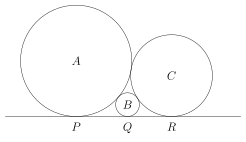
- The diagram shows three touching circles \(A\), \(B\) and \(C\), with a common tangent \(PQR\). The radii of the circles are \(a\), \(b\) and \(c\), respectively. Show that \[ \frac 1 {\sqrt b} = \frac 1 {\sqrt{a}} + \frac1{\sqrt{c}} \tag{\(*\)} \] and deduce that \[ 2\left(\frac1{a^2} + \frac1 {b^2} + \frac1 {c^2} \right) = \left(\frac1 a + \frac1 {b} + \frac1 {c} \right)^{\!2} . \tag{\(**\)} \]
- Instead, let \(a\), \(b\) and \(c\) be positive numbers, with \(b < c < a\), which satisfy \((**)\). Show that they also satisfy \((*)\).
Solution:
- \(\,\)
Notice that \begin{align*} && (a+b)^2 &= PQ^2 + (a-b)^2 \\ \Rightarrow && PQ^2 &= 4ab \\ && (b+c)^2 &= QR^2 + (c-b)^2 \\ \Rightarrow && QR^2 &= 4bc \\ && (a+c)^2 &= PR^2 + (a-c)^2 \\ \Rightarrow && PR^2 &= 4ac \\ \Rightarrow && 2\sqrt{ac} &= 2\sqrt{ab}+2\sqrt{bc} \\ \Rightarrow && \frac{1}{\sqrt{b}} &= \frac{1}{\sqrt{c}} + \frac1{\sqrt{a}} \\ \end{align*} Let \(x, y, z = \frac{1}{\sqrt{a}}, \frac1{\sqrt{b}}, \frac{1}{\sqrt{z}}\) so we would like to prove that \(2(x^4+y^4+z^4) = (x^2+y^2+z^2)^2\) or \(x^4+y^4+z^4 = 2x^2y^2+2y^2z^2+2z^2x^2\). We also have \begin{align*} && y &= x+z \\ \Rightarrow &&y^2 &= x^2+z^2+2xz \\ \Rightarrow && (y^2-x^2-z^2)^2 &= 4x^2z^2 \\ \Rightarrow && y^4+x^4+z^4 - 2x^2y^2-2y^2z^2+2x^2z^2 &= 4x^2z^2\\ \Rightarrow && y^4+x^4+z^4 &= 2x^2y^2+2y^2z^2+2z^2x^2 \end{align*}
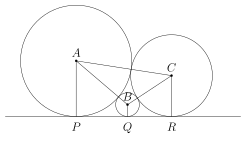
- Notice that subject to \(y > z > x\) all these steps are reversible, so we must have the equality we desire
2011 Paper 3 Q7
Let \[ T _n = \left( \sqrt{a+1} + \sqrt a\right)^n\,, \] where \(n\) is a positive integer and \(a\) is any given positive integer.
- In the case when \(n\) is even, show by induction that \(T_n\) can be written in the form \[ A_n +B_n \sqrt{a(a+1)}\,, \] where \(A_n\) and \(B_n\) are integers (depending on \(a\) and \(n\)) and \(A_n^2 =a(a+1)B_n^2 +1\).
- In the case when \(n\) is odd, show by considering \((\sqrt{a+1} +\sqrt a)T_m\) where \(m\) is even, or otherwise, that \(T_n\) can be written in the form \[ C_n \sqrt {a+1} + D_n \sqrt a \,, \] where \(C_n\) and \(D_n\) are integers (depending on \(a\) and \(n\)) and \( (a+1)C_n^2 = a D_n^2 +1\,\).
- Deduce that, for each \(n\), \(T_n\) can be written as the sum of the square roots of two consecutive integers.
Solution:
- Claim: For all \(n \geq 1\) \(T_{2n} = A_{2n} + B_{2n}\sqrt{a(a+1)}\) where \(A_{2n}, B_{2n}\) are integers and \(A_{2n}^2 = a(a+1)B_{2n}^2+1\) Proof: (By induction) Base case: \(n =1\). \begin{align*} && T_2 &= (\sqrt{a+1}+\sqrt{a})^2 \\ &&&= a+1+2\sqrt{a(a+1)}+a \\ &&&=2a+1+2\sqrt{a(a+1)} \\ \Rightarrow && A_2 &= 2a+1 \\ && B_2 &= 2 \\ && A_2^2 &= 4a^2+4a+1 \\ && a(a+1)B_1^2 + 1 &= 4a^2+4a+1 \end{align*} Therefore our base case is true. Suppose it is true for some \(n = k\) then consider \(n = k+1\) we must have \(T_{2k} = A_{2k}+B_{2k}\sqrt{a(a+1)}\) \begin{align*} && T_{2(k+1)} &= T_{2k} (\sqrt{a+1}+\sqrt{a})^2 \\ &&&= \left (A_{2k}+B_{2k}\sqrt{a(a+1)} \right)\left (2a+1+2\sqrt{a(a+1)} \right) \\ &&&= (2a+1)A_{2k}+2a(a+1)B_{2k} + (2A_{2k}+(2a+1)B_{2k})\sqrt{a(a+1)} \\ \Rightarrow && A_{2(k+1)} &= (2a+1)A_{2k}+2a(a+1)B_{2k} \in \mathbb{Z} \\ && B_{2(k+1)} &= 2A_{2k}+(2a+1)B_{2k} \in \mathbb{Z} \\ && A_{2(k+1)}^2 &= \left ( (2a+1)A_{2k}+2a(a+1)B_{2k} \right)^2 \\ &&&= (2a+1)^2A_{2k}^2+4a^2(a+1)^2B_{2k}^2+4a(a+1)(2a+1)A_{2k}B_{2k} \\ &&&= a^2(a+1)^2(2a+1)^2B_{2k}^2+(2a+1)^2\\ &&&\quad\quad+4a^2(a+1)^2B_{2k}^2+4a(a+1)(2a+1)A_{2k}B_{2k}\\ && a(a+1)B_{2(k+1)}^2 + 1 &= a(a+1)\left ( 2A_{2k}+(2a+1)B_{2k} \right)^2 \\ &&&= 4a(a+1)A_{2k}^2 + 4a(a+1)(2a+1)A_{2k}B_{2k} + a(a+1)(2a+1)^2B_{2k}^2 + 1\\ &&&= 4a^2(a+1)^2B_{2k}^2+4a(a+1) + \\ &&&\quad\quad+ 4a(a+1)(2a+1)A_{2k}B_{2k} + a(a+1)(2a+1)^2B_{2k}^2 + 1 \end{align*} So our relation holds ad therefore by induction we're done.
- When \(n\) is odd, notice that \begin{align*} && T_n &= (\sqrt{a+1}+\sqrt{a})(A_m+B_m\sqrt{a(a+1)})\\ &&&= \sqrt{a+1}(\underbrace{A_m+aB_m}_{C_n})+\sqrt{a}(\underbrace{(a+1)B_m+A_m}_{D_n}) \\ \\ && (a+1)C_n^2 &= (a+1)(A_m+aB_m)^2 \\ &&&= (a+1)(A_m^2+2aA_mB_m+B_m^2) \\ &&&= (a+1)(a(a+1)B_m^2+1+2aA_mB_m+B_m^2) \\ &&&= a(a+1)^2B_m^2 + 2a(a+1)A_mB_m+(a+1)B_m^2+a+1 \\ && aD_n^2+1 &= a((a+1)^2B_m + 2(a+1)A_mB_m + A_m^2)+1 \\ &&&= a(a+1)^2B_m + 2a(a+1)A_mB_m + aB_{m}^2+a+1 \end{align*}
- For even \(n\) \(T_n = \sqrt{a(a+1)B_{2n}^2+1} + \sqrt{a(a+1)B_{2n}^2}\) For odd \(n\), \(T_n = \sqrt{aD_n^2+1}+ \sqrt{aD_n^2}\) therefore it is always the sum of the square root of two consecutive integers.
2007 Paper 3 Q3
A sequence of numbers, \(F_1, F_2, \ldots\), is defined by \(F_1=1, F_2=1\), and \[ F_n=F_{n-1}+F_{n-2}\, \quad \text{for \(n\ge 3\)}. \]
- Write down the values of \(F_3, F_4, \ldots , F_8\).
- Prove that \(F^{\vphantom{2}}_{2k+3}F^{\vphantom{2}}_{2k+1} -F_{2k+2}^2 = -F^{\vphantom{2}}_{2k+2}F^{\vphantom{2}}_{2k}+F_{2k+1}^2\,\).
- Prove by induction or otherwise that \(F^{\vphantom{2}}_{2n+1}F^{\vphantom{2}}_{2n-1}-F^2_{2n}=1\,\) and deduce that \(F^2_{2n}+1\,\) is divisible by \(F^{\vphantom{2}}_{2n+1}\,.\)
- Prove that \(F^2_{2n-1}+1\,\) is divisible by \(F^{\vphantom{2}}_{2n+1}\,.\)
2006 Paper 3 Q5
Show that the distinct complex numbers \(\alpha\), \(\beta\) and \(\gamma\) represent the vertices of an equilateral triangle (in clockwise or anti-clockwise order) if and only if \[ \alpha^2 + \beta^2 +\gamma^2 -\beta\gamma - \gamma \alpha -\alpha\beta =0\,. \] Show that the roots of the equation \begin{equation*} z^3 +az^2 +bz +c=0 \tag{\(*\)} \end{equation*} represent the vertices of an equilateral triangle if and only if \(a^2=3b\). Under the transformation \(z=pw+q\), where \(p\) and \(q\) are given complex numbers with \(p\ne0\), the equation (\(*\)) becomes \[ w^3 +Aw^2 +Bw +C=0\,. \tag{\(**\)} \] Show that if the roots of equation \((*)\) represent the vertices of an equilateral triangle, then the roots of equation \((**)\) also represent the vertices of an equilateral triangle.
Solution: The complex numbers represent an equilateral triangle iff \(\gamma\) is a \(\pm 60^\circ\) rotation of \(\beta\) around \(\alpha\), ie \begin{align*} && \gamma - \alpha &= \omega(\beta - \alpha) \\ \Leftrightarrow && \omega &= \frac{\gamma - \alpha}{\beta - \alpha} \\ \Leftrightarrow && -1 &= \left (\frac{\gamma - \alpha}{\beta - \alpha} \right)^3 \\ \Leftrightarrow && -(\beta - \alpha)^3 &=(\gamma - \alpha)^3 \\ \Leftrightarrow && 0 &= (\gamma-\alpha)^3+(\beta-\alpha)^3 \\ &&&= \gamma^3-3\gamma^2\alpha +3\gamma\alpha^2-\alpha^3 +\beta^3-3\beta^2\alpha+3\beta\alpha^2-\alpha^3 \\ &&&= (\beta + \gamma - 2\alpha)(\alpha^2+\beta^2+\gamma^2 - \alpha\beta - \beta\gamma - \gamma \delta) \\ \Leftrightarrow && 0 &= \alpha^2+\beta^2+\gamma^2 - \alpha\beta - \beta\gamma - \gamma \delta \end{align*} The roots of the equation \(z^3+az^2+bz+c = 0\) represents the vertices of an equilateral triangle iff \(a^2-3b = (\alpha+\beta+\gamma^2) - 3(\alpha\beta+\beta\gamma+\gamma\alpha) = \alpha^2+\beta^2+\gamma^2 - \alpha\beta - \beta\gamma - \gamma \delta = 0\) as erquired. Suppose \(a^2 = 3b\), then consider \(z = pw +q\), we must have \begin{align*} && 0 &= (pw+q)^3+a(pw+q)^2 + b(pw+q)+c \\ &&&= p^3w^3 +(3p^2q+ap^2)w^2+(3pq^2+2apq+bp)w+(q^3+aq^2+bq+c) \\ &&&= p^3w^3+p^2(3q+a)w^2+p(3q^2+2aq+b)w+(q^3+aq^2+bq+c) \\ \end{align*} We need to check if \(\left(\frac{3q+a}{p} \right)^2 = 3 \left (\frac{3q^2+2qa+b}{p^2} \right)\). Clearly the denominators match, so consider the numerators \begin{align*} && (3q+a)^2 &= 9q^2+6aq+a^2 \\ &&&= 9q^2+6aq+3b \\ &&&= 3(3q^2+2qa+b) \end{align*} as required
2005 Paper 2 Q4
The positive numbers \(a\), \(b\) and \(c\) satisfy \(bc=a^2+1\). Prove that $$ \arctan\left(\frac1 {a+b}\right)+ \arctan\left(\frac1 {a+c}\right)= \arctan\left(\frac1 a \right). $$ The positive numbers \(p\), \(q\), \(r\), \(s\), \(t\), \(u\) and \(v\) satisfy $$ st = (p+q)^2 + 1 \;, \ \ \ \ \ \ uv=(p+r)^2 + 1 \;, \ \ \ \ \ \ qr = p^2+1\;. $$ Prove that $$ \arctan \! \!\left(\!\frac1 {p+q+s}\!\right) + \arctan \! \!\left(\!\frac 1{p+q+t}\!\right) + \arctan \! \!\left(\!\frac 1 {p+r+u}\!\right) + \arctan \! \!\left(\!\frac1 {p+r+v}\!\right) =\arctan \! \!\left( \! \frac1 p \! \right) . $$ Hence show that $$ \arctan\left(\frac1 {13}\right) +\arctan\left(\frac1 {21}\right) +\arctan\left(\frac1 {82}\right) +\arctan\left(\frac1 {187}\right) =\arctan\left(\frac1 {7}\right). $$ [Note that \(\arctan x\) is another notation for \( \tan^{-1}x \,.\,\)]
Solution: \begin{align*} && \tan \left (\arctan\left(\frac1 {a+b}\right)+ \arctan\left(\frac1 {a+c}\right) \right) &= \frac{\frac1{a+b}+\frac1{a+c}}{1-\frac{1}{(a+b)(a+c)}} \\ &&&= \frac{a+c+a+b}{(a+b)(a+c)-1} \\ &&&= \frac{2a+b+c}{a^2+ab+ac+bc-1} \\ &&&= \frac{2a+b+c}{2a^2+ab+ac} \\ &&&= \frac{1}{a} \\ &&&= \tan \arctan \frac1a\\ \Rightarrow && \arctan\left(\frac1 {a+b}\right)+ \arctan\left(\frac1 {a+c}\right) &= \arctan \frac{1}{a} + n \pi \end{align*} Since \(\arctan x \in (-\frac{\pi}{2}, \frac{\pi}{2})\) the LHS \(\in (0, \pi)\) so \(n = 0\). \begin{align*} a=p+q, b = s, c = t:&& \arctan \! \!\left(\!\frac1 {p+q+s}\!\right) + \arctan \! \!\left(\!\frac 1{p+q+t}\!\right) &= \arctan \left ( \frac{1}{p+q} \right) \\ a=p+r, b= u, c = v && \arctan \! \!\left(\!\frac 1 {p+r+u}\!\right) + \arctan \! \!\left(\!\frac1 {p+r+v}\!\right) &= \arctan \! \!\left(\!\frac1 {p+r}\!\right) \\ a = p, b = q, c = r:&& \arctan \left ( \frac{1}{p+q} \right) +\arctan \! \!\left(\!\frac1 {p+r}\!\right) &= \arctan \left ( \frac1p \right) \end{align*} and the result follows. Taking \(p = 7\) we need to solve \[ \begin{cases} q+s &= 6 \\ q+t &= 14 \\ r+u &= 75 \\ r+v &= 180 \end{cases} \] also satisfying \(qr = 50\) etc, so say \(q = 1, r = 50, s = 5, v=25\)
1999 Paper 2 Q4
By considering the expansions in powers of \(x\) of both sides of the identity $$ {(1+x)^n}{(1+x)^n}\equiv{(1+x)^{2n}}, $$ show that $$ \sum_{s=0}^n {n\choose s}^2 = {2n\choose n}, $$ where \(\displaystyle {n\choose s}= \frac{n!}{s!\,(n-s)!}\). By considering similar identities, or otherwise, show also that:
- if \(n\) is an even integer, then \(\displaystyle \sum_{s=0}^n {{(-1)}^s}{n \choose s}^2= (-1)^{n/2}{n \choose n/2};\)
- \(\displaystyle \sum\limits_{t=1}^ n 2t { n \choose t}^2 = n {2n\choose n} .\)
Solution: To obtain the coefficient of \(x^n\) on the RHS we clearly have \(\displaystyle \binom{2n}n\). To obtain the coefficient of \(x^n\) on the LHS we can obtain \(x^s\) from the first bracket and \(x^{n-s}\) from the second bracket, ie \(\displaystyle \sum_{s=0}^n \binom{n}{s}\binom{n}{n-s} = \sum_{s=0}^n \binom{n}{s}\binom{n}{s} = \sum_{s=0}^n \binom{n}{s}^2\)
- Consider \((1-x)^n(1+x)^n = (1-x^2)^n\), then the coefficient of \(x^n\) (if \(n\) is even) is for the RHS \(\displaystyle (-1)^{n/2} \binom{n}{n/2}\). For the LHS, we can obtain \(x^n\) via \(x^s\) and \(x^{n-s}\) which is \(\displaystyle \sum_{s=0}^n (-1)^s\binom{n}{s}\binom{n}{n-s} = \sum_{s=0}^n (-1)^s\binom{n}{s}^2\)
- Notice that \begin{align*} && \sum_{t=1}^ n 2t { n \choose t}^2 &= n {2n\choose n} \\ \Leftrightarrow && \sum_{t=1}^ n 2t \frac{n}{t} { n-1 \choose t-1}\binom{n}{t} &= n \frac{2n}{n}{2n-1\choose n-1} \\ \Leftrightarrow && \sum_{t=1}^ n { n-1 \choose t-1}\binom{n}{t} &= {2n-1\choose n-1} \\ \Leftrightarrow && \sum_{t=1}^ n { n-1 \choose t-1}\binom{n}{n-t} &= {2n-1\choose n-1} \\ \end{align*} but this is exactly what we would obtain by considering the coefficient of \(x^{n-1}\) in \((1+x)^{n-1}(1+x)^n \equiv (1+x)^{2n-1}\)
1999 Paper 3 Q5
The sequence \(u_0\), \(u_1\), \(u_2\), ... is defined by $$ u_0=1,\hspace{0.2in} u_1=1, \quad u_{n+1}=u_n+u_{n-1} \hspace{0.2in}{\rm for}\hspace{0.1in}n \ge 1\,. $$ Prove that $$ u^2_{n+2} + u^2_{n-1} = 2( u^2_{n+1} + u^2_n ) \,. $$ Using induction, or otherwise, prove the following result: \[ u_{2n} = u^2_n + u^2_{n-1} \quad \mbox{ and }\quad u_{2n+1} = u^2_{n+1} - u^2_{n-1} \] for any positive integer \(n\).
Solution: Claim: \(u^2_{n+2} + u^2_{n-1} = 2( u^2_{n+1} + u^2_n )\) Proof: (By Induction). (Base Case): \(n = 1\) \begin{align*} && LHS &= u_{n+2}^2 + u_{n-1}^2 \\ &&&= u_3^2 + u_0^2 \\ &&&= 3^2 + 1^2 = 10\\ && RHS &= 2(u_{n+1}^2+u_n^2) \\ &&&= 2(2^2 + 1^2) \\ &&&= 10 \end{align*} Therefore the base case is true. (Inductive hypothesis) Suppose \(u^2_{n+2} + u^2_{n-1} = 2( u^2_{n+1} + u^2_n )\) is true for some \(n = k\), ie \(u^2_{k+2} + u^2_{k-1} = 2( u^2_{k+1} + u^2_k )\), the consider \(n = k+1\) \begin{align*} && LHS &= u_{k+1+2}^2 + u_{k+1-1}^2 \\ &&&= (u_{k+1}+u_{k+2})^2+u_k^2 \\ &&&= u_{k+2}^2+u_{k+1}^2+ u_k^2 + 2u_{k+1}u_{k+2} \\ &&&= u_{k+2}^2+u_{k+1}^2+ u_k^2 + 2u_{k+1}(u_{k+1}+u_k) \\ &&&= u_{k+2}^2 + u_{k+1}^2+u_k^2+2u_{k+1}^2+2u_{k+1}u_k \\ &&&= u_{k+1}^2+2u_{k+1}^2+ u_{k+1}^2+u_k^2+2u_{k+1}u_k \\ &&&= u_{k+2}^2+2u_{k+1}^2+ (u_{k+1}+u_k)^2 \\ &&&= u_{k+2}^2+2u_{k+1}^2+ u_{k+2}^2 \\ &&&=2(u_{k+2}^2+u_{k+1}^2) \\ &&&= RHS \end{align*} Therefore it is true for \(n = k+1\). Therefore by the principle of mathematical induction it is true for all \(n \geq 1\) Claim: $ u_{2n} = u^2_n + u^2_{n-1} \quad \mbox{ and }\quad u_{2n+1} = u^2_{n+1} - u^2_{n-1} $ Proof: Notice that \(\begin{pmatrix}u_{n+1} \\ u_n \end{pmatrix}= \begin{pmatrix} 1 & 1 \\ 1 & 0 \end{pmatrix}^n \begin{pmatrix}1 \\1 \end{pmatrix}\), in particular \begin{align*} && \begin{pmatrix}u_{n}& u_{n-1} \\ u_{n-1} & u_{n-2} \end{pmatrix}&= \begin{pmatrix} 1 & 1 \\ 1 & 0 \end{pmatrix}^{n} \\ \Rightarrow && \begin{pmatrix}u_{2n}& u_{2n-1} \\ u_{2n-1} & u_{2n-2} \end{pmatrix}&= \begin{pmatrix} 1 & 1 \\ 1 & 0 \end{pmatrix}^{2n} \\ &&&= \begin{pmatrix} 1 & 1 \\ 1 & 0 \end{pmatrix}^{n} \begin{pmatrix} 1 & 1 \\ 1 & 0 \end{pmatrix}^{n} \\ &&&=\begin{pmatrix}u_{n}& u_{n-1} \\ u_{n-1} & u_{n-2} \end{pmatrix}\begin{pmatrix}u_{n}& u_{n-1} \\ u_{n-1} & u_{n-2} \end{pmatrix}\\ &&&= \begin{pmatrix}u_{n}^2+u_{n-1}^2& u_{n-1}(u_n+u_{n-2}) \\ u_{n-1}(u_n+u_{n-2}) & u_{n-1}^2+u_{n-2}^2 \end{pmatrix} \end{align*} Therefore \(u_{2n} = u_{n}^2+u_{n-1}^2\) and \(u_{2n+1} = u_n(u_{n+1}+u_{n-1}) =(u_{n+1}-u_{n-1})(u_{n+1}-u_{n-1}) = u_{n+1}^2-u_{n-1}^2\)
1997 Paper 1 Q6
Find constants \(a_{0}\), \(a_{1}\), \(a_{2}\), \(a_{3}\), \(a_{4}\), \(a_{5}\), \(a_{6}\) and \(b\) such that \[x^{4}(1-x)^{4}=(a_{6}x^{6}+a_{5}x^{5}+a_{4}x^{4}+a_{3}x^{3}+ a_{2}x^{2}+a_{1}x+a_{0})(x^{2}+1)+b.\] Hence, or otherwise, prove that \[\int_{0}^{1}\frac{x^{4}(1-x)^{4}}{1+x^{2}}{\rm d}x =\frac{22}{7}-\pi.\] Evaluate \(\displaystyle{\int_{0}^{1}x^{4}(1-x)^{4}{\rm d}x}\) and deduce that \[\frac{22}{7}>\pi>\frac{22}{7}-\frac{1}{630}.\]
Solution: Plugging in \(x = i\) we obtain \((1-i)^4 = (-2i)^2 = -4 \Rightarrow b = -4\). \begin{align*} x^4(1-x)^4 &= x^4(1-4x+6x^2-4x^3+x^4) \\ &= x^8-4x^7+6x^6-4x^5+x^4 \\ &= x^6(x^2+1) - x^6 -4x^7+6x^6-4x^5+x^4 \\ &= x^6(x^2+1) -4x^5(x^2+1)+4x^5 +5x^6-4x^5+x^4 \\ &= (x^6-4x^5)(x^2+1) +5x^4(x^2+1)-5x^4+x^4 \\ &= (x^6-4x^5+5x^4)(x^2+1) -4x^2(x^2+1)+4x^2 \\ &= (x^6-4x^5+5x^4-4x^2)(x^2+1) +4(x^2+1)-4 \\ &= (x^6-4x^5+5x^4-4x^2+4)(x^2+1) -4 \\ \end{align*} So \begin{align*} \int_0^1 \frac{x^4(1-x)^4}{1+x^2} \d x &= \int_0^1 (x^6-4x^5+5x^4-4x^2+4) - \frac{4}{1+x^2} \d x \\ &= \frac17 - \frac46+1-\frac43+4 - \pi \\ &= \frac{22}7 - \pi \end{align*} \begin{align*} \int_0^1 x^4(1-x)^4 \d x &= B(5,5) \\ &= \frac{4!4!}{9!} \\ &= \frac1{630} \end{align*} Therefore since \(0 < \frac{x^4(1-x)^4}{1+x^2} < x^4(1-x)^4\) we must have that \begin{align*} && 0 &< \frac{22}7 - \pi \\ \Rightarrow && \pi & < \frac{22}{7} \\ && \frac{22}{7} - \pi &< \frac1{630} \\ \Rightarrow && \frac{22}{7} - \frac1{630} &< \pi \end{align*} which is what we wanted.
1988 Paper 1 Q5
Given that \(b>a>0\), find, by using the binomial theorem, coefficients \(c_{m}\) (\(m=0,1,2,\ldots\)) such that \[ \frac{1}{\left(1-ax\right)\left(1-bx\right)}=c_{0}+c_{1}x+c_{2}x^{2}+\ldots+c_{m}x^{m}+\cdots \] for \(b\left|x\right|<1\). Show that \[ c_{m}^{2}=\frac{a^{2m+2}-2(ab)^{m+1}+b^{2m+2}}{(a-b)^{2}}\,. \] Hence, or otherwise, show that \[ c_{0}^{2}+c_{1}^{2}x+c_{2}^{2}x^{2}+\cdots+c_{m}^{2}x^{m}+\cdots=\frac{1+abx}{\left(1-abx\right)\left(1-a^{2}x\right)\left(1-b^{2}x\right)}\,, \] for \(x\) in a suitable interval which you should determine.
Solution: \begin{align*} \frac{1}{(1-ax)(1-bx)} &=\frac{1}{b-a} \l \frac{b}{1-bx}-\frac{a}{1-ax}\r \\ &= \frac{1}{b-a} \l \sum_{k=0}^{\infty} b(bx)^k-\sum_{k=0}^{\infty} a(ax)^k \r \\ &= \frac{1}{b-a} \sum_{k=0}^{\infty} \l b^{k+1} - a^{k+1} \r x^k \end{align*} Therefore \(\displaystyle c_m = \frac{b^{k+1}-a^{k+1}}{b-a}\). \begin{align*} c_m^2 &= \frac{(b^{m+1}-a^{m+1})^2}{(b-a)^2} \\ &= \frac{a^{2m+2} - 2(ab)^{m+1} + b^{2m+2}}{(b-a)^2} \end{align*} \begin{align*} \sum_{m=0}^{\infty} c_m x^m &= \sum_{m=0}^{\infty} \l \frac{a^{2m+2} - 2(ab)^{m+1} + b^{2m+2}}{(b-a)^2} \r x^m \\ &= \frac{1}{(b-a)^2} \l \sum_{m=0}^{\infty} a^{2m+2} x^m-2\sum_{m=0}^{\infty} (ab)^{m+1} x^m+\sum_{m=0}^{\infty} b^{2m+2} x^m \r \\ &= \frac{1}{(b-a)^2} \l a^2\sum_{m=0}^{\infty} a^{2m} x^m-2ab\sum_{m=0}^{\infty} (ab)^{m} x^m+b^2\sum_{m=0}^{\infty} b^{2m} x^m \r \\ &= \frac{1}{(b-a)^2} \l \frac{a^2}{1-a^2x^2} - \frac{2ab}{1-abx} + \frac{b^2}{1-b^2x^2}\r \\ &= \frac{1+ab}{(1-a^2x)(1-abx)(1-b^2x)} \end{align*} Where geometric series will converge if \(|a^2x| < 1, |b^2x| < 1, |abx| < 1\), ie \(|x| < \min (\frac{1}{a^2}, \frac{1}{b^2} )\)
1987 Paper 2 Q1
Prove that:
- if \(a+2b+3c=7x\), then \[ a^{2}+b^{2}+c^{2}=\left(x-a\right)^{2}+\left(2x-b\right)^{2}+\left(3x-c\right)^{2}; \]
- if \(2a+3b+3c=11x\), then \[ a^{2}+b^{2}+c^{2}=\left(2x-a\right)^{2}+\left(3x-b\right)^{2}+\left(3x-c\right)^{2}. \]
Solution:
- \begin{align*} \left(x-a\right)^{2}+\left(2x-b\right)^{2}+\left(3x-c\right)^{2} &= x^2-2ax+a^2 + 4x^2 -4bx+b^2 + 9x^2-6cx + c^2 \\ &= (1^2 + 2^2 + 3^2)x^2 - 2x(a+2b+3c) +a^2+b^2 + c^2 \\ &= 14x^2 - 2x(7x) + a^2 + b^2 + c^2 \\ &= a^2 + b^2 + c^2 \end{align*}
- \begin{align*} \left(2x-a\right)^{2}+\left(3x-b\right)^{2}+\left(3x-c\right)^{2} &= (2^2+3^2+3^2)x^2 - 2x(2a+3b+3c) + (a^2 + b^2+c^2) \\ &= 22x^2 - 2x(11x) + a^2+b^2+c^2 \\ &= a^2+b^2+c^2 \end{align*}