Problems
Filters
20 problems found
2018 Paper 2 Q5
In this question, you should ignore issues of convergence.
- Write down the binomial expansion, for \(\vert x \vert<1\,\), of \(\;\dfrac{1}{1+x}\,\) and deduce that %. By considering %$ %\displaystyle \int \frac 1 {1+x} \, \d x %\,, %$ %show that \[ \displaystyle \ln (1+x) = -\sum_{n=1}^\infty \frac {(-x)^n}n \, \] for \(\vert x \vert <1 \,\).
- Write down the series expansion in powers of \(x\) of \(\displaystyle \e^{-ax}\,\). Use this expansion to show that \[ \int_0^\infty \frac {\left(1- \e^{-ax}\right)\e^{-x}}x \,\d x = \ln(1+a) \ \ \ \ \ \ \ (\vert a \vert <1)\,. \]
- Deduce the value of \[ \int_0^1 \frac{x^p - x^q}{\ln x} \, \d x \ \ \ \ \ \ (\vert p\vert <1, \ \vert q\vert <1) \,. \]
Solution:
- \begin{align*} && \frac1{1+x} &= 1 - x+ x^2 - x^3+ \cdots \\ \Rightarrow && \int_0^x \frac{1}{1+t} \d t &= \int_0^x \sum_{n=0}^{\infty} (-t)^n \d t \\ &&&= \left [\sum_{n=0}^{\infty} -\frac{(-t)^{n+1}}{n+1} \right]_0^x \\ \Rightarrow &&\ln(1+x)&=- \sum_{n=1}^\infty \frac{(-x)^n}{n} \end{align*}
- \begin{align*} && e^{-ax} &= \sum_{n=0}^\infty \frac{(-a)^n}{n!} x^n \\ \Rightarrow && \int_0^{\infty} \frac{1}{x} \left (1-e^{-ax} \right)e^{-x} \d x &= \int_0^{\infty} \frac{1}{x} \left (-\sum_{n=1}^\infty \frac{(-a)^n}{n!}x^n \right)e^{-x} \d x \\ &&&= -\int_0^{\infty} \sum_{n=1}^\infty \frac{(-a)^n}{n!} x^{n-1} e^{-x} \d x \\ &&&= -\sum_{n=1}^\infty \frac{(-a)^n}{n!} \int_0^{\infty} x^{n-1} e^{-x} \d x \\ &&&= -\sum_{n=1}^\infty \frac{(-a)^n}{n!} (n-1)! \\ &&&= -\sum_{n=1}^\infty \frac{(-a)^n}{n} \\ &&&= \ln (1+a) \end{align*}
- \begin{align*} && \int_0^1 \frac{x^p - x^q}{\ln x} \, \d x &= \int_0^1 \frac{x^p(1 - x^{q-p})}{\ln x} \, \d x \\ e^{-u} = x, \d x = -e^{-u} \d u: &&&=\int_{u=\infty}^{0} \frac{e^{-pu}-e^{-qu}}{-u} (-e^{-u})\d u \\ &&&= \int_0^\infty \frac{e^{-u}(e^{-qu}-e^{-pu})}{u} \d u \\ &&&= \int_0^\infty \frac{e^{-(1+q)u}(1-e^{-(p-q)u})}{u} \d u \\ v = (1+q)u, \d v = (1+q) \d u: &&&=\int_0^{\infty} \frac{e^{-v}(1-e^{-\left(\frac{p-q}{1+q}\right)v}}{v}\d v \\ &&&= \ln \left(1 + \frac{p-q}{1+q} \right) \\ &&&= \ln \left ( \frac{1+p}{1+q} \right) \end{align*}
2018 Paper 3 Q8
In this question, you should ignore issues of convergence.
- Let \[ I = \int_0^1 \frac{\f(x^{-1}) } {1+x} \, \d x \,, \] where \(\f(x)\) is a function for which the integral exists. Show that \[ I = \sum_{n=1}^\infty \int_n^{n+1} \frac{\f(y) } {y(1+y)}\, \d y \] and deduce that, if \(\f(x) = \f(x+1)\) for all \(x\), then \[ I= \int_0^1 \frac{\f(x)} {1+x} \, \d x \,. \]
- The {\em fractional part}, \(\{x\}\), of a real number \(x\) is defined to be \(x-\lfloor x\rfloor\) where \(\lfloor x \rfloor\) is the largest integer less than or equal to \(x\). For example \(\{3.2\} = 0.2\) and \(\{3\}=0\,\). Use the result of part (i) to evaluate \[ \displaystyle \int _0^1 \frac { \{x^{-1}\}}{1+x}\, \d x \text{ and } \displaystyle \int _0^1 \frac { \{2x^{-1}\}}{1+x}\, \d x \,. \]
- (Bonus) Use the same method to evaluate \[ \int_0^1 \frac {x\{x^{-1}\}}{1-x^2} \, \d x \,. \]
- (Bonus - harder) Use the same method to evaluate \[ \int_0^1 \frac {x^2\{x^{-1}\}}{1-x^2} \, \d x \,. \]
Solution:
- \begin{align*} && I &= \int_0^1 \frac{f(x^{-1})}{1+x} \d x \\ u = x^{-1}, \d u = -x^{-2} \d x: &&&= \int_{\infty}^1 \frac{f(u)}{1+\frac{1}{u}} \frac{-1}{u^2} \d u \\ &&&= \int_1^{\infty} \frac{f(u)}{u(1+u)} \d u \\ &&&= \sum_{n=1}^{\infty} \int_n^{n+1} \frac{f(u)}{u(u+1)} \d u \\ \\ \text{if} f(x) = f(x+1)\, \forall x && &=\sum_{n=1}^{\infty} \int_{0}^1 \frac{f(x+n)}{(x+n)(x+n+1)} \d x \\ &&&= \sum_{n=1}^\infty \int_0^1 \frac{f(x)}{(x+n)(x+n+1)} \d x \\ &&&= \int_0^1 f(x) \l \sum_{n=1}^{\infty} \frac{1}{(x+n)(x+n+1)}\r \d x \\ &&&= \int_0^1 f(x) \l \sum_{n=1}^{\infty} \l \frac{1}{x+n} - \frac{1}{x+n+1} \r\r \d x \\ &&&= \int_0^1 f(x) \l \frac{1}{x+1} \r \d x \\ &&&= \int_0^1\frac{f(x)}{x+1} \d x \\ \end{align*}
- Since the fractional part is periodic with period \(1\), we can say \begin{align*} && \int_0^1 \frac{\{ x^{-1} \} }{1+x} \d x &= \int_0^1 \frac{\{ x\}}{x+1} \d x \\ &&&= \int_0^1 \frac{x}{x+1} \d x \\ &&&= \int_0^1 1-\frac{1}{x+1} \d x \\ &&&= [x - \ln (1+x) ]_0^1 \\ &&&= 1 - \ln 2 \end{align*} \begin{align*} && \int_0^1 \frac{\{ 2x^{-1}\}}{1+x} \d x &= \int_0^1 \frac{\{2x\}}{x+1} \d x \\ &&&= \int_0^{1/2} \frac{2x}{x+1} \d x +\int_{1/2}^{1} \frac{2x-1}{x+1} \d x \\ &&&= 2\int_0^1 \frac{x}{x+1} \d x + \int_{1/2}^1 \frac{-1}{x+1} \d x \\ &&&= 2 - 2\ln 2 - \l \ln 2 - \ln \tfrac32 \r \\ &&&= 2 - 4 \ln 2 + \ln 3 \\ &&&= 2 + \ln \tfrac {3}{16} \end{align*}
- \begin{align*} && \int_0^1 \frac{x \{ x^{-1} \} }{1-x^2} \d x &= \frac12 \l \int_0^1 \frac{ \{ x^{-1} \}}{1-x} - \frac{\{x^{-1} \}}{1+x} \d x\r \end{align*} Consider for \(f\) periodic with period \(1\) \begin{align*} \int_0^1 \frac{f(x^{-1})}{1-x} \d x &= \int_1^{\infty} \frac{f(u)}{u(u-1)} \d u \\ &= \sum_{n=1}^{\infty}\int_{n}^{n+1} \frac{f(u)}{u(u-1)} \d u \\ &= \sum_{n=1}^{\infty}\int_{0}^{1} \frac{f(u)}{(u+n)(u+n-1)} \d u \\ &= \int_{0}^{1} \sum_{n=1}^{\infty}\frac{f(u)}{(u+n)(u+n-1)} \d u \\ &= \int_{0}^{1} f(u) \sum_{n=1}^{\infty}\l\frac{1}{u+n-1} - \frac{1}{u+n} \r\d u \\ &= \int_0^1 \frac{f(u)}{u} \d u \end{align*} So we have \begin{align*} && \int_0^1 \frac{x \{ x^{-1} \} }{1-x^2} \d x &= \frac12 \l \int_0^1 \frac{ \{ x^{-1} \}}{1-x} - \frac{\{x^{-1} \}}{1+x} \d x \r \\ &&&= \frac12 \int_0^1 \frac{\{ x \}}{x} \d x - \frac12 (1 - \ln 2) \\ &&&= \frac12 - \frac12 + \frac12 \ln 2 \\ &&&= \frac12 \ln 2 \end{align*}
2015 Paper 2 Q1
- By use of calculus, show that \(x- \ln(1+x)\) is positive for all positive \(x\). Use this result to show that \[ \sum_{k=1}^n \frac 1 k > \ln (n+1) \,. \]
- By considering \( x+\ln (1-x)\), show that \[ \sum_{k=1}^\infty \frac 1 {k^2} <1+ \ln 2 \,. \]
Solution:
- Consider \(f(x) = x - \ln (1+ x)\), then \(f'(x) = 1 - \frac{1}{1+x} = \frac{x}{1+x} > 0\) if \(x >0\). Therefore \(f(x)\) is strictly increasing on the positive reals. Since \(f(0) = 0\) we must have \(f(x) > 0\) for all positive \(x\), ie \(x - \ln(1+x)\) is positive for all positive \(x\). \begin{align*} \sum_{k=1}^n \frac1k &\underbrace{>}_{x > \ln(1+x)} \sum_{k=1}^n \ln \left (1 + \frac1k \right ) \\ &= \sum_{k=1}^n \ln \left ( \frac{k+1}{k} \right ) \\ &= \sum_{k=1}^n \left ( \ln (k+1) - \ln (k) \right) \\ &= \ln (n+1) - \ln 1 \\ &= \ln (n+1) \end{align*}
- Let \(g(x) = x + \ln (1-x)\) ,then \(g'(x) = 1 - \frac{1}{1-x} = \frac{-x}{1-x} < 0\) if \(0 < x < 1\) and \(g(0) = 0\). Therefore \(g(x)\) is decreasing and hence negative on \(0 < x < 1\), in particular \(x < -\ln(1-x) \) \begin{align*} \sum_{k=2}^n \frac1{k^2} &\underbrace{<}_{x < -\ln(1+x)} \sum_{k=2}^n - \ln \left (1-\frac1{k^2} \right) \\ &= -\sum_{k=2}^n \ln \left ( \frac{k^2-1}{k^2}\right) \\ &= \sum_{k=2}^n \l 2 \ln k - \ln(k-1) - \ln(k+1) \r \\ &= \ln n - \ln(n+1) - \ln 0+\ln 2 \\ &= \ln 2 + \ln \frac{n}{n+1} \end{align*} as \(n \to \infty\) we must have \(\displaystyle \sum_{k=2}^{\infty} \frac1{k^2} < \ln 2\) ie \[ \sum_{k=1}^\infty \frac 1 {k^2} <1+ \ln 2\]
2013 Paper 3 Q2
In this question, you may ignore questions of convergence. Let \(y= \dfrac {\arcsin x}{\sqrt{1-x^2}}\,\). Show that \[ (1-x^2)\frac {\d y}{\d x} -xy -1 =0 \] and prove that, for any positive integer \(n\), \[ (1-x^2) \frac{\d^{n+2}y}{\d x^{n+2}} - (2n+3)x \frac{\d ^{n+1}y}{\d x ^{n+1}} -(n+1)^2 \frac{\d^ny}{\d x^n}=0\, . \] Hence obtain the Maclaurin series for \( \dfrac {\arcsin x}{\sqrt{1-x^2}}\,\), giving the general term for odd and for even powers of \(x\). Evaluate the infinite sum \[ 1 + \frac 1 {3!} + \frac{2^2}{5!} + \frac {2^2\times 3^2}{7!}+\cdots + \frac {2^2\times 3^2\times \cdots \times n^2}{(2n+1)!} + \cdots\,. \]
Solution: \begin{align*} && y &= \frac{\arcsin x}{\sqrt{1-x^2}} \\ && \frac{\d y}{\d x} &= \frac{(1-x^2)^{-1/2} \cdot (1-x^2)^{1/2}-\arcsin x \cdot (-x)(1-x^2)^{-1/2}}{1-x^2} \\ &&&= \frac{1+ xy}{1-x^2} \\ \Rightarrow && 0 &= (1-x^2) \frac{\d y}{\d x} -xy-1\\ \\ \frac{\d^n}{\d x^{n+1}}: && 0 &= \left ( (1-x^2) y' \right)^{(n+1)} - (xy)^{(n+1)} \\ \Rightarrow && 0 &= (1-x^2)y^{(n+2)} + \binom{n+1}{1}(1-x^2)^{(1)}y^{(n+1)}+\binom{n+1}{2} (1-x^2)^{(2)}y^{(n)} - (xy^{(n+1)} +\binom{n+1}{1} y^{(n)} ) \\ &&&= (1-x^2)y^{(n+2)}+\left ( (n+1)\cdot(-2x)-x \right)y^{(n+1)} + \left ( \frac{(n+1)n}{2} \cdot (-2)-(n+1) \right)y^{(n)} \\ &&&= (1-x^2)y^{(n+2)}-\left ( 2n+3 \right)xy^{(n+1)} - \left ( (n+1)n+(n+1)\right)y^{(n)} \\ &&&= (1-x^2)y^{(n+2)}-\left ( 2n+3 \right)xy^{(n+1)} - \left ( n+1\right)^2y^{(n)} \\ \end{align*} Since \(y(0) = 0, y'(0) = 1\) we can look at the recursion: \(y^{(n+2)} - (n+1)^2y^{(n)}\) for larger terms, ie \(y^{(2k)}(0) = 0\) \(y^{(1)}(0) = 1, y^{(3)}(0) = (1+1)^2 \cdot 1 = 2^2, y^{(5)}(0) = (3+1)^2 y^{(3)} = 4^2 \cdot 2^2\) and \(y^{(2k+1)}(0) = (2k)^2 \cdot (2k-2)^2 \cdots 2^2 \cdot 1^2 = 2^{2k} \cdot (k!)^2\). Therefore \begin{align*} && \frac{\arcsin x}{\sqrt{1-x^2}} &= \sum_{k=0}^{\infty} \frac{2^{2k} \cdot (k!)^2}{(2k+1)!} x^{2k+1} \\ \\ \Rightarrow && \frac{\arcsin \frac12}{\sqrt{1-\left (\frac12 \right)^2}} &= \sum_{k=0}^{\infty} \frac{2^{2k} \cdot (k!)^2}{(2k+1)!} 2^{-2k-1}\\ &&&= \frac12 \sum_{k=0}^{\infty} \frac{ (k!)^2}{(2k+1)!} \\ &&&= \frac12 \left ( 1 + \frac1{3!} + \frac{2^2}{5!} + \cdots+ \right) \\ \Rightarrow&& S &= 2 \frac{2\frac{\pi}{6}}{\sqrt{3}} = \frac{2\pi}{3\sqrt{6}} \end{align*}
2012 Paper 2 Q4
In this question, you may assume that the infinite series \[ \ln(1+x) = x-\frac{x^2}2 + \frac{x^3}{3} -\frac {x^4}4 +\cdots + (-1)^{n+1} \frac {x^n}{n} + \cdots \] is valid for \(\vert x \vert <1\).
- Let \(n\) be an integer greater than 1. Show that, for any positive integer \(k\), \[ \frac1{(k+1)n^{k+1}} < \frac1{kn^{k}}\,. \] Hence show that \(\displaystyle \ln\! \left(1+\frac1n\right) <\frac1n\,\). Deduce that \[ \left(1+\frac1n\right)^{\!n}<\e\,. \]
- Show, using an expansion in powers of \(\dfrac1y\,\), that $ \displaystyle \ln \! \left(\frac{2y+1}{2y-1}\right) > \frac 1y %= \sum _{r=0}^\infty \frac 1{(2r+1)(2y)^{2r}}\,. \( for \)y>\frac12$. Deduce that, for any positive integer \(n\), \[ \e < \left(1+\frac1n\right)^{\! n+\frac12}\,. \]
- Use parts (i) and (ii) to show that as \(n\to\infty\) \[ \left(1+\frac1n\right)^{\!n} \to \e\,. \]
Solution:
- Since \(k \geq 1\) we have \(n^{k+1} > n^k\) and \((k+1) > k\), therefore \((k+1)n^{k+1} >kn^k \Rightarrow \frac{1}{(k+1)n^{k+1}} < \frac{1}{kn^k}\) \begin{align*} && \ln \left ( 1 + \frac1n \right) &= \frac1n -\frac{1}{2n^2} + \frac{1}{3n^3} - \frac{1}{4n^4} + \cdots \\ &&&= \frac1n - \underbrace{\left (\frac{1}{2n^2}-\frac{1}{3n^3} \right)}_{>0}- \underbrace{\left (\frac{1}{4n^4}-\frac{1}{5n^5} \right)}_{>0} - \cdot \\ &&&< \frac1n \\ \\ \Rightarrow && n \ln \left ( 1 + \frac1n \right) &< 1 \\ \Rightarrow && \ln \left ( \left ( 1 + \frac1n \right)^n \right) &< 1 \\ \Rightarrow && \left ( 1 + \frac1n \right)^n &< e \end{align*}
- \(\,\) \begin{align*} &&\ln \left(\frac{2y+1}{2y-1}\right) &= \ln \left (1 + \frac{1}{2y} \right)-\ln \left (1 - \frac{1}{2y} \right) \\ &&&= \frac{1}{2y} - \frac{1}{2(2y)^2} + \frac{1}{3(2y)^3} - \cdots - \left (-\frac{1}{2y} - \frac{1}{2(2y)^2} - \frac{1}{3(2y)^3} - \cdots \right) \\ &&&= \frac{1}{y} + \frac{2}{3(2y)^3} + \frac{2}{5(2y)^5} \\ &&&= \sum_{r=1}^{\infty} \frac{2}{(2r-1)(2y)^{2r-1}} \\ &&&> \frac1y \\ \\ \Rightarrow && \ln \left (1 + \frac{1}{y-\frac12} \right) &> \frac{1}{y} \\\Rightarrow && \ln \left (1 + \frac{1}{n} \right) &> \frac{1}{n+\frac12} \\ \Rightarrow &&(n+\tfrac12) \ln \left (1 + \frac{1}{n} \right) &> 1\\ \Rightarrow && \ln \left ( \left (1 + \frac{1}{n} \right)^{n+\tfrac12} \right) &> 1\\ \Rightarrow && \left (1 + \frac{1}{n} \right)^{n+\tfrac12} & > e \end{align*}
2012 Paper 3 Q4
- Show that \[ \sum_{n=1} ^\infty \frac{n+1}{n!} = 2\e - 1 \] and \[ \sum _{n=1}^\infty \frac {(n+1)^2}{n!} = 5\e-1\,. \] Sum the series $\displaystyle \sum _{n=1}^\infty \frac {(2n-1)^3}{n!} \,.$
- Sum the series $\displaystyle \sum_{n=0}^\infty \frac{(n^2+1)2^{-n}}{(n+1)(n+2)}\,$, giving your answer in terms of natural logarithms.
Solution:
- \begin{align*} \sum_{n=1}^{\infty} \frac{n+1}{n!} &= \sum_{n=1}^\infty \left ( \frac{1}{(n-1)!} + \frac{1}{n!} \right) \\ &= \sum_{n=0}^\infty \frac{1}{n!} + \sum_{n=1}^\infty \frac{1}{n!} \\ &= \sum_{n=0}^\infty \frac{1}{n!} + \sum_{n=0}^\infty \frac{1}{n!} - 1 \\ &= e + e - 1 \\ &= 2e-1 \end{align*} \begin{align*} \sum_{n=1}^{\infty} \frac{(n+1)^2}{n!} &= \sum_{n=1}^{\infty} \frac{n(n-1) + 3n + 1}{n!} \\ &= \sum_{n=2}^{\infty} \frac{1}{(n-2)!} + 3 \sum_{n=1}^\infty \frac1{(n-1)!} + \sum_{n=1}^\infty \frac{1}{n!} \\ &= \sum_{n=0}^{\infty} \frac{1}{n!} + 3 \sum_{n=0}^\infty \frac1{n!} + \sum_{n=0}^\infty \frac{1}{n!} -1 \\ &= 5e-1 \end{align*} \begin{align*} \sum_{n=1}^\infty \frac{(2n-1)^3}{n!} &= \sum_{n=1}^\infty \frac{8n^3-12n^2+6n-1}{n!} \\ &= \sum_{n=1}^\infty \frac{8n(n-1)(n-2)+12n^2-10n-1}{n!} \\ &= \sum_{n=1}^\infty \frac{8n(n-1)(n-2)+12n(n-1)+2n-1}{n!} \\ &= 8 e+12e+2e-(e-1) \\ &=21e+1 \end{align*}
- \begin{align*} \frac{n^2+1}{(n+1)(n+2)} &= \frac{n^2+3n+2-3n-1}{(n+1)(n+2)}\\ &= 1 - \frac{3n+1}{(n+1)(n+2)} \\ &= 1 + \frac{2}{n+1} - \frac{5}{n+2} \\ -\log(1-x) &= \sum_{n=1}^\infty \frac1{n}x^{n} \\ \log(2) &= \sum_{n=1}^\infty \frac{2^{-n}}{n} \\ \sum_{n=0}^\infty \frac{(n^2+1)2^{-n}}{(n+1)(n+2)} &= \sum_{n=0}^{\infty} 2^{-n} + 2 \sum_{n=0}^\infty \frac{2^{-n}}{n+1}-5 \sum_{n=0}^\infty \frac{2^{-n}}{n+2} \\ &= 2 + 2\log2-5 \sum_{n=2}^\infty \frac{2^{-n+2}}{n} \\ &= 2 + 2 \log 2 - 5 \left (2\log 2 - 2 \right) \\ &= 12-8\log2 \end{align*}
2009 Paper 3 Q3
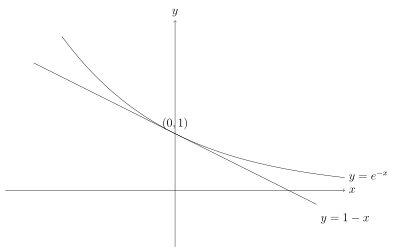
The function \(\f(t)\) is defined, for \(t\ne0\), by \[ \f(t) = \frac t {\e^t-1}\,. \] \begin{questionparts} \item By expanding \(\e^t\), show that \(\displaystyle \lim _{t\to0} \f(t) = 1\,\). Find \(\f'(t)\) and evaluate \(\displaystyle \lim _{t\to0} \f'(t)\,\). \item Show that \(\f(t) +\frac12 t\) is an even function. [{\bf Note:} A function \(\g(t)\) is said to be {\em even} if \(\g(t) \equiv \g(-t)\).] \item Show with the aid of a sketch that \( \e^t( 1-t)\le 1\,\) and deduce that \(\f'(t)\ne 0\) for \(t\ne0\). \end{questionpart} Sketch the graph of \(\f(t)\).
Solution:
- Claim \(f(t) + \frac12 t\) is an even function. Proof: Consider \(f(-t) - \frac12t\), then \begin{align*} f(-t) - \frac12t &= \frac{-t}{e^{-t}-1} - \frac12t \\ &= \frac{-te^t}{1-e^t} - \frac12 t \\ &= \frac{t(1-e^t) -t}{1-e^t} - \frac12 t \\ &= t - \frac{t}{1-e^t} - \frac12 t \\ &= \frac{t}{e^t-1} + \frac12 t \end{align*} So it is even.
- Drawing the tangent to \(y = e^{-x}\) at \((0,1)\) we find that \(e^{-t} \geq (1-t)\) for all \(t\), in particular, \(e^t(1-t) \leq 1\) \(f'(t) = \frac{(e^t(1-t) -1}{(e^t-1)^2} \leq 0\) and \(f'(t) = -\frac12\) when \(t = 0\)

2006 Paper 3 Q3
- Let \[ \tan x = \sum\limits_{n=0}^\infty a_n x^n \text{ and } \cot x = \dfrac 1 x +\sum\limits_{n=0}^\infty b_nx^n \] for \(0< x < \frac12\pi\,\). Explain why \(a_n=0\) for even \(n\). Prove the identity \[ \cot x - \tan x \equiv 2 \cot 2x\, \] and show that \[a_{n} = (1-2^{n+1})b_n\,.\]
- Let $ \displaystyle {\rm cosec}\, x = \frac1x +\sum\limits _{n=0}^\infty c_n x^n\,$ for \(0< x < \frac12\pi\,\). By considering \(\cot x + \tan x\), or otherwise, show that \[ c_n = (2^{-n} -1)b_n \,. \]
- Show that \[ \left(1+x{ \sum\limits_{n=0}^\infty} b_n x^n \right)^2 +x^2 = \left(1+x{ \sum\limits_{n=0} ^\infty} c_n x^n \right)^2\,. \] Deduce from this and the previous results that \(a_1=1\), and find \(a_3\).
Solution:
- Since \(\tan (-x) = -\tan x\), \(\tan\) is an odd function, and in particular all it's even coefficients are zero. \begin{align*} && 2 \cot 2x &\equiv \frac{2 cos 2x}{\sin 2 x} \\ &&&\equiv \frac{2(\cos^2 x- \sin^2 x)}{2 \sin x \cos x} \\ &&&\equiv \frac{\cos x}{\sin x} - \frac{\sin x}{ \cos x} \\ &&&\equiv \cot x - \tan x \end{align*} Therefore \begin{align*} && \underbrace{\frac1x + \sum_{n=0}^\infty b_nx^n}_{\cot x} - \underbrace{\sum_{n=0}^\infty a_n x^n}_{\tan x} &= 2 \left (\underbrace{\frac{1}{2x} + \sum_{n=0}^\infty b_n(2x)^n}_{\cot 2x} \right) \\ \Rightarrow && \sum_{n=0}^\infty a_n x^n &= \sum_{n=0}^\infty b_nx^n - 2\sum_{n=0}^\infty b_n(2x)^n \\ &&&= \sum_{n=0}^{\infty}b_n(1-2^{n+1})x^n \\ [x^n]: && a_n &= (1-2^{n+1})b_n \end{align*}
- \(\,\) \begin{align*} && \cot x + \tan x &= \frac{\cos x}{\sin x} + \frac{\sin x}{\cos x} \\ &&&= \frac{1}{\sin x \cos x} \\ &&&=2\cosec 2x \\ \\ \Rightarrow && \underbrace{\frac1x + \sum_{n=0}^\infty b_nx^n}_{\cot x} + \underbrace{\sum_{n=0}^\infty a_n x^n}_{\tan x} &= 2\left (\underbrace{ \frac1{2x} +\sum\limits _{n=0}^\infty c_n (2x)^n}_{\cosec 2x} \right) \\ \Rightarrow && \sum_{n=0}^\infty 2^{n+1}c_n x^n &= \sum_{n=0}^{\infty}(a_n+b_n)x^n \\ &&&= \sum_{n=0}^{\infty}\left((1-2^{n+1})b_n+ b_n\right)x^n \\ &&&= \sum_{n=0}^{\infty}\left(2-2^{n+1}\right)b_nx^n \\ [x^n]: && c_n &= (2^{-n}-1)b_n \end{align*}
- \(\,\) \begin{align*} && \cot^2 x + 1 &= \cosec^2 x \\ \Rightarrow && x^2 \cot^2 x + x^2 &= x^2 \cosec^2 x \\ \Rightarrow && x^2 \left ( \underbrace{\frac1x + \sum_{n=0}^\infty b_nx^n}_{\cot x} \right)^2 + x^2 &= x^2 \left (\underbrace{ \frac1{x} +\sum\limits _{n=0}^\infty c_n x^n}_{\cosec x} \right)^2 \\ \Rightarrow && \left ( 1 + x\sum_{n=0}^\infty b_nx^{n} \right)^2 + x^2 &= \left ( 1 +x\sum\limits _{n=0}^\infty c_n x^{n} \right)^2 \\ \\ \Rightarrow && \left ( 1 + x(b_1x + b_3 x^3 + \cdots) \right)^2 + x^2 &= \left ( 1 + x(c_1x + c_3 x^3 + \cdots) \right)^2 \\ \Rightarrow && 1 + (1+2b_1)x^2+(2b_3+b_1^2)x^4 + \cdots &= 1 + 2c_1x^2 + (2c_3+c_1^2)x^4 + \cdots \\ \Rightarrow && 1 + 2b_1 &= 2(2^{-1}-1)b_1 \\ \Rightarrow && b_1 &= -\frac13 \\ \Rightarrow && a_1 &= (1-2^{2})(-\tfrac13) = 1 \\ && c_1 &= \frac16\\ \Rightarrow && 2b_3+\frac19&= 2c_3+\frac1{36} \\ \Rightarrow && 2b_3 -2(2^{-3}-1)b_3 &= -\frac{1}{12} \\ \Rightarrow && \frac{15}{4}b_3 &= -\frac{1}{12} \\ \Rightarrow && b_3 &= -\frac{1}{45} \\ \Rightarrow && a_3 &= -(1-2^4)\frac{1}{45} = \frac13 \end{align*}
2006 Paper 3 Q4
The function \(f\) satisfies the identity \begin{equation} f(x) +f(y) \equiv f(x+y) \tag{\(*\)} \end{equation} for all \(x\) and \(y\). Show that \(2\f(x)\equiv \f(2x)\) and deduce that \(f''(0)=0\). By considering the Maclaurin series for \(\f(x)\), find the most general function that satisfies \((*)\). [{\it Do not consider issues of existence or convergence of Maclaurin series in this question.}]
- By considering the function \(\G\), defined by \(\ln\big(\g(x)\big) =\G(x)\), find the most general function that, for all \(x\) and \(y\), satisfies the identity \[ \g(x) \g(y) \equiv \g(x+y)\,. \]
- By considering the function \(H\), defined by \(\h(\e^u) =H(u)\), find the most general function that satisfies, for all positive \(x\) and \(y\), the identity \[ \h(x) +\h(y) \equiv \h(xy) \,. \]
- Find the most general function \(t\) that, for all \(x\) and \(y\), satisfies the identity \begin{equation*} t(x) + t(y) \equiv t(z)\,, \end{equation*} where \(z= \dfrac{x+y}{1-xy}\,\).
Solution: \begin{align*} &&2f(x) &\equiv f(x) + f(x) \\ &&&\equiv f(x+x) \\ &&&\equiv f(2x) \\ \\ \Rightarrow && 2f(0) &= f(0) \\ \Rightarrow && f(0) &= 0 \\ && f''(0) &= \lim_{h \to 0} \frac{f(2h)-2f(0)+f(-2h)}{h^2} \\ &&&= \lim_{h \to 0} \frac{f(2h)+f(-2h)}{h^2} \\ &&&= \lim_{h \to 0} \frac{f(0)}{h^2} \\ &&&= 0 \\ \Rightarrow && f''(0) &= 0 \end{align*} If \(f(x)\) satisfies the equation, then \(f'(x)\) satisfies the equation. In particular this means that \(f^{(n)}(0) = 0\) for all \(n \geq 2\). Therefore the only non-zero term in the Maclaurin series is \(x^1\). Therefore \(f(x) = cx\)
- Suppose \(g(x)g(y) \equiv g(x+y)\), then if \(G(x) = \ln g(x)\) we must have \(G(x)+G(y) \equiv G(x+y)\), ie \(G(x) = cx \Rightarrow g(x) = e^{cx}\)
- Suppose \(h(x)+h(y) \equiv h(xy)\), then if \(h(e^u) = H(u)\) we must have that \(H(u)+H(v) \equiv h(e^u) + h(e^v) \equiv h(e^{u+v}) \equiv H(u+v)\).Therefore \(H(u) = cu\), ie \(h(e^u) = cu\) or \(h(x) = h(e^{\ln x}) = c \ln x\).
- Finally if \(t(x) + t(y) \equiv t(z)\), the considering \(T(w) = t(\tan w)\) then \(T(x) + T(y) \equiv t(\tan x) + t(\tan y) \equiv t( \frac{\tan x + \tan y}{1- \tan x \tan y}) \equiv t (\tan (x+y)) \equiv T(x+y)\). Therefore \(T(x) = cx\) Therefore \(t(\tan w) = c w \Rightarrow t(x) = c \tan^{-1} x\)
2005 Paper 2 Q13
The number of printing errors on any page of a large book of \(N\) pages is modelled by a Poisson variate with parameter \(\lambda\) and is statistically independent of the number of printing errors on any other page. The number of pages in a random sample of \(n\) pages (where \(n\) is much smaller than \(N\) and \(n\ge2\)) which contain fewer than two errors is denoted by \(Y\). Show that \(\P(Y=k) = \binom n k p^kq^{n-k}\) where \(p=(1+\lambda)e^{-\lambda}\) and \(q=1-p\,\). Show also that, if \(\lambda\) is sufficiently small,
- \(q\approx \frac12 \lambda^2\,\);
- the largest value of \(n\) for which \(\P(Y=n)\ge 1-\lambda\) is approximately \(2/\lambda\,\);
- \(\P(Y>1 \;\vert\; Y>0) \approx 1-n(\lambda^2/2)^{n-1}\;.\)
Solution: First notice that the the probability a page contains fewer than two errors is \(\mathbb{P}(X < 2)\) where \(X \sim Po(\lambda)\), ie \(\mathbb{P}(X<2) = e^{-\lambda} + \lambda e^{-\lambda} = (1+\lambda)e^{-\lambda}\). Therefore the number of pages \(Y\) with fewer than two errors out of our sample of \(n\) is \(Bin(n, p)\) where \(p\) is as before. ie \(\mathbb{P}(Y = k) = \binom{n}{k} p^kq^{n-k}\).
- \(\,\) \begin{align*} && q &= 1- p = 1-(1+\lambda)e^{-\lambda} \\ &&&= 1 - (1+ \lambda)(1 - \lambda + \tfrac12 \lambda^2 + o(\lambda^3)) \\ &&&= 1 - 1+ \lambda - \lambda+\lambda^2 - \tfrac12 \lambda^2 + o(\lambda^3) \\ &&&= \tfrac12 \lambda^2 + o(\lambda^3) \end{align*}
- \(\,\) \begin{align*} && \mathbb{P}(Y = n) &= p^n \\ &&&= (1+\lambda)^ne^{-\lambda n} \\ &&&= (1 + n \lambda + \frac{n(n-1)}{2} \lambda^2 + \cdots)(1 - \lambda n + \frac{\lambda^2 n^2}{2} + \cdots) \\ &&&= 1 + 0 \lambda + \left ( \frac{n(n-1)}{2} + \frac{n^2}{2} - n^2 \right) \lambda^2 + o(\lambda^3) \\ &&&= 1 - \frac{n}{2} \lambda^2 + o(\lambda^3) \end{align*} So if \(\frac{n}{2} \lambda \leq 1\) or \(n \leq \frac{2}{\lambda}\) \(\mathbb{P}(Y = n) \leq 1- \lambda\).
- \(\,\) \begin{align*} && \mathbb{P}(Y > 1 | Y > 0) &= \frac{1-(q^n + npq^{n-1})}{1-q^n} \\ &&&= 1 - \frac{npq^{n-1}}{1-q^n} \\ &&&= 1 -n \frac{(1+ \lambda)e^{-\lambda} (\tfrac12 \lambda^2 + o(\lambda^3))^{n-1}}{1-(\tfrac12 \lambda^2 + o(\lambda^3))^n} \\ &&&= 1 - n \left (\frac{\lambda^2}{2} \right)^{n-1} \frac{(1+ \lambda)(1-\lambda + \lambda^2/2 - \cdots)(1+o(\lambda)^{n-1}}{1-(\tfrac12 \lambda^2 + o(\lambda^3))^n} \\ &&&= 1 - n \left (\frac{\lambda^2}{2} \right)^{n-1} (1 + o(\lambda)) \\ &&&\approx 1 - n \left (\frac{\lambda^2}{2} \right)^{n-1} \end{align*}
2001 Paper 3 Q1
Given that \(y = \ln ( x + \sqrt{x^2 + 1})\), show that \( \displaystyle \frac{\d y}{\d x} = \frac1 {\sqrt{x^2 + 1} }\;\). Prove by induction that, for \(n \ge 0\,\), \[ \l x^2 + 1 \r y^{\l n + 2 \r} + \l 2n + 1 \r x y^{\l n + 1 \r} + n^2 y^{\l n \r} = 0\;, \] where \(\displaystyle y^{(n)} = \frac{\d^n y}{\d x^n}\) and \(y^{(0)} =y\,\). Using this result in the case \(x = 0\,\), or otherwise, show that the Maclaurin series for \(y\) begins \[ x - {x^3 \over 6} +{3 x^5 \over 40} \] and find the next non-zero term.
Solution: \begin{align*} && y & = \ln ( x + \sqrt{x^2+1}) \\ \Rightarrow && \frac{\d y}{\d x} &= \frac{1}{x+\sqrt{x^2+1}} \cdot \frac{\d }{\d x} \left ( x + \sqrt{x^2+1} \right) \\ &&&= \frac{1}{x+\sqrt{x^2+1}} \left (1 + \frac12 \frac{2x}{\sqrt{x^2+1}} \right) \\ &&&= \frac{1}{x+\sqrt{x^2+1}} \left ( \frac{\sqrt{x^2+1} + x}{\sqrt{x^2+1}}\right) \\ &&&= \frac{1}{\sqrt{x^2+1}} \end{align*} Note that \(\displaystyle y^{(2)} = - \frac12 \frac{2x}{(x^2+1)^{3/2}} = - \frac{x}{(x^2+1)^{3/2}}\), and in particular \((x^2+1)y^{(2)} + xy^{(1)} = 0\). Now applying Leibnitz formula: \begin{align*} 0 &= \left ( (x^2+1)y^{(2)} + xy^{(1)} \right )^{(n)} \\ &= \left ( (x^2+1)y^{(2)}\right )^{(n)} + \left (xy^{(1)} \right )^{(n)} \\ &= (x^2+1)y^{(n+2)} +n2xy^{(n+1)} + \binom{n}{2}2y^{(n)} + xy^{(n+1)} + n y^{(n)} \\ &= (x^2+1)y^{(n+2)} + (2n+1)xy^{(n+1)} + (n^2-n+n)y^{(n)} \\ &= (x^2+1)y^{(n+2)} + (2n+1)xy^{(n+1)} + n^2y^{(n)} \end{align*} as required. When \(x = 0\): \begin{align*} && y(0) &= \ln(0 + \sqrt{0^2+1}) \\ &&&= \ln 1 = 0 \\ && y'(0) &= \frac{1}{\sqrt{0^2+1}} = 1 \\ && y^{(n+2)} &= -n^2 y^{(n)} \\ && y^{(2k)} &= 0 \\ && y^{(3)} &= -1 \\ && y^{(5)} &= 3^2 \\ && y^{(7)} &= - 5^2 \cdot 3^2 \\ \end{align*} Therefore the Maclaurin series about \(x = 0\) is \begin{align*} y &= x - \frac{1}{3!} x^3 + \frac{3^2}{5!} x^5 - \frac{3^2 \cdot 5^2}{7!} x^7 + \cdots \\ &= x - \frac{1}{6} x^3 + \frac{3}{1 \cdot 2 \cdot 4 \cdot 5} x^5 - \frac{5}{1 \cdot 2 \cdot 4 \cdot 2 \cdot 7} x^7 + \cdots \\ &= x - \frac{1}{6}x^3 + \frac{3}{40} x^5 - \frac{5}{56} x^7 + \cdots \end{align*}
1998 Paper 3 Q5
The exponential of a square matrix \({\bf A}\) is defined to be $$ \exp ({\bf A}) = \sum_{r=0}^\infty {1\over r!} {\bf A}^r \,, $$ where \({\bf A}^0={\bf I}\) and \(\bf I\) is the identity matrix. Let $$ {\bf M}=\left(\begin{array}{cc} 0 & -1 \\ 1 & \phantom{-} 0 \end{array} \right) \,. $$ Show that \({\bf M}^2=-{\bf I}\) and hence express \(\exp({\theta {\bf M}})\) as a single \(2\times 2\) matrix, where \(\theta\) is a real number. Explain the geometrical significance of \(\exp({\theta {\bf M}})\). Let $$ {\bf N}=\left(\begin{array}{rr} 0 & 1 \\ 0 & 0 \end{array}\right) \,. $$ Express similarly \(\exp({s{\bf N}})\), where \(s\) is a real number, and explain the geometrical significance of \(\exp({s{\bf N}})\). For which values of \(\theta\) does $$ \exp({s{\bf N}})\; \exp({\theta {\bf M}})\, = \, \exp({\theta {\bf M}})\;\exp({s{\bf N}}) $$ for all \(s\)? Interpret this fact geometrically.
Solution: \begin{align*} \mathbf{M}^2 &= \begin{pmatrix} 0 & - 1 \\ 1 & 0 \end{pmatrix}^2 \\ &= \begin{pmatrix} 0 \cdot 0 + (-1) \cdot 1 & 0 \cdot (-1) + (-1) \cdot 0 \\ 1 \cdot 0 + 0 \cdot 1 & 1 \cdot (-1) + 0 \cdot 0 \end{pmatrix} \\ &= \begin{pmatrix} -1 & 0 \\ 0 & -1\end{pmatrix} \\ &= - \mathbf{I} \end{align*} \begin{align*} \exp(\theta \mathbf{M}) &= \sum_{r=0}^\infty \frac1{r!} (\theta \mathbf{M})^r \\ &= \sum_{r=0}^\infty \frac{1}{r!} \theta^r \mathbf{M}^r \\ &= \cos \theta \mathbf{I} + \sin \theta \mathbf{M} \\ &= \begin{pmatrix} \cos \theta & -\sin \theta \\ \sin \theta & \cos \theta \end{pmatrix} \end{align*} This is a rotation of \(\theta\) degrees about the origin. \begin{align*} && \mathbf{N}^2 &= \begin{pmatrix} 0 & 1 \\ 0 & 0 \end{pmatrix}^2 \\ && &= \begin{pmatrix} 0 & 0 \\ 0 & 0 \end{pmatrix} \\ \Rightarrow && \exp(s\mathbf{N}) &= \sum_{r=0}^\infty \frac{1}{r!} (s\mathbf{N})^r \\ &&&= \mathbf{I} + s \mathbf{N} \\ &&&= \begin{pmatrix} 1 &s \\ 0 & 1 \end{pmatrix} \end{align*} This is a shear, leaving the \(y\)-axis invariant, sending \((1,1)\) to \((1+s, 1)\). Suppose those matrices commute, for all \(s\), ie \begin{align*} && \begin{pmatrix} 1 &s \\ 0 & 1 \end{pmatrix}\begin{pmatrix} \cos \theta & -\sin \theta \\ \sin \theta & \cos \theta \end{pmatrix} &= \begin{pmatrix} \cos \theta & -\sin \theta \\ \sin \theta & \cos \theta \end{pmatrix}\begin{pmatrix} 1 &s \\ 0 & 1 \end{pmatrix} \\ \Rightarrow && \begin{pmatrix} \cos \theta - s \sin \theta & -\sin \theta + s \cos \theta \\ \sin \theta & \cos \theta \end{pmatrix} &= \begin{pmatrix} \cos \theta & s \cos \theta - \sin \theta \\ \sin \theta & s \sin \theta + \cos \theta \end{pmatrix} \\ \Rightarrow && \sin \theta &= 0 \\ \Rightarrow && \theta &=n \pi, n \in \mathbb{Z} \end{align*} Clearly it doesn't matter when we do nothing. If we are rotating by \(\pi\) then it also doesn't matter which order we do it in as the stretch happens in both directions equally.
1998 Paper 3 Q7
Sketch the graph of \({\rm f}(s)={ \e}^s(s-3)+3\) for \(0\le s < \infty\). Taking \({\e\approx 2.7}\), find the smallest positive integer, \(m\), such that \({\rm f}(m) > 0\). Now let $$ {\rm b}(x) = {x^3 \over \e^{x/T} -1} \, $$ where \(T\) is a positive constant. Show that \({\rm b}(x)\) has a single turning point in \(0 < x < \infty\). By considering the behaviour for small \(x\) and for large \(x\), sketch \({\rm b}(x)\) for \(0\le x < \infty\). Let $$ \int_0^\infty {\rm b}(x)\,\d x =B, $$ which may be assumed to be finite. Show that \(B = K T^n\) where \(K\) is a constant, and \(n\) is an integer which you should determine. Given that \(\displaystyle{B \approx 2 \int_0^{Tm} {\rm b}(x) {\,\rm d }x}\), use your graph of \({\rm b}(x)\) to find a rough estimate for \(K\).
1997 Paper 3 Q1
- By considering the series expansion of \((x^2+5x+4){\rm \; e}^x\) show that \[10{\rm\, e}=4+\frac{3^2}{1!}+\frac{4^2}{2!}+\frac{5^2}{3!}+\cdots\;.\]
- Show that \[5{\rm\, e}=1+\frac{2^2}{1!}+\frac{3^2}{2!}+\frac{4^2}{3!}+\cdots\;.\]
- Evaluate \[1+\frac{2^3}{1!}+\frac{3^3}{2!}+\frac{4^3}{3!}+\cdots\;.\]
Solution:
- \begin{align*} (x^2+5x+4)e^x &= \sum_{k=0}^\infty \frac{1}{k!} x^{k+2}+\sum_{k=0}^\infty \frac{5}{k!} x^{k+1}+\sum_{k=0}^\infty \frac{4}{k!} x^{k} \\ &= \sum_{k=0}^{\infty} \l \frac{1}{k!}+\frac{5}{(k+1)!}+\frac{4}{(k+2)!} \r x^{k+2} + 5x+4+4x \\ &= 4 + 9x + \sum_{k=0}^{\infty} \l \frac{(k+2)(k+1)}{(k+2)!}+\frac{5(k+2)}{(k+2)!}+\frac{4}{(k+2)!} \r x^{k+2}\\ &= 4 + 9x + \sum_{k=0}^{\infty} \l \frac{k^2+3k+2+5k+10+4}{(k+2)!} \r x^{k+2}\\ &= 4 + 9x + \sum_{k=0}^{\infty} \frac{(k+4)^2}{(k+2)!} x^{k+2}\\ &= 4 + 9x + \sum_{k=2}^{\infty} \frac{(k+2)^2}{k!} x^{k}\\ \end{align*} So when \(x = 1\) we have \[10e = 4 + \frac{3^2}{1!} + \frac{4^2}{2!} + \frac{5^2}{3!} + \cdots \]
- \begin{align*} (x^2+3x+1)e^x &= \sum_{k=0}^\infty \frac{1}{k!}x^{k+2}+\sum_{k=0}^\infty 3\frac{1}{k!}x^{k+1} + \sum_{k=0}^{\infty} \frac{1}{k!} x^k \\ &= 1+3x+\sum_{k=1}^{\infty} \l \frac1{(k-1)!}+\frac{3}{k!} + \frac{1}{(k+1)!} \r x^{k+1} \\ &= 1+3x+\sum_{k=1}^{\infty} \frac{(k+1)k + 3(k+1)+1}{(k+1)!}x^{k+1} \\ &= 1+3x+\sum_{k=1}^{\infty} \frac{k^2+4k+4}{(k+1)!}x^{k+1} \\ &= 1+3x+\sum_{k=0}^{\infty} \frac{(k+2)^2}{(k+1)!}x^{k+1} \\ &=1+3x+ \sum_{k=1}^{\infty} \frac{(k+1)^2}{k!}x^k \end{align*} Plugging in \(x=1\) we get the desired result.
- \begin{align*} && xe^x &= \sum_{k=0}^{\infty} \frac{x^{k+1}}{k!} \\ x\frac{\d}{\d x} : && x(1+x)e^x &= \sum_{k=0}^{\infty} \frac{(k+1)x^{k+1}}{k!} \\ x\frac{\d}{\d x} : && x(x(1+x)+1+2x)e^x &= \sum_{k=0}^{\infty} \frac{(k+1)^2x^{k+1}}{k!} \\ &&(x^3+3x^2+x)e^x &= \sum_{k=0}^{\infty} \frac{(k+1)^2x^{k+1}}{k!} \\ \frac{\d}{\d x} : && e^x(x^3+3x^2+x+3x^2+6x+1) &=\sum_{k=0}^{\infty} \frac{(k+1)^3x^{k}}{k!} \\ \Rightarrow && 15e &= 1 + \frac{2^3}{1!} + \frac{3^3}{2!} + \cdots \end{align*}
1994 Paper 3 Q5
The function \(\mathrm{f}\) is given by \(\mathrm{f}(x)=\sin^{-1}x\) for \(-1 < x < 1.\) Prove that \[ (1-x^{2})\mathrm{f}''(x)-x\mathrm{f}'(x)=0. \] Prove also that \[ (1-x^{2})\mathrm{f}^{(n+2)}(x)-(2n+1)x\mathrm{f}^{(n+1)}(x)-n^{2}\mathrm{f}^{(n)}(x)=0, \] for all \(n>0\), where \(\mathrm{f}^{(n)}\) denotes the \(n\)th derivative of \(\mathrm{f}\). Hence express \(\mathrm{f}(x)\) as a Maclaurin series. The function \(\mathrm{g}\) is given by \[ \mathrm{g}(x)=\ln\sqrt{\frac{1+x}{1-x}}, \] for \(-1 < x < 1.\) Write down a power series expression for \(\mathrm{g}(x),\) and show that the coefficient of \(x^{2n+1}\) is greater than that in the expansion of \(\mathrm{f},\) for each \(n > 0\).