Problems
Filters
3 problems found
2010 Paper 2 Q6
Each edge of the tetrahedron \(ABCD\) has unit length. The face \(ABC\) is horizontal, and \(P\) is the point in \(ABC\) that is vertically below \(D\).
- Find the length of \(PD\).
- Show that the cosine of the angle between adjacent faces of the tetrahedron is \(1/3\).
- Find the radius of the largest sphere that can fit inside the tetrahedron.
Solution:
- \(D\) must be above the centre (of any kind) of the equilateral triangle \(ABC\). Therefore it is a distance \(\frac23 \frac{\sqrt{3}}2 = \frac{\sqrt{3}}3\) from \(A\). \(D\) is \(1\) from \(A\), therefore by Pythagoras \(PD = \sqrt{1-\frac13} = \sqrt{\frac23}\)
- We can place \(D\) at \(\langle 0,0,\sqrt{\frac23}\rangle\) and \(A'\) (the midpoint of \(BC\)) at \(\langle-\frac{\sqrt{3}}{6},0,0 \rangle\) and we find: \begin{align*} && \cos \theta &= \frac{(\mathbf{a}'-\mathbf{d})\cdot \mathbf{a}'}{|\mathbf{a}'-\mathbf{d}|| \mathbf{a}'|} \\ &&&= \frac{|\mathbf{a}'|}{|\mathbf{a}'-\mathbf{d}|} \\ &&&= \frac{\frac{\sqrt{3}}{6}}{\sqrt{\frac23+\frac{3}{36}}} = \frac13 \end{align*}
- We have And therefore we must have \(\tan \frac{\cos^{-1} \frac13}{2} = \frac{r}{\frac{\sqrt{3}}{6}}\) therefore \begin{align*} && r &= \frac{\sqrt{3}}{6} \tan \left (\frac{\cos^{-1} \frac13}{2} \right) \\ &&&= \frac{\sqrt{3}}6 \sqrt{\frac{1-\cos(\cos^{-1}\frac13)}{1+\cos(\cos^{-1}\frac13)}} \\ &&&= \frac{\sqrt{3}}6 \sqrt{\frac{\frac23}{\frac43}} \\ &&&= \frac{\sqrt{6}}{12} \end{align*}

2002 Paper 1 Q6
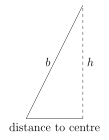
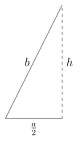
A pyramid stands on horizontal ground. Its base is an equilateral triangle with sides of length~\(a\), the other three sides of the pyramid are of length \(b\) and its volume is \(V\). Given that the formula for the volume of any pyramid is $ \textstyle \frac13 \times \mbox{area of base} \times \mbox {height} \,, $ show that \[ V= \frac1{12} {a^2(3b^2-a^2)}^{\frac12}\;. \] The pyramid is then placed so that a non-equilateral face lies on the ground. Show that the new height, \(h\), of the pyramid is given by \[ h^2 = \frac{a^2(3b^2-a^2)}{4b^2-a^2}\;. \] Find, in terms of \(a\) and \(b\,\), the angle between the equilateral triangle and the horizontal.
Solution: First let's consider the area of the base. It is an equilateral triangle with side length \(a\), so \(\frac12 a^2 \sin 60^\circ = \frac{\sqrt{3}}4a^2\).
1987 Paper 3 Q11
A woman stands in a field at a distance of \(a\,\mathrm{m}\) from the straight bank of a river which flows with negligible speed. She sees her frightened child clinging to a tree stump standing in the river \(b\,\mathrm{m}\) downstream from where she stands and \(c\,\mathrm{m}\) from the bank. She runs at a speed of \(u\,\mathrm{ms}^{-1}\) and swims at \(v\,\mathrm{ms}^{-1}\) in straight lines. Find an equation to be satisfied by \(x,\) where \(x\,\mathrm{m}\) is the distance upstream from the stump at which she should enter the river if she is to reach the child in the shortest possible time. Suppose now that the river flows with speed \(v\) ms\(^{-1}\) and the stump remains fixed. Show that, in this case, \(x\) must satisfy the equation \[ 2vx^{2}(b-x)=u(x^{2}-c^{2})[a^{2}+(b-x)^{2}]^{\frac{1}{2}}. \] For this second case, draw sketches of the woman's path for the three possibilities \(b>c,\) \(b=c\) and \(b< c\).
Solution:


