Problems
Filters
17 problems found
2023 Paper 2 Q11
- \(X_1\) and \(X_2\) are both random variables which take values \(x_1, x_2, \ldots, x_n\), with probabilities \(a_1, a_2, \ldots, a_n\) and \(b_1, b_2, \ldots, b_n\) respectively. The value of random variable \(Y\) is defined to be that of \(X_1\) with probability \(p\) and that of \(X_2\) with probability \(q = 1-p\). If \(X_1\) has mean \(\mu_1\) and variance \(\sigma_1^2\), and \(X_2\) has mean \(\mu_2\) and variance \(\sigma_2^2\), find the mean of \(Y\) and show that the variance of \(Y\) is \(p\sigma_1^2 + q\sigma_2^2 + pq(\mu_1 - \mu_2)^2\).
- To find the value of random variable \(B\), a fair coin is tossed and a fair six-sided die is rolled. If the coin shows heads, then \(B = 1\) if the die shows a six and \(B = 0\) otherwise; if the coin shows tails, then \(B = 1\) if the die does not show a six and \(B = 0\) if it does. The value of \(Z_1\) is the sum of \(n\) independent values of \(B\), where \(n\) is large. Show that \(Z_1\) is a Binomial random variable with probability of success \(\frac{1}{2}\). Using a Normal approximation, show that the probability that \(Z_1\) is within \(10\%\) of its mean tends to \(1\) as \(n \longrightarrow \infty\).
- To find the value of random variable \(Z_2\), a fair coin is tossed and \(n\) fair six-sided dice are rolled, where \(n\) is large. If the coin shows heads, then the value of \(Z_2\) is the number of dice showing a six; if the coin shows tails, then the value of \(Z_2\) is the number of dice not showing a six. Use part (i) to write down the mean and variance of \(Z_2\). Explain why a Normal distribution with this mean and variance will not be a good approximation to the distribution of \(Z_2\). Show that the probability that \(Z_2\) is within \(10\%\) of its mean tends to \(0\) as \(n \longrightarrow \infty\).
2016 Paper 2 Q13
- The random variable \(X\) has a binomial distribution with parameters \(n\) and \(p\), where \(n=16\) and \(p=\frac12\). Show, using an approximation in terms of the standard normal density function $\displaystyle \tfrac{1}{\sqrt{2\pi}} \, \e ^{-\frac12 x^2} $, that \[ \P(X=8) \approx \frac 1{2\sqrt{2\pi}} \,. \]
- By considering a binomial distribution with parameters \(2n\) and \(\frac12\), show that \[ (2n)! \approx \frac {2^{2n} (n!)^2}{\sqrt{n\pi}} \,. \]
- By considering a Poisson distribution with parameter \(n\), show that \[ n! \approx \sqrt{2\pi n\, } \, \e^{-n} \, n^n \,. \]
Solution:
- \(X \sim B(16, \tfrac12)\), then \(X \approx N(8, 2^2)\), in particular \begin{align*} && \mathbb{P}(X = 8) &\approx \mathbb{P} \left ( 8 - \frac12 \leq 2Z + 8 \leq 8 + \frac12 \right) \\ &&&= \mathbb{P} \left (-\frac14 \leq Z \leq \frac14 \right) \\ &&&= \int_{-\frac14}^{\frac14} \frac{1}{\sqrt{2 \pi}}e^{-\frac12 x^2} \d x \\ &&&\approx \frac{1}{\sqrt{2\pi}} \int_{-\frac14}^{\frac14} 1\d x\\ &&&= \frac{1}{2 \sqrt{2\pi}} \end{align*}
- Suppose \(X \sim B(2n, \frac12)\) then \(X \approx N(n, \frac{n}{2})\), and \begin{align*} && \mathbb{P}(X = n) &\approx \mathbb{P} \left ( n - \frac12 \leq \sqrt{\frac{n}{2}} Z + n \leq n + \frac12 \right) \\ &&&= \mathbb{P} \left ( - \frac1{\sqrt{2n}} \leq Z \leq \frac1{\sqrt{2n}}\right) \\ &&&= \int_{-\frac1{\sqrt{2n}}}^{\frac1{\sqrt{2n}}} \frac{1}{\sqrt{2 \pi}} e^{-\frac12 x^2} \d x \\ &&&\approx \frac{1}{\sqrt{n\pi}}\\ \Rightarrow && \binom{2n}{n}\frac1{2^n} \frac{1}{2^n} & \approx \frac{1}{\sqrt{n \pi}} \\ \Rightarrow && (2n)! &\approx \frac{2^{2n}(n!)^2}{\sqrt{n\pi}} \end{align*}
- \(X \sim Po(n)\), then \(X \approx N(n, (\sqrt{n})^2)\), therefore \begin{align*} && \mathbb{P}(X = n) &\approx \mathbb{P} \left (-\frac12 \leq \sqrt{n} Z \leq \frac12 \right) \\ &&&= \int_{-\frac{1}{2 \sqrt{n}}}^{\frac{1}{2 \sqrt{n}}} \frac{1}{\sqrt{2\pi}}e^{-\frac12 x^2} \d x \\ &&&\approx \frac{1}{\sqrt{2 \pi n}} \\ \Rightarrow && e^{-n} \frac{n^n}{n!} & \approx \frac{1}{\sqrt{2 \pi n}} \\ \Rightarrow && n! &\approx \sqrt{2 \pi n} e^{-n}n^n \end{align*}
2009 Paper 3 Q13
- The point \(P\) lies on the circumference of a circle of unit radius and centre \(O\). The angle, \(\theta\), between \(OP\) and the positive \(x\)-axis is a random variable, uniformly distributed on the interval \(0\le\theta<2\pi\). The cartesian coordinates of \(P\) with respect to \(O\) are \((X,Y)\). Find the probability density function for \(X\), and calculate \(\var (X)\). Show that \(X\) and \(Y\) are uncorrelated and discuss briefly whether they are independent.
- The points \(P_i\) (\(i=1\), \(2\), \(\ldots\) , \(n\)) are chosen independently on the circumference of the circle, as in part (i), and have cartesian coordinates \((X_i, Y_i)\). The point \(\overline P\) has coordinates \((\overline X, \overline Y)\), where \(\overline X =\dfrac1n \sum\limits _{i=1}^n X_i\) and \(\overline Y =\dfrac1n \sum\limits _{i=1}^n Y_i\). Show that \(\overline X\) and \(\overline Y\) are uncorrelated. Show that, for large \(n\), \(\displaystyle \P\left(\vert \overline X \vert \le \sqrt{\frac2n}\right)\approx 0.95\,\).
Solution:
- \(X = \cos \theta\) \(\theta \sim U(0, 2\pi)\). Noting that \(\mathbb{P}(X \geq t ) = \frac{2}{2\pi}\cos^{-1} t\) so \(f_X(t) = \frac{1}{\pi} \frac{1}{\sqrt{1-x^2}}\) \begin{align*} && \E[X] &= 0 \tag{by symmetry} \\ && \E[X^2] &= \int_0^{2\pi} \cos^2 \theta \frac{1}{2 \pi} \d \theta \\ &&&= \frac{1}{2} \cdot 2\pi \cdot \frac{1}{2\pi} \\ &&&= \frac12 \\ \Rightarrow & &\var[X] &= \frac12 \\ \\ && \E[XY] &= \int_0^{2\pi} \cos \theta \sin \theta \frac{1}{2 \pi} \d \theta \\ &&&= \frac{1}{4\pi} \int_0^{2\pi} \sin 2\theta \d \theta \\ &&& =0 = \E[X]\E[Y] \end{align*} But note that clearly \(X\) and \(Y\) are not independent, since given \(X\) there are only two possible values of \(Y\).
- \(\,\) \begin{align*} && \E \left [ XY \right] &= \E \left [ \left ( \frac1n \sum_{i=1}^n X_i \right)\left ( \frac1n \sum_{i=1}^n Y_i\right) \right] \\ &&&= \frac{1}{n^2} \sum_{i=1}^n \sum_{j=1}^n \E [X_i Y_j] \\ &&&= 0 = \E[X] \E[Y] \end{align*} Therefore \(X\) and \(Y\) are uncorrelated. Note that \(\E[X_i] = 0, \var[X_i] = \frac12\) so we can apply the central limit theorem to see that \(X \approx N(0, \frac{1}{2n})\), in particular \begin{align*} && 0.95 &\approx \mathbb{P}(|Z| < 2) \\ &&&= \mathbb{P} \left ( \Big |\frac{X}{\sqrt{\frac{1}{2n}}} \Big | < 2 \right ) \\ &&&= \mathbb{P}\left (|X| < \sqrt{\frac{2}{n}} \right) \end{align*}
2008 Paper 3 Q12
Let \(X\) be a random variable with a Laplace distribution, so that its probability density function is given by \[ \f(x) = \frac12 \e^{-\vert x \vert }\;, \text{ \(-\infty < x < \infty \)}. \tag{\(*\)} \] Sketch \(\f(x)\). Show that its moment generating function \({\rm M}_X(\theta)\) is given by \({\rm M}_X(\theta)= (1-\theta^2)^{-1}\) and hence find the variance of \(X\). A frog is jumping up and down, attempting to land on the same spot each time. In fact, in each of \(n\) successive jumps he always lands on a fixed straight line but when he lands from the \(i\)th jump (\(i=1\,,2\,,\ldots\,,n\)) his displacement from the point from which he jumped is \(X_i\,\)cm, where \(X_i\) has the distribution \((*)\). His displacement from his starting point after \(n\) jumps is \(Y\,\)cm (so that \(Y=\sum\limits_{i=1}^n X_i\)). Each jump is independent of the others. Obtain the moment generating function for \(Y/ \sqrt {2n}\) and, by considering its logarithm, show that this moment generating function tends to \(\exp(\frac12\theta^2)\) as \(n\to\infty\). Given that \(\exp(\frac12\theta^2)\) is the moment generating function of the standard Normal random variable, estimate the least number of jumps such that there is a \(5\%\) chance that the frog lands 25 cm or more from his starting point.
Solution:
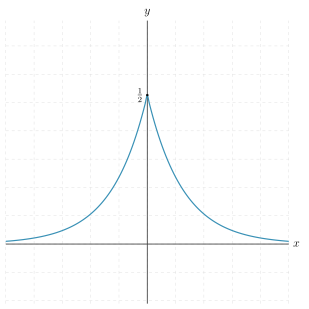
2004 Paper 3 Q12
A team of \(m\) players, numbered from \(1\) to \(m\), puts on a set of a \(m\) shirts, similarly numbered from \(1\) to \(m\). The players change in a hurry, so that the shirts are assigned to them randomly, one to each player. Let \(C_i\) be the random variable that takes the value \(1\) if player \(i\) is wearing shirt \(i\), and 0 otherwise. Show that \(\mathrm{E}\left(C_1\right)={1 \over m}\) and find \(\var \left(C_1\right)\) and \(\mathrm{Cov}\left(C_1 \, , \; C_2 \right) \,\). Let \(\, N = C_1 + C_2 + \cdots + C_m \,\) be the random variable whose value is the number of players who are wearing the correct shirt. Show that \(\mathrm{E}\left(N\right)= \var \left(N\right) = 1 \,\). Explain why a Normal approximation to \(N\) is not likely to be appropriate for any \(m\), but that a Poisson approximation might be reasonable. In the case \(m = 4\), find, by listing equally likely possibilities or otherwise, the probability that no player is wearing the correct shirt and verify that an appropriate Poisson approximation to \(N\) gives this probability with a relative error of about \(2\%\). [Use \(\e \approx 2\frac{72}{100} \,\).]
Solution: There are \(m!\) different ways of assigning the shirts, and in \((m-1)!\) of them player \(1\) gets their own shirt, ie \(\mathbb{E}(C_1) = \mathbb{P}(\text{player }1\text{ gets own shirt}) = \frac{(m-1)!}{m!} = \frac{1}{m}\). \(\var(C_1) = \mathbb{E}(C_1^2) - [\mathbb{E}(C_1)]^2 = \frac{1}{m} - \frac{1}{m^2} = \frac{m-1}{m^2}\). If we have two players, there are \((m-2)!\) ways they both get their own shirts, therefore \(\textrm{Cov}(C_1,C_2) = \mathbb{E}(C_1C_2) - \mathbb{E}(C_1)\mathbb{E}(C_2) = \frac{(m-2)!}{m!} - \frac{1}{m^2} = \frac{1}{m(m-1)} - \frac{1}{m^2} = \frac{m-m+1}{m^2(m-1)} = \frac{1}{m^2(m-1)}\). \begin{align*} \mathbb{E}(N) &= \mathbb{E}(C_1 + C_2 + \cdots + C_m) \\ &= \mathbb{E}(C_1) + \mathbb{E}(C_2) + \cdots + \mathbb{E}(C_m) \\ &= \frac{1}{m} + \frac{1}{m} +\cdots+ \frac1m \\ &= 1 \\ \\ \var(N) &= \sum_{r=1}^m \var(C_r) + 2\sum_{r=1}^{m-1} \sum_{s=2}^{m} \textrm{Cov}(C_r,C_s) \\ &= m \frac{m-1}{m^2} + 2 \frac{m(m-1)}{2}\frac{1}{m^2(m-1)} \\ &=\frac{m-1}{m} + \frac{1}{m} \\ &= 1 \end{align*} If we were to take a normal approximation, we would want to take \(N(1,1)\), but this would say things like \(-1\) is as likely as \(3\) shirts being correct, which is clearly a bad model. A Poisson is much more likely to be a sensible model as they have the same mean and variance as the parameter, and if \(m\) is large, the covariance between shirts is going to be very small, so it will appear similar to random events occurring. We can have \begin{align*} BADC \\ BCDA \\ BDAC \\ CADB \\ CDAB\\ CDBA \\ DABC\\ DCAB \\ DCBA \end{align*} Ie \(\frac{9}{24}\) ways to have no player wearing their own shirt with \(4\) players. \(Po(1)\) would say this probability is \(e^{-1}\), giving a relative error of: \begin{align*} \frac{e^{-1}-\frac{9}{24}}{\frac9{24}} &\approx \frac{\frac{100}{272} - \frac{9}{24}}{\frac9{24}} \\ &= -\frac{1}{51} \\ &\approx -2\% \end{align*}
2003 Paper 2 Q13
The random variable \(X\) takes the values \(k=1\), \(2\), \(3\), \(\dotsc\), and has probability distribution $$ \P(X=k)= A{{{\lambda}^k\e^{-{\lambda}}} \over {k!}}\,, $$ where \(\lambda \) is a positive constant. Show that \(A = (1-\e^{-\lambda})^{-1}\,\). Find the mean \({\mu}\) in terms of \({\lambda}\) and show that $$ \var(X) = {\mu}(1-{\mu}+{\lambda})\;. $$ Deduce that \({\lambda} < {\mu} < 1+{\lambda}\,\). Use a normal approximation to find the value of \(P(X={\lambda})\) in the case where \({\lambda}=100\,\), giving your answer to 2 decimal places.
Solution: Let \(Y \sim Po(\lambda)\) \begin{align*} && 1 &= \sum_{k=1}^\infty \mathbb{P}(X = k ) \\ &&&= \sum_{k=1}^\infty A \frac{\lambda^k e^{-\lambda}}{k!}\\ &&&= Ae^{-\lambda} \sum_{k=1}^{\infty} \frac{\lambda^k e^{-\lambda}}{k!} \\ &&&= Ae^{-\lambda} \left (e^{\lambda}-1 \right) \\ \Rightarrow && A &= (1-e^{-\lambda})^{-1} \\ \\ && \E[X] &= \sum_{k=1}^{\infty} k \cdot \mathbb{P}(X=k) \\ &&&= A\sum_{k=1}^{\infty} k \frac{\lambda^k e^{-\lambda}}{k!} \\ &&&= A\E[Y] = A\lambda = \lambda(1-e^{-\lambda})^{-1} \\ \\ && \var[X] &= \E[X^2] - (\E[X])^2 \\ &&&= A\sum_{k=1}^{\infty} k^2 \frac{\lambda^k e^{-\lambda}}{k!} - \mu^2 \\ &&&= A\E[Y^2] - \mu^2 \\ &&&= A(\var[Y]+\lambda^2) - \mu^2 \\ &&&= A(\lambda + \lambda^2) - \mu^2 \\ &&&= A\lambda(1+\lambda) - \mu^2 \\ &&&= \mu(1+\lambda - \mu) \end{align*} Since \(A > 1\) we must have \(\mu > \lambda\) and since \(\var[X] > 0\) we must have \(1 + \lambda > \mu\) as required. If \(\lambda = 100\), then \(A \approx 1\) and \(P(X=\lambda) \approx P(Y = \lambda)\) and \(Y \approx N(\lambda, \lambda)\) so the value is approximately \(\displaystyle \int_{-\frac12}^{\frac12} \frac{1}{\sqrt{2\pi \lambda}} e^{-\frac{x^2}{2\lambda}} \d x \approx \frac{1}{\sqrt{200\pi}} = \frac{1}{\sqrt{630.\ldots}} \approx \frac{1}{25} = 0.04 \)
2002 Paper 2 Q12
On \(K\) consecutive days each of \(L\) identical coins is thrown \(M\) times. For each coin, the probability of throwing a head in any one throw is \(p\) (where \(0 < p < 1\)). Show that the probability that on exactly \(k\) of these days more than \(l\) of the coins will each produce fewer than \(m\) heads can be approximated by \[ {K \choose k}q^k(1-q)^{K-k}, \] where \[ q=\Phi\left( \frac{2h-2l-1}{2\sqrt{h} }\right), \ \ \ \ \ \ h=L\Phi\left( \frac{2m-1-2Mp}{2\sqrt{ Mp(1-p)}}\right) \] and \(\Phi(\cdot)\) is the cumulative distribution function of a standard normal variate. Would you expect this approximation to be accurate in the case \(K=7\), \(k=2\), \(L=500\), \(l=4\), \(M=100\), \(m=48\) and \(p=0.6\;\)?
Solution: Let \(H_i\) be the random variable of how many heads the \(i\)th coin throws on a given day. Then \(H_i \sim B(M,p)\), and the probability that a given coin produces fewer than \(m\) heads is \(p_h = \P(H_i < m)\) Let \(C\) be the random variable the number of coins producing fewer than \(m\) heads, then \(C \sim B(L, p_h)\). The probability that more than \(l\) of the coins produce fewer than \(m\) heads is therefore \(\P(C > l)\). Finally, the probability that on exactly \(k\) days more than \(l\) of the coins will produce fewer than \(m\) heads is: \[ \binom{K}{k} \cdot \P(C > l)^k \cdot (1-\P(C > l))^{K-k} \] Let's start by assuming that all our Binomials can be approximated by a normal distribution. \(B(M,p) \approx N(Mp, Mp(1-p))\) and so: \begin{align*} p_h &= \P(H_i < m) \\ &\approx \P( \sqrt{Mp(1-p)}Z+Mp < m-\frac12) \\ &= \P \l Z < \frac{2m-2Mp-1}{2\sqrt{Mp(1-p)}} \r \\ &= \Phi\l\frac{2m-2Mp-1}{2\sqrt{Mp(1-p)}} \r \end{align*} \(B(L, p_h) \approx B \l L, \P \l Z < \frac{2m-2Mp-1}{2\sqrt{Mp(1-p)}} \r\r = B(L, \frac{h}{L}) \approx N(h, \frac{h(L-h)}{L})\) Therefore \begin{align*} \P(C > l) &= 1-\P(C \leq l) \\ &\approx 1- \P \l \sqrt{\frac{h(L-h)}{L}} Z + h \leq l+\frac12 \r \\ &= 1 - \P \l Z \leq \frac{2l-2h+1}{2\sqrt{\frac{h(L-h)}{L}}}\r \\ &= 1- \Phi\l \frac{2l-2h+1}{2\sqrt{\frac{h(L-h)}{L}}} \r \\ &= \Phi\l \frac{2h-2l-1}{2\sqrt{\frac{h(L-h)}{L}}} \r \end{align*} If we can approximate \(\sqrt{1-\frac{h}{L}}\) by \(1\) then we obtain the approximation in the question. Alternatively, \(B(L, \frac{h}{L}) \approx Po(h)\) and \(Po(h) \approx N(h,h)\) so we obtain: \begin{align*} \P(C > l) &= 1-\P(C \leq l) \\ &\approx 1 - \P(\sqrt{h} Z +h < l + \frac12) \\ &= 1 - \P \l Z < \frac{2l-2h+1}{2\sqrt{h}} \r \\ &= \Phi \l \frac{2h - 2l -1}{2\sqrt{h}}\r \end{align*} as required. [I think this is what the examiners expected]. Considering the case \(K=7\), \(k=2\), \(L=500\), \(l=4\), \(M=100\), \(m=48\) and \(p=0.6\), we have the first normal approximation depends on \(Mp\) and \(M(1-p)\) being large. They are \(60\) and \(40\) respectively, so this is likely a good approximation. The first approximation finds that \begin{align*} h &= 500 \cdot \Phi \l \frac{2 \cdot 48 - 2 \cdot 60 - 1}{2\sqrt{24}} \r \\ &= 500 \cdot \Phi \l \frac{2 \cdot 48 - 2 \cdot 60 - 1}{2\sqrt{24}} \r \\ &= 500 \cdot \Phi \l \frac{-25}{2 \sqrt{24}} \r \\ &\approx 500 \cdot \Phi (-2.5) \\ &= 500 \cdot 0.0062 \\ &\approx 3.1 \end{align*} The second binomial approximation will be good if \(500 \cdot \frac{3.1}{500} = 3.1\) is large, but this is quite small. Therefore, we shouldn't expect this to be a good approximation. However, since \(m = 48\) is far from the mean (in a normalised sense), we might expect the percentage error to be large. [Alternatively, using what I expect the desired approach] The approximation of \(B(L, \frac{h}{L}) \approx Po(h)\) is acceptable since \(n>50\) and \(h < 5\). The approximation of \(Po(h) \sim N(h,h)\) is not acceptable since \(h\) is small (in particular \(h < 15\)) Finally, we can compute all these values exactly using a modern calculator. \begin{array}{l|cc} & \text{correct} & \text{approx} \\ \hline p_h & 0.005760\ldots & 0.005362\ldots \\ \P(C > l) & 0.164522\ldots & 0.133319\ldots \\ \text{ans} & 0.231389\ldots & 0.182516\ldots \end{array} We can also see how the errors propagate, by doing the calculations assuming the previous steps are correct, and also including the Poisson step. \begin{array}{lccc} & \text{correct} & \text{approx} & \text{using approx } p_h \\ \hline p_h & 0.005760\ldots & 0.005362\ldots & - \\ \P(C > l)\quad [Po(h)] & 0.164522\ldots & 0.165044\ldots & 0.134293\ldots \\ \P(C > l)\quad [N(h,h)] & 0.164522\ldots & 0.169953\ldots & 0.133319\ldots \\ \P(C > l)\quad [N(h,h(1-\frac{h}{L})] & 0.164522\ldots & 0.169255\ldots & 0.132677\ldots \\ \text{ans} & 0.231389\ldots & 0.231389\ldots \end{array} By doing this, we discover that the largest errors are actually coming not from approximating the second approximation but from the small absolute (but large relative error) in the first approximation. This is, in fact, a coincidence; we can observe it by investigating the specific values being used. The first approximation looks as follows:


2001 Paper 2 Q14
Two coins \(A\) and \(B\) are tossed together. \(A\) has probability \(p\) of showing a head, and \(B\) has probability \(2p\), independent of \(A\), of showing a head, where \(0 < p < \frac12\). The random variable \(X\) takes the value 1 if \(A\) shows a head and it takes the value \(0\) if \(A\) shows a tail. The random variable \(Y\) takes the value 1 if \(B\) shows a head and it takes the value \(0\) if \(B\) shows a tail. The random variable \(T\) is defined by \[ T= \lambda X + {\textstyle\frac12} (1-\lambda)Y. \] Show that \(\E(T)=p\) and find an expression for \(\var(T)\) in terms of \(p\) and \(\lambda\). Show that as \(\lambda\) varies, the minimum of \(\var(T)\) occurs when \[ \lambda =\frac{1-2p}{3-4p}\;. \] The two coins are tossed \(n\) times, where \(n>30\), and \(\overline{T}\) is the mean value of \(T\). Let \(b\) be a fixed positive number. Show that the maximum value of \(\P\big(\vert \overline{T}-p\vert < b\big)\) as \(\lambda\) varies is approximately \(2\Phi(b/s)-1\), where \(\Phi\) is the cumulative distribution function of a standard normal variate and \[ s^2= \frac{p(1-p)(1-2p)}{(3-4p)n}\;. \]
Solution: \begin{align*} && \E[T] &= \E[\lambda X + \tfrac12(1-\lambda)Y] \\ &&&= \lambda \E[X] + \tfrac12(1-\lambda) \E[Y] \\ &&&= \lambda p + \tfrac12 (1-\lambda) 2p \\ &&&= p \\ \\ && \var[T] &= \var[\lambda X + \tfrac12(1-\lambda)Y] \\ &&&= \lambda^2 \var[X] + \tfrac14(1-\lambda)^2 \var[Y] \\ &&&= \lambda^2 p(1-p) + \tfrac14(1-\lambda)^22p(1-2p) \\ &&&= p(\lambda^2 + \tfrac12(1-\lambda)^2) -p^2(\lambda^2+(1-\lambda)^2)\\ &&&= p(\tfrac32\lambda^2 - \lambda + \tfrac12) -p^2(2\lambda^2 -2\lambda + 2) \end{align*} Differentiating \(\var[T]\) with respect to \(\lambda\), and noting it is a quadratic with positive leading coefficient, we get \begin{align*} && \frac{\d \var[T]}{\d \lambda} &= p(2\lambda -(1-\lambda)) - p^2(2 \lambda -2(1-\lambda)) \\ &&&= p(3\lambda - 1)-p^2(4\lambda - 2) \\ \Rightarrow && \lambda(4p-3) &= 2p-1 \\ \Rightarrow && \lambda &= \frac{1-2p}{3-4p} \end{align*} By the central limit theorem \(\overline{T} \sim N(p, \frac{\sigma^2}{n})\) in particular, \(\mathbb{P}(|\overline{T} - p| < b) = \mathbb{P}(\left \lvert |\frac{\overline{T}-p}{\frac{\sigma}{\sqrt{n}}} \right \lvert < \frac{b}{\frac{\sigma}{\sqrt{n}}}) = \mathbb{P}(|Z| < \frac{b\sqrt{n}}{\sigma}) = 2\Phi(b/s) - 1\) where \(s = \frac{\sigma}{\sqrt{n}}\) so \begin{align*} && s^2 &= \frac1n \sigma^2 \\ &&&= \frac1n \left ( \left (\left ( \frac{1-2p}{3-4p} \right)^2 + \tfrac12 \left (1-\frac{1-2p}{3-4p} \right)^2 \right)p - \left ( \left ( \frac{1-2p}{3-4p} \right)^2 + \left (1-\frac{1-2p}{3-4p} \right)^2\right)p^2 \right) \\ &&&= \frac1n \left ( \left (\left ( \frac{1-2p}{3-4p} \right)^2 + \tfrac12 \left (\frac{2-2p}{3-4p} \right)^2 \right)p - \left ( \left ( \frac{1-2p}{3-4p} \right)^2 + \left (\frac{2-2p}{3-4p} \right)^2\right)p^2 \right) \\ &&&= \frac{p}{n(3-4p)^2} \left ( (1 -4p + 4p^2 + 2-4p+2p^2) - (1-4p+4p^2+4-8p+4p^2)p \right) \\ &&&= \frac{p}{n(3-4p)^2} \left (3-13p+18p^2-8p^3 \right) \\ &&&= \frac{p}{n(3-4p)^2} (3-4p)(1-2p)(1-p) \\ &&&= \frac{p(1-p)(1-2p)}{(3-4p)n} \end{align*}
2000 Paper 2 Q14
The random variables \(X_1\), \(X_2\), \(\ldots\) , \(X_{2n+1}\) are independently and uniformly distributed on the interval \(0 \le x \le 1\). The random variable \(Y\) is defined to be the median of \(X_1\), \(X_2\), \(\ldots\) , \(X_{2n+1}\). Given that the probability density function of \(Y\) is \(\g(y)\), where \[ \mathrm{g}(y)=\begin{cases} ky^{n}(1-y)^{n} & \mbox{ if }0\leqslant y\leqslant1\\ 0 & \mbox{ otherwise} \end{cases} \] use the result $$ \int_0^1 {y^{r}}{{(1-y)}^{s}}\,\d y = \frac{r!s!}{(r+s+1)!} $$ to show that \(k={(2n+1)!}/{{(n!)}^2}\), and evaluate \(\E(Y)\) and \({\rm Var}\,(Y)\). Hence show that, for any given positive number \(d\), the inequality $$ {\P\left({\vert {Y - 1/2} \vert} < {d/{\sqrt {n}}} \right)} < {\P\left({\vert {{\bar X} - 1/2} \vert} < {d/{\sqrt {n}}} \right)} $$ holds provided \(n\) is large enough, where \({\bar X}\) is the mean of \(X_1\), \(X_2\), \(\ldots\) , \(X_{2n+1}\). [You may assume that \(Y\) and \(\bar X\) are normally distributed for large \(n\).]
1997 Paper 1 Q12
An experiment produces a random number \(T\) uniformly distributed on \([0,1]\). Let \(X\) be the larger root of the equation \[x^{2}+2x+T=0.\] What is the probability that \(X>-1/3\)? Find \(\mathbb{E}(X)\) and show that \(\mathrm{Var}(X)=1/18\). The experiment is repeated independently 800 times generating the larger roots \(X_{1}, X_{2}, \dots, X_{800}\). If \[Y=X_{1}+X_{2}+\dots+X_{800}.\] find an approximate value for \(K\) such that \[\mathrm{P}(Y\leqslant K)=0.08.\]
Solution: \((x+1)^2+T-1 = 0\) so the larger root is \(-1 + \sqrt{1-T}\) \begin{align*} && \mathbb{P}(X > -1/3) &= \mathbb{P}(-1 + \sqrt{1-T} > -1/3) \\ &&&= \mathbb{P}(\sqrt{1-T} > 2/3)\\ &&&= \mathbb{P}(1-T > 4/9)\\ &&&= \mathbb{P}\left (T < \frac59 \right) = \frac59 \end{align*} Similarly, for \(t \in [-1,0]\) \begin{align*} && \mathbb{P}(X \leq t) &= \mathbb{P}(-1 + \sqrt{1-T} \leq t) \\ &&&= \mathbb{P}(\sqrt{1-T} \leq t+1)\\ &&&= \mathbb{P}(1-T \leq (t+1)^2)\\ &&&= \mathbb{P}\left (T \geq 1-(t+1)^2\right) = (t+1)^2 \\ \Rightarrow && f_X(t) &= 2(t+1) \\ \Rightarrow && \E[X] &= \int_{-1}^0 x \cdot f_X(x) \d x \\ &&&= \int_{-1}^0 x2(x+1) \d x \\ &&&= \left [\frac23x^3+x^2 \right]_{-1}^0 \\ &&&= -\frac13 \\ && \E[X^2] &= \int_{-1}^0 x^2 \cdot f_X(x) \d x \\ &&&= \int_{-1}^0 2x^2(x+1) \d x \\ &&&= \left [ \frac12 x^4 + \frac23x^3\right]_{-1}^0 \\ &&&= \frac16 \\ \Rightarrow && \var[X] &= \E[X^2] - \left (\E[X] \right)^2 \\ &&&= \frac16 - \frac19 = \frac1{18} \end{align*} Notice that by the central limit theorem \(\frac{Y}{800} \approx N( -\tfrac13, \frac{1}{18 \cdot 800})\). Also notice that \(\Phi^{-1}(0.08) \approx -1.4 \approx -\sqrt{2}\) Therefore we are looking for roughly \(800 \cdot (-\frac13 -\frac{1}{\sqrt{18 \cdot 800}} \sqrt{2})) = -267-9 = -276\)
1996 Paper 2 Q14
The random variable \(X\) is uniformly distributed on \([0,1]\). A new random variable \(Y\) is defined by the rule \[ Y=\begin{cases} 1/4 & \mbox{ if }X\leqslant1/4,\\ X & \mbox{ if }1/4\leqslant X\leqslant3/4\\ 3/4 & \mbox{ if }X\geqslant3/4. \end{cases} \] Find \({\mathrm E}(Y^{n})\) for all integers \(n\geqslant 1\). Show that \({\mathrm E}(Y)={\mathrm E}(X)\) and that \[{\mathrm E}(X^{2})-{\mathrm E}(Y^{2})=\frac{1}{24}.\] By using the fact that \(4^{n}=(3+1)^{n}\), or otherwise, show that \({\mathrm E}(X^{n}) > {\mathrm E}(Y^{n})\) for \(n\geqslant 2\). Suppose that \(Y_{1}\), \(Y_{2}\), \dots are independent random variables each having the same distribution as \(Y\). Find, to a good approximation, \(K\) such that \[{\rm P}(Y_{1}+Y_{2}+\cdots+Y_{240000} < K)=3/4.\]
Solution: \begin{align*} && \E[Y^n] &= \frac14 \cdot \frac1{4^n} + \frac14 \cdot \frac{3^n}{4^n} + \frac12 \int_{1/4}^{3/4}2 y^n \d y \\ &&&= \frac{3^n+1}{4^{n+1}} + \left [ \frac{y^{n+1}}{n+1} \right]_{1/4}^{3/4} \\ &&&= \frac{3^n+1}{4^{n+1}} + \frac{3^{n+1}-1}{(n+1)4^{n+1}} \end{align*} \begin{align*} && \E[Y] &= \frac{3+1}{16} + \frac{9-1}{2 \cdot 16} \\ &&&= \frac{1}{4} + \frac{1}{4} = \frac12 = \E[X] \end{align*} \begin{align*} && \E[X^2] &= \int_0^1 x^2 \d x = \frac13 \\ && \E[Y^2] &= \frac{9+1}{64} + \frac{27-1}{3 \cdot 64} = \frac{56}{3 \cdot 64} = \frac{7}{24} \\ \Rightarrow && \E[X^2] - \E[Y^2] &= \frac13 - \frac{7}{24} = \frac{1}{24} \end{align*} \begin{align*} && \E[X^n] &= \frac{1}{n+1} \\ && \E[Y^n] &= \frac{1}{n+1} \frac{1}{4^{n+1}}\left ( (n+1)(3^n+1)+3^{n+1}-1 \right) \\ &&&= \frac{1}{n+1} \frac{1}{4^{n+1}}\left ( 3^{n+1} + (n+1)3^n +n \right) \\ \\ && (3+1)^{n+1} &= 3^{n+1} + (n+1)3^n + \cdots + (n+1) \cdot 3 + 1 \\ &&&> 3^{n+1} + (n+1)3^n + n + 1 \end{align*} if \(n \geq 2\) Notice that by the central limit theorem: \begin{align*} &&\frac{1}{240\,000} \sum_{i=1}^{240\,000} Y_i &\sim N \left ( \frac12, \frac{1}{24 \cdot 240\,000}\right) \\ \Rightarrow && \mathbb{P}\left (\frac{\frac{1}{240\,000} \sum_{i=1}^{240\,000} Y_i - \frac12}{\frac1{24} \frac{1}{100}} \leq \frac23 \right) &\approx 0.75 \\ \Rightarrow && \mathbb{P} \left ( \sum_i Y_i \leq 240\,000 \cdot \left ( \frac2{3} \frac1{2400}+\frac12 \right) \right ) & \approx 0.75 \\ \Rightarrow && K &= 120\,000 + 66 \\ &&&\approx 120\,066 \end{align*}
1993 Paper 2 Q15
Two computers, LEP and VOZ are programmed to add numbers after first approximating each number by an integer. LEP approximates the numbers by rounding: that is, it replaces each number by the nearest integer. VOZ approximates by truncation: that is, it replaces each number by the largest integer less than or equal to the number. The fractional parts of the numbers to be added are uniformly and independently distributed. (The fractional part of a number \(a\) is \(a-\left\lfloor a\right\rfloor ,\) where \(\left\lfloor a\right\rfloor \) is the largest integer less than or equal to \(a\).) Both computers approximate and add 1500 numbers. For each computer, find the probability that the magnitude of error in the answer will exceed 15. How many additions can LEP perform before the probability that the magnitude of error is less than 10 drops below 0.9?
1992 Paper 1 Q14
The average number of pedestrians killed annually in road accidents in Poldavia during the period 1974-1989 was 1080 and the average number killed annually in commercial flight accidents during the same period was 180. Discuss the following newspaper headlines which appeared in 1991. (The percentage figures in square brackets give a rough indication of the weight of marks attached to each discussion.)
- [\(10\%\)] Six Times Safer To Fly Than To Walk. 1974-1989 Figures Prove It.
- [\(10\%\)] Our Skies Are Safer. Only 125 People Killed In Air Accidents In 1990.
- [\(30\%\)] Road Carnage Increasing. 7 People Killed On Tuesday.
- [\(50\%\)] Alarming Rise In Pedestrian Casualties. 1350 Pedestrians Killed In Road Accidents During 1990.
Solution:
- We cannot say this, since we do not know how many people were flying or walking each year.
- This is difficult to say without knowing the variance. We might expect this to have quite a skewed distribution (one big air crash causes lots of deaths infrequently) so it's impossible to know, although it is substantially lower.
- If we have 1080 deaths annually, we should expect ~3 deaths per day. While a day with \(7\) deaths might seem unlikely, over the course of a year it is very likely to occur. (Perhaps the weather was bad). It is also probably a case of selective reporting, we are seeing this data point because it's notable and being reported rather than because it is significant).
- This is certainly the most alarming, a ~25% increase is very unlikely without something else going on. (We'd expect it to be ~Po(1080) approximalely N(1080, 1080) but then this is many standard deviations away). However we also know that other factors could drive this (more walking, more people, change in reporting etc)
1991 Paper 1 Q15
A fair coin is thrown \(n\) times. On each throw, 1 point is scored for a head and 1 point is lost for a tail. Let \(S_{n}\) be the points total for the series of \(n\) throws, i.e. \(S_{n}=X_{1}+X_{2}+\cdots+X_{n},\) where \[ X_{j}=\begin{cases} 1 & \text{ if the }j \text{ th throw is a head}\\ -1 & \text{ if the }j\text{ th throw is a tail.} \end{cases} \]
- If \(n=10\,000,\) find an approximate value for the probability that \(S_{n}>100.\)
- Find an approximate value for the least \(n\) for which \(\mathrm{P}(S_{n}>0.01n)<0,01.\)
Solution: Notice that \(\mathbb{E}(X_i) = 0, \mathbb{E}(X_i^2) = 1\) and so \(\mathbb{E}(S_n) =0, \textrm{Var}(S_n) = n\).
- Then by the central limit theorem (or alternatively the normal approximation to the binomial), \begin{align*} && \mathbb{P}(S_n > 100) &\underbrace{\approx}_{\text{CLT}} \mathbb{P} \left (Z > \frac{100}{\sqrt{10\, 000}} \right) \\ &&&= \mathbb{P}(Z > 1) \\ &&&= 1-\Phi(1) \\ &&&\approx 15.9\% \end{align*}
- \begin{align*} &&\mathbb{P}(S_n > 0.01n) &\approx \mathbb{P} \left (Z > \frac{0.01n}{\sqrt{n}} \right) \\ &&&= \mathbb{P}(Z > 0.01 \sqrt{n}) \\ &&&= 1-\Phi(0.01\sqrt{n}) \\ &&&< 0.01 \\ && \Phi^{-1}(0.01) &= -2.3263\ldots \\ \Rightarrow && 0.01 \sqrt{n} &= 2.3263\ldots \\ \Rightarrow && n &\approx 233^2 \end{align*}
1991 Paper 2 Q16
Each time it rains over the Cabbibo dam, a volume \(V\) of water is deposited, almost instanetaneously, in the reservoir. Each day (midnight to midnight) water flows from the reservoir at a constant rate \(u\) units of volume per day. An engineer, if present, may choose to alter the value of \(u\) at any midnight.
- Suppose that it rains at most once in any day, that there is a probability \(p\) that it will rain on any given day and that, if it does, the rain is equally likely to fall at any time in the 24 hours (i.e. the time at which the rain falls is a random variable uniform on the interval \([0,24]\)). The engineers decides to take two days' holiday starting at midnight. If at this time the volume of water in the reservoir is \(V\) below the top of the dam, find an expression for \(u\) such that the probability of overflow in the two days is \(Q\), where \(Q < p^{2}.\)
- For the engineer's summer holidays, which last 18 days, the reservoir is drained to a volume \(kV\) below the top of the dam and the rate of outflow \(u\) is set to zero. The engineer wants to drain off as little as possible, consistent with the requirement that the probability that the dam will overflow is less than \(\frac{1}{10}.\) In the case \(p=\frac{1}{3},\) find by means of a suitable approximation the required value of \(k\).
- Suppose instead that it may rain at most once before noon and at most once after noon each day, that the probability of rain in any given half-day is \(\frac{1}{6}\) and that it is equally likely to rain at any time in each half-day. Is the required value of \(k\) lower or higher?
Solution:
- It cannot overflow on the first day, since it is already \(V\) below the top. The only way it can overflow is if it rains both days. This will occur with probability \(p^2\). The probability it overflows therefore is the probability that bad timing hampers us, ie \(V - u(1+t_2) > 0\) where \(t_2\) is the timing of the rain on day 2 (as a fraction of a day). Ie \(t_2 < \frac{V}{u}-1\). Therefore \begin{align*} && Q &= p^2 \left (\frac{V}{u} - 1 \right) \\ \Rightarrow && u &= \frac{Vp^2}{p^2+Q} \end{align*}
- The probability the reservoir overflows during this \(18\) days is \(\mathbb{P}(\text{rains more than }k\text{ times})\). The number of times it rains (\(X\)) is \(B(18, \tfrac13)\), since \(18 \cdot \tfrac13 = 6 > 5\) a normal approximation is reasonable, ie \(X \approx N(6, 4)\). We wish to find \(k\) such that \(\mathbb{P}( X > k + 0.5) < \tfrac1{10}\) therefore \(k \approx 1.28 \cdot 2 + 6 - 0.5 \approx 8.1\) so they should set \(k\) to \(9\)
- In this case we have \(B(36, \tfrac16)\) approximated by \(B(6, 5)\) which has a larger standard deviation, therefore we need to choose a larger value for \(k\). [It turns out to actually be the same, but there's no reason to be able to expect students without a calculator to establish this]