Problems
Filters
1 problem found
2025 Paper 2 Q1
D: 1500.0
B: 1500.0
curve sketching
piecewise function
Min function
solving equations
stationary points
local maxima and minima
quadratic
cubic
The function \(\mathrm{Min}\) is defined as \[ \mathrm{Min}(a, b) = \begin{cases} a & \text{if } a \leq b \\ b & \text{if } a > b \end{cases} \]
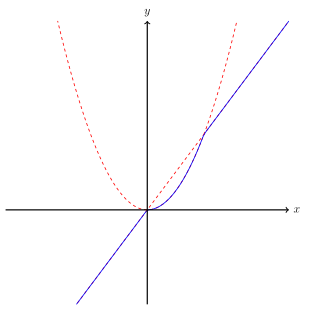
- Sketch the graph \(y = \mathrm{Min}(x^2, 2x)\).
- Solve the equation \(2\mathrm{Min}(x^2, 2x) = 5x - 3\).
- Solve the equation \(\mathrm{Min}(x^2, 2x) + \mathrm{Min}(x^3, 4x) = mx\) in the cases \(m = 2\) and \(m = 6\).
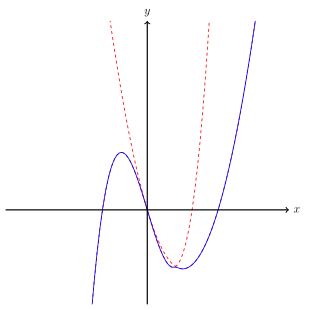
- Show that \((1, -3)\) is a local maximum point on the curve \(y = 2\mathrm{Min}(x^2, x^3) - 5x\) and find the other three local maxima and minima on this curve. Sketch the curve.
Solution:
- \(2 \textrm{Min}(x^2,2x) = 5x-3\) tells us either \(2x^2 = 5x-3 \Rightarrow 2x^2 - 5x +3 = 0 \Rightarrow (2x-3)(x-1) \Rightarrow x = 1, \frac32\) and \(0 \leq x \leq 2\) or \(4x = 5x-3 \Rightarrow x= 3\) and \(x < 0\) or \(2 > x\), therefore our solutions are \(x = 1, \frac32, 3\)
- We have different cases based on \(x\) vs \(-2, 0, 2\), ie Case \(x \leq -2\): \begin{align*} && mx &= \mathrm{Min}(x^2, 2x) + \mathrm{Min}(x^3, 4x) \\ &&&= 2x + x^3 \end{align*} So \(2x = 2x + x^3 \Rightarrow x^3 = 0\), but \(x \leq -2\) so no solutions. or \(6x = 2x + x^3 \Rightarrow 0 = x(x^2-4) \Rightarrow x = 0, 2, -2\) so \(x = -2\). Case \(-2 < x \leq 0\): \begin{align*} && mx &= \mathrm{Min}(x^2, 2x) + \mathrm{Min}(x^3, 4x) \\ &&&= 2x + 4x \end{align*} So \(2x = 2x + 4x\) ie \(x = 0\) which is valid. Or \(6x = 2x + 4x\) ie valid for all values in \(-2 \leq x \leq 0\) Case \(0 < x \leq 2\): \begin{align*} && mx &= \mathrm{Min}(x^2, 2x) + \mathrm{Min}(x^3, 4x) \\ &&&= x^2 + x^3 \end{align*} So \(2x = x^2 + x^3 \Rightarrow 0 = x(x^2+x-2) = x(x-1)(x+2)\) so \(x = 0, 1, -2\), but the range means \(x = 0\) or \(x = 1\) Or \(6x = x^2 + x^3 \Rightarrow 0 = x(x^2+x-6) = x(x-2)(x+3)\) so \(x = 0, 2, -3\), but the range means \(x = 0\) or \(x = 2\) Case \(2 \leq x \): \begin{align*} && mx &= \mathrm{Min}(x^2, 2x) + \mathrm{Min}(x^3, 4x) \\ &&&=2x + 4x \end{align*} So \(2x = 2x + 4x \Rightarrow x = 0\) so no solutions. Or \(6x = 2x + 4x\) so a range of solutions. Therefore the final solutions for \(m = 2\) are \(x = 0, x = 1\) and for \(m = 2\) are \(x \in [-2,0] \cup [2, \infty)\)
- \(\mathrm{Min}(x^2, x^3)\) switches when \(x = 1\), so we must consider both limits:
\begin{align*}
&& \frac{\d y}{\d x}\vert_{x > 1} &= 4x - 5 \\
\\
&& \frac{\d y}{\d x}\vert_{x < 1} &= 6x^2 - 5 \\
\end{align*}
so when \(x = 1\) the sign of the derivative changes from positive to negative, hence a local maximum.
The other local maxima and minima will be when \(x = \frac54\) or \(x = \pm \sqrt{5/6}\)