Problems
Filters
1 problem found
2009 Paper 3 Q3
D: 1700.0
B: 1500.0
Taylor series
exponential function
limits
even function
curve sketching
differentiation
inequality
Maclaurin expansion
The function \(\f(t)\) is defined, for \(t\ne0\), by \[ \f(t) = \frac t {\e^t-1}\,. \] \begin{questionparts} \item By expanding \(\e^t\), show that \(\displaystyle \lim _{t\to0} \f(t) = 1\,\). Find \(\f'(t)\) and evaluate \(\displaystyle \lim _{t\to0} \f'(t)\,\). \item Show that \(\f(t) +\frac12 t\) is an even function. [{\bf Note:} A function \(\g(t)\) is said to be {\em even} if \(\g(t) \equiv \g(-t)\).] \item Show with the aid of a sketch that \( \e^t( 1-t)\le 1\,\) and deduce that \(\f'(t)\ne 0\) for \(t\ne0\). \end{questionpart} Sketch the graph of \(\f(t)\).
Solution:
- Claim \(f(t) + \frac12 t\) is an even function. Proof: Consider \(f(-t) - \frac12t\), then \begin{align*} f(-t) - \frac12t &= \frac{-t}{e^{-t}-1} - \frac12t \\ &= \frac{-te^t}{1-e^t} - \frac12 t \\ &= \frac{t(1-e^t) -t}{1-e^t} - \frac12 t \\ &= t - \frac{t}{1-e^t} - \frac12 t \\ &= \frac{t}{e^t-1} + \frac12 t \end{align*} So it is even.
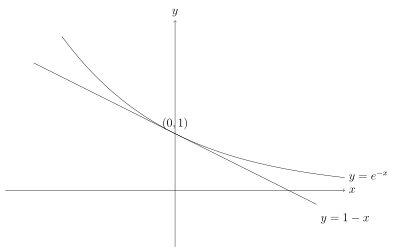
- Drawing the tangent to \(y = e^{-x}\) at \((0,1)\) we find that \(e^{-t} \geq (1-t)\) for all \(t\), in particular, \(e^t(1-t) \leq 1\) \(f'(t) = \frac{(e^t(1-t) -1}{(e^t-1)^2} \leq 0\) and \(f'(t) = -\frac12\) when \(t = 0\)