Problems
Filters
2 problems found
2018 Paper 2 Q2
A function \(\f(x)\) is said to be concave for \(a< x < b\) if \[ \ t\,\f(x_1) +(1-t)\,\f(x_2) \le \f\big(tx_1+ (1-t)x_2\big) \, ,\] for \(a< x_1 < b\,\), \(a< x_2< b\) and \(0\le t \le 1\,\). Illustrate this definition by means of a sketch, showing the chord joining the points \(\big(x_1, \f(x_1)\big) \) and \(\big(x_2, \f(x_2)\big) \), in the case \(x_1 < x_2\) and \(\f(x_1)< \f(x_2)\,\). Explain why a function \(\f(x)\) satisfying \(\f''(x)<0\) for \(a< x < b\) is concave for \(a< x < b\,\).
- By choosing \(t\), \(x_1\) and \(x_2\) suitably, show that, if \(\f(x)\) is concave for \(a< x < b\,\), then \[ \f\Big(\frac{u+ v+w}3\Big) \ge \frac{ \f(u) +\f(v) +\f(w)}3 \, ,\] for \(a< u < b\,\), \(a< v < b\,\) and \(a< w < b\,\).
- Show that, if \(A\), \(B\) and \(C\) are the angles of a triangle, then \[ \sin A +\sin B + \sin C \le \frac{3\sqrt3}2 \,. \]
- By considering \(\ln (\sin x)\), show that, if \(A\), \(B\) and \(C\) are the angles of a triangle, then \[ \sin A \times \sin B \times \sin C \le \frac {3 \sqrt 3} 8 \,. \]
Solution:
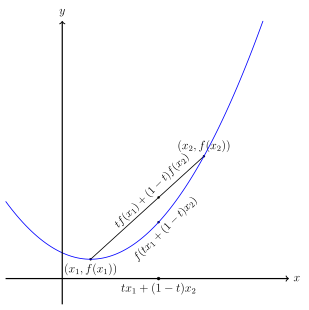
- \(\,\) \begin{align*} && f \left ( \frac{u+v+w}{3} \right) &= f \left ( \frac{2}{3}\cdot \frac{u+v}2+\frac{1}{3}w \right) \\ &&&\geq \frac23 f \left ( \frac{u+v}{2} \right) + \frac13 f(w) \\ &&&\geq \frac23 \left (\frac12 f(u) + \frac12 f(v) \right) + \frac13 f(w) \\ &&&= \frac{f(u)+f(v)+f(w)}{3} \end{align*}
- Notice that if \(A, B, C\) are angles in a triangle then they add to \(\pi\) \(0 < A,B,C < \pi\). We also have \(f(x) = \sin x \Rightarrow f''(x) = - \sin x < 0\) on this interval. Therefore \(\sin A + \sin B + \sin C \leq 3 \sin \frac{A+B+C}{3} = 3 \sin \frac{\pi}{3} = \frac{3\sqrt{3}}2\)
- Also notice that \begin{align*} && f(x) &= \ln ( \sin x) \\ \Rightarrow && f'(x) &= \frac{\cos x}{ \sin x} \\ && f''(x) &= -\textrm{cosec}^2 x < 0 \\ \\ \Rightarrow && \ln( \sin A) + \ln (\sin B) + \ln (\sin C) &\leq 3 \ln \left (\sin \left ( \frac{A + B+ C}{3} \right) \right) \\ &&&= 3 \ln \left ( \frac{\sqrt{3}}{2} \right) = \ln \frac{3\sqrt{3}}{8} \\ \Rightarrow && \sin A \sin B \sin C &\leq \frac{3\sqrt{3}}8 \end{align*}
2007 Paper 2 Q7
A function \(\f(x)\) is said to be concave on some interval if \(\f''(x)<0\) in that interval. Show that \(\sin x\) is concave for \(0< x < \pi\) and that \(\ln x\) is concave for \(x > 0\). Let \(\f(x)\) be concave on a given interval and let \(x_1\), \(x_2\), \(\ldots\), \(x_n\) lie in the interval. Jensen's inequality states that \[ \frac1 n \sum_{k=1}^n\f(x_k) \le \f \bigg (\frac1 n \sum_{k=1}^n x_k\bigg) \] and that equality holds if and only if \(x_1=x_2= \cdots =x_n\). You may use this result without proving it.
- Given that \(A\), \(B\) and \(C\) are angles of a triangle, show that \[ \sin A + \sin B + \sin C \le \frac{3\sqrt3}2 \,. \]
- By choosing a suitable function \(\f\), prove that
\[
\sqrt[n]{t_1t_2\cdots t_n}\; \le \; \frac{t_1+t_2+\cdots+t_n}n
\]
for any positive integer \(n\) and for any positive numbers \(t_1\), \(t_2\), \(\ldots\), \(t_n\).
Hence:
- show that \(x^4+y^4+z^4 +16 \ge 8xyz\), where \(x\), \(y\) and \(z\) are any positive numbers;
- find the minimum value of \(x^5+y^5+z^5 -5xyz\), where \(x\), \(y\) and \(z\) are any positive numbers.
Solution: \begin{align*} && f(x) &= \sin x \\ \Rightarrow && f''(x) &= -\sin x \end{align*} which is clearly negative on \((0,\pi)\) since \(\sin\) is positive on this interval. \begin{align*} && f(x) &= \ln x \\ \Rightarrow && f''(x) &= -1/x^2 \end{align*} which is clearly negative for \(x > 0\)
- Since \(A,B,C\) are angles in a triangle, we must have \(0 < A,B,C< \pi\) and so we can apply Jensen with \(f = \sin\) to obtain: \begin{align*} &&\frac13( \sin A + \sin B + \sin C) &\leq \sin \left ( \frac{A+B+C}{3}\right) \\ &&&= \sin \frac{\pi}{3} = \frac{\sqrt{3}}2 \\ \Rightarrow && \sin A + \sin B + \sin C &\leq\frac{3\sqrt{3}}2 \end{align*}
- Suppose \(f(x) = \ln x\), then applying Jensen on the positive numbers \(t_1, \ldots, t_n\) we obtain
\begin{align*}
&& \frac1n \left ( \sum_{i=1}^n \ln t_n \right) &\leq \ln \left ( \frac1n\sum_{i=1}^n t_n \right) \\
\Rightarrow && \frac1n \ln\left (\prod_{i=1} t_n\right)&\leq \ln \left ( \frac1n\sum_{i=1}^n t_n \right) \\
\Rightarrow && \ln\left (\left (\prod_{i=1} t_n\right)^{1/n}\right)&\leq \ln \left ( \frac1n\sum_{i=1}^n t_n \right) \\
\Rightarrow && \left (\prod_{i=1} t_n\right)^{1/n}&\leq\frac1n\sum_{i=1}^n t_n \\
\Rightarrow && \sqrt[n]{t_1t_2 \cdots t_n}&\leq\frac1n(t_1 + t_2 + \cdots + t_n) \tag{AM-GM}\\
\end{align*}
- Applying AM-GM with \(t_1 = x^4, t_2 = y^4, t_3 = z^4, t_4 = 2^4\) we have \begin{align*} && \frac{x^4+y^4+z^4+16}{4} & \geq \sqrt[4]{x^4y^4z^42^4} \\ \Rightarrow && x^4+y^4+z^4+16 &\geq 8xyz \end{align*}
- Applying AM-GM with \(t_1 = x^5, t_2 = y^5, t_3 = z^5, t_4 = 1^5, t_5 = 1^5\) we have \begin{align*} && \frac{x^5+y^5+z^5+1+1}{5} & \geq \sqrt[5]{x^5y^5z^5} \\ \Rightarrow && x^5+y^5+z^5+2 &\geq 5xyz \\ \Rightarrow && x^5+y^5+z^5 - 5xyz &\geq -2 \end{align*} Therefore the minimum is \(-2\)