Problems
Filters
13 problems found
2016 Paper 2 Q1
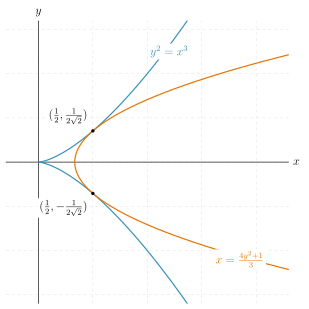
The curve \(C_1\) has parametric equations \(x=t^2\), \(y= t^3\), where \(-\infty < t < \infty\,\). Let \(O\) denote the point \((0,0)\). The points \(P\) and \(Q\) on \(C_1\) are such that \(\angle POQ\) is a right angle. Show that the tangents to \(C_1\) at \(P\) and \(Q\) intersect on the curve \(C_2\) with equation \(4y^2=3x-1\). Determine whether \(C_1\) and \(C_2\) meet, and sketch the two curves on the same axes.
Solution: \(\angle POQ = 90^\circ\) means that if \(P(p^2,p^3)\) and \(Q(q^2,q^3)\) are our points then \(OP^2+OQ^2 = PQ^2\), so \begin{align*} && p^4+p^6+q^4+q^6 &= (p^2-q^2)^2+(p^3-q^3)^2 \\ &&&= p^4+q^4-2p^2q^2+p^6+q^6-2p^3q^3 \\ \Rightarrow && 0 &= 2p^2q^2(1+pq) \\ \Rightarrow && pq &= -1 \\ \\ && \frac{\d y}{ \d x} &= \frac{\frac{\d y }{\d t}}{\frac{\d x}{\d t}} \\ &&&= \frac{3t^2}{2t} = \tfrac32t \\ \Rightarrow && \frac{y-p^3}{x-p^2} &= \tfrac32p \\ \Rightarrow && 2(y-p^3) &=3p(x-p^2) \\ && 2(y-q^3) &=3q(x-q^2) \\ \Rightarrow && 2(q^3-p^3) &= (3p-3q)x+3(q^3-p^3) \\ && p^3-q^3 &= 3(p-q)x \\ \Rightarrow && x &= \tfrac13(p^2+q^2+pq) \\ && 2y &= 3p(\tfrac13(p^2+q^2+pq)-p^2)+2p^3 \\ &&&= p(p^2+q^2+pq)-p^3 \\ &&&= pq^2+p^2q \\ &&&= -p-q \\ &&y&= -\frac{p+q}{2} \\ \\ && 4y^2 &= p^2+q^2 \\ && 3x-1 &= p^2+q^2 \\ \end{align*} To check if they meet, try \(4t^6=3t^2 - 1\). Consider \(y = 4x^3-3x+1\) \(y(0) = 1\) and \(y' = 12x^2-3 = 3(4x^2-1)\) which has roots at \(\pm \tfrac12\), therefore we need to test \(y(\tfrac12) = \tfrac12-\tfrac32 + 1 = 0\), so there is a one intersection at \(x = \tfrac1{2}, y = \tfrac1{2\sqrt{2}}\)
2016 Paper 2 Q2
Use the factor theorem to show that \(a+b-c\) is a factor of \[ (a+b+c)^3 -6(a+b+c)(a^2+b^2+c^2) +8(a^3+b^3+c^3) \,. \tag{\(*\)} \] Hence factorise (\(*\)) completely.
- Use the result above to solve the equation \[ (x+1)^3 -3 (x+1)(2x^2 +5) +2(4x^3+13)=0\,. \]
- By setting \(d+e=c\), or otherwise, show that \((a+b-d-e)\) is a factor of \[ (a+b+d+e)^3 -6(a+b+d+e)(a^2+b^2+d^2+e^2) +8(a^3+b^3+d^3+e^3) \, \] and factorise this expression completely. Hence solve the equation \[ (x+6)^3 - 6(x+6)(x^2+14) +8(x^3+36)=0\,. \]
Solution: Suppose \(c = a+b\) then \begin{align*} (a+b+c)^3 &-6(a+b+c)(a^2+b^2+c^2) +8(a^3+b^3+c^3) \\ &= (2(a+b))^3-6(2(a+b))(a^2+b^2+(a+b)^2) + 8(a^3+b^3+(a+b)^3) \\ &=16(a+b)^3 - 24(a+b)(a^2+b^2+ab)+8(a^3+b^3) \\ &= 8(a+b)(2(a+b)^2-3(a^2+b^2+ab)+(a^2-ab+b^2)) \\ &= 0 \end{align*} Therefore \(a+b-c\) is a factor. By symmetry \(a-b+c\) and \(-a+b+c\) are also factors. Since our polynomial is degree \(3\) it must be \(K(a+b-c)(b+c-a)(c+a-b)\) for some \(K\). Since the coefficient of \(a^3\) is \(3\), \(K = 3\). so we have: \(3(a+b-c)(b+c-a)(c+a-b)\)
- We want \(x + a + b = x+1\), \(x^2 + a^2 + b^2 = x^3+\frac52, x^3 + a^3 + b^3 = x^3+ \frac{13}{4}\). \(a+b = 1, a^2 + b^2 = 5/2\) so \(a = \frac32, b = -\frac12\) \begin{align*} 0 &= (x+1)^3 - 3(x+1)(2x^2+5)+2(4x^3+13) \\ &= 3(x +\frac{3}{2}+\frac{1}{2})(x - \frac{3}{2} - \frac{1}{2})(-x + \frac{3}{2} - \frac{1}{2}) \\ &= 3(x+2)(x-2)(1-x) \end{align*} and so the roots are \(x = 1, 2, -2\)
- Letting \(c = d+e\) we have \begin{align*} (a+b+d+e)^3 &-6(a+b+d+e)(a^2+b^2+d^2+e^2) +8(a^3+b^3+d^3+e^3) \\ &= (a+b+c)^3 -6(a+b+c)(a^2+b^2+c^2-2de) +8(a^3+b^3+c^3 - 3cde) \\ &= (a+b+c)^3 -6(a+b+c)(a^2+b^2+c^2)+8(a^3+b^3+c^3)+12(a+b+c)de - 24cde \\ &= \underbrace{(a+b+c)^3 -6(a+b+c)(a^2+b^2+c^2)+8(a^3+b^3+c^3)}_{\text{has a factor of }a+b-c} + 12(a+b-c)de \end{align*} Therefore there is a factor of \(a+b-c\) or \(a+b-d-e\). By symmetry we must have the factors: \((a+b-d-e)(a-b-d+e)(a-b+d-e)\) and so the final expression must be: \(K(a+b-d-e)(a-b-d+e)(a-b+d-e)\) The coefficient of \(a^3\) is \(3\), therefore \(K = 3\) We want \(x+a+b+c = x + 6\), \(x^2+a^2+b^2+c^2 = 14\) and \(x^3 + a^3+b^3+c^3 = 36\), ie \(a = 1,b=2,c=3\) would work, so \begin{align*} 0 &= (x+6)^3 - 6(x+6)(x^2+14) +8(x^3+36) \\ &= 3(x+1-2-3)(x-1+2-3)(x-1-2+3) \\ &= 3x(x-4)(x-2) \end{align*} ie the roots are \(x = 0, 2, 4\)
2016 Paper 2 Q3
For each non-negative integer \(n\), the polynomial \(\f_n\) is defined by \[ \f_n(x) = 1 + x + \frac{x^2}{2!} + \frac {x^3}{3!} + \cdots + \frac{x^n}{n!} \]
- Show that \(\f'_{n}(x) = \f_{n-1}(x)\,\) (for \(n\ge1\)).
- Show that, if \(a\) is a real root of the equation \[\f_n(x)=0\,,\tag{\(*\)}\] then \(a<0\).
- Let \(a\) and \(b\) be distinct real roots of \((*)\), for \(n\ge2\). Show that \(\f_n'(a)\, \f_n'(b)>0\,\) and use a sketch to deduce that \(\f_n(c)=0\) for some number \(c\) between \(a\) and \(b\). Deduce that \((*)\) has at most one real root. How many real roots does \((*)\) have if \(n\) is odd? How many real roots does \((*)\) have if \(n\) is even?
Solution:
- \(\,\) \begin{align*} && f'_n(x) &= 0 + 1 + \frac{2x}{2!} + \frac{3x^2}{3!} + \cdots + \frac{nx^{n-1}}{n!} \\ &&&= 1 + x + \frac{x^2}{2!} + \frac{x^3}{3!} + \cdots + \frac{x^{n-1}}{(n-1)!} \\ &&&= f_{n-1}(x) \end{align*}
- Claim: \(f_n(x) > 0\) for all \(x > 0\) Proof: (By induction) Base case: (\(n = 1\)) \(f_1(x) = 1 + x > 1\) therefore \(f_1(x) > 0\) Suppose it's true for \(n = k\), then consider \(f_{k+1}\), if we differentiate it, we find it is increasing on \((0, \infty)\) by our inductive hypothesis. But then \(f_{k+1}(0) = 1 > 0\). Therefore \(f_{k+1}(x) > 0\) as well. Therefore by the principle of mathematical induction we are done. Since \(f_n(x) > 0\) for non-negative \(x\), if \(a\) is a root it must be negative.
- Suppose \(f_n(a) = f_n(b) = 0\) then \(f'_n(a) = -\frac{a^n}{n!}\) and \(f'_n(b) = -\frac{b^n}{n!}\), but then \(f_n'(a) f_n'(b) = \frac{(-a)^n(-b)^n}{(n!)^2} > 0\) since \(a < 0, b < 0\). \(_n'(a) f_n'(b)\) is positive, the two gradients must have the same sign (and not be zero). Therefore if they are both increasing, at some point the curve must cross the axis in between. Therefore there is some root \(c\) between \(a\) and \(b\). But then there is also a root between \(c\) and \(a\) and \(c\) and \(b\), and very quickly we find more than \(n\) roots which is not possivel. Therefore there must be at most \(1\) root. If \(n\) is odd there must be exactly one root, since \(f_n\) changes sign as \(x \to -\infty\) vs \(x = 0\). If \(n\) is even then there can't be any roots, since if it crossed the \(x\)-axis there would be two roots (not possible) and it cannot touch the axis, since \(f'_n(a) \neq 0\) unless \(a = 0\), and we know \(a < 0\)
2016 Paper 2 Q4
Let \[ y=\dfrac{x^2+x\sin\theta+1}{x^2+x\cos\theta+1} \,.\]
- Given that \(x\) is real, show that \[ (y\cos\theta -\sin\theta)^2 \ge 4 (y-1)^2 \,. \] Deduce that \[ y^2+1 \ge 4(y-1)^2 \,, \] and hence that \[ \dfrac {4-\sqrt7}3 \le y \le \dfrac {4+\sqrt7}3 \,. \]
- In the case $y= \dfrac {4+\sqrt7}3 \,$, show that \[\sqrt{y^2+1}=2(y-1)\] and find the corresponding values of \(x\) and \(\tan\theta\).
Solution:
- \(\,\) \begin{align*} && y&=\frac{x^2+x\sin\theta+1}{x^2+x\cos\theta+1} \\ \Leftrightarrow && 0 &= x^2(y-1) + x(y \cos \theta - \sin \theta) + y-1 \\ \Leftrightarrow && 0 &\leq \Delta = (y\cos \theta - \sin \theta)^2 - 4(y-1)^2 \\ \Leftrightarrow && (y\cos \theta - \sin \theta)^2 &\geq 4(y-1)^2 \end{align*} [Assuming that \(y \neq 1\), if \(y = 1\) then the RHS is \(0\) and it is automatically satisfied]. Notice that \((y\cos \theta - \sin \theta)^2 \leq (y^2+1)(\cos^2 \theta + \sin^2 \theta)\) by Cauchy-Schwarz, so \(y^2 + 1 \geq 4(y-1)^2\). \begin{align*} && y^2 + 1 &\geq 4(y-1)^2 \\ \Leftrightarrow && 0 &\geq 3y^2-8y+3 \\ \text{c.v.} && y&= \frac{8 \pm \sqrt{64-4\cdot3 \cdot 3}}{6} \\ &&&= \frac{4 \pm \sqrt{16-9}}{3} = \frac{4 \pm \sqrt{7}}3 \end{align*} so \(\frac{4-\sqrt{7}}3 \leq y \leq \frac{4+\sqrt7}3\).
- If \(y = \frac{4+\sqrt7}3\) then \(y - 1 = \frac{1+\sqrt7}3\) and since \(y^2+1 = 4(y-1)^2\) taking square roots we obtain \(\sqrt{y^2+1} = 2(y-1)\). Since equality must hold in our C-S identity, we must have \(\langle y, -1 \rangle\) parallel to \( \langle \cos \theta , \sin \theta \rangle\), ie \(\tan \theta = -\frac{3}{4+\sqrt{7}}\) and \begin{align*} && x & = \frac{-(y \cos \theta - \sin \theta) \pm \sqrt{\Delta}}{2(y-1)} \\ &&&= \frac{\pm2(y-1)}{2(y-1)} \\ &&&= \pm1 \end{align*}
2016 Paper 2 Q5
In this question, the definition of \(\displaystyle\binom pq\) is taken to be \[ \binom pq = \begin{cases} \dfrac{p!}{q!(p-q)!} & \text{ if } p\ge q\ge0 \,,\\[4mm] 0 & \text{ otherwise } . \end{cases} \]
- Write down the coefficient of \(x^n\) in the binomial expansion for \((1-x)^{-N}\), where \(N\) is a positive integer, and write down the expansion using the \(\Sigma\) summation notation. By considering $ (1-x)^{-1} (1-x)^{-N} \, ,$ where \(N\) is a positive integer, show that \[ \sum_{j=0}^n \binom { N+j -1}{j} = \binom{N+n}{n}\,. \]
- Show that, for any positive integers \(m\), \(n\) and \(r\) with \(r\le m+n\), \[ \binom{m+n} r = \sum _{j=0}^r \binom m j \binom n {r-j} \,. \]
- Show that, for any positive integers \(m\) and \(N\), \[ \sum_{j=0}^n(-1)^{j} \binom {N+m} {n-j} \binom {m+j-1}{j } = \displaystyle \binom N n . \]
Solution:
- \(\frac{(-N)(-N-1)\cdots(-N-n+1)}{n!} = \binom{N+n-1}{n}\), so \[ (1-x)^{-N} = \sum_{n=0}^{\infty} \binom{N+n-1}{n} x^n\] \begin{align*} && (1-x)^{-N-1} &= (1-x)^{-1}(1-x)^{-N} \\ &&&= (1 + x + x^2 + \cdots)\left ( \sum_{n=0}^{\infty} \binom{N+n-1}{n} x^n\right)\\ [x^{n}]: && \binom{N+1+n-1}{n} &= \sum_{j=0}^n \underbrace{1}_{x^{n-j} \text{ from 1st bracket}}\cdot\underbrace{\binom{N+j-1}{j}}_{x^j\text{ from second bracket}} \\ \Rightarrow && \binom{N+n}{n} &= \sum_{j=0}^n \binom{N+j-1}{j} \end{align*}
- Consider \((1+x)^{m+n} = (1+x)^m(1+x)^n\) and consider the coefficient of \(x^r\) from each side. On the left hand side this is clearly \(\binom{m+n}{r}\) on the right hand side we can take \(x^j\) from \((1+x)^m\) and \(x^{n-j}\) from \((1+x)^n\) and \(j\) can take any value from \(0\) to \(r\), ie \[ \binom{m+n} r = \sum _{j=0}^r \binom m j \binom n {r-j} \]
- Consider \((1-x)^{-(N+m+1)} = (\)
2016 Paper 2 Q6
This question concerns solutions of the differential equation \[ (1-x^2) \left(\frac{\d y}{\d x}\right)^2 + k^2 y^2 = k^2\, \tag{\(*\)} \] where \(k\) is a positive integer. For each value of \(k\), let \(y_k(x)\) be the solution of \((*)\) that satisfies \(y_k(1)=1\); you may assume that there is only one such solution for each value of \(k\).
- Write down the differential equation satisfied by \(y_1(x)\) and verify that \(y_1(x) = x\,\).
- Write down the differential equation satisfied by \(y_2(x)\) and verify that \(y_2(x) = 2x^2-1\,\).
- Let \(z(x) = 2\big(y_n(x)\big)^2 -1\). Show that \[ (1-x^2) \left(\frac{\d z}{\d x}\right)^2 +4n^2 z^2 = 4n^2\, \] and hence obtain an expression for \(y_{2n}(x)\) in terms of \(y_n(x)\).
- Let \(v(x) = y_n\big(y_m(x)\big)\,\). Show that \(v(x) = y_{mn}(x)\,\).
Solution:
- When \(k =1\), we have \((1-x^2)(y')^2 + y^2 = 1\). Notice that if \(y_1 = x\) we have \(y_1' = 1\) and \((1-x^2) \cdot 1 + x^2 = 1\) so \(y_1\) is a solution, and we are allowed to assume this is the only solution. And notice that \(y_1(1) = 1\).
- When \(k = 2\) we have \((1-x^2)(y')^2 + 4y^2 = 4\). Trying \(y_2 = 2x^2-1\) we see that \(y_2' = 4x\) and \((1-x^2)(4x)^2 + 4(2x^2-1)^2 = 16x^2-16x^4+16x^4-16x^2+4 = 4\). We can also check that \(y(1) = 2 \cdot 1^2 - 1 = 1\)
- Let \(z(x) = 2(y_n(x))^2-1\), then \begin{align*} && \frac{\d z}{\d x} &= 4y'_n(x)y_n(x) \\ \Rightarrow && LHS &= (1-x^2)\left ( \frac{\d z}{\d x} \right)^2 + 4n^2 z^2 \\ &&&= (1-x^2)16(y'_n(x))^2(y_n(x))^2 + 4n^2(2(y_n(x))^2-1)^2 \\ &&&= 16y_n^2(1-x^2) \left [\frac{n^2-n^2y_n^2}{(1-x^2)} \right] + 16n^2y_n^4-16n^2y_n^2+4n^2 \\ &&&= 4n^2 = RHS \end{align*} Therefore \(y_{2n}(x) = 2(y_n(x))^2-1 = y_2(y_n(x))\) (notice also that \(z(1) = 2(y_n(1))^2-1 = 2-1 = 1\)).
- Let \(v(x) = y_n(y_m(x))\) so \begin{align*} && (y_m')^2 &= \frac{m^2(1-y_m^2)}{1-x^2} \\ && (y_n')^2 &= \frac{n^2(1-y_n^2)}{1-x^2} \\ \\ && \frac{\d v}{\d x} &= y_n'(y_m(x)) \cdot y_m'(x) \\ && (1-x^2)(v')^2 &= (1-x^2) \cdot (y_n'(y_m(x)))^2 (y_m')^2 \\ &&&= (1-x^2) \cdot (y_n'(y_m(x)))^2 \left ( \frac{m^2(1-y_m^2)}{1-x^2} \right) \\ &&&= (y_n'(y_m(x)))^2 m^2(1-y_m^2) \\ &&&= \frac{n^2(1-(y_n(y_m(x)))^2)}{1-y_m^2}m^2(1-y_m^2) \\ &&&= n^2m^2(1-v^2) \end{align*} Therefore \(v\) satisfies our differential equation and \(v(1) = y_n(y_m(1)) = y_n(1) = 1\) so it must be our desired solution.
2016 Paper 2 Q7
Show that \[ \int_0^a \f(x) \d x= \int _0^a \f(a-x) \d x\,, \tag{\(*\)} \] where f is any function for which the integrals exist.
- Use (\(*\)) to evaluate \[ \int_0^{\frac12\pi} \frac{\sin x}{\cos x + \sin x} \, \d x \,. \]
- Evaluate \[ \int_0^{\frac14\pi} \frac{\sin x}{\cos x + \sin x} \, \d x \,. \]
- Evaluate \[ \int_0^{\frac14\pi} \ln (1+\tan x) \, \d x \,. \]
- Evaluate \[ \int_0^{\frac14 \pi} \frac x {\cos x \, (\cos x + \sin x)}\, \d x \,. \]
Solution: \begin{align*} u = a-x, \d u = - \d x: && \int_0^a f(x) \d x &= \int_{u=a}^{u=0} f(a-u) (-1) \d u \\ &&&= \int_0^a f(a-u) \d u \\ &&&= \int_0^a f(a-x) \d x \end{align*}
- \begin{align*} && I &= \int_0^{\frac12 \pi} \frac{\sin x}{\cos x + \sin x } \d x\\ &&&= \int_0^{\frac12 \pi} \frac{\sin (\frac12 \pi - x)}{\cos (\frac12 \pi-x) + \sin (\frac12 \pi-x) } \d x\\ &&&= \int_0^{\frac12 \pi} \frac{\cos x}{\sin x + \cos x } \d x\\ \Rightarrow && 2I &= \int_0^{\frac12 \pi} 1 \d x \\ \Rightarrow && I &= \frac{\pi}{4} \end{align*}
- \begin{align*} && I &= \int_0^{\frac14 \pi} \frac{\sin x}{\cos x + \sin x } \d x\\ &&&= \int_0^{\frac14 \pi} \frac{\sin (\frac14 \pi - x)}{\cos (\frac14 \pi-x) + \sin (\frac14 \pi-x) } \d x\\ &&&= \int_0^{\frac14 \pi} \frac{\frac1{\sqrt{2}} \cos x - \frac{1}{\sqrt{2}} \sin x}{\frac1{\sqrt{2}} \cos x + \frac{1}{\sqrt{2}} \sin x + \frac1{\sqrt{2}} \cos x - \frac{1}{\sqrt{2}} \sin x} \d x \\ &&&= \int_0^{\frac14 \pi} \frac{\cos x - \sin x}{2 \cos x} \d x \\ &&&= \left [\frac12 x + \ln(\cos x) \right]_0^{\pi/4} \\ &&&= \frac{\pi}{8} -\frac12\ln2 - 1 \end{align*}
- \begin{align*} && I &= \int_0^{\frac14\pi} \ln (1+\tan x) \, \d x \\ &&&= \int_0^{\frac14 \pi} \ln \left (1 + \tan \left(\frac{\pi}{4} - x\right) \right) \, \d x\\ &&&= \int_0^{\frac14 \pi} \ln \left (1 +\frac{1 - \tan x}{1+ \tan x} \right) \, \d x\\ &&&= \int_0^{\frac14 \pi} \ln \left (\frac{2}{1+ \tan x} \right) \, \d x\\ &&&= \frac{\pi}{4} \ln 2 - I \\ \Rightarrow && I &= \frac{\pi}{8} \ln 2 \end{align*}
- \begin{align*} && I &= \int_0^{\frac14 \pi} \frac x {\cos x \, (\cos x + \sin x)}\, \d x \\ &&&= \int_0^{\frac14 \pi} \frac {\frac14 \pi - x} {(\frac1{\sqrt{2}} \cos x + \frac{1}{\sqrt{2}} \sin x) \, (\frac{2}{\sqrt{2}}\cos x)}\, \d x \\ &&&= \int_0^{\frac14 \pi} \frac {\frac14 \pi - x} {\cos x \, (\cos x + \sin x)}\, \d x \\ \\ \Rightarrow && I &= \frac{\pi}{8} \int_0^{\pi/4} \frac{\sec^2 x}{1 + \tan x} \d x\\ &&&= \frac{\pi}{8} \left [\ln (1 + \tan x) \right]_0^{\pi/4} \\ &&&= \frac{\pi}{8} \ln 2 \end{align*}
2016 Paper 2 Q8
Evaluate the integral \[ \hphantom{ \ \ \ \ \ \ \ \ \ (m> \tfrac12)\,.} \int_{m-\frac12} ^\infty \frac 1{x^2}\, \d x { \ \ \ \ \ \ \ \ \ (m > \tfrac12)\,.} \] Show by means of a sketch that \[ \sum_{r=m}^n \frac 1 {r^2} \approx \int_{m-\frac12}^{n+\frac12} \frac1 {x^2} \, \d x \,, \tag{\(*\)} \] where \(m\) and \(n\) are positive integers with \(m < n\).
- You are given that the infinite series \(\displaystyle \sum_{r=1}^\infty \frac 1 {r^2}\) converges to a value denoted by \(E\). Use \((*)\) to obtain the following approximations for \(E\): \[ E\approx 2\,; \ \ \ \ E\approx \frac53\,; \ \ \ \ E\approx \frac{33}{20} \,.\]
- Show that, when \(r\) is large, the error in approximating \(\dfrac 1{r^2}\) by \(\displaystyle \int_{r-\frac12}^{r+\frac12} \frac 1 {x^2} \, \d x\) is approximately \(\dfrac 1{4r^4}\,\). Given that \(E \approx 1.645\), show that \(\displaystyle \sum_{r=1}^\infty \frac1{r^4} \approx 1.08\, \).
Solution: \begin{align*} && \int_{m-\frac12}^\infty \frac{1}{x^2} \d x &= \lim_{K \to \infty} \left [ -x^{-1} \right]_{m-\frac12}^K \\ &&&= \frac{1}{m-\frac12} - \lim_{K \to \infty }\frac{1}K \\ &&&= \frac{1}{m-\frac12} \end{align*}

- \(\,\) \begin{align*} E &\approx \int_{1-\frac12}^\infty \frac1{x^2} \d x = \frac{1}{1-\frac12} = 2 \\ E &\approx 1 + \int_{2-\frac12}^\infty \frac1{x^2} \d x= 1 + \frac{1}{2 - \frac12} = \frac53 \\ E &\approx 1 +\frac14 + \int_{3-\frac12}^\infty \frac1{x^2} \d x= \frac54 + \frac{1}{3-\frac12} \\ &= \frac54+\frac{2}{5} = \frac{33}{20} \end{align*}
- The error is \begin{align*} && \epsilon &= \int_{r-\frac12}^{r+\frac12} \frac 1 {x^2} \, \d x - \frac1{r^2} \\ &&&= \frac{1}{r-\frac12} - \frac{1}{r + \frac12} - \frac1{r^2} \\ &&&= \frac{1}{r^2 - \frac14} - \frac1{r^2} \\ &&&= \frac{\frac14}{r^2(r^2-\frac14)} \\ &&&\approx \frac{1}{4r^4} \end{align*} Therefore \begin{align*} && \sum_{n=1}^\infty \frac1{r^4} &\approx 4 \left ( 1 +\frac14 + \int_{3-\frac12}^\infty \frac1{x^2} \d x-\sum_{r=1}^\infty \frac{1}{r^2} \right) + 1 + \frac{1}{2^4}\\ &&&= 4 \left ( \frac{33}{20}-1.645 \right) + 1 + \frac{1}{2^4} \\ &&&= 4 \left ( 1.65-1.645 \right) + 1 + \frac{1}{2^4} \\ &&&= 1.0825 \approx 1.08 \end{align*}
2016 Paper 2 Q9
A small bullet of mass \(m\) is fired into a block of wood of mass \(M\) which is at rest. The speed of the bullet on entering the block is \(u\). Its trajectory within the block is a horizontal straight line and the resistance to the bullet's motion is \(R\), which is constant.
- The block is fixed. The bullet travels a distance \(a\) inside the block before coming to rest. Find an expression for \(a\) in terms of \(m\), \(u\) and \(R\).
- Instead, the block is free to move on a smooth horizontal table. The bullet travels a distance \(b\) inside the block before coming to rest relative to the block, at which time the block has moved a distance \(c\) on the table. Find expressions for \(b\) and \(c\) in terms of \(M\), \(m\) and \(a\).
Solution:
- Since \(R\) is constant, \(F=ma \Rightarrow \text{acc} = \frac{R}{m}\) and \(v^2 = u^2 + 2as\) so \(0 = u^2 - 2 \frac{R}{m}a\), ie \(a = \frac{m u^2}{2R}\)
- By conservation of momentum, the bullet/block combination will eventually be travelling at \(v = \frac{m}{m+M}u\). The bullet will slow down to this speed in a time of \(\frac{m}{m+M}u = u - \frac{R}{m} T \Rightarrow T = \frac{Mm}{R(m+M)}u\) and will travel \(b+c = \frac{\left ( 1 - \left ( \frac{m}{m+M} \right)^2\right)u^2m}{2R}= \left ( 1 - \left ( \frac{m}{m+M} \right)^2\right)a\). The block will travell \(c = \frac12 \frac{R}{M} \frac{M^2m^2u^2}{R^2(m+M)^2} = \frac{Mm}{(m+M)^2}a\) Therefore the \(b = \left ( 1 - \left ( \frac{m}{m+M} \right)^2\right)a - \frac{Mm}{(m+M)^2}a = \frac{M}{M+m}a\)
2016 Paper 2 Q10
A thin uniform wire is bent into the shape of an isosceles triangle \(ABC\), where \(AB\) and \(AC\) are of equal length and the angle at \(A\) is \(2\theta\). The triangle \(ABC\) hangs on a small rough horizontal peg with the side \(BC\) resting on the peg. The coefficient of friction between the wire and the peg is \(\mu\). The plane containing \(ABC\) is vertical. Show that the triangle can rest in equilibrium with the peg in contact with any point on \(BC\) provided \[ \mu \ge 2\tan\theta(1+\sin\theta) \,. \]
Solution:


2016 Paper 2 Q11
- Two particles move on a smooth horizontal surface. The positions, in Cartesian coordinates, of the particles at time \(t\) are \((a+ut\cos\alpha \,,\, ut\sin\alpha)\) and \((vt\cos\beta\,,\, b+vt\sin\beta )\), where \(a\), \(b\), \(u\) and \(v\) are positive constants, \(\alpha\) and \(\beta\) are constant acute angles, and \(t\ge0\). Given that the two particles collide, show that \[ u \sin(\theta+\alpha) = v\sin(\theta +\beta)\,, \] where \(\theta \) is the acute angle satisfying \(\tan\theta = \dfrac b a\).
- A gun is placed on the top of a vertical tower of height \(b\) which stands on horizontal ground. The gun fires a bullet with speed \(v\) and (acute) angle of elevation \(\beta\). Simultaneously, a target is projected from a point on the ground a horizontal distance \(a\) from the foot of the tower. The target is projected with speed \(u\) and (acute) angle of elevation \(\alpha\), in a direction directly away from the tower. Given that the target is hit before it reaches the ground, show that \[ 2u\sin\alpha (u\sin\alpha - v\sin\beta) > bg\,. \] Explain, with reference to part (i), why the target can only be hit if \(\alpha > \beta\).
Solution:
- The particles collide if there exists a time when \begin{align*} && a + ut \cos \alpha &= vt \cos \beta \\ \Rightarrow && t (v \cos \beta-u \cos \alpha) &= a\\ && ut \sin \alpha &= b + vt \sin \beta \\ \Rightarrow && t(u \sin \alpha - v \sin \beta) &= b\\ \Rightarrow && a(u\sin \alpha - v \sin \beta) &= b(v \cos \beta - u \cos \alpha) \\ \Rightarrow && u(a \sin \alpha + b \cos \alpha) &= v (b \cos \beta + a \sin \beta) \\ \Rightarrow && u \sin (\alpha + \theta) &= v \sin (\beta + \theta) \end{align*}
- The path of the bullet is \((vt \cos \beta, b + vt \sin \beta -\frac12 g t^2)\). The path of the target is \((a+ut \cos \alpha, ut \sin \alpha - \frac12 g t^2)\). By comparing components as in part (i) and noting the acceleration doesn't change the story, we can see that \(t(u \sin \alpha - v \sin \beta) = b\) and we also need \(u t \sin \alpha - \frac12 gt^2 >0\) or \(u \sin \alpha - \frac12 gt > 0\) \begin{align*} && u \sin \alpha & > \frac12 gt \\ && 2u \sin \alpha & > g \frac{b}{(u \sin \alpha - v \sin \beta)} \\ \Rightarrow && 2u \sin \alpha( u \sin \alpha - v \sin \beta) & > gb \end{align*} Notice we must have \(u \sin \alpha > v \sin \beta\) and \(u \sin (\alpha + \theta) = v \sin (\beta + \theta)\) so \( \frac{\sin \alpha}{\sin (\alpha + \theta)} > \frac{\sin \beta}{\sin (\beta + \theta)}\), but if we consider \(f(t) = \frac{\sin t}{\sin(t+x)}\) we can see \(f'(t) = \frac{\cos t \sin(t + x) - \sin t \cos(t+x)}{\sin^2(t+x)} = \frac{\sin x}{\sin^2(t+x)} > 0\) is increasing, therefore \(\alpha > \beta\).
2016 Paper 2 Q12
Starting with the result \(\P(A\cup B) = \P(A)+P(B) - \P(A\cap B)\), prove that \[ \P(A\cup B\cup C) = \P(A)+\P(B)+\P(C) - \P(A\cap B) - \P(B\cap C) - \P(C \cap A) + \P(A\cap B\cap C) \,. \] Write down, without proof, the corresponding result for four events \(A\), \(B\), \(C\) and \(D\). A pack of \(n\) cards, numbered \(1, 2, \ldots, n\), is shuffled and laid out in a row. The result of the shuffle is that each card is equally likely to be in any position in the row. Let \(E_i\) be the event that the card bearing the number \(i\) is in the \(i\)th position in the row. Write down the following probabilities:
- \(\P(E_i)\);
- \(\P(E_i\cap E_j)\), where \(i\ne j\);
- \(\P(E_i\cap E_j\cap E_k)\), where \(i\ne j\), \(j\ne k\) and \(k\ne i\).
Solution: \begin{align*} && \mathbb{P}(A \cup B \cup C) &= \mathbb{P}(A \cup B) + \mathbb{P}(C) - \mathbb{P}((A \cup B) \cap C) \tag{applying with \(A\cup B\) and \(C\)} \\ &&&= \mathbb{P}(A \cup B) + \mathbb{P}(C) - \mathbb{P}((A \cap C) \cup (B \cap C)) \\ &&&= \mathbb{P}(A)+\mathbb{P}(B) - \mathbb{P}(A\cap B) + \mathbb{P}(C) - \mathbb{P}((A \cap C) \cup (B \cap C)) \tag{applying with \(A\) and \(B\)}\\ &&&= \mathbb{P}(A)+\mathbb{P}(B) - \mathbb{P}(A\cap B) + \mathbb{P}(C) - \left ( \mathbb{P}(A \cap C) +\mathbb{P}(B \cap C) - \mathbb{P}( (A \cap C) \cap (B \cap C) )\right) \\ &&&= \mathbb{P}(A)+\mathbb{P}(B) +\mathbb{P}(C)- \mathbb{P}(A\cap B)- \mathbb{P}(A \cap C) -\mathbb{P}(B \cap C)+\mathbb{P}( A \cap B \cap C) \end{align*} \[ \mathbb{P}(A_1 \cup A_2 \cup A_3 \cup A_4) = \sum_i \mathbb{P}(A_i) - \sum_{i \neq j} \mathbb{P}(A_i \cap A_j) + \sum_{i \neq j \neq j} \mathbb{P}(A_i \cap A_j \cap A_k) - \mathbb{P}(A_1 \cap A_2 \cap A_3 \cap A_4) \]
- \(\mathbb{P}(E_i) = \frac{1}{n}\)
- \(\mathbb{P}(E_i \cap E_j) = \frac{1}{n} \cdot \frac{1}{n-1} = \frac{1}{n(n-1)}\)
- \(\mathbb{P})(E_i \cap E_j \cap E_k) = \frac{1}{n(n-1)(n-2)}\)
2016 Paper 2 Q13
- The random variable \(X\) has a binomial distribution with parameters \(n\) and \(p\), where \(n=16\) and \(p=\frac12\). Show, using an approximation in terms of the standard normal density function $\displaystyle \tfrac{1}{\sqrt{2\pi}} \, \e ^{-\frac12 x^2} $, that \[ \P(X=8) \approx \frac 1{2\sqrt{2\pi}} \,. \]
- By considering a binomial distribution with parameters \(2n\) and \(\frac12\), show that \[ (2n)! \approx \frac {2^{2n} (n!)^2}{\sqrt{n\pi}} \,. \]
- By considering a Poisson distribution with parameter \(n\), show that \[ n! \approx \sqrt{2\pi n\, } \, \e^{-n} \, n^n \,. \]
Solution:
- \(X \sim B(16, \tfrac12)\), then \(X \approx N(8, 2^2)\), in particular \begin{align*} && \mathbb{P}(X = 8) &\approx \mathbb{P} \left ( 8 - \frac12 \leq 2Z + 8 \leq 8 + \frac12 \right) \\ &&&= \mathbb{P} \left (-\frac14 \leq Z \leq \frac14 \right) \\ &&&= \int_{-\frac14}^{\frac14} \frac{1}{\sqrt{2 \pi}}e^{-\frac12 x^2} \d x \\ &&&\approx \frac{1}{\sqrt{2\pi}} \int_{-\frac14}^{\frac14} 1\d x\\ &&&= \frac{1}{2 \sqrt{2\pi}} \end{align*}
- Suppose \(X \sim B(2n, \frac12)\) then \(X \approx N(n, \frac{n}{2})\), and \begin{align*} && \mathbb{P}(X = n) &\approx \mathbb{P} \left ( n - \frac12 \leq \sqrt{\frac{n}{2}} Z + n \leq n + \frac12 \right) \\ &&&= \mathbb{P} \left ( - \frac1{\sqrt{2n}} \leq Z \leq \frac1{\sqrt{2n}}\right) \\ &&&= \int_{-\frac1{\sqrt{2n}}}^{\frac1{\sqrt{2n}}} \frac{1}{\sqrt{2 \pi}} e^{-\frac12 x^2} \d x \\ &&&\approx \frac{1}{\sqrt{n\pi}}\\ \Rightarrow && \binom{2n}{n}\frac1{2^n} \frac{1}{2^n} & \approx \frac{1}{\sqrt{n \pi}} \\ \Rightarrow && (2n)! &\approx \frac{2^{2n}(n!)^2}{\sqrt{n\pi}} \end{align*}
- \(X \sim Po(n)\), then \(X \approx N(n, (\sqrt{n})^2)\), therefore \begin{align*} && \mathbb{P}(X = n) &\approx \mathbb{P} \left (-\frac12 \leq \sqrt{n} Z \leq \frac12 \right) \\ &&&= \int_{-\frac{1}{2 \sqrt{n}}}^{\frac{1}{2 \sqrt{n}}} \frac{1}{\sqrt{2\pi}}e^{-\frac12 x^2} \d x \\ &&&\approx \frac{1}{\sqrt{2 \pi n}} \\ \Rightarrow && e^{-n} \frac{n^n}{n!} & \approx \frac{1}{\sqrt{2 \pi n}} \\ \Rightarrow && n! &\approx \sqrt{2 \pi n} e^{-n}n^n \end{align*}