Vector Product and Surfaces

Showing 1-4 of 4 problems
2022 Paper 3 Q7
D: 1500.0 B: 1500.0

Let \(\mathbf{n}\) be a vector of unit length in three dimensions. For each vector \(\mathbf{r}\), \(\mathrm{f}(\mathbf{r})\) is defined by \[ \mathrm{f}(\mathbf{r}) = \mathbf{n} \times \mathbf{r}\,. \]

  1. Given that \[ \mathbf{n} = \begin{pmatrix} a \\ b \\ c \end{pmatrix} \quad \text{and} \quad \mathbf{r} = \begin{pmatrix} x \\ y \\ z \end{pmatrix}, \] show that the \(x\)-component of \(\mathrm{f}(\mathrm{f}(\mathbf{r}))\) is \(-x(b^2+c^2)+aby+acz\). Show further that \[ \mathrm{f}(\mathrm{f}(\mathbf{r})) = (\mathbf{n}.\mathbf{r})\mathbf{n} - \mathbf{r}\,. \] Explain, by means of a diagram, how \(\mathrm{f}(\mathrm{f}(\mathbf{r}))\) is related to \(\mathbf{n}\) and \(\mathbf{r}\).
  2. Let \(R\) be the point with position vector \(\mathbf{r}\) and \(P\) be the point with position vector \(\mathrm{g}(\mathbf{r})\), where \(\mathrm{g}\) is defined by \[ \mathrm{g}(\mathbf{s}) = \mathbf{s} + \sin\theta\,\mathrm{f}(\mathbf{s}) + (1-\cos\theta)\,\mathrm{f}(\mathrm{f}(\mathbf{s}))\,. \] By considering \(\mathrm{g}(\mathbf{n})\) and \(\mathrm{g}(\mathbf{r})\) when \(\mathbf{r}\) is perpendicular to \(\mathbf{n}\), state, with justification, the geometric transformation which maps \(R\) onto \(P\).
  3. Let \(R\) be the point with position vector \(\mathbf{r}\) and \(Q\) be the point with position vector \(\mathrm{h}(\mathbf{r})\), where \(\mathrm{h}\) is defined by \[ \mathrm{h}(\mathbf{s}) = -\mathbf{s} - 2\,\mathrm{f}(\mathrm{f}(\mathbf{s}))\,. \] State, with justification, the geometric transformation which maps \(R\) onto \(Q\).

1997 Paper 3 Q5
D: 1700.0 B: 1484.0

Find the ratio, over one revolution, of the distance moved by a wheel rolling on a flat surface to the distance traced out by a point on its circumference.

Show Solution
The point on the circumference will have position \((a\cos t, a \sin t )\) relative to the circumference where \(t \in [0, 2\pi]\). the wheel will travel \(2\pi a\), therefore the position is \((a\cos t + at, a \sin t )\). The total distance travelled can be computed using the arc length: \begin{align*} && s &= \int_0^{2\pi} \sqrt{\left ( \frac{\d y}{\d t} \right)^2 +\left ( \frac{\d x}{\d t} \right)^2} \d t \\ &&&= \int_0^{2\pi} \sqrt{(a - a\sin t)^2 +(a \cos t)^2 } \d t \\ &&&= a \int_0^{2\pi} \sqrt{2 - 2 \sin t } \d t \\ &&&= \sqrt{2}a \int_0^{2 \pi} \sqrt{1 - \sin t} \d t \\ &&&= \sqrt{2}a \int_0^{2 \pi} \frac{|\cos t|}{\sqrt{1 + \sin t}} \d t \\ &&&= 2\sqrt{2} a \int_{-\pi/2}^{\pi/2} \frac{\cos t}{\sqrt{1+\sin t}} \d t \\ &&&= 2\sqrt{2} a \left [ 2\sqrt{1+\sin t} \right]_{-\pi/2}^{\pi/2} \\ &&& = 2\sqrt{2} a 2\sqrt{2} \\ &&&= 8a \end{align*} Therefore the ratio is \(\frac{4}{\pi}\)
1993 Paper 3 Q1
D: 1700.0 B: 1500.0

The curve \(P\) has the parametric equations $$ x= \sin\theta, \quad y=\cos2\theta \qquad\hbox{ for }-\pi/2 \le \theta \le \pi/2. $$ Show that \(P\) is part of the parabola \(y=1-2x^2\) and sketch \(P\). Show that the length of \(P\) is \(\surd (17) + {1\over 4} \sinh^{-1}4\). Obtain the volume of the solid enclosed when \(P\) is rotated through \(2\pi\) radians about the line \(y=-1\).

Show Solution
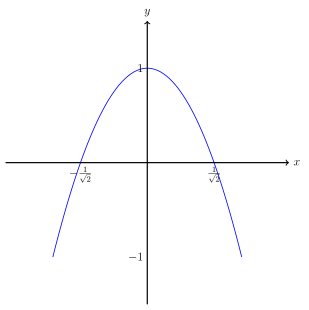
First notice that \(y = \cos 2 \theta = 1 - 2\sin^2 \theta = 1- 2x^2\), therefore \(P\) is lies on that parabola.
TikZ diagram
The arc length is \begin{align*} && s &= \int_{-\pi/2}^{\pi/2} \sqrt{\left ( \frac{\d x}{\d \theta} \right)^2+\left ( \frac{\d y}{\d \theta} \right)^2} \d \theta\\ && &= \int_{-\pi/2}^{\pi/2} \sqrt{\cos^2 \theta+16 \sin^2 \theta \cos^2 \theta } \d \theta\\ && &= \int_{-\pi/2}^{\pi/2} \cos \theta\sqrt{1+16 \sin^2 \theta} \d \theta\\ u = \sin \theta, \d u = \cos \theta \d \theta && &= \int_{u=-1}^{u=1} \sqrt{1+16 u^2} \d u\\ 4u = \sinh v, 4\d u = \cosh v: && &= \int_{v=-\sinh^{-1} 4}^{v=\sinh^{-1} 4} \sqrt{1+\sinh^2 v} \tfrac14\cosh v \d v\\ && &= \frac14 \int_{-\sinh^{-1} 4}^{\sinh^{-1} 4} \cosh^2 v \d v\\ && &= \frac18 \int_{-\sinh^{-1} 4}^{\sinh^{-1} 4} (1 + \cosh 2v) \d v\\ && &= \frac14 \sinh^{-1} 4 + \frac18\left [ \frac12\sinh 2v \right]_{-\sinh^{-1} 4}^{\sinh^{-1} 4}\\ && &= \frac14 \sinh^{-1} 4 + \frac18\left [ \sinh v \sqrt{1 + \sinh^2 v} \right]_{-\sinh^{-1} 4}^{\sinh^{-1} 4}\\ && &= \frac14 \sinh^{-1} 4 + \left (\frac18 \cdot 4 \sqrt{17} \right) - \left (\frac18 \cdot (-4) \sqrt{17} \right)\\ && &= \frac14 \sinh^{-1} 4 + \sqrt{17}\\ \end{align*} The volume of revolution is \begin{align*} && V &=\pi \int_{-1}^1 (2-2x^2)^2 \d x \\ &&&= \pi \left [4x-\frac83x^3+\frac45x^5 \right]_{-1}^1 \\ &&&= \pi \left ( 8-\frac{16}3+\frac85 \right) \\ &&&= \frac{64}{15}\pi \end{align*}
1988 Paper 3 Q4
D: 1700.0 B: 1472.3

A kingdom consists of a vast plane with a central parabolic hill. In a vertical cross-section through the centre of the hill, with the \(x\)-axis horizontal and the \(z\)-axis vertical, the surface of the plane and hill is given by \[ z=\begin{cases} \dfrac{1}{2a}(a^{2}-x^{2}) & \mbox{ for }\left|x\right|\leqslant a,\\ 0 & \mbox{ for }\left|x\right|>a. \end{cases} \] The whole surface is formed by rotating this cross-section about the \(z\)-axis. In the \((x,z)\) plane through the centre of the hill, the king has a summer residence at \((-R,0)\) and a winter residence at \((R,0)\), where \(R>a.\) He wishes to connect them by a road, consisting of the following segments: \begin{itemize} \item a path in the \((x,z)\) plane joining \((-R,0)\) to \((-b,(a^{2}-b^{2})/2a),\) where \(0\leqslant b\leqslant a.\) \item a horizontal semicircular path joining the two points \((\pm b,(a^{2}-b^{2})/2a),\) if \(b\neq0;\) \item a path in the \((x,z)\) plane joining \((b,(a^{2}-b^{2})/2a)\) to \((R,0).\) \end{itemiz} The king wants the road to be as short as possible. Advise him on his choice of \(b.\)

Show Solution
The path can be broken down into \(5\) sections. 1. The section from \((-R,0)\) to \((-a,0)\) which will have distance \(R-a\) and is unchangeable. 2. The distance from \((-a,0)\) to \((-b, \frac{a^2-b^2}{2a})\) whose distance we will calculate shortly. 3. The distance from \((-b, \frac{a^2-b^2}{2a})\) to \((b, \frac{a^2-b^2}{2a})\) which will have distance \(\pi b\). 4. The distance from \((b, \frac{a^2-b^2}{2a})\) to \((a,0)\) which will have the same distance as 2. 5. The distance from \((a,0)\) to \((R,0)\) which will have distance \(R-a\) and we have no control over. \begin{align*} \text{distance 2.} &= \int_b^a \sqrt{1 + \left ( \frac{x}{a}\right)^2 } \d x \end{align*} We want to minimize the total, by varying \(b\), so it makes sense to differentiate and set to zero. \begin{align*} &&0&= -2\sqrt{1+\frac{b^2}{a^2}} + \pi \\ \Rightarrow && \frac{\pi^2}{4} &= 1 + \frac{b^2}{a^2} \\ \Rightarrow && b &= a \sqrt{\frac{\pi^2}{4}-1} \end{align*} Since \(\pi \approx 3\) this point is outside our range \(0 \leq b \leq a\), and our derivative is always positive. Therefore the distance is always increasing and the king would be better off going around the hill as soon as he arrives at it.