Variable Force
A train moves westwards on a straight horizontal track with constant acceleration \(a\), where \(a > 0\). Axes are chosen as follows: the origin is fixed in the train; the \(x\)-axis is in the direction of the track with the positive \(x\)-axis pointing to the East; and the positive \(y\)-axis points vertically upwards. A smooth wire is fixed in the train. It lies in the \(x\)--\(y\) plane and is bent in the shape given by \(ky = x^2\), where \(k\) is a positive constant. A small bead is threaded onto the wire. Initially, the bead is held at the origin. It is then released.
- Explain why the bead cannot remain stationary relative to the train at the origin.
- Show that, in the subsequent motion, the coordinates \((x, y)\) of the bead satisfy \[ \dot{x}(\ddot{x} - a) + \dot{y}(\ddot{y} + g) = 0 \] and deduce that \(\tfrac{1}{2}(\dot{x}^2 + \dot{y}^2) - ax + gy\) is constant during the motion.
- Find an expression for the maximum vertical displacement, \(b\), of the bead from its initial position in terms of \(a\), \(k\) and \(g\).
- Find the value of \(x\) for which the speed of the bead relative to the train is greatest and give this maximum speed in terms of \(a\), \(k\) and \(g\).
A car of mass \(m\) makes a journey of distance \(2d\) in a straight line. It experiences air resistance and rolling resistance so that the total resistance to motion when it is moving with speed \(v\) is \(Av^2 +R\), where \(A\) and \(R\) are constants. The car starts from rest and moves with constant acceleration \(a\) for a distance \(d\). Show that the work done by the engine for this half of the journey is \[ \int_0^d (ma+R+Av^2) \, \d x \] and that it can be written in the form \[ \int_0^w \frac {(ma+R+Av^2)v}a\; \d v \,, \] where \(w =\sqrt {2ad\,}\,\). For the second half of the journey, the acceleration of the car is \(-a\).
- In the case \(R>ma\), show that the work done by the engine for the whole journey is \[ 2Aad^2 + 2Rd \,. \]
- In the case \(ma-2Aad< R< ma\), show that at a certain speed the driving force required to maintain the constant acceleration falls to zero. Thereafter, the engine does no work (and the driver applies the brakes to maintain the constant acceleration). Show that the work done by the engine for the whole journey is \[ 2Aad^2 + 2 Rd + \frac{(ma-R)^2}{4Aa} \, .\]
- For the second part of the journey, the engine will be putting out a force of \(-ma+R+Av^2>0\), and the car will have a final speed of \(0\) \begin{align*} WD &= \int_0^{w} \frac{(ma+R+Av^2)v}{a} \d v + \int_w^0 \frac{(-ma+R+Av^2)v}{-a} \d v \\ &= \int_0^w \frac{2(Rv+Av^3)}{a} \d v \\ &= \frac{Rw^2+\frac12Aw^4}{a} \\ &= \frac{R2ad+\frac12A4a^2d^2}{a} \\ &= 2Rd + 2Aad^2 \end{align*}
- If \(ma - 2Aad < R < ma\) then the driving force is still \(-ma+R+Av^2\) which is positive when \(v = \sqrt{2as}\) but negative when \(v = 0\), and therefore at some point in-between the driving force must be \(0\). The engine will stop working when \(-ma+R+Av^2 =0 \Rightarrow v = \sqrt{\frac{ma-R}{A}}\) so \begin{align*} WD &= \int_0^w \frac{(ma+R+Av^2)v}{a} \d v + \int_w^{ \sqrt{\frac{ma-R}{A}}} \frac{(-ma+R+Av^2)v}{-a} \d v \\ &= \int_0^w \frac{2(R+Av^2)v}{a} \d v - \int_0^{\sqrt{\frac{ma-R}{A}}} \frac{(-ma+R+Av^2)v}{a}\d v \\ &= 2Aad^2+2Rd + \frac1a\left (\frac12(R-ma)\frac{ma-R}{A} + \frac{A}{4}\left ( \frac{ma-R}{A}\right)^2 \right) \\ &= 2Aad^2+2Rd - \frac{(ma-R)^2}{Aa}\left (-\frac12+ \frac14 \right) \\ &= 2Aad^2+2Rd - \frac{(ma-R)^2}{4Aa} \end{align*}
A car of mass \(m\) travels along a straight horizontal road with its engine working at a constant rate \(P\). The resistance to its motion is such that the acceleration of the car is zero when it is moving with speed \(4U\).
- Given that the resistance is proportional to the car's speed, show that the distance \(X_1\) travelled by the car while it accelerates from speed \(U\) to speed \(2U\), is given by \[ \lambda X_1 = 2\ln \tfrac 9 5 - 1 \,, \] where \(\lambda= P/(16mU^3)\).
- Given instead that the resistance is proportional to the square of the car's speed, show that the distance \(X_2\) travelled by the car while it accelerates from speed \(U\) to speed \(2U\) is given by \[ \lambda X_2 = \tfrac43 \ln \tfrac 98 \,. \]
- Given that \(3.17<\ln 24 < 3.18\) and \(1.60<\ln 5 < 1.61\), determine which is the larger of \(X_1\) and \(X_2\).
- \(\,\) \begin{align*} && F_{res} &= kv \\ && P &= Fv \\ v = 4U: && 0 &= F-F_{res} \\ \Rightarrow && 0 &= \frac{P}{4U} - 4Uk \\ \Rightarrow && k &= \frac{P}{16U^2} \\ \\ &&m v \frac{\d v}{\d x}&= \frac{P}{v} - \frac{P}{16U^2}v \\ \Rightarrow && X_1 &= \int_{v=U}^{v=2U} \frac{16U^2mv^2}{P(16U^2-v^2)} \d v \\ v = Ut&& &= \frac{16mU^2}{P} \int_{t=1}^{t=2}\left ( \frac{t^2}{16-t^2} \right)U\d t \\ &&&= \frac{16mU^3}{P} \int_1^2 \left ( -1 + \frac{16}{16-t^2} \right) \d t \\ &&&= \frac{16mU^3}{P} \int_1^2 \left ( -1 +\frac{2}{4+t} +\frac{2}{4-t} \right) \d t \\ &&&= \frac{1}{\lambda}\left (-1 + 2\ln(6)-2\ln(2)-2\ln(5)+2\ln(3) \right) \\ \Rightarrow && \lambda X_1 &= 2\ln \tfrac95-1 \end{align*}
- \(\,\) \begin{align*} && F_{res} = kv^2 \\ v = 4U: && 0 &= \frac{P}{4U} - 16U^2k \\ \Rightarrow && k &= \frac{P}{64U^3} \\ \\ && mv \frac{\d v}{\d x} &= \frac{P}{v} - \frac{P}{64U^3}v^2 \\ \Rightarrow && X_2 &= \int_{v=U}^{v=2U} \frac{64U^3mv^2}{P(64U^3-v^3)} \d v \\ &&&= \frac{64U^3m}{P} \int_{v=U}^{v=2U} \frac{v^2}{64U^3-v^3} \d v\\ v = Ut &&&= \frac{64U^3m}{P} \int_{t=1}^{t=2} \frac{U^2t^2}{64U^3-U^3v^3} U \d t\\ &&&= \frac{4}{\lambda} \int_1^2 \frac{t^2}{64-t^3} \d t \\ &&&= \frac{4}{\lambda} \left [ -\frac13\ln(64-t^3) \right]_1^2 \\ &&&= \frac{4}{3\lambda} \ln (63/56) \\ \Rightarrow && \lambda X_2 &= \tfrac43 \ln \tfrac98 \end{align*}
- \(\,\) \begin{align*} && 2\ln \tfrac95 - 1 &\overset{?}{>} \frac43 \ln \frac98 \\ \Leftrightarrow && 4 \ln 3 - 2\ln 5 - 1 &\overset{?}{>} \frac83\ln 3 -4 \ln 2 \\ \Leftrightarrow && \frac43(3\ln 3 + 3\ln 2 - 2 \ln 3) &\overset{?}{>} 2 \ln 5 + 1\\ \Leftrightarrow && \frac43\ln 24 &\overset{?}{>} 2 \ln 5 + 1\\ \end{align*} The \(LHS\) is \(>4.22\). The \(RHS\) is \(< 4.22\), and therefore our inequality holds, in particular, \(X_1 > X_2\).
A particle \(P\) of mass \(m\) moves on a smooth fixed straight horizontal rail and is attached to a fixed peg \(Q\) by a light elastic string of natural length \(a\) and modulus \(\lambda\). The peg \(Q\) is a distance \(a\) from the rail. Initially \(P\) is at rest with \(PQ=a\). An impulse imparts to \(P\) a speed \(v\) along the rail. Let \(x\) be the displacement at time \(t\) of \(P\) from its initial position. Obtain the equation \[ \dot x^2 = v^2 - k^2 \left( \sqrt{x^2+a^2} -a\right)^{\!2} \] where \( k^2 = \lambda/(ma)\), \(k>0\) and the dot denotes differentiation with respect to \(t\). Find, in terms of \(k\), \(a\) and \(v\), the greatest value, \(x_0\), attained by \(x\). Find also the acceleration of \(P\) at \(x=x_0\). Obtain, in the form of an integral, an expression for the period of the motion. Show that in the case \(v\ll ka\) (that is, \(v\) is much less than \(ka\)), this is approximately \[ \sqrt {\frac {32a}{kv}} \int_0^1 \frac 1 {\sqrt{1-u^4}} \, \d u \, . \]
A light rod of length \(2a\) has a particle of mass \(m\) attached to each end and it moves in a vertical plane. The midpoint of the rod has coordinates \((x,y)\), where the \(x\)-axis is horizontal (within the plane of motion) and \(y\) is the height above a horizontal table. Initially, the rod is vertical, and at time \(t\) later it is inclined at an angle \(\theta\) to the vertical. Show that the velocity of one particle can be written in the form \[ \begin{pmatrix} \dot x + a \dot\theta \cos\theta \\ \dot y - a \dot\theta \sin\theta \end{pmatrix} \] and that \[ m\begin{pmatrix} \ddot x + a\ddot\theta \cos\theta - a \dot\theta^2 \sin\theta \\ \ddot y- a\ddot\theta \sin\theta - a \dot\theta^2 \cos\theta \end{pmatrix} =-T\begin{pmatrix} \sin\theta \\ \cos\theta \end{pmatrix} -mg \begin{pmatrix} 0 \\ 1 \end{pmatrix} \] where the dots denote differentiation with respect to time \(t\) and \(T\) is the tension in the rod. Obtain the corresponding equations for the other particle. Deduce that \(\ddot x =0\), \(\ddot y = -g\) and \(\ddot\theta =0\). Initially, the midpoint of the rod is a height \(h\) above the table, the velocity of the higher particle is \(\Big(\begin{matrix} \, u \, \\ v \end{matrix}\Big)\), and the velocity of the lower particle is \(\Big(\begin{matrix}\, 0 \, \\ v\end{matrix}\Big)\). Given that the two particles hit the table for the first time simultaneously, when the rod has rotated by \(\frac12\pi\), show that \[ 2hu^2 = \pi^2a^2 g - 2\pi uva \,. \]
A particle of mass \(m\) is projected with velocity \(\+ u\). It is acted upon by the force \(m\+g\) due to gravity and by a resistive force \(-mk \+v\), where \(\+v\) is its velocity and \(k\) is a positive constant. Given that, at time \(t\) after projection, its position \(\+r\) relative to the point of projection is given by \[ \+r = \frac{kt -1 +\.e^{-kt}} {k^2} \, \+g + \frac{ 1-\.e^{-kt}}{k} \, \+u \,, \] find an expression for \(\+v\) in terms of \(k\), \(t\), \(\+g\) and \(\+u\). Verify that the equation of motion and the initial conditions are satisfied. Let \(\+u = u\cos\alpha \, \+i + u \sin\alpha \, \+j\) and $\+g = -g\, \+j\(, where \)0<\alpha<90^\circ\(, and let \)T$ be the time after projection at which \(\+r \,.\, \+j =0\). Show that \[ uk \sin\alpha = \left(\frac{kT}{1-\.e^{-kT}} -1\right)g\,. \] Let \(\beta\) be the acute angle between \(\+v\) and \(\+i\) at time \(T\). Show that \[ \tan\beta = \frac{(\.e^{kT}-1)g}{uk\cos\alpha}-\tan\alpha \,. \] Show further that \(\tan\beta >\tan\alpha\) (you may assume that \(\sinh kT >kT\)) and deduce that~\(\beta >\alpha\).
A comet in deep space picks up mass as it travels through a large stationary dust cloud. It is subject to a gravitational force of magnitude \(M\!f\) acting in the direction of its motion. When it entered the cloud, the comet had mass \(M\) and speed \(V\). After a time \(t\), it has travelled a distance \(x\) through the cloud, its mass is \(M(1+bx)\), where~\(b\) is a positive constant, and its speed is \(v\).
- In the case when \(f=0\), write down an equation relating \(V\), \(x\), \(v\) and \(b\). Hence find an expression for \(x\) in terms of \(b\), \(V\) and \(t\).
- In the case when \(f\) is a non-zero constant, use Newton's second law in the form \[ \text{force} = \text{rate of change of momentum} \] to show that \[ v = \frac{ft+V}{1+bx}\,. \] Hence find an expression for \(x\) in terms of \(b\), \(V\), \(f\) and \(t\). Show that it is possible, if \(b\), \(V\) and \(f\) are suitably chosen, for the comet to move with constant speed. Show also that, if the comet does not move with constant speed, its speed tends to a constant as \(t\to\infty\).
A particle of mass \(m\) is initially at rest on a rough horizontal surface. The particle experiences a force \(mg\sin \pi t\), where \(t\) is time, acting in a fixed horizontal direction. The coefficient of friction between the particle and the surface is \(\mu\). Given that the particle starts to move first at \(t=T_0\), state the relation between \(T_0\) and \(\mu\).
- For \(\mu = \mu_0\), the particle comes to rest for the first time at \(t=1\). Sketch the acceleration-time graph for \(0\le t \le 1\). Show that \[ 1+\left(1-\mu_0^2\right)^{\frac12} -\mu_0\pi +\mu_0 \arcsin \mu_0 =0\,. \]
- For \(\mu=\mu_0\) sketch the acceleration-time graph for \(0\le t\le 3\). Describe the motion of the particle in this case and in the case \(\mu=0\).
The maximum power that can be developed by the engine of train \(A\), of mass \(m\), when travelling at speed \(v\) is \(Pv^{3/2}\,\), where \(P\) is a constant. The maximum power that can be developed by the engine of train \(B\), of mass \(2m\), when travelling at speed \(v\) is \(2Pv^{3/2}.\) For both \(A\) and \(B\) resistance to motion is equal to \(kv\), where \(k\) is a constant. For \(t\le0\), the engines are crawling along at very low equal speeds. At \(t = 0\,\), both drivers switch on full power and at time \(t\) the speeds of \(A\) and \(B\) are \(v_{\vphantom{\dot A}\!A}\) and \(v_{\vphantom{\dot B}\hspace{-1pt}B},\) respectively.
- Show that \[ v_{\vphantom{\dot A}\!A} = \frac{P^2 \left(1-\e^{-kt/2m}\right)^2}{k^2} \] and write down the corresponding result for \(v_{\vphantom{\dot B}B}\).
- Find \(v_{\vphantom{\dot B}A}\) and \(v_{\vphantom{\dot B}B}\) when \(9 v_{\vphantom{\dot B}A} =4v_{\vphantom{\dot B}B}\;\). [Not on original paper] Show that \(1 < v_{\vphantom{\dot B}\hspace{-1pt}B} /v_{\vphantom{\dot A}\!A} < 4\) for \(t > 0\,\).
- Both engines are switched off when \(9 v_{\vphantom{\dot B}A} =4v_{\vphantom{\dot B}B}\,\). Show that thereafter \(k^2 v_{\vphantom{\dot B}B}^2 = 4 P^2 v_{\vphantom{\dot B}A}\,\).
- \(\,\) \begin{align*} && P &= Fv \\ \text{N2}(\rightarrow): && Pv^{1/2} - kv &= ma \\ \Rightarrow && \dot{v} &= \frac{P}{m} \sqrt{v}-\frac{k}{m}v \\ \Rightarrow && \int \d t & = \int \frac{m}{\sqrt{v}\left (P-k\sqrt{v} \right)} \d v \\ &&t &= -\frac{2m}k\ln\left (P - k\sqrt{v_A}\right) + C \\ t = 0, v_A \approx 0: && 0 & =-\frac{2m}{k} \ln P+ C \\ \Rightarrow && C &= \frac{2m}{k} \ln P \\ \Rightarrow && e^{-kt/2m} &= \frac{P- k \sqrt{v_A}}{P} \\ \Rightarrow && v_A &= \frac{P^2(1-e^{-kt/2m})^2}{k^2} \end{align*} The equation of motion for \(B\) is \(\dot{v_B} = \frac{P}{m}\sqrt{v} - \frac{k}{2m} v\), ie \(k \to \frac{k}{2}\), so \[ v_B = \frac{4P^2(1-e^{-kt/4m})^2}{k^2} \]
- Suppose \(9v_A = 4v_B\), then and let \(e^{-kt/4m} = X\) \begin{align*} && 9 \frac{P^2(1-e^{-kt/2m})^2}{k^2} &= 4 \frac{4P^2(1-e^{-kt/4m})^2}{k^2} \\ \Rightarrow && \frac{3}{4} &= \frac{1-X}{1-X^2} \\ \Rightarrow && 0 &= 3X^2-4X+1 \\ &&&= (3X-1)(X-1) \\ \Rightarrow && X &= 1, \frac13 \\ X = 1: && t &= 0 \\ X = \frac13: && e^{-kt/4m} &= \frac13\\ \Rightarrow && t &= \frac{4m}{k}\ln 3 \\ && v_A &= \frac{P^2(1-\frac19)^2}{k^2} \\ &&&= \frac{64P^2}{81k^2} \\ && v_B &= \frac{P^2(1-\frac13)^2}{k^2} \\ &&&= \frac{4P^2}{9k^2} \end{align*} Notice also that \begin{align*} && \frac{v_B}{v_A} &= 4\left ( \frac{1-X}{1-X^2} \right)^2 \\ &&&= 4 \frac{1}{(1+X)^2} \end{align*} Since \(X \in (0,1)\) \(\frac{v_B}{v_A} \in (1, 4)\)
- Once the engines are switched off, the equation of motion for \(A\) is (where \(t\) is measured from that point) \begin{align*} && \dot{v} &= -\frac{k}{m}v \\ \Rightarrow && v &= Ae^{-kt/m} \\ \Rightarrow && v_A &= \frac{64P^2}{81k^2}e^{-kt/m} \end{align*} Similarly, \(v_B = \frac{4P^2}{9k^2}e^{-kt/2m}\) so \begin{align*} && \frac{v_A}{v_B^2} &= \frac{64P^2}{81k^2} \cdot \frac{81k^4}{16P^4} = \frac{4k^2}{P^2} \end{align*} as required.
Particles \(P\), of mass \(2\), and \(Q\), of mass \(1\), move along a line. Their distances from a fixed point are \(x_1\) and \(x_2\), respectively where \(x_2>x_1\,\). Each particle is subject to a repulsive force from the other of magnitude \(\displaystyle {2 \over z^3}\), where \(z = x_2-x_1 \,\). Initially, \(x_1=0\), \(x_2 = 1\), \(Q\) is at rest and \(P\) moves towards \(Q\) with speed 1. Show that \(z\) obeys the equation \(\displaystyle {\mathrm{d}^2 z \over \mathrm{d}t^2} = {3 \over z^3}\). By first writing \(\displaystyle {\mathrm{d}^2 z \over \mathrm{d}t^2} = v {\mathrm{d}v \over \mathrm{d}z} \,\), where \(\displaystyle v={\mathrm{d}z \over \mathrm{d}t}\,\), show that \(z=\sqrt{4t^2-2t+1}\,\). By considering the equation satisfied by \(2x_1+x_2\,\), find \(x_1\) and \(x_2\) in terms of \(t \,\).
Show SolutionA particle moves along the \(x\)-axis in such a way that its acceleration is \(kx \dot{x}\,\) where \(k\) is a positive constant. When \(t = 0\), \(x = d\) (where \(d>0\)) and \(\dot{x} =U\,\).
- Find \(x\) as a function of \(t\) in the case \(U = kd^2\) and show that \(x\) tends to infinity as \(t\) tends to \(\displaystyle \frac{\pi }{2 dk}\,\).
- If \(U < 0\), find \(x\) as a function of \(t\) and show that it tends to a limit, which you should state in terms of \(d\) and \(U\,\), as \(t\) tends to infinity.
- \(\,\) \begin{align*} && \ddot{x} &= kx \dot{x} \\ \Rightarrow && \frac{\d v}{\d x} \dot{x} &= k x \dot{x} \\ \Rightarrow && \int \d v &= \int k x \d x \\ \Rightarrow && v &= \frac12kx^2 + C \\ t=0, x = d, \dot{x} = kd^2: && kd^2 &= \frac12kd^2 + C \\ \Rightarrow && \dot{x} &= \frac12k(x^2+d^2) \\ \Rightarrow && \frac{\d x}{\d t} &= \frac12k(x^2+d^2) \\ \Rightarrow && \int \d t &= \int \frac{1}{\frac12k(x^2+d^2)} \d x \\ &&&= \frac{2}{kd}\tan^{-1} \frac{x}{d} \\ \Rightarrow && t &= \frac{2}{kd}\tan^{-1} \frac{x}{d} + C' \\ t = 0, x = d: && 0 &= \frac{\pi}{2kd} + C' \\ \Rightarrow && t &= \frac{2}{kd}\tan^{-1} \frac{x}{d}-\frac{\pi}{2kd} \end{align*} As \(x \to \infty\), \(t \to \frac{2}{kd} \frac{\pi}{2} - \frac{\pi}{2kd} = \frac{\pi}{2kd} \)
- \(\,\) \begin{align*} && v &= \frac12kx^2 + C \\ t=0, x = d, \dot{x} = U && U &= \frac12kd^2 + C \\ \Rightarrow && \dot{x} &= \frac12k(x^2-d^2)+U \\ \Rightarrow && \frac{\d x}{\d t} &=\frac12k(x^2-d^2)+U \\ \Rightarrow && \int \d t &= \int \frac{1}{\frac12k(x^2-d^2)+U} \d x \\ && &=\frac{2}{k} \int \frac{1}{x^2-d^2+\frac{2U}k} \d x \\ &&&= \frac2{k} \frac{1}{2\sqrt{d^2-\frac{2U}k}} \ln \frac{ \sqrt{d^2-\frac{2U}k}-x}{x+\sqrt{d^2-\frac{2U}k}} \\ \Rightarrow && t &= \frac2{k} \frac{1}{2\sqrt{d^2-\frac{2U}k}} \ln \frac{ \sqrt{d^2-\frac{2U}k}-x}{x+\sqrt{d^2-\frac{2U}k}} + C'' \\ t = 0, \dot{x} = d: && 0 &= \frac2{k} \frac{1}{2\sqrt{d^2-\frac{2U}k}} \ln \frac{ \sqrt{d^2-\frac{2U}k}-d}{d+\sqrt{d^2-\frac{2U}k}} + C'' \\ \Rightarrow && t &= \frac2{k} \frac{1}{2\sqrt{d^2-\frac{2U}k}} \ln \left ( \frac{ \sqrt{d^2-\frac{2U}k}-x}{x+\sqrt{d^2-\frac{2U}k}} \frac{d+\sqrt{d^2-\frac{2U}k}}{ \sqrt{d^2-\frac{2U}k}-d} \right ) \end{align*} as \(t \to \infty\) the denominator needs to head to \(0\), ie \(x \to -\sqrt{d^2-\frac{2U}k}\)
A particle of unit mass is projected vertically upwards with speed \(u\). At height \(x\), while the particle is moving upwards, it is found to experience a total force \(F\), due to gravity and air resistance, given by \(F=\alpha \e^{-\beta x}\), where \(\alpha\) and \(\beta\) are positive constants. Calculate the energy expended in reaching this height. Show that \[ F= {\textstyle \frac12} \beta v^2+ \alpha - {\textstyle \frac12} \beta u^2 \;, \] where \(v\) is the speed of the particle, and explain why \( \alpha = \frac12 \beta u^2 +g\), where \(g\) is the acceleration due to gravity. Determine an expression, in terms of \(y\), \(g\) and \(\beta\), for the air resistance experienced by the particle on its downward journey when it is at a distance \(y\) below its highest point.
Show SolutionIn an aerobatics display, Jane and Karen jump from a great height and go through a period of free fall before opening their parachutes. While in free fall at speed \(v\), Jane experiences air resistance \(kv\) per unit mass but Karen, who spread-eagles, experiences air resistance \mbox{\(kv + (2k^2/g)v^2\)} per unit mass. Show that Jane's speed can never reach \(g/k\). Obtain the corresponding result for Karen. Jane opens her parachute when her speed is \(g/(3{k})\). Show that she has then been in free fall for time \(k^{-1}\ln (3/2)\). Karen also opens her parachute when her speed is \(g/(3{k})\). Find the time she has then been in free fall.
Show SolutionIn the \(Z\)--universe, a star of mass \(M\) suddenly blows up, and the fragments, with various initial speeds, start to move away from the centre of mass \(G\) which may be regarded as a fixed point. In the subsequent motion the acceleration of each fragment is directed towards \(G\). Moreover, in accordance with the laws of physics of the \(Z\)--universe, there are positive constants \(k_1\), \(k_2\) and \(R\) such that when a fragment is at a distance \(x\) from \(G\), the magnitude of its acceleration is \(k_1x^3\) if \(x < R\) and is \(k_2x^{-4}\) if \(x \ge R\). The initial speed of a fragment is denoted by \(u\).
- For \(x < R\), write down a differential equation for the speed \(v\), and hence determine \(v\) in terms of \(u\), \(k_1\) and \(x\) for \( x < R\).
- Show that if \(u < a\), where \(2a^2=k_1 R^4\), then the fragment does not reach a distance \(R\) from \(G\).
- Show that if \(u \ge b\), where $ 6b^2= 3k_1R^4 + 4k_2 /R^3, $ then from the moment of the explosion the fragment is always moving away from \(G\).
- If \(a < u < b\), determine in terms of \(k_2\), \(b\) and \(u\) the maximum distance from \(G\) attained by the fragment.
A particle of unit mass is projected vertically upwards in a medium whose resistance is \(k\) times the square of the velocity of the particle. If the initial velocity is \(u\), prove that the velocity \(v\) after rising through a distance \(s\) satisfies \begin{equation*} v^{2}=u^{2}\e^{-2ks}+\frac{g}{k}(\e^{-2ks}-1). \tag{*} \end{equation*} Find an expression for the maximum height of the particle above he point of projection. Does equation \((*)\) still hold on the downward path? Justify your answer.
Show SolutionTwo identical particles of unit mass move under gravity in a medium for which the magnitude of the retarding force on a particle is \(k\) times its speed. The first particle is allowed to fall from rest at a point \(A\) whilst, at the same time, the second is projected upwards with speed \(u\) from a point \(B\) a positive distance \(d\) vertically above \(A\). Find their distance apart after a time \(t\) and show that this distance tends to the value \[ d+\frac{u}{k} \] as \(t\rightarrow\infty.\)
Show SolutionA train starts from a station. The tractive force exerted by the engine is at first constant and equal to \(F\). However, after the speed attains the value \(u\), the engine works at constant rate \(P,\) where \(P=Fu.\) The mass of the engine and the train together is \(M.\) Forces opposing motion may be neglected. Show that the engine will attain a speed \(v\), with \(v\geqslant u,\) after a time \[ t=\frac{M}{2P}\left(u^{2}+v^{2}\right). \] Show also that it will have travelled a distance \[ \frac{M}{6P}(2v^{3}+u^{3}) \] in this time.
Show SolutionIn this question, take the value of \(g\) to be \(10\ \mathrm{ms^{-2}.\)} A body of mass \(m\) kg is dropped vertically into a deep pool of liquid. Once in the liquid, it is subject to gravity, an upward buoyancy force of \(\frac{6}{5}\) times its weight, and a resistive force of \(2mv^{2}\mathrm{N}\) opposite to its direction of travel when it is travelling at speed \(v\) \(\mathrm{ms}^{-1}.\) Show that the body stops sinking less than \(\frac{1}{4}\pi\) seconds after it enters the pool. Suppose now that the body enters the liquid with speed \(1\ \mathrm{ms}^{-1}.\) Show that the body descends to a depth of \(\frac{1}{4}\ln2\) metres and that it returns to the surface with speed \(\frac{1}{\sqrt{2}}\ \mathrm{ms}^{-1},\) at a time \[ \frac{\pi}{8}+\frac{1}{4}\ln\left(\frac{\sqrt{2}+1}{\sqrt{2}-1}\right) \] seconds after entering the pool.
Show SolutionA comet, which may be regarded as a particle of mass \(m\), moving in the sun's gravitational field, at a distance \(x\) from the sun, experiences a force \(Gm/x^{2}\) (where \(G\) is a constant) directly towards the sun. Show that if, at some time, \(x=h\) and the comet is travelling directly away from the sun with speed \(V\), then \(x\) cannot become arbitrarily large unless \(V^{2}\geqslant2G/h\). A comet is initially motionless at a great distance from the sun. If, at some later time, it is at a distance \(h\) from the sun, how long after that will it take to fall into the sun?
Show SolutionThe current in a straight river of constant width \(h\) flows at uniform speed \(\alpha v\) parallel to the river banks, where \(0<\alpha<1\). A boat has to cross from a point \(A\) on one bank to a point \(B\) on the other bank directly opposite to \(A\). The boat moves at constant speed \(v\) relative to the water. When the position of the boat is \((x,y)\), where \(x\) is the perpendicular distance from the opposite bank and \(y\) is the distance downstream from \(AB\), the boat is pointing in a direction which makes an angle \(\theta\) with \(AB\). Determine the velocity vector of the boat in terms of \(v,\theta\) and \(\alpha.\) The pilot of the boat steers in such a way that the boat always points exactly towards \(B\). Show that the velocity vector of the boat is \[ \begin{pmatrix}\dfrac{\mathrm{d}x}{\mathrm{d}t}\\ \tan\theta\dfrac{\mathrm{d}x}{\mathrm{d}t}+x\sec^{2}\theta\dfrac{\mathrm{d}\theta}{\mathrm{d}t} \end{pmatrix}. \] By comparing this with your previous expression deduce that \[ \alpha\frac{\mathrm{d}x}{\mathrm{d}\theta}=-x\sec\theta \] and hence show that \[ (x/h)^{\alpha}=(\sec\theta+\tan\theta)^{-1}. \] Let \(s(t)\) be a new variable defined by \(\tan\theta=\sinh(\alpha s).\) Show that \(x=h\mathrm{e}^{-s},\) and that \[ h\mathrm{e}^{-s}\cosh(\alpha s)\frac{\mathrm{d}s}{\mathrm{d}t}=v. \] Hence show that the time of crossing is \(hv^{-1}(1-\alpha^{2})^{-1}.\)
A spaceship of mass \(M\) is travelling at constant speed \(V\) in a straight line when it enters a force field which applies a resistive force acting directly backwards and of magnitude \(M\omega(v^{2}+V^{2})/v\), where \(v\) is the instantaneous speed of the spaceship, and \(\omega\) is a positive constant. No other forces act on the spaceship. Find the distance travelled from the edge of the force field until the speed is reduced to \(\frac{1}{2}V\). As soon as the spaceship has travelled this distance within the force field, the field is altered to a constant resistive force, acting directly backwards, whose magnitude is within 10% of that of the force acting on the spaceship immediately before the change. If \(z\) is the extra distance travelled by the spaceship before coming instantaneously to rest, determine limits between which \(z\) must lie.
Show SolutionA goalkeeper stands on the goal-line and kicks the football directly into the wind, at an angle \(\alpha\) to the horizontal. The ball has mass \(m\) and is kicked with velocity \(\mathbf{v}_{0}.\) The wind blows horizontally with constant velocity \(\mathbf{w}\) and the air resistance on the ball is \(mk\) times its velocity relative to the wind velocity, where \(k\) is a positive constant. Show that the equation of motion of the ball can be written in the form \[ \frac{\mathrm{d}\mathbf{v}}{\mathrm{d}t}+k\mathbf{v}=\mathbf{g}+k\mathbf{w}, \] where \(\mathbf{v}\) is the ball's velocity relative to the ground, and \(\mathbf{g}\) is the acceleration due to gravity. By writing down horizontal and vertical equations of motion for the ball, or otherwise, find its position at time \(t\) after it was kicked. On the assumption that the goalkeeper moves out of the way, show that if \(\tan\alpha=\left|\mathbf{g}\right|/(k\left|\mathbf{w}\right|),\) then the goalkeeper scores an own goal.
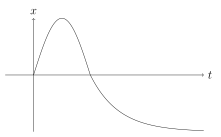
Show SolutionA particle of mass \(m\) moves along the \(x\)-axis. At time \(t=0\) it passes through \(x=0\) with velocity \(v_{0} > 0\). The particle is acted on by a force \(\mathrm{F}(x)\), directed along the \(x\)-axis and measured in the direction of positive \(x\), which is given by \[ \mathrm{F}(x)=\begin{cases} -m\mu^{2}x & \qquad(x\geqslant0),\\ -m\kappa\dfrac{\mathrm{d}x}{\mathrm{d}t} & \qquad(x < 0), \end{cases} \] where \(\mu\) and \(\kappa\) are positive constants. Obtain the particle's subsequent position as a function of time, and give a rough sketch of the \(x\)-\(t\) graph.
Show Solution