Projectiles
{\sl In this question take the acceleration due to gravity to be \(10\,{\rm m \,s}^{-2}\) and neglect air resistance.} The point \(O\) lies in a horizontal field. The point \(B\) lies \(50\,\)m east of \(O\). A particle is projected from \(B\) at speed \(25\,{\rm m\,s}^{-1}\) at an angle \(\arctan \frac12\) above the horizontal and in a direction that makes an angle \(60^\circ\) with \(OB\); it passes to the north of \(O\).
- Taking unit vectors \(\mathbf i\), \(\mathbf j\) and \(\mathbf k\) in the directions east, north and vertically upwards, respectively, find the position vector of the particle relative to \(O\) at time \(t\)~seconds after the particle was projected, and show that its distance from \(O\) is \[ 5(t^2- \sqrt5 t +10)\, {\rm m}. \] When this distance is shortest, the particle is at point \(P\). Find the position vector of \(P\) and its horizontal bearing from \(O\).
- Show that the particle reaches its maximum height at \(P\).
- When the particle is at \(P\), a marksman fires a bullet from \(O\) directly at \(P\). The initial speed of the bullet is \(350\,{\rm m\,s}^{-1}\). Ignoring the effect of gravity on the bullet show that, when it passes through \(P\), the distance between \(P\) and the particle is approximately~\(3\,\)m.
A particle is projected from a point on a plane that is inclined at an angle~\(\phi\) to the horizontal. The position of the particle at time \(t\) after it is projected is \((x,y)\), where \((0,0)\) is the point of projection, \(x\) measures distance up the line of greatest slope and \(y\) measures perpendicular distance from the plane. Initially, the velocity of the particle is given by \((\dot x, \dot y) = (V\cos\theta, V\sin\theta)\), where \(V>0\) and \(\phi+\theta<\pi/2\,\). Write down expressions for \(x\) and \(y\). The particle bounces on the plane and returns along the same path to the point of projection. Show that \[2\tan\phi\tan\theta =1\] and that \[ R= \frac{V^2\cos^2\theta}{2g\sin\phi}\,, \] where \(R\) is the range along the plane. Show further that \[ \frac{2V^2}{gR} = 3\sin\phi + {\rm cosec}\,\phi \] and deduce that the largest possible value of \(R\) is \(V^2/ (\sqrt{3}\,g)\,\).
A particle \(P\) is projected in the \(x\)-\(y\) plane, where the \(y\)-axis is vertical and the \(x\)-axis is horizontal. The particle is projected with speed \(V\) from the origin at an angle of \(45 ^\circ\) above the positive \(x\)-axis. Determine the equation of the trajectory of \(P\). The point of projection (the origin) is on the floor of a barn. The roof of the barn is given by the equation \(y= x \tan \alpha +b\,\), where \(b>0\) and \(\alpha\) is an acute angle. Show that, if the particle just touches the roof, then \(V(-1+ \tan\alpha) =-2 \sqrt{bg}\); you should justify the choice of the negative root. If this condition is satisfied, find, in terms of \(\alpha\), \(V\) and \(g\), the time after projection at which touching takes place. A particle \(Q\) can slide along a smooth rail fixed, in the \(x\)-\(y\) plane, to the under-side of the roof. It is projected from the point \((0,b)\) with speed \(U\) at the same time as \(P\) is projected from the origin. Given that the particles just touch in the course of their motions, show that \[ 2 \sqrt 2 \, U \cos \alpha = V \big(2 + \sin\alpha\cos\alpha -\sin^2\alpha) . \]
A projectile of unit mass is fired in a northerly direction from a point on a horizontal plain at speed \(u\) and an angle \(\theta\) above the horizontal. It lands at a point \(A\) on the plain. In flight, the projectile experiences two forces: gravity, of magnitude \(g\); and a horizontal force of constant magnitude \(f\) due to a wind blowing from North to South. Derive an expression, in terms of \(u\), \(g\), \(f\) and \(\theta\) for the distance \(OA\).
- Determine the angle \(\alpha\) such that, for all \(\theta>\alpha\), the wind starts to blow the projectile back towards \(O\) before it lands at \(A\).
- An identical projectile, which experiences the same forces, is fired from \(O\) in a northerly direction at speed \(u\) and angle \(45^\circ\) above the horizontal and lands at a point \(B\) on the plain. Given that \(\theta\) is chosen to maximise \(OA\), show that \[ \frac{OB}{OA} = \frac{ g-f}{\; \sqrt{g^2+f^2\;}- f \;\;}\;. \] Describe carefully the motion of the second projectile when \(f=g\).
The points \(A\) and \(B\) are \(180\) metres apart and lie on horizontal ground. A missile is launched from \(A\) at speed of \(100\,\)m\,s\(^{-1}\) and at an acute angle of elevation to the line \(AB\) of \(\arcsin \frac35\). A time \(T\) seconds later, an anti-missile missile is launched from \(B\), at speed of \(200\,\)m\,s\(^{-1}\) and at an acute angle of elevation to the line \(BA\) of \(\arcsin \frac45\). The motion of both missiles takes place in the vertical plane containing \(A\) and \(B\), and the missiles collide. Taking \(g =10\,\)m\,s\(^{-2}\) and ignoring air resistance, find \(T\). \noindent [Note that \(\arcsin \frac35\) is another notation for \(\sin^{-1} \frac35\,\).]
A particle is projected over level ground with a speed \(u\) at an angle \(\theta\) above the horizontal. Derive an expression for the greatest height of the particle in terms of \(u\), \(\theta\) and \(g\). A particle is projected from the floor of a horizontal tunnel of height \({9\over 10}d\). Point \(P\) is \({1\over 2}d\) metres vertically and \(d\) metres horizontally along the tunnel from the point of projection. The particle passes through point \(P\) and lands inside the tunnel without hitting the roof. Show that \[ \arctan \textstyle {3 \over 5} < \theta < \arctan \, 3 \;. \]
Show SolutionA particle is projected with speed \(V\) at an angle \(\theta\) above the horizontal. The particle passes through the point \(P\) which is a horizontal distance \(d\) and a vertical distance \(h\) from the point of projection. Show that \[ T^2 -2kT + \frac{2kh}{d}+1=0\;, \] where \(T=\tan\theta\) and \(\ds k= \frac{V^2}{gd}\,\). %Derive an equation relating \(\tan \theta\), \(V\), \(g\), \(d\) and \(h\). Show that, if \(\displaystyle {kd > h + \sqrt {h^2 + d^2}}\;\), there are two distinct possible angles of projection. Let these two angles be \(\alpha\) and \(\beta\). Show that \(\displaystyle \alpha + \beta = \pi - \arctan ( {d/ h}) \,\).
A particle \(P_1\) is projected with speed \(V\) at an angle of elevation \({\alpha}\,\,\,( > 45^{\circ})\,,\,\,\,\) from a point in a horizontal plane. Find \(T_1\), the flight time of \(P_1\), in terms of \({\alpha}, V \hbox{ and } g\,\). Show that the time after projection at which the direction of motion of \(P_1\) first makes an angle of \(45^{\circ}\) with the horizontal is \(\frac12 (1-\cot \alpha)T_1\,\). A particle \(P_2\) is projected under the same conditions. When the direction of the motion of \(P_2\) first makes an angle of \(45^{\circ}\) with the horizontal, the speed of \(P_2\) is instantaneously doubled. If \(T_2\) is the total flight time of \(P_2\), show that $$ \frac{2T_2}{T_1} = 1+\cot{\alpha} +\sqrt{1+3\cot^2{\alpha}} \;. $$
A particle is projected from a point \(O\) on a horizontal plane
with speed \(V\) and at an angle
of elevation \(\alpha\). The vertical plane in which the motion takes place
is perpendicular to two vertical walls, both of height \(h\), at distances
\(a\) and \(b\) from \(O\). Given that the particle just passes over the
walls, find \(\tan\alpha\) in terms of \(a\), \(b\) and \(h\) and
show that
\[
\frac{2V^2} g = \frac {ab} h +\frac{ (a+b)^2 h}{ab} \;.
\]
The heights of the walls are now increased by the same small positive
amount \(\delta h\,\).
A second particle is projected so that it just passes over
both walls, and the new angle and speed of projection
are \(\alpha +\delta \alpha \) and \(V+\delta V\), respectively.
Show that
\[
\sec^2 \alpha \, \delta \alpha \approx \frac {a+b}{ab}\,\delta h \;,
\]
and deduce that \(\delta \alpha >0\,\). Show also that
\(\delta V\) is positive if \(h> ab/(a+b)\) and negative if \(h
A gun is sited on a horizontal plain and can fire shells in any direction and at any elevation at speed \(v\). The gun is a distance \(d\) from a straight railway line which crosses the plain, where \(v^2>gd\). The gunner aims to hit the line, choosing the direction and elevation so as to maximize the time of flight of the shell. Show that the time of flight, \(T\), of the shell satisfies \[ %\frac{2v}{g} \sin \left( \frac12 \arccos \frac{gd}{v^2}\right)\,. g^2 T^2 = 2 v^2 +2 \left(v^4 -g^2d^2\right)^{\frac12}\,. \] Extension: (Not in original paper) Find the time of flight if the gun is constrained so that the angle of elevation \(\alpha \) is not greater than \( 45^\circ\).
Show SolutionA two-stage missile is projected from a point \(A\) on the ground with horizontal and vertical velocity components \(u\) and \(v\), respectively. When it reaches the highest point of its trajectory an internal explosion causes it to break up into two fragments. Immediately after this explosion one of these fragments, \(P\), begins to move vertically upwards with speed \(v_e\), but retains the previous horizontal velocity. Show that \(P\) will hit the ground at a distance \(R\) from \(A\) given by $$ \frac{gR}u = v+v_e + \sqrt{v_e^2 +v^2}\, . $$ It is required that the range \(R\) should be greater than a certain distance \(D\) (where \(D> 2uv/g\)). Show that this requirement is satisfied if \[ v_e> \frac{gD}{2u}\left( \frac{gD-2uv}{gD-uv}\right). \] \noindent[{\sl The effect of air resistance is to be neglected.}]
A child is playing with a toy cannon on the floor of a long railway carriage. The carriage is moving horizontally in a northerly direction with acceleration \(a\). The child points the cannon southward at an angle \(\theta\) to the horizontal and fires a toy shell which leaves the cannon at speed \(V\). Find, in terms of \(a\) and \(g\), the value of \(\tan 2\theta\) for which the cannon has maximum range (in the carriage). If \(a\) is small compared with \(g\), show that the value of \(\theta\) which gives the maximum range is approximately \[ \frac \pi 4 + \frac a {2g}, \] and show that the maximum range is approximately \(\displaystyle \frac {V^2} g + \frac {V^2a}{g^2}. \)
Show SolutionA shell explodes on the surface of horizontal ground. Earth is scattered in all directions with varying velocities. Show that particles of earth with initial speed \(v\) landing a distance \(r\) from the centre of explosion will do so at times \(t\) given by \[ {\textstyle \frac{1}{2}} g^2t^2=v^{2}\pm\surd(v^{4}-g^{2}r^{2}). \] Find an expression in terms of \(v\), \(r\) and \(g\) for the greatest height reached by such particles.
A fielder, who is perfectly placed to catch a ball struck by the batsman in a game of cricket, watches the ball in flight. Assuming that the ball is struck at the fielder's eye level and is caught just in front of her eye, show that \(\frac{ {\rm d}}{{\rm d t}} (\tan\theta ) \) is constant, where \(\theta\) is the angle between the horizontal and the fielder's line of sight. In order to catch the next ball, which is also struck towards her but at a different velocity, the fielder runs at constant speed \(v\) towards the batsman. Assuming that the ground is horizontal, show that the fielder should choose \(v\) so that \(\frac{ {\rm d}}{{\rm d t}} (\tan\theta ) \) remains constant.
Show SolutionA tennis player serves from height \(H\) above horizontal ground, hitting the ball downwards with speed \(v\) at an angle \(\alpha\) below the horizontal. The ball just clears the net of height \(h\) at horizontal distance \(a\) from the server and hits the ground a further horizontal distance \(b\) beyond the net. Show that $$v^2 = \frac{ g(a+b)^2(1+\tan^2\alpha)}{ 2[H-(a+b)\tan\alpha]}$$ and $$\tan\alpha = \frac{2a+b }{ a(a+b)}H - \frac{a+b }{ ab}h \,.$$ By considering the signs of \(v^2\) and \(\tan\alpha\), find upper and lower bounds on \(H\) for such a serve to be possible.
Show SolutionA particle is projected under the influence of gravity from a point \(O\) on a level plane in such a way that, when its horizontal distance from \(O\) is \(c\), its height is \(h\). It then lands on the plane at a distance \(c+d\) from \(O\). Show that the angle of projection \(\alpha\) satisfies \[ \tan\alpha=\frac{h(c+d)}{cd} \] and that the speed of projection \(v\) satisfies \[ v^{2}=\frac{g}{2}\left(\frac{cd}{h}+\frac{(c+d)^{2}h}{cd}\right)\,. \]
A particle is projected from a point \(O\) with speed \(\sqrt{2gh},\) where \(g\) is the acceleration due to gravity. Show that it is impossible, whatever the angle of projection, for the particle to reach a point above the parabola \[ x^{2}=4h(h-y), \] where \(x\) is the horizontal distance from \(O\) and \(y\) is the vertical distance above \(O\). State briefly the simplifying assumptions which this solution requires.
Show SolutionA cannon is situated at the bottom of a plane inclined at angle \(\beta\) to the horizontal. A (small) cannon ball is fired from the cannon at an initial speed \(u.\) Ignoring air resistance, find the angle of firing which will maximise the distance up the plane travelled by the cannon ball and show that in this case the ball will land at a distance \[ \frac{u^{2}}{g(1+\sin\beta)} \] from the cannon.
A cannon-ball is fired from a cannon at an initial speed \(u\). After time \(t\) it has reached height \(h\) and is at a distance \(\sqrt{x^{2}+h^{2}}\) from the cannon. Ignoring air resistance, show that \[ \tfrac{1}{4}g^{2}t^{4}-(u^{2}-gh)t^{2}+h^{2}+x^{2}=0. \] Hence show that if \(u^{2}>2gh\) then the horizontal range for a given height \(h\) and initial speed \(u\) is less than or equal to \[ \frac{u\sqrt{u^{2}-2gh}}{g}. \] Show that there is always an angle of firing for which this value is attained.
Show SolutionAs part of a firework display a shell is fired vertically upwards with velocity \(v\) from a point on a level stretch of ground. When it reaches the top of its trajectory an explosion it splits into two equal fragments each travelling at speed \(u\) but (since momentum is conserved) in exactly opposite (not necessarily horizontal) directions. Show, neglecting air resistance, that the greatest possible distance between the points where the two fragments hit the ground is \(2uv/g\) if \(u\leqslant v\) and \((u^{2}+v^{2})/g\) if \(v\leqslant u.\)
Show SolutionIn a clay pigeon shoot the target is launched vertically from ground level with speed \(v\). At a time \(T\) later the competitor fires a rifle inclined at angle \(\alpha\) to the horizontal. The competitor is also at ground level and is a distance \(l\) from the launcher. The speed of the bullet leaving the rifle is \(u\). Show that, if the competitor scores a hit, then \[ l\sin\alpha-\left(vT-\tfrac{1}{2}gT^{2}\right)\cos\alpha=\frac{v-gT}{u}l. \] Suppose now that \(T=0\). Show that if the competitor can hit the target before it hits the ground then \(v < u\) and \[ \frac{2v\sqrt{u^{2}-v^{2}}}{g}>l. \]
I am standing next to an ice-cream van at a distance \(d\) from the top of a vertical cliff of height \(h\). It is not safe for me to go any nearer to the top of the cliff. My niece Padma is on the broad level beach at the foot of the cliff. I have just discovered that I have left my wallet with her, so I cannot buy her an ice-cream unless she can throw the wallet up to me. She can throw it at speed \(V\), at any angle she chooses and from anywhere on the beach. Air resistance is negligible; so is Padma's height compared to that of the cliff. Show that she can throw the wallet to me if and only if \[ V^{2}\geqslant g(2h+d). \]
Show Solution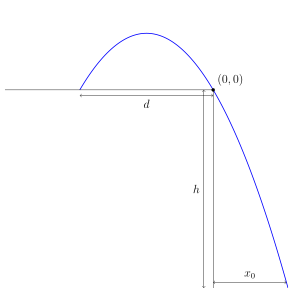
The Ruritanian army is supplied with shells which may explode at any time in flight but not before the shell reaches its maximum height. The effect of the explosion on any observer depends only on the distance between the exploding shell and the observer (and decreases with distance). Ruritanian guns fire the shells with fixed muzzle speed, and it is the policy of the gunners to fire the shell at an angle of elevation which minimises the possible damages to themselves (assuming the ground is level) - i.e. they aim so that the point on the descending trajectory that is nearest to them is as far away as possible. With that intention, they choose the angle of elevation that minimises the damage to themselves if the shell explodes at its maximum height. What angle do they choose? Does the shell then get any nearer to the gunners during its descent?
A shell of mass \(m\) is fired at elevation \(\pi/3\) and speed \(v\). Superman, of mass \(2m\), catches the shell at the top of its flight, by gliding up behind it in the same horizontal direction with speed \(3v\). As soon as Superman catches the shell, he instantaneously clasps it in his cloak, and immediately pushes it vertically downwards, without further changing its horizontal component of velocity, but giving it a downward vertical component of velocity of magnitude \(3v/2\). Calculate the total time of flight of the shell in terms of \(v\) and \(g\). Calculate also, to the nearest degree, the angle Superman's flight trajectory initially makes with the horizontal after releasing the shell, as he soars upwards like a bird. {[}Superman and the shell may be regarded as particles.{]}
Show SolutionA shot-putter projects a shot at an angle \(\theta\) above the horizontal, releasing it at height \(h\) above the level ground, with speed \(v\). Show that the distance \(R\) travelled horizontally by the shot from its point of release until it strikes the ground is given by \[ R=\frac{v^{2}}{2g}\sin2\theta\left(1+\sqrt{1+\frac{2hg}{v^{2}\sin^{2}\theta}}\right). \] The shot-putter's style is such that currently \(\theta=45^{\circ}\). Determine (with justification) whether a small decrease in \(\theta\) will increase \(R\). [Air resistance may be neglected.]
Show Solution