Newton's laws and connected particles
A truck of mass \(M\) is connected by a light, rigid tow-bar, which is parallel to the ground, to a trailer of mass \(kM\). A constant driving force \(D\) which is parallel to the ground acts on the truck, and the only resistance to motion is a frictional force acting on the trailer, with coefficient of friction \(\mu\).
- When the truck pulls the trailer up a slope which makes an angle \(\alpha\) to the horizontal, the acceleration is \(a_1\) and there is a tension \(T_1\) in the tow-bar.
- When the truck pulls the trailer on horizontal ground, the acceleration is \(a_2\) and there is a tension \(T_2\) in the tow-bar.
- When the truck pulls the trailer down a slope which makes an angle \(\alpha\) to the horizontal, the acceleration is \(a_3\) and there is a tension \(T_3\) in the tow-bar.
- Show that \(T_1 = T_3\) and that \(M(a_1 + a_3 - 2a_2) = 2(T_2 - T_1)\).
- It is given that \(\mu < 1\).
- Show that \[a_2 < \tfrac{1}{2}(a_1 + a_3) < a_3\,.\]
- Show further that \[a_1 < a_2\,.\]
Two particles, \(A\) of mass \(m\) and \(B\) of mass \(M\), are fixed to the ends of a light inextensible string \(AB\) of length \(r\) and lie on a smooth horizontal plane. The origin of coordinates and the \(x\)- and \(y\)-axes are in the plane. Initially, \(A\) is at \((0,\,0)\) and \(B\) is at \((r,\,0)\). \(B\) is at rest and \(A\) is given an instantaneous velocity of magnitude \(u\) in the positive \(y\) direction. At a time \(t\) after this, \(A\) has position \((x,\,y)\) and \(B\) has position \((X,\,Y)\). You may assume that, in the subsequent motion, the string remains taut.
- Explain by means of a diagram why \[X = x + r\cos\theta\] \[Y = y - r\sin\theta\] where \(\theta\) is the angle clockwise from the positive \(x\)-axis of the vector \(\overrightarrow{AB}\).
- Find expressions for \(\dot{X}\), \(\dot{Y}\), \(\ddot{X}\) and \(\ddot{Y}\) in terms of \(\ddot{x}\), \(\ddot{y}\), \(\dot{x}\), \(\dot{y}\), \(r\), \(\ddot{\theta}\), \(\dot{\theta}\) and \(\theta\), as appropriate. Assume that the tension \(T\) in the string is the only force acting on either particle.
- Show that \[\ddot{x}\sin\theta + \ddot{y}\cos\theta = 0\] \[\ddot{X}\sin\theta + \ddot{Y}\cos\theta = 0\] and hence that \(\theta = \dfrac{ut}{r}\).
- Show that \[m\ddot{x} + M\ddot{X} = 0\] \[m\ddot{y} + M\ddot{Y} = 0\] and find \(my + MY\) in terms of \(t\) and \(m, M, u, r\) as appropriate.
- Show that \[y = \frac{1}{m+M}\left(mut + Mr\sin\!\left(\frac{ut}{r}\right)\right).\]
- Show that, if \(M > m\), then the \(y\) component of the velocity of particle \(A\) will be negative at some time in the subsequent motion.
A train is made up of two engines, each of mass \(M\), and \(n\) carriages, each of mass \(m\). One of the engines is at the front of the train, and the other is coupled between the \(k\)th and \((k+1)\)th carriages. When the train is accelerating along a straight, horizontal track, the resistance to the motion of each carriage is \(R\) and the driving force on each engine is \(D\), where \(2D >nR\,\). The tension in the coupling between the engine at the front and the first carriage is \(T\).
- Show that \[ T = \frac{n(mD+MR)}{nm+2M}\,. \]
- Show that \(T\) is greater than the tension in any other coupling provided that \(k> \frac12n\,\).
- Show also that, if \(k> \frac12n\,\), then at least one of the couplings is in compression (that is, there is a negative tension in the coupling).
- \(\,\)
\begin{align*} \text{N2}(\leftarrow, \text{first engine}): && D-T &= Ma \\ \text{N2}(\leftarrow, \text{rest of train}): && T-nR+D &= (M+nm)a \\ \Rightarrow && \frac{D-T}{M} &= \frac{T+D-nR}{M+nm} \\ \Rightarrow && T \left ( \frac{1}{M+nm}+\frac{1}{M} \right) &= \frac{D}{M} + \frac{nR-D}{M+nm} \\ \Rightarrow && T \left ( 2M+nm\right) &= DM +Dnm + nRM - DM \\ &&&= n(mD+MR) \\ \Rightarrow && T &= \frac{n(mD+MR)}{2M+nm} \end{align*}
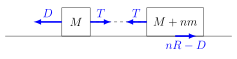
- The greatest coupling must occur behind an engine, because each carriage behind an engine acts as a drag.
Therefore we need only consider the couple between the second engine and the rest of the carriages:
\begin{align*} \text{N2}(\leftarrow, \text{up to second engine}): && 2D - T_2 - kR &= (2M+km)a \\ \text{N2}(\leftarrow, \text{everything else}): && T_2 - (n-k)R &= (n-k)ma \\ \Rightarrow && \frac{2D-T_2-kR}{2M+km} &= \frac{T_2-(n-k)R}{(n-k)m} \\ \Rightarrow && T_2 \left (\frac{1}{(n-k)m} + \frac{1}{2M+km} \right) &= \frac{2D-kR}{2M+km} + \frac{R}{m} \\ \Rightarrow && T_2 \left (2M+ nm \right) &= (2D-kR)m(n-k) + R(2M+km)(n-k) \\ \Rightarrow && T_2 &= \frac{(n-k)\left (2Dm+2RM \right)}{2M+nm} \\ &&&= \frac{2(n-k)(mD + MR)}{2M+nm} \end{align*} Therefore \(T > T_2\) provided \(2(n-k) < n \Leftrightarrow k > \frac12n\)
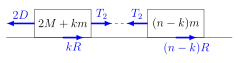
- If there is a coupling which is in negative tension, it must be between the two engines. In particular, if there is one, there must be one directly in front of the first engine.
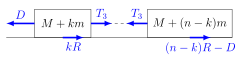
\begin{align*} \text{N2}(\leftarrow, \text{before second engine}): && D - T_3 - kR &= (M+km)a \\ \text{N2}(\leftarrow, \text{everything else}): && T_3 +D- (n-k)R &= (M+(n-k)m)a \\ \Rightarrow && \frac{D-T_3-kR}{M+km} &= \frac{T_3+D-(n-k)R}{M+(n-k)m} \\ \Rightarrow && T_3 \left ( \frac{1}{M+(n-k)m} + \frac{1}{M+km} \right) &= \frac{D-(n-k)R}{M+(n-k)m}+\frac{kR-D}{M+km} \\ \Rightarrow && T_3 (2M+nm) &= (D-(n-k)R)(M+km)+(kR-D)(M+(n-k)m) \\ &&&= D(M+km-M-(n-k)m) + R(kM+k(n-k)m-(n-k)M-k(n-k)m) \\ &&&= D(n-2k)m+RM(2k-n)m \\ &&&= (n-2k)m(D-RM) \end{align*} Therefore \(T_3\) is negative if \(k > \frac12n\) so there are some connections in compression.
A particle of mass \(m\) is pulled along the floor of a room in a straight line by a light string which is pulled at constant speed \(V\) through a hole in the ceiling. The floor is smooth and horizontal, and the height of the room is \(h\). Find, in terms of \(V\) and \(\theta\), the speed of the particle when the string makes an angle of \(\theta\) with the vertical (and the particle is still in contact with the floor). Find also the acceleration, in terms of \(V\), \(h\) and \(\theta\). Find the tension in the string and hence show that the particle will leave the floor when \[ \tan^4\theta = \frac{V^2}{gh}\,. \]
Show Solution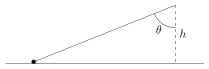
A light smoothly jointed planar framework in the form of a regular hexagon \(ABCDEF\) is suspended smoothly from \(A\) and a weight 1kg is suspended from \(C\). The framework is kept rigid by three light rods \(BD\), \(BE\) and \(BF\). What is the direction and magnitude of the supporting force which must be exerted on the framework at \(A\)? Indicate on a labelled diagram which rods are in thrust (compression) and which are in tension. Find the magnitude of the force in \(BE\).
A projectile of mass \(m\) is fired horizontally from a toy cannon of mass \(M\) which slides freely on a horizontal floor. The length of the barrel is \(l\) and the force exerted on the projectile has the constant value \(P\) for so long as the projectile remains in the barrel. Initially the cannon is at rest. Show that the projectile emerges from the barrel at a speed relative to the ground of \[ \sqrt{\frac{2PMl}{m(M+m)}}. \]
\(\ \)\vspace{-1cm} \noindent
One end of a thin uniform inextensible, but perfectly flexible, string of length \(l\) and uniform mass per unit length is held at a point on a smooth table a distance \(d(< l)\) away from a small vertical hole in the surface of the table. The string passes through the hole so that a length \(l-d\) of the string hangs vertically. The string is released from rest. Assuming that the height of the table is greater than \(l\), find the time taken for the end of the string to reach the top of the hole.
Show SolutionA librarian wishes to pick up a row of identical books from a shelf, by pressing her hands on the outer covers of the two outermost books and lifting the whole row together. The covers of the books are all in parallel vertical planes, and the weight of each book is \(W\). With each arm, the librarian can exert a maximum force of \(P\) in the vertical direction, and, independently, a maximum force of \(Q\) in the horizontal direction. The coefficient of friction between each pair of books and also between each hand and a book is \(\mu.\) Derive an expression for the maximum number of books that can be picked up without slipping, using this method. {[}You may assume that the books are thin enough for the rotational effect of the couple on each book to be ignored.{]}
Show Solution