Exponentials and Logarithms
If \(x=\log_bc\,\), express \(c\) in terms of \(b\) and \(x\) and prove that $ \dfrac{\log_a c}{\log_a b} = \ds \log_b c \,$.
- Given that \(\pi^2 < 10\,\), prove that \[ \frac{1}{\log_2 \pi}+\frac{1}{\log_5 \pi} > 2\,. \]
- Given that \(\ds \log_2 \frac{\pi}{\e} > \frac{1}{5}\) and that \(\e^2 < 8\), prove that \(\ln \pi > \frac{17}{15}\,\).
- Given that \(\e^3 >20\), \, \(\pi^2 < 10\,\) and \(\log_{10}2 >\frac{3}{10}\,\), prove that \(\ln \pi < \frac{15}{13}\,\).
- Since \(\pi^2 < 10\), we have \begin{align*} \Leftrightarrow && \pi^2 &< 10 \\ \Leftrightarrow && 2\log_{10} \pi &< 1 \\ \Leftrightarrow && 2 &< \frac{1}{\log_{10} \pi} \\ \Leftrightarrow && 2 &< \frac{\log_{10} 2 + \log_{10} 5}{\log_{10} \pi} \\ \Leftrightarrow && 2 &< \frac{\log_{10} 2}{\log_{10} \pi} + \frac{\log_{10} 5}{\log_{10} \pi} \\ \Leftrightarrow && 2 &< \frac1{\log_2\pi}+ \frac1{\log_5\pi} \\ \end{align*}
- Since \(e^2 < 8 \Rightarrow 2 < 3 \ln 2 \Rightarrow \ln 2 > \frac23\) \begin{align*} && \log_2 \frac{\pi}{e} &= \frac{\ln \frac{\pi}{e}}{\ln 2} \\ &&&= \frac{\ln \frac{\pi}{e}}{\ln 2} \\ &&&< \frac{3(\ln \pi - 1)}{2} \\ \Rightarrow && \frac{1}{5} &< \frac{3 \ln \pi - 1}{2} \\ \Rightarrow && \frac{2}{15} + 1 = \frac{17}{15}&< \ln \pi \end{align*}
- From the inequalities given we can set up two linear inequalities in \(\ln 2\) and \(\ln 5\) \begin{align*} && 20 &< e^3 \\ \Rightarrow && 2\ln 2 + \ln 5 &< 3 \tag{*}\\ \\ && \frac{3}{10} &< \log_{10} 2 \\ \Rightarrow && \frac{3}{10} &< \frac{\ln 2}{\ln 10} \\ \Rightarrow && 3 \ln 2 + 3 \ln 5 &< 10 \ln 2 \\ \Rightarrow && -7 \ln 2 + 3 \ln 5 &< 0 \tag{**}\\ \\ \\ && \pi^2 & < 10 \\ \Rightarrow && 2 \ln \pi &< \ln 2 + \ln 5 \tag{***}\\ \end{align*} It would be nice to combine \((*)\) and \((**)\) to bound \(\ln 2+ \ln 5\), so we want to use a linear combination such that \begin{align*} && \begin{cases} 2x -7y &= 1 \\ x + 3y &= 1\end{cases} \\ \Rightarrow && \begin{cases} y &= \frac1{13} \\ x &= \frac{10}{13}\end{cases} \\ \\ \Rightarrow && \ln 2 + \ln 5 < \frac{30}{13} + 0 \\ \Rightarrow && \ln \pi < \frac{15}{13} \end{align*}
A function \(\f(x)\) is said to be concave on some interval if \(\f''(x)<0\) in that interval. Show that \(\sin x\) is concave for \(0< x < \pi\) and that \(\ln x\) is concave for \(x > 0\). Let \(\f(x)\) be concave on a given interval and let \(x_1\), \(x_2\), \(\ldots\), \(x_n\) lie in the interval. Jensen's inequality states that \[ \frac1 n \sum_{k=1}^n\f(x_k) \le \f \bigg (\frac1 n \sum_{k=1}^n x_k\bigg) \] and that equality holds if and only if \(x_1=x_2= \cdots =x_n\). You may use this result without proving it.
- Given that \(A\), \(B\) and \(C\) are angles of a triangle, show that \[ \sin A + \sin B + \sin C \le \frac{3\sqrt3}2 \,. \]
- By choosing a suitable function \(\f\), prove that
\[
\sqrt[n]{t_1t_2\cdots t_n}\; \le \; \frac{t_1+t_2+\cdots+t_n}n
\]
for any positive integer \(n\) and for any positive numbers \(t_1\), \(t_2\), \(\ldots\), \(t_n\).
Hence:
- show that \(x^4+y^4+z^4 +16 \ge 8xyz\), where \(x\), \(y\) and \(z\) are any positive numbers;
- find the minimum value of \(x^5+y^5+z^5 -5xyz\), where \(x\), \(y\) and \(z\) are any positive numbers.
- Since \(A,B,C\) are angles in a triangle, we must have \(0 < A,B,C< \pi\) and so we can apply Jensen with \(f = \sin\) to obtain: \begin{align*} &&\frac13( \sin A + \sin B + \sin C) &\leq \sin \left ( \frac{A+B+C}{3}\right) \\ &&&= \sin \frac{\pi}{3} = \frac{\sqrt{3}}2 \\ \Rightarrow && \sin A + \sin B + \sin C &\leq\frac{3\sqrt{3}}2 \end{align*}
- Suppose \(f(x) = \ln x\), then applying Jensen on the positive numbers \(t_1, \ldots, t_n\) we obtain
\begin{align*}
&& \frac1n \left ( \sum_{i=1}^n \ln t_n \right) &\leq \ln \left ( \frac1n\sum_{i=1}^n t_n \right) \\
\Rightarrow && \frac1n \ln\left (\prod_{i=1} t_n\right)&\leq \ln \left ( \frac1n\sum_{i=1}^n t_n \right) \\
\Rightarrow && \ln\left (\left (\prod_{i=1} t_n\right)^{1/n}\right)&\leq \ln \left ( \frac1n\sum_{i=1}^n t_n \right) \\
\Rightarrow && \left (\prod_{i=1} t_n\right)^{1/n}&\leq\frac1n\sum_{i=1}^n t_n \\
\Rightarrow && \sqrt[n]{t_1t_2 \cdots t_n}&\leq\frac1n(t_1 + t_2 + \cdots + t_n) \tag{AM-GM}\\
\end{align*}
- Applying AM-GM with \(t_1 = x^4, t_2 = y^4, t_3 = z^4, t_4 = 2^4\) we have \begin{align*} && \frac{x^4+y^4+z^4+16}{4} & \geq \sqrt[4]{x^4y^4z^42^4} \\ \Rightarrow && x^4+y^4+z^4+16 &\geq 8xyz \end{align*}
- Applying AM-GM with \(t_1 = x^5, t_2 = y^5, t_3 = z^5, t_4 = 1^5, t_5 = 1^5\) we have \begin{align*} && \frac{x^5+y^5+z^5+1+1}{5} & \geq \sqrt[5]{x^5y^5z^5} \\ \Rightarrow && x^5+y^5+z^5+2 &\geq 5xyz \\ \Rightarrow && x^5+y^5+z^5 - 5xyz &\geq -2 \end{align*} Therefore the minimum is \(-2\)
To nine decimal places, \(\log_{10}2=0.301029996\) and \(\log_{10}3=0.477121255\).
- Calculate \(\log_{10}5\) and \(\log_{10}6\) to three decimal places. By taking logs, or otherwise, show that \[ 5\times 10^{47} < 3^{100} < 6\times 10^{47}. \] Hence write down the first digit of \(3^{100}\).
- Find the first digit of each of the following numbers: \(2^{1000}\); \ \(2^{10\,000}\); \ and \(2^{100\, 000}\).
- \begin{align*} \log_{10}5 &= \log_{10} 10 - \log_{10}2 \\ &= 1- \log_{10} 2 \\ &= 0.699\\ \\ \log_{10} 6 &= \log_{10} 2 + \log_{10} 3 \\ &= 0.301029996+0.477121255 \\ &= 0.778 \end{align*} \begin{align*} && 5 \times 10^{47} < 3^{100} < 6 \times 10^{47} \\ \Leftrightarrow && 47 + \log_{10} 5 < 100 \log_{10} 3 < \log_{10} 6 + 47 \\ \Leftrightarrow &&47.699< 47.71 < 47.778 \\ \end{align*} Which is true. Therefore the first digit of \(3^{100}\) is 5.
- \(\log_{10} 2^{1000} = 1000 \log_{10} 2 = 301.02\cdots\). Therefore it starts with a \(1\). \(\log_{10}2^{10\, 000} = 10\,000 \log_{10} 2 = 3010.2\) therefore this also starts with a \(1\). \(\log_{10} 2^{100\, 000} = 100\,000 \log_{10} 2 = 30102.9996\) therefore it starts with a \(9\)
Let \(x=10^{100}\), \(y=10^{x}\), \(z=10^{y}\), and let $$ a_1=x!, \quad a_2=x^y,\quad a_3=y^x,\quad a_4=z^x,\quad a_5=\e^{xyz},\quad a_6=z^{1/y},\quad a_7 = y^{z/x}. $$
- Use Stirling's approximation \(n! \approx \sqrt{2 \pi}\, {n^{n+{1\over2}}\e^{-n}}\), which is valid for large \(n\), to show that \(\log_{10}\left(\log_{10} a_1 \right) \approx 102\).
- Arrange the seven numbers \(a_1\), \(\ldots\) , \(a_7\) in ascending order of magnitude, justifying your result.
- \begin{align*} \log_{10}(\log_{10} a_1) &= \log_{10} (\log_{10} (x!) \\ &\approx \log_{10} (\log_{10} \sqrt{2 \pi} x^{x+\frac12} e^{-x}) \\ &= \log_{10} \l \log_{10} \sqrt{2 \pi} + (x+\frac12) \log_{10} x-x \r \\ &= \log_{10} \l \log_{10} \sqrt{2 \pi} + (100x+50)-x \r \\ &= \log_{10} \l 99x + \epsilon \r \\ &\approx \log_{10} 99 + \log_{10} x \\ &\approx 2 + 100 = 102 \end{align*}
- \begin{align*} \log_{10}(\log_{10} a_2) &= \log_{10}(\log_{10} x^y) \\ &= \log_{10} y + \log_{10} \log_{10} x \\ &= x + 2 \end{align*} \begin{align*} \log_{10}(\log_{10} a_3) &= \log_{10}(\log_{10} y^x) \\ &= \log_{10} x + \log_{10} \log_{10} y \\ &= 100 + \log_{10} x \\ &= 200 \end{align*} \begin{align*} \log_{10}(\log_{10} a_4) &= \log_{10}(\log_{10} z^x) \\ &= \log_{10} x + \log_{10} \log_{10} z \\ &= 100 + \log_{10} y \\ &= 100+x \end{align*} \begin{align*} \log_{10}(\log_{10} a_5) &= \log_{10}(\log_{10} e^{xyz}) \\ &= \log_{10} x + \log_{10}y+\log_{10} z+ \log_{10} \log_{10} e \\ &\approx 100 + x + y \end{align*} \begin{align*} \log_{10}(\log_{10} a_6) &= \log_{10}(\log_{10} z^{1/y}) \\ &= \log_{10}(\log_{10} 10) \\ &= 0 \end{align*} \begin{align*} \log_{10}(\log_{10} a_7) &= \log_{10}(\log_{10} y^{z/x}) \\ &= \log_{10}z-\log_{10} x + \log_{10} \log_{10} y \\ &= y \end{align*} Since \(0 < 102 < 200 < x+2 < x+100 < y < y+x+100\) we must have \(a_6 < a_1 < a_3 < a_2 < a_4 < a_7 < a_5\)
Let \(a_{1}=3\), \(a_{n+1}=a_{n}^{3}\) for \(n\geqslant 1\). (Thus \(a_{2}=3^{3}\), \(a_{3}=(3^{3})^{3}\) and so on.)
- What digit appears in the unit place of \(a_{7}\)?
- Show that \(a_{7}\geqslant 10^{100}\).
- What is \(\dfrac{a_{7}+1}{2a_{7}}\) correct to two places of decimals? Justify your answer.
- Notice that \(a_n = 3^{3^{n-1}}\) in particular, \(a_7 = 3^{3^6}\). Using Fermat's little theorem, we can see that \(3^4 \equiv 1 \pmod{5}\) and so we need to figure out \(3^6 \pmod{4}\), which is clearly \(1\). Therefore \(3^{3^6} \equiv 3^{4k+1} \equiv 3 \pmod{5}\). Therefore the units digit is \(3\).
- Notice that \(3^5 > 100\) and \(3^3 > 10\). Therefore \begin{align*} a_7 &= 3^{3^6} \\ &= (3^3)^{3^5} \\ &> 10^{3^5} \\ &> 10^{100} \end{align*}
- \begin{align*} \frac{a_7+1}{2a_7} &= \frac12 + \frac1{2a_7} \\ &= 0.5 + 0.\underbrace{000\cdots}_{\text{at least }99\text{ zeros}} \\ &= 0.50 \end{align*} Since \(a_7 > 10^{100}, \, \frac{1}{2a_7} < 10^{-100}\)
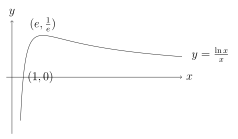
Let \[\mathrm{f}(t)=\frac{\ln t}t\quad\text{ for }t>0.\] Sketch the graph of \(\mathrm{f}(t)\) and find its maximum value. How many positive values of \(t\) correspond to a given value of \(\mathrm f(t)\)? Find how many positive values of \(y\) satisfy \(x^y=y^x\) for a given positive value of \(x\). Sketch the set of points \((x,y)\) which satisfy \(x^y=y^x\) with \(x,y>0\).
Sketch the graph of the function \(\mathrm{h}\), where \[ \mathrm{h}(x)=\frac{\ln x}{x},\qquad(x>0). \] Hence, or otherwise, find all pairs of distinct positive integers \(m\) and \(n\) which satisfy the equation \[ n^{m}=m^{n}. \]
Show Solution