Cumulative distribution functions
- Let \(\lambda > 0\). The independent random variables \(X_1, X_2, \ldots, X_n\) all have probability density function $$f(t) = \begin{cases} \lambda e^{-\lambda t} & t \geq 0 \\ 0 & t < 0 \end{cases}$$ and cumulative distribution function \(F(x)\). The value of random variable \(Y\) is the largest of the values \(X_1, X_2, \ldots, X_n\). Show that the cumulative distribution function of \(Y\) is given, for \(y \geq 0\), by $$G(y) = (1 - e^{-\lambda y})^n$$
- The values \(L(\alpha)\) and \(U(\alpha)\), where \(0 < \alpha \leq \frac{1}{2}\), are such that $$P(Y < L(\alpha)) = \alpha \text{ and } P(Y > U(\alpha)) = \alpha$$ Show that $$L(\alpha) = -\frac{1}{\lambda}\ln(1 - \alpha^{1/n})$$ and write down a similar expression for \(U(\alpha)\).
- Use the approximation \(e^t \approx 1 + t\), for \(|t|\) small, to show that, for sufficiently large \(n\), $$\lambda L(\alpha) \approx \ln(n) - \ln\left(\ln\left(\frac{1}{\alpha}\right)\right)$$
- Hence show that the median of \(Y\) tends to infinity as \(n\) increases, but that the width of the interval \(U(\alpha) - L(\alpha)\) tends to a value which is independent of \(n\).
- You are given that, for \(|t|\) small, \(\ln(1 + t) \approx t\) and that \(e^3 \approx 20\). Show that, for sufficiently large \(n\), there is an interval of width approximately \(4\lambda^{-1}\) in which \(Y\) lies with probability \(0.9\).
- Note that \(\displaystyle F(y) = \mathbb{P}(X_i < y) = \int_0^y \lambda e^{-\lambda t} \d t = 1-e^{-\lambda y}\). Notice also that \begin{align*} G(y) &= \mathbb{P}(Y < y) \\ &= \mathbb{P}(\max_i(X_i) < y) \\ &= \mathbb{P}(X_i < y \text{ for all }i) \\ &= \prod_{i=1}^n \mathbb{P}(X_i < y) \\ &= \prod_{i=1}^n (1-e^{-\lambda y})\\ &= (1-e^{-\lambda y})^n \end{align*} as required.
- \begin{align*} && \mathbb{P}(Y < L(\alpha)) &= \alpha \\ \Rightarrow && (1-e^{-\lambda L(\alpha)})^n &= \alpha \\ \Rightarrow && 1-e^{-\lambda L(\alpha)} &= \alpha^{\tfrac1n} \\ \Rightarrow && L(\alpha) &= -\frac{1}{\lambda}\ln \left (1-\alpha^{\tfrac1n} \right) \end{align*} Notice also: \begin{align*} && \mathbb{P}(Y > U(\alpha)) &= \alpha \\ \Rightarrow && 1 - (1-e^{-\lambda U(\alpha)})^n &= \alpha \\ \Rightarrow && U(\alpha) &= -\frac{1}{\lambda}\ln \left ( 1-(1-\alpha)^{\tfrac1n} \right) \end{align*}
- \begin{align*} \lambda L(\alpha) &= -\ln \left (1-\alpha^{\tfrac1n} \right) \\ &= -\ln \left (1-e^{\tfrac1n \ln \alpha} \right) \\ &\approx - \ln \left ( 1 - 1 - \frac1n \ln \alpha\right) \tag{\(e^t \approx 1 + t\)} \\ &= -\ln \left ( \frac{1}{n} \ln \frac{1}\alpha \right) \\ &= - \ln \frac{1}{n} - \ln \left ( \ln \frac{1}{\alpha} \right )\\ &= \ln n - \ln \left ( \ln \left ( \frac{1}{\alpha} \right ) \right) \end{align*} since if \(n\) is large, \(\frac{\ln \alpha}{n}\) is small.
- The median is the value where \(\mathbb{P}(Y < M) = \frac12\), or in other words \(L(\frac12)\), but this is \(\approx \frac{\ln n - \ln (\ln 2)}{\lambda} \to \infty\). \begin{align*} && \lambda U(\alpha) &\approx \ln n - \ln \left ( \ln \left ( \frac{1}{1-\alpha} \right ) \right) \\ \Rightarrow && \lambda(U(\alpha) - L(\alpha)) &\approx -\ln \left ( \ln \left ( \frac{1}{1-\alpha} \right ) \right)+ \ln \left ( \ln \left ( \frac{1}{\alpha} \right ) \right) \\ \Rightarrow && U(\alpha) - L(\alpha) &\to \frac{1}{\lambda} \left ( \ln \left ( \ln \left ( \frac{1}{\alpha} \right ) \right)-\ln \left ( \ln \left ( \frac{1}{1-\alpha} \right ) \right ) \right) \end{align*} which doesn't depend on \(n\).
- Suppose \(\alpha = \frac{1}{20}\) then \begin{align*} U(\alpha) - L(\alpha) &\approx \frac{1}{\lambda} \left (\ln \ln 20 - \ln \ln \frac{20}{19} \right) \\ &= \lambda^{-1} \left (\ln \ln 20 - \ln \ln (1 + \frac{1}{19}) \right) \\ &\approx \lambda^{-1} \left (\ln 3 - \ln \frac{1}{19} \right) \tag{\(\ln(1+t) \approx t\)} \\ &\approx \lambda^{-1} \ln 3 \cdot 19 \\ &\approx \lambda^{-1} (1 + 3) \\ &\approx 4\lambda^{-1} \end{align*} [Note that \(\ln \ln 20 - \ln \ln \frac{20}{19} = 4.0673\ldots\)]
The lifetime of a fly (measured in hours) is given by the continuous random variable \(T\) with probability density function \(f(t)\) and cumulative distribution function \(F(t)\). The hazard function, \(h(t)\), is defined, for \(F(t) < 1\), by \[ h(t) = \frac{f(t)}{1-F(t)}\,. \]
- Given that the fly lives to at least time \(t\), show that the probability of its dying within the following \(\delta t\) is approximately \(h (t) \, \delta t\) for small values of \(\delta t\).
- Find the hazard function in the case \(F(t) = t/a\) for \(0< t < a\). Sketch \(f(t)\) and \(h(t)\) in this case.
- The random variable \(T\) is distributed on the interval \(t > a\), where \(a>0\), and its hazard function is \(t^{-1}\). Determine the probability density function for \(T\).
- Show that \(h(t)\) is constant for \(t > b\) and zero otherwise if and only if \(f(t) =ke^{-k(t-b)}\) for \(t > b\), where \(k\) is a positive constant.
- The random variable \(T\) is distributed on the interval \(t > 0\) and its hazard function is given by \[ h(t) = \left(\frac{\lambda}{\theta^\lambda}\right)t^{\lambda-1}\,, \] where \(\lambda\) and \(\theta\) are positive constants. Find the probability density function for \(T\).
- \(\,\) \begin{align*} && \mathbb{P}(T > t + \delta t | T > t) &= \frac{\mathbb{P}(T < t + \delta t)}{\mathbb{P}(T > t )} \\ &&&= \frac{\int_t^{t+\delta t} f(s) \d s}{1-F(t)} \\ &&&\approx \frac{f(t)\delta t}{1-F(t)} \\ &&&= h(t) \delta t \end{align*}
- If \(F(t) = t/a\) then \(f(t) = 1/a\) and \(h(t) = \frac{1/a}{1-t/a} = \frac{1}{a-t}\)
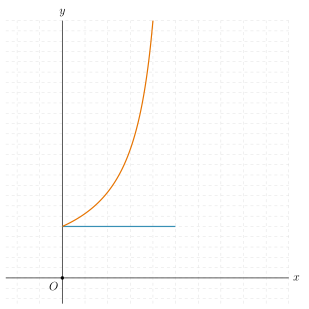
- \(\,\) \begin{align*} && \frac{F'}{1-F} &= \frac{1}{t} \\ \Rightarrow && -\ln (1-F) &= \ln t + C\\ \Rightarrow && 1-F &= \frac{A}{t} \\ && F &= 1 - \frac{A}{t} \\ F(a) = 0: && F &= 1 - \frac{a}{t} \\ && f(t) &= \frac{a}{t^2} \end{align*}
- (\(\Rightarrow\)) \begin{align*} && \frac{F'}{1-F} &= k \\ \Rightarrow && -\ln(1-F) &= kt+C \\ \Rightarrow && 1-F &= Ae^{-kt} \\ F(b) = 0: && 1 &= Ae^{-kb} \\ \Rightarrow && 1-F &= e^{-k(t-b)}\\ \Rightarrow && f &= ke^{-k(t-b)} \\ \end{align*} (\(\Leftarrow\)) \(f(t) = ke^{-k(t-b)} \Rightarrow F(t) = 1-e^{-k(t-b)}\) and the result is clear.
- \(\,\) \begin{align*} && \frac{F'}{1-F} &= \left ( \frac{\lambda}{\theta^{\lambda}} \right) t^{\lambda-1} \\ \Rightarrow && -\ln(1-F) &= \left ( \frac{t}{\theta} \right)^{\lambda} +C\\ \Rightarrow && F &= 1-A\exp \left (- \left ( \frac{t}{\theta} \right)^{\lambda} \right) \\ F(0) = 0: && 0 &= 1-A \\ \Rightarrow && F &= 1 - \exp \left (- \left ( \frac{t}{\theta} \right)^{\lambda} \right) \\ \Rightarrow && f &= \lambda t^{\lambda -1} \theta^{-\lambda} \exp \left (- \left ( \frac{t}{\theta} \right)^{\lambda} \right) \end{align*}
The random variable \(X\) has probability density function \(f(x)\) (which you may assume is differentiable) and cumulative distribution function \(F(x)\) where \(-\infty < x < \infty \). The random variable \(Y\) is defined by \(Y= \e^X\). You may assume throughout this question that \(X\) and \(Y\) have unique modes.
- Find the median value \(y_m\) of \(Y\) in terms of the median value \(x_m\) of \(X\).
- Show that the probability density function of \(Y\) is \(f(\ln y)/y\), and deduce that the mode \(\lambda\) of \(Y\) satisfies \(\f'(\ln \lambda) = \f(\ln \lambda)\).
- Suppose now that \(X \sim {\rm N} (\mu,\sigma^2)\), so that \[ f(x) = \frac{1}{\sigma \sqrt{2\pi}\,} \e^{-(x-\mu)^2/(2\sigma^2)} \,. \] Explain why \[\frac{1}{\sigma \sqrt{2\pi}\,} \int_{-\infty}^{\infty}\e^{-(x-\mu-\sigma^2)^2/(2\sigma^2)} \d x = 1 \] and hence show that \( \E(Y) = \e ^{\mu+\frac12\sigma^2}\).
- Show that, when \(X \sim {\rm N} (\mu,\sigma^2)\), \[ \lambda < y_m < \E(Y)\,. \]
- \begin{align*} && \frac12 &= \mathbb{P}(X \leq x_m) \\ \Leftrightarrow && \frac12 &= \mathbb{P}(e^X \leq e^{x_m} = y_m) \end{align*} Therefore the median is \(y_m = e^{x_m}\)
- \begin{align*} && \mathbb{P}(Y \leq y) &= \mathbb{P}(e^X \leq y) \\ &&&= \mathbb{P}(X \leq \ln y) \\ &&&= F(\ln y) \\ \Rightarrow && f_Y(y) &= f(\ln y)/y \\ \\ && f'_Y(y) &= \frac{f'(\ln y) - f(\ln y)}{y^2} \end{align*} Therefore since the mode satisfies \(f'_Y = 0\) we must have \(f'(\ln \lambda ) = f(\ln \lambda)\)
- This is the integral of the pdf of \(N(\mu + \sigma^2, \sigma^2)\) and therefore is clearly \(1\). \begin{align*} && \E[Y] &= \int_{-\infty}^{\infty} e^x \cdot \frac{1}{\sqrt{2\pi \sigma^2}} e^{-(x-\mu)^2/(2\sigma^2)} \d x \\ &&&= \frac{1}{\sqrt{2\pi \sigma^2}} \int_{-\infty}^{\infty} \exp (x - (x-\mu)^2/(2\sigma^2)) \d x\\ &&&= \frac{1}{\sqrt{2\pi \sigma^2}} \int_{-\infty}^{\infty} \exp ((2x \sigma^2- (x-\mu)^2)/(2\sigma^2)) \d x\\ &&&= \frac{1}{\sqrt{2\pi \sigma^2}} \int_{-\infty}^{\infty} \exp (-(x-\mu-\sigma^2)^2+2\mu \sigma^2-\sigma^4)/(2\sigma^2)) \d x\\ &&&= \frac{1}{\sqrt{2\pi \sigma^2}} \int_{-\infty}^{\infty} \exp (-(x-\mu+\sigma^2)^2)/(2\sigma^2)+\mu +\frac12\sigma^2) \d x\\ &&&= \e^{\mu +\frac12\sigma^2}\frac{1}{\sqrt{2\pi \sigma^2}} \int_{-\infty}^{\infty} \exp (-(x-\mu-\sigma^2)^2)/(2\sigma^2)) \d x\\ &&&= \e^{\mu +\frac12\sigma^2} \end{align*}
- Notice that \(y_m = e^\mu < e^{\mu + \tfrac12 \sigma^2} = \E[Y]\), so it suffices to prove that \(\lambda < e^{\mu}\) Notice that \(f'(x) - f(x) = f(x)[-(x-\mu)/\sigma^2 - 1]\) and therefore \(\ln y - \mu = -\sigma^2\) so \(\lambda = e^{\mu - \sigma^2}\) which is clearly less than \(e^{\mu}\) as required.
- The continuous random variable \(X\) satisfies
\(0\le X\le 1\), and has probability density function
\(\f(x)\) and cumulative distribution
function \(\F(x)\). The
greatest value of \(\f(x)\) is \(M\), so that \(0\le \f(x) \le M\).
- Show that \(0\le \F(x) \le Mx\) for \(0\le x\le1\).
- For any function \(\g(x)\), show that \[ \int_0^1 2 \g(x) \F(x) \f(x) \d x = \g(1) - \int_0^1 \g'(x) \big( \F(x)\big)^2 \d x \,. \]
- The
continuous random variable \(Y\)
satisfies
\(0\le Y\le 1\), and has probability density function
\(k \F(y) \f(y)\), where \(\f\) and \(\F\) are as above.
- Determine the value of the constant \(k\).
- Show that \[ 1+ \frac{nM}{n+1}\mu_{n+1} - \frac{nM}{n+1} \le \E(Y^n) \le 2M\mu_{n+1}\,, \] where \(\mu_{n+1} = \E(X^{n+1})\) and \(n\ge0\).
- Hence show that, for \(n\ge 1\), \[ \mu _n \ge \frac{n}{(n+1)M} -\frac{n-1}{n+1} \,.\]
- \(\,\) \begin{align*} && 0 &\leq f(t) &\leq M \\ \Rightarrow && \int_0^x 0 \d t &\leq \int_0^x f(t) \d t & \leq \int_0^x M \d x \\ \Rightarrow && 0 &\leq F(x) &\leq Mx \end{align*}
- \(\,\) \begin{align*} && \int_0^1 2g(x)F(x)f(x) \d x &= \left [ g(x) F(x)^2 \right] - \int_0^1 g'(x) \left ( F(x)\right)^2 \d x \\ &&&= g(1) - \int_0^1 g'(x) \left ( F(x)\right)^2 \d x \end{align*}
- \(\,\) \begin{align*} && 1 &= \int_0^1 kF(y)f(y) \d y \\ &&&= k\left [ \frac12 F(y)^2\right]_0^1 \\ &&&= \frac{k}{2} \\ \Rightarrow && k &= 2 \end{align*}
- \(\,\) \begin{align*} \E[Y^n] &= \int_0^1 y^n 2F(y)f(y) \d y \\ &\geq \int_0^1 y^n 2My f(y) \d y \\ &= 2M\int_0^1 y^{n+1} f(y) \d y \\ &= 2M \E[X^{n+1}] = 2M\mu_{n+1} \\ \\ \E[Y^n] &= \int_0^1 y^n 2F(y)f(y) \d y \\ &= 1 - \int_0^1 ny^{n-1} F(y)^2 \d y \\ &\geq 1 - \int_0^1 ny^{n-1}My F(y) \d y \\ &= 1 - M\int_0^1 ny^n F(y) \d y \\ &= 1 - M[\frac{n}{n+1}y^{n+1} F(y)]_0^1 + M\int_0^1\frac{n}{n+1} y^{n+1} f(y) \d y \\ &= 1 - \frac{nM}{n+1} + \frac{nM}{n+1} \mu_{n+1} \end{align*}
- Since \(\E[Y^{n-1}] \geq 0\) we must have \begin{align*} && 2M\mu_n \geq 1 + \frac{(n-1)M}{n}\mu_n - \frac{(n-1)M}{n} \\ \Rightarrow && \mu_n \left (2M + \frac{(n-1)M}{n} \right) \geq 1 - \frac{(n-1)M}{n} \\ \Rightarrow && \mu_n \frac{3Mn-M}{n} & \geq \frac{n-(n-1)M}{n} \\ \Rightarrow && \mu_n & \geq \frac{n-(n-1)M}{3Mn-M} \end{align*}
What property of a distribution is measured by its skewness?
- One measure of skewness, \(\gamma\), is given by \[ \displaystyle \gamma= \frac{ \E\big((X-\mu)^3\big)}{\sigma^3}\,, \] where \(\mu\) and \(\sigma^2\) are the mean and variance of the random variable \(X\). Show that \[ \gamma = \frac{ \E(X^3) -3\mu \sigma^2 - \mu^3}{\sigma^3}\,. \] The continuous random variable \(X\) has probability density function \(\f\) where \[ \f(x) = \begin{cases} 2x & \text{for } 0\le x\le 1\,, \\[2mm] 0 & \text{otherwise}\,. \end{cases} \] Show that for this distribution \(\gamma= -\dfrac{2\sqrt2}{5}\).
- The decile skewness, \(D\), of a distribution is defined by \[D= \frac { {\rm F}^{-1}(\frac9{10}) - 2{\rm F} ^{-1}(\frac12) + {\rm F}^{-1} (\frac1{10}) } {{\rm F}^{-1}(\frac9{10}) - {\rm F} ^{-1} (\frac1{10})}\,, \] where \({\rm F}^{-1}\) is the inverse of the cumulative distribution function. Show that, for the above distribution, \( D= 2 -\sqrt5\,.\) The Pearson skewness, \(P\), of a distribution is defined by \[ P = \frac{3(\mu-M)}{\sigma} \,,\] where \(M\) is the median. Find \(P\) for the above distribution and show that \(D > P > \gamma\,\).
- \(\,\) \begin{align*} && \gamma &= \frac{\E \left [ (X - \mu)^3 \right ]}{\sigma^3} \\ &&&= \frac{\E \left [ X^3 - 3\mu X^2 + 3\mu^2 X - \mu^3 \right ]}{\sigma^3} \\ &&&= \frac{\E [ X^3 ]- 3\mu \E[X^2] + 3\mu^2 \E[X] - \mu^3 }{\sigma^3} \\ &&&= \frac{\E [ X^3 ]- 3\mu (\mu^2 + \sigma^2) + 3\mu^2\cdot \mu- \mu^3 }{\sigma^3} \\ &&&= \frac{\E [ X^3 ]- 3\mu \sigma^2 - \mu^3 }{\sigma^3} \\ \end{align*} \begin{align*} && f(x) &= \begin{cases} 2x & \text{for } 0\le x\le 1\,, \\[2mm] 0 & \text{otherwise}\,. \end{cases} \\ && \E[X] &= \int_0^1 2x^2 \d x \\ &&&= \frac23 \\ && \E[X^2] &= \int_0^1 2x^3 \d x \\ &&&= \frac12 \\ && \E[X^3] &= \int_0^1 2x^4 \d x \\ &&&= \frac25 \\ \\ && \mu &= \frac23 \\ && \sigma^2 &= \frac12 - \frac49 = \frac{1}{18} \\ && \gamma &= \frac{\frac25 - 3 \cdot \frac23 \cdot \frac1{18} - \frac8{27}}{\frac{1}{54\sqrt2}} \\ &&&= -\frac{2\sqrt2}{5} \end{align*}
- First note that \(\displaystyle F(x) = \int_0^x 2t \d t = x^2\) for \(x \in [0,1]\). In particular, \(F^{-1}(x) = \sqrt{x}\), so \begin{align*} && D &= \frac { {\rm F}^{-1}(\frac9{10}) - 2{\rm F} ^{-1}(\frac12) + {\rm F}^{-1} (\frac1{10}) } {{\rm F}^{-1}(\frac9{10}) - {\rm F} ^{-1} (\frac1{10})} \\ &&&= \frac{\sqrt{\frac9{10}} - 2 \sqrt{\frac5{10}} + \sqrt{\frac1{10}}}{\sqrt{\frac9{10}}-\sqrt{\frac1{10}}} \\ &&&= \frac{3-2\sqrt5+1}{3 - 1} \\ &&&= \frac{4-2\sqrt5}{2} = 2-\sqrt5 \end{align*} \begin{align*} && P &= \frac{3(\mu - M)}{\sigma} \\ &&&= \frac{3(\frac23 - \sqrt{\frac12})}{\frac{1}{3\sqrt2}} \\ &&&= 6 \sqrt2 - 9 \end{align*} First we compare \(P\) and \(D\), \(6\sqrt2-9\) and \(2-\sqrt5\) \begin{align*} && D & > P \\ \Leftrightarrow && 2-\sqrt5 &> 6\sqrt2 - 9 \\ \Leftrightarrow && 11 -6\sqrt2 &> \sqrt 5 \\ \Leftrightarrow && (121 + 72 - 132\sqrt2) & > 5 \\ \Leftrightarrow && 188 & > 132\sqrt2 \\ \Leftrightarrow && 47 & > 33 \sqrt 2\\ \Leftrightarrow && 2209 & > 2178 \end{align*} also \begin{align*} && P &> \gamma \\ \Leftrightarrow && 6\sqrt2 - 9 &> -\frac{2\sqrt2}{5} \\ \Leftrightarrow && 30\sqrt2 - 45 & > -2\sqrt2 \\ \Leftrightarrow && 32 \sqrt 2 &> 45 \\ \Leftrightarrow && 2048 &> 2025 \end{align*}
The continuous random variable \(X\) has probability density function \(\f(x)\), where \[ \f(x) = \begin{cases} a & \text {for } 0\le x < k \\ b & \text{for } k \le x \le 1\\ 0 & \text{otherwise}, \end{cases} \] where \(a > b > 0\) and \(0 < k < 1\). Show that \(a > 1\) and \(b < 1\).
- Show that \[ \E(X) = \frac{1-2b+ab}{2(a-b)}\,. \]
- Show that the median, \(M\), of \(X\) is given by \(\displaystyle M=\frac 1 {2a}\) if \(a+b\ge 2ab\) and obtain an expression for the median if \(a+b\le 2ab\).
- Show that \(M < \E(X)\,\).
- \(\,\) \begin{align*} && \E[X] &= \int_0^1 x \cdot f(x) \d x \\ &&&= \int_0^k ax \d x + \int_k^1 b x \d x \\ &&&= a \frac{k^2}{2} + b \frac{1-k^2}{2} \\ &&&= \frac12b + (a-b) \frac{(1-b)^2}{2(a-b)^2} \\ &&&= \frac{(1-b)^2+b(a-b)}{2(a-b)} \\ &&&= \frac{1-2b+ab}{2(a-b)} \end{align*}
- \(\,\) The median \(M\) satisfies \[\frac12 = \int_0^M f(x) \d x \] If \(ka = \frac{a-ab}{a-b} \leq \frac12 \Leftrightarrow 2a-2ab \leq a-b \Leftrightarrow a+b \leq 2ab\) then \(M > k\) otherwise \(M < k\). In the latter case: \begin{align*} && \frac12 &= Ma \\ \Rightarrow && M &= \frac{1}{2M} \end{align*} In the former case \begin{align*} && \frac12 &= ka + (M-k)b \\ &&&= k(a-b) + Mb \\ &&&= 1-b + M b \\ \Rightarrow && M &= 1-\frac1{2b} \end{align*}
The random variable \(X\) has a continuous probability density function \(\f(x)\) given by \begin{equation*} \f(x) = \begin{cases} 0 & \text{for } x \le 1 \\ \ln x & \text{for } 1\le x \le k\\ \ln k & \text{for } k\le x \le 2k\\ a-bx & \text{for } 2k \le x \le 4k \\ 0 & \text{for } x\ge 4k \end{cases} \end{equation*} where \(k\), \(a\) and \(b\) are constants.
- Sketch the graph of \(y=\f(x)\).
- Determine \(a\) and \(b\) in terms of \(k\) and find the numerical values of \(k\), \(a\) and \(b\).
- Find the median value of \(X\).

- Since \(f(x)\) is continuous, \(a -bx\) joins \((2k, \ln k)\) and \((4k ,0)\). ie it has a gradient of \(\frac{-\ln k}{2k}\) and is zero at \(4k\), hence \(\displaystyle b = -\frac{\ln k}{2k}, a = 2\ln k\). The \(3\) sections have areas \(\int_1^k \ln x \d x = k \ln k -k +1\), \(k \ln k, k \ln k\). Therefore \begin{align*} &&1&= 3k\ln k - k +1 \\ \Rightarrow &&0 &= k(3\ln k - 1) \\ \Rightarrow &&\ln k &= \frac13 \\ \Rightarrow &&k &= e^{1/3} \\ && a &= \frac23 \\ && b&= -\frac16e^{-1/3} \end{align*}
- Clearly \(1 > k \ln k > \frac{1}{3}\), therefore the median must lie between \(k\) and \(2k\). So we need, \(\frac12\) to be the area of the rectangle + the triangle, ie: \begin{align*} && \frac12 &= k \ln k + (2k-M) \ln k \\ &&&= \frac13 k + \frac13 (2k - M) \\ \Rightarrow && M &= 3k - \frac32 \\ \Rightarrow && M &= 3e^{1/3} - \frac32 \end{align*}
In this question, you may use the result \[ \displaystyle \int_0^\infty \frac{t^m}{(t+k)^{n+2}} \; \mathrm{d}t =\frac{m!\, (n-m)!}{(n+1)! \, k^{n-m+1}}\;, \] where \(m\) and \(n\) are positive integers with \(n\ge m\,\), and where \(k>0\,\). The random variable \(V\) has density function \[ \f(x) = \frac{C \, k^{a+1} \, x^a}{(x+k)^{2a+2}} \quad \quad (0 \le x < \infty) \;, \] where \(a\) is a positive integer. Show that \(\displaystyle C = \frac{(2a+1)!}{a! \, a!}\;\). Show, by means of a suitable substitution, that \[ \int_0^v \frac{x^a}{(x+k)^{2a+2}} \; \mathrm{d}x = \int_{\frac{k^2}{v}}^\infty \frac{u^a}{(u+k)^{2a+2}} \; \mathrm{d}u \] and deduce that the median value of \(V\) is \(k\). Find the expected value of \(V\). The random variable \(V\) represents the speed of a randomly chosen gas molecule. The time taken for such a particle to travel a fixed distance \(s\) is given by the random variable \(\ds T=\frac{s}{V}\). Show that \begin{equation} \mathbb{P}( T < t) = \ds \int_{\frac{s}{t}}^\infty \frac{C \, k^{a+1} \, x^a}{(x+k)^{2a+2}}\; \mathrm{d}x \tag{\( *\)} \end{equation} and hence find the density function of \(T\). You may find it helpful to make the substitution \(\ds u = \frac{s}{x}\) in the integral \((*)\). Hence show that the product of the median time and the median speed is equal to the distance \(s\), but that the product of the expected time and the expected speed is greater than \(s\).
Show SolutionSketch the graph, for \(x \ge 0\,\), of $$ y = kx\e^{-ax^2} \;, $$ where \(a\) and \(k\) are positive constants. The random variable \(X\) has probability density function \(\f(x)\) given by \begin{equation*} \f(x)= \begin{cases} kx\e^{-ax^2} & \text{for \(0 \le x \le 1\)}\\[3pt] 0 & \text{otherwise}. \end{cases} \end{equation*} Show that \(\displaystyle k=\frac{2a}{1-\e^{-a}}\) and find the mode \(m\) in terms of \(a\,\), distinguishing between the cases \(a < \frac12\) and \(a > \frac12\,\). Find the median \(h\) in terms of \(a\), and show that \(h > m\) if \(a > -\ln\left(2\e^{-1/2} - 1\right).\) Show that, \(-\ln\left(2\e^{-1/2}-1\right)> \frac12 \,\). Show also that, if \(a > -\ln\left(2\e^{-1/2} - 1\right) \,\), then $$ P(X > m \;\vert\; X < h) = {{2\e^{-1/2}-\e^{-a}-1} \over 1-\e^{-a}}\;. $$
Show Solution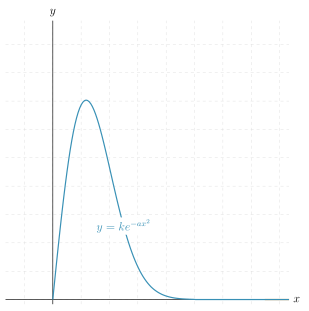
Let \(\F(x)\) be the cumulative distribution function of a random variable \(X\), which satisfies \(\F(a)=0\) and \(\F(b)=1\), where \(a>0\). Let \[ \G(y) = \frac{\F(y)}{2-\F(y)}\;. \] Show that \(\G(a)=0\,\), \(\G(b)=1\,\) and that \(\G'(y)\ge0\,\). Show also that \[ \frac12 \le \frac2{(2-\F(y))^2} \le 2\;. \] The random variable \(Y\) has cumulative distribution function \(\G(y)\,\). Show that \[ { \tfrac12} \,\E(X) \le \E(Y) \le 2 \E(X) \;, \] and that \[ \var(Y) \le 2\var(X) +\tfrac 74 \big(\E(X)\big)^2\;. \]
Show Solution- Let \(X_{1}, X_{2}, \dots, X_{n}\) be independent random variables each of which is uniformly distributed on \([0,1]\). Let \(Y\) be the largest of \(X_{1}, X_{2}, \dots, X_{n}\). By using the fact that \(Y<\lambda\) if and only if \(X_{j}<\lambda\) for \(1\leqslant j\leqslant n\), find the probability density function of \(Y\). Show that the variance of \(Y\) is \[\frac{n}{(n+2)(n+1)^{2}}.\]
- The probability that a neon light switched on at time \(0\) will have failed by a time \(t>0\) is \(1-\mathrm{e}^{-t/\lambda}\) where \(\lambda>0\). I switch on \(n\) independent neon lights at time zero. Show that the expected time until the first failure is \(\lambda/n\).
- \(\,\) \begin{align*} && F_Y(\lambda) &= \mathbb{P}(Y < \lambda) \\ &&&= \prod_i \mathbb{P}(X_i < \lambda) \\ &&&= \lambda^n \\ \Rightarrow && f_Y(\lambda) &= \begin{cases} n \lambda^{n-1} & \text{if } 0 \leq \lambda \leq 1 \\ 0 & \text{otherwise} \end{cases} \\ \\ && \E[Y] &= \int_0^1 \lambda f_Y(\lambda) \d \lambda \\ &&&= \int_0^1 n \lambda^n \d \lambda \\ &&&= \frac{n}{n+1} \\ && \E[Y^2] &= \int_0^1 \lambda^2 f_Y(\lambda) \d \lambda \\ &&&= \int_0^1 n \lambda^{n+1} \d \lambda \\ &&&= \frac{n}{n+2} \\ \Rightarrow && \var[Y] &= \E[Y^2]-(\E[Y])^2 \\ &&&= \frac{n}{n+2} - \frac{n^2}{(n+1)^2} \\ &&&= \frac{(n+1)^2n-n^2(n+2)}{(n+2)(n+1)^2} \\ &&&= \frac{n[(n^2+2n+1)-(n^2+2n)]}{(n+2)(n+1)^2} \\ &&&= \frac{n}{(n+2)(n+1)^2} \end{align*}
- Using the same reasoning, we can see that \begin{align*} && 1-F_Z(t) &= \mathbb{P}(\text{all lights still on after t}) \\ &&&= \prod_i e^{-t/\lambda} \\ &&&= e^{-nt/\lambda} \\ \\ \Rightarrow && F_Z(t) &= 1-e^{-nt/\lambda} \end{align*} Therefore \(Z \sim Exp(\frac{n}{\lambda})\) and the time to first failure is \(\lambda/n\)
A goat \(G\) lies in a square field \(OABC\) of side \(a\). It wanders randomly round its field, so that at any time the probability of its being in any given region is proportional to the area of this region. Write down the probability that its distance, \(R\), from \(O\) is less than \(r\) if \(0 < r\leqslant a,\) and show that if \(r\geqslant a\) the probability is \[ \left(\frac{r^{2}}{a^{2}}-1\right)^{\frac{1}{2}}+\frac{\pi r^{2}}{4a^{2}}-\frac{r^{2}}{a^{2}}\cos^{-1}\left(\frac{a}{r}\right). \] Find the median of \(R\) and probability density function of \(R\). The goat is then tethered to the corner \(O\) by a chain of length \(a\). Find the conditional probability that its distance from the fence \(OC\) is more than \(a/2\).
A target consists of a disc of unit radius and centre \(O\). A certain marksman never misses the target, and the probability of any given shot hitting the target within a distance \(t\) from \(O\) it \(t^{2}\), where \(0\leqslant t\leqslant1\). The marksman fires \(n\) shots independently. The random variable \(Y\) is the radius of the smallest circle, with centre \(O\), which encloses all the shots. Show that the probability density function of \(Y\) is \(2ny^{2n-1}\) and find the expected area of the circle. The shot which is furthest from \(O\) is rejected. Show that the expected area of the smallest circle, with centre \(O\), which encloses the remaining \((n-1)\) shots is \[ \left(\frac{n-1}{n+1}\right)\pi. \]
Show SolutionThe continuous random variable \(X\) is uniformly distributed over the interval \([-c,c].\) Write down expressions for the probabilities that:
- \(n\) independently selected values of \(X\) are all greater than \(k\),
- \(n\) independently selected values of \(X\) are all less than \(k\),
- \begin{align*} \mathbb{P}(n\text{ independent values of }X > k) &= \prod_{i=1}^n \mathbb{P}(X > k) \\ &= \left ( \frac{c-k}{2c}\right)^n \end{align*}
- \begin{align*} \mathbb{P}(n\text{ independent values of }X < k) &= \prod_{i=1}^n \mathbb{P}(X < k) \\ &= \left ( \frac{k+c}{2c}\right)^n \end{align*}