Polynomials
Be able to manipulate polynomials algebraically and know how to use the factor theorem Be able to simplify rational expressions
- The functions \(\mathrm{f}_1\) and \(\mathrm{F}_1\), each with domain \(\mathbb{Z}\), are defined by \[ \mathrm{f}_1(n) = n^2 + 6n + 11, \] \[ \mathrm{F}_1(n) = n^2 + 2. \] Show that \(\mathrm{F}_1\) has the same range as \(\mathrm{f}_1\).
- The function \(\mathrm{g}_1\), with domain \(\mathbb{Z}\), is defined by \[ \mathrm{g}_1(n) = n^2 - 2n + 5. \] Show that the ranges of \(\mathrm{f}_1\) and \(\mathrm{g}_1\) have empty intersection.
- The functions \(\mathrm{f}_2\) and \(\mathrm{g}_2\), each with domain \(\mathbb{Z}\), are defined by \[ \mathrm{f}_2(n) = n^2 - 2n - 6, \] \[ \mathrm{g}_2(n) = n^2 - 4n + 2. \] Find any integers that lie in the intersection of the ranges of the two functions.
- Show that \(p^2 + pq + q^2 \geqslant 0\) for all real \(p\) and \(q\). The functions \(\mathrm{f}_3\) and \(\mathrm{g}_3\), each with domain \(\mathbb{Z}\), are defined by \[ \mathrm{f}_3(n) = n^3 - 3n^2 + 7n, \] \[ \mathrm{g}_3(n) = n^3 + 4n - 6. \] Find any integers that lie in the intersection of the ranges of the two functions.
- \(\,\) \begin{align*} && f_1(n) &= n^2 + 6n + 11 \\ &&&= (n+3)^2 + 2 \\ &&&=F_1(n+3) \end{align*} Since \(n \mapsto n+3\) is a bijection on \(\mathbb{Z}\) both functions must have exactly the same range.
- \(g_1(n) = n^2-2n+5 = (n-1)^2 + 4\). Since squares are always \(0, 1 \pmod{4}\) it's impossible for \(f_1\) and \(g_1\) to take the same value therefore the ranges have empty intersection.
- \(\,\) \begin{align*} && f_2(n) &= n^2-2n - 6 \\ &&&= (n-1)^2-7 \\ && g_2(n) &= n^2-4n+2 \\ &&&= (n-2)^2 - 2 \end{align*} so suppose \(x^2 - 7 = y^2 - 2\) then \begin{align*} && x^2 - 7 &= y^2 -2 \\ \Rightarrow && 5 &= y^2 - x^2 \\ &&&= (y-x)(y+x) \end{align*} So we have cases: \(y-x = -5, y + x = -1 \Rightarrow y = -3\) and the output is \(7\) \(y-x=-1, y+x = -5 \Rightarrow y = -3\) same output \(y-x=1, y+x = 5 \Rightarrow y = 3\) same output \(y-x=5, y-x = 1 \Rightarrow y = 3\) same ouput.
- \begin{align*} && 0 &\leq \frac12(p^2+q^2)+\frac12(p+q)^2 \\ &&&= p^2 + q^2 + pq \end{align*} Looking at \(f_3\) we see \begin{align*} && f_3(n) &= n^3 - 3n^2 + 7n \\ &&&= (n-1)^3 -3n + 7n +1 \\ &&&= (n-1)^3 +4(n-1) -3 \\ &&&= g_3(n-1) + 3 \end{align*} So suppose we have two values which are equal, ie \begin{align*} && x^3 + 4x -3 &= y^3 +4y -6 \\ \Rightarrow && 3 &= y^3-x^3+4y-4x \\ &&&= (y-x)(y^2+xy+x^2+4) \end{align*} Since \(x^2+xy+y^2 \geq 0\) then the right hand factor is always a positive integer bigger than \(3\) and in particular there will be no solutions and hence no integers in the intersection of the ranges.
Let \(\mathrm{p}(x)\) be a polynomial of degree \(n\) with \(\mathrm{p}(x) > 0\) for all \(x\) and let \[\mathrm{q}(x) = \sum_{k=0}^{n} \mathrm{p}^{(k)}(x)\,,\] where \(\mathrm{p}^{(k)}(x) \equiv \dfrac{\mathrm{d}^k \mathrm{p}(x)}{\mathrm{d}x^k}\) for \(k \geqslant 1\) and \(\mathrm{p}^{(0)}(x) \equiv \mathrm{p}(x)\).
- Explain why \(n\) must be even and show that \(\mathrm{q}(x)\) takes positive values for some values of \(x\).
- Show that \(\mathrm{q}'(x) = \mathrm{q}(x) - \mathrm{p}(x)\).
- In this part you will be asked to show the same result in three different ways.
- Show that the curves \(y = \mathrm{p}(x)\) and \(y = \mathrm{q}(x)\) meet at every stationary point of \(y = \mathrm{q}(x)\). Hence show that \(\mathrm{q}(x) > 0\) for all \(x\).
- Show that \(\mathrm{e}^{-x}\mathrm{q}(x)\) is a decreasing function. Hence show that \(\mathrm{q}(x) > 0\) for all \(x\).
- Show that \[\int_0^{\infty} \mathrm{p}(x+t)\mathrm{e}^{-t}\,\mathrm{d}t = \mathrm{p}(x) + \int_0^{\infty} \mathrm{p}^{(1)}(x+t)\mathrm{e}^{-t}\,\mathrm{d}t\,.\] Show further that \[\int_0^{\infty} \mathrm{p}(x+t)\mathrm{e}^{-t}\,\mathrm{d}t = \mathrm{q}(x)\,.\] Hence show that \(\mathrm{q}(x) > 0\) for all \(x\).
- Show that, if \((x-\sqrt{2})^2 = 3\), then \(x^4 - 10x^2 + 1 = 0\). Deduce that, if \(\mathrm{f}(x) = x^4 - 10x^2 + 1\), then \(\mathrm{f}(\sqrt{2}+\sqrt{3}) = 0\).
- Find a polynomial \(\mathrm{g}\) of degree 8 with integer coefficients such that \(\mathrm{g}(\sqrt{2}+\sqrt{3}+\sqrt{5}) = 0\). Write your answer in a form without brackets.
- Let \(a\), \(b\) and \(c\) be the three roots of \(t^3 - 3t + 1 = 0\). Find a polynomial \(\mathrm{h}\) of degree 6 with integer coefficients such that \(\mathrm{h}(a+\sqrt{2}) = 0\), \(\mathrm{h}(b+\sqrt{2}) = 0\) and \(\mathrm{h}(c+\sqrt{2}) = 0\). Write your answer in a form without brackets.
- Find a polynomial \(\mathrm{k}\) with integer coefficients such that \(\mathrm{k}(\sqrt[3]{2}+\sqrt[3]{3}) = 0\). Write your answer in a form without brackets.
- \(\,\) \begin{align*} && 3 &= (x-\sqrt2)^2 \\ &&&= x^2 - 2\sqrt2 x + 2 \\ \Rightarrow && 2\sqrt2 x &= x^2-1 \\ \Rightarrow && 8x^2 &= x^4 - 2x^2 + 1 \\ \Rightarrow && 0 &= x^4 - 10x^2 + 1 \end{align*} Noticing that \((\sqrt2+\sqrt3-\sqrt2)^2 = 3\) we note that \(\sqrt2 + \sqrt3\) is a root of our quartic.
- Suppose \(x = \sqrt2 + \sqrt3 + \sqrt5\) then \begin{align*} && 0 &= (x - \sqrt5)^4 - 10(x-\sqrt5)^2 + 1 \\ &&&= x^4 - 4\sqrt5x^3 + 30x^2-20\sqrt5 x +25 - 10x^2+20\sqrt5x -50 + 1\\ &&&= (x^4+20x^2- 24) - 4\sqrt5 x^3 \\ \Rightarrow && 80x^6 &= (x^4+20x^2-24)^2 \\ &&&= x^8 + 40x^6 + 352x^4 - 960x^2+576 \\ \Rightarrow && 0 &= x^8-40x^6 + 352x^4-960x^2+576 \end{align*} So take \(g(x) = x^8-40x^6 + 352x^4-960x^2+576\).
- Notice that if \(p(t) = t^3-3t+1\) then \(p(t -\sqrt2) = 0\) for \(t = a,b,c\) so \begin{align*} && 0 &= (t - \sqrt2)^3 -3(t - \sqrt2) + 1 \\ &&&= t^3-3\sqrt2 t^2 + 6t - 2\sqrt2 - 3t + 3\sqrt 2 + 1 \\ &&&= (t^3+3t+1) - \sqrt2 (3t^2+1) \\ \Rightarrow && 2(3t^2+1)^2 &= (t^3+3t+1)^2 \\ \Rightarrow && 2(9t^4+6t^2+1) &= t^6 + 6t^4+2t^3+9t^2+6t+1 \\ \Rightarrow && 0 &= t^6-12t^4+2t^3-3t^2+6t-1 \end{align*}
- \(\,\) \begin{align*} && t &= \sqrt[3]{2} + \sqrt[3]{3} \\ \Rightarrow && t^3 &= 2 + 3\sqrt[3]{12} + 3\sqrt[3]{18} + 3 \\ &&&= 5 + 3 \sqrt[3]{6}(\sqrt[3]{2} + \sqrt[3]{3}) \\ &&&= 5 + 3\sqrt[3]{6}t \\ \Rightarrow && 162t^3 &= (t^3-5)^3 \\ &&&= t^9-15t^6+75t^3 -125 \\ \Rightarrow && 0 &= t^9-15t^6-87t^3-125 \end{align*} so \(k(x) = x^9 - 15x^6-87x^3-125\)
In this question, the numbers \(a\), \(b\) and \(c\) may be complex.
- Let \(p\), \(q\) and \(r\) be real numbers. Given that there are numbers \(a\) and \(b\) such that \[ a + b = p, \quad a^2 + b^2 = q \quad \text{and} \quad a^3 + b^3 = r, \qquad (*) \] show that \(3pq - p^3 = 2r\).
- Conversely, you are given that the real numbers \(p\), \(q\) and \(r\) satisfy \(3pq - p^3 = 2r\). By considering the equation \(2x^2 - 2px + (p^2 - q) = 0\), show that there exist numbers \(a\) and \(b\) such that the three equations \((*)\) hold.
- Let \(s\), \(t\), \(u\) and \(v\) be real numbers. Given that there are distinct numbers \(a\), \(b\) and \(c\) such that \[ a + b + c = s, \quad a^2 + b^2 + c^2 = t, \quad a^3 + b^3 + c^3 = u \quad \text{and} \quad abc = v, \] show, using part~(i), that \(c\) is a root of the equation \[ 6x^3 - 6sx^2 + 3(s^2 - t)x + 3st - s^3 - 2u = 0 \] and write down the other two roots. Deduce that \(s^3 - 3st + 2u = 6v\).
- Find numbers \(a\), \(b\) and \(c\) such that \[ a + b + c = 3, \quad a^2 + b^2 + c^2 = 1, \quad a^3 + b^3 + c^3 = -3 \quad \text{and} \quad abc = 2, \qquad (**) \] and verify that your solution satisfies the four equations \((**)\).
- Find integers \(m\) and \(n\) such that $$\sqrt{3+2\sqrt{2}} = m + n\sqrt{2}.$$
- Let \(f(x) = x^4 - 10x^2 + 12x - 2\). Given that the equation \(f(x) = 0\) has four real roots, explain why \(f(x)\) can be written in the form $$f(x)=(x^2 + sx + p)(x^2 - sx + q)$$ for some real constants \(s\), \(p\) and \(q\), and find three equations for \(s\), \(p\) and \(q\). Show that $$s^2(s^2 - 10)^2 + 8s^2 - 144 = 0$$ and find the three possible values of \(s^2\). Use the smallest of these values of \(s^2\) to solve completely the equation \(f(x) = 0\), simplifying your answers as far as you can.
- \((1+\sqrt{2})^2 = 3 + 2\sqrt{2}\) so \(\sqrt{3 + 2\sqrt{2}} = 1 + \sqrt{2}\)
- We can always factorise any quartic in the form \((x^2+ax+b)(x^2+cx+d)\), since \(x^3\) has a coefficient of \(a+b\) we must have \(a = -b\), ie the form in the question. \begin{align*} && 0 &= (x^2+sx+p)(x^2-sx+q) \\ &&&= x^4+(p+q-s^2)x^2+s(q-p)x+pq \\ \Rightarrow && pq &= -2 \\ && s(q-p) &= 12 \\ && p+q-s^2 &= -10 \\ \\ && p+q &= s^2-10 \\ && (p+q)^2 &= (s^2-10)^2 \\ && (q-p)^2 &= \frac{12}{s^2} \\ \Rightarrow && (s^2-10)^2 &= \frac{12}{s^2} + 4pq \\ && (s^2-10)^2 &= \frac{144}{s^2} -8 \\ && 0 &= s^2(s^2-10)^2+8s^2-144 \\ &&&= s^6-20s^4+108s^2-144 \\ &&&= (s^2-2)(s^2-6)(s^2-12) \end{align*} Suppose \(s = \sqrt{2}\), and we have \begin{align*} && q-p &= 6\sqrt{2} \\ && p+q &= -8 \\ \Rightarrow && q &= 3\sqrt{2}-4 \\ && p &= -4-3\sqrt{2} \end{align*} Solving our quadratic equations, we have \begin{align*} && 0 &= x^2-\sqrt{2}x-4+3\sqrt{2} \\ \Rightarrow && x &= \frac{\sqrt{2}\pm \sqrt{2-4\cdot(-4+3\sqrt{2})}}{2} \\ &&&= \frac{\sqrt{2}\pm \sqrt{18-12\sqrt{2}}}{2} \\ &&&= \frac{\sqrt{2}\pm (2\sqrt{3}-\sqrt{6})}{2} \\ \\ && 0 &= x^2+\sqrt{2}x-3\sqrt{2}-4 \\ && x &= \frac{-\sqrt{2} \pm \sqrt{2-4\cdot(3\sqrt{3}-4)}}{2}\\ && &= \frac{-\sqrt{2} \pm \sqrt{18+12\sqrt{2}}}{2}\\ && &= \frac{-\sqrt{2} \pm (\sqrt{6}+2\sqrt{3})}{2}\\ \end{align*}
For any two real numbers \(x_1\) and \(x_2\), show that $$|x_1 + x_2| \leq |x_1| + |x_2|.$$ Show further that, for any real numbers \(x_1, x_2, \ldots, x_n\), $$|x_1 + x_2 + \cdots + x_n| \leq |x_1| + |x_2| + \cdots + |x_n|.$$
- The polynomial f is defined by
$$f(x) = 1 + a_1 x + a_2 x^2 + \cdots + a_{n-1} x^{n-1} + x^n$$
where the coefficients are real and satisfy \(|a_i| \leq A\) for \(i = 1, 2, \ldots, n-1\), where \(A \geq 1\).
- If \(|x| < 1\), show that $$|f(x) - 1| \leq \frac{A|x|}{1 - |x|}.$$
- Let \(\omega\) be a real root of f, so that \(f(\omega) = 0\). In the case \(|\omega| < 1\), show that $$\frac{1}{1 + A} \leq |\omega| \leq 1 + A. \quad (*)$$
- Show further that the inequalities \((*)\) also hold if \(|\omega| \geq 1\).
- Find the integer root or roots of the quintic equation $$135x^5 - 135x^4 - 100x^3 - 91x^2 - 126x + 135 = 0.$$
- \(\,\) \begin{align*} && |f(x) - 1| &= |a_1 x + a_2x^2 + \cdots + a_{n-1}x^{n-1} + x^n| \\ &&&\leq |a_1x| + |a_2x^2| + \cdots + |a_{n-1}x^{n-1}| + |x^n| \\ &&&\leq |a_1||x| + |a_2||x|^2 + \cdots + |a_{n-1}||x|^{n-1} + |x|^n \\ &&&\leq A|x| + A|x|^2 + \cdots + A|x|^{n-1} + |x|^n \\ &&&=A|x| \frac{1-|x|^{n-1}}{1-|x|} + |x|^n \\ &&&= \frac{A|x|-A|x|^{n}+|x|^{n+1}-|x|^n}{1-|x|} \\ &&&= \frac{A|x|-|x|^n(\underbrace{A-|x|+1}_{\geq0})}{1-|x|} \\ &&&\leq \frac{A|x|}{1-|x|} \end{align*}
- If \(f(\omega) = 0\) then \begin{align*} && 1 & \leq \frac{A|\omega|}{1-|\omega|} \\ \Leftrightarrow && 1-|\omega| &\leq A |\omega| \\ \Leftrightarrow && 1 &\leq (1+A) |\omega| \\ \Leftrightarrow && \frac{1}{1+A} &\leq |\omega| \\ \end{align*} We also know \(\omega \leq 1 < 1 + A\)
- If \(\omega\) is a root of \(f(x)\) then \(1/\omega\) is a root of \(1 + a_{n-1}x + a_{n-2}x^2 + \cdots + a_1x^{n-1}+x^n\) and so \(1/\omega\) satisfies that inequality, ie \begin{align*} && \frac{1}{1+A} && \leq &&|1/\omega| && \leq &&1 + A \\ \Leftrightarrow &&1+A && \geq&& |\omega| && \geq&& \frac{1}{1 + A} \end{align*}
- First notice that it's equivalent to: \(0 = x^5 - 1x^4 - \frac{100}{135}x^3-\frac{91}{135}x^2-\frac{126}{135} + 1\) therefore all integer roots must be between \(-2,-1\) and \(1\) and \(2\). \(1\) doesn't work. \(-1\) works. Clearly \(2\) cannot work by parity argument, therefore the only integer root is \(-1\).
- Write down the most general polynomial of degree 4 that leaves a remainder of 1 when divided by any of \(x-1\,\), \(x-2\,\), \(x-3\,\) or \(x-4\,\).
- The polynomial \(\P(x)\) has degree \(N\), where \(N\ge1\,\), and satisfies \[ \P(1) = \P(2) = \cdots = \P(N) =1\,. \] Show that \(\P(N+1) \ne 1\,\). Given that \(\P(N+1)= 2\,\), find \(\P(N+r)\) where \(r\) is a positive integer. Find a positive integer \(r\), independent of \(N,\) such that \(\P(N+r) = N+r\,\).
- The polynomial \({\rm S}(x)\) has degree 4. It has integer coefficients and the coefficient of \(x^4\) is 1. It satisfies
\[
{\rm S}(a) =
{\rm S}(b) =
{\rm S}(c) =
{\rm S}(d) = 2001\,,
\]
where \(a\), \(b\), \(c\) and \(d\) are distinct (not necessarily positive)
integers.
- Show that there is no integer \(e\) such that \({\rm S}(e) = 2018\,\).
- Find the number of ways the (distinct) integers \(a\), \(b\), \(c\) and \(d\) can be chosen such that \({\rm S}(0) = 2017\) and \(a < b< c< d\,.\)
- \(p(x) = C(x-1)(x-2)(x-3)(x-4)+1\)
- Suppose \(P(N+1) = 1\) them we could consider \(f(x) = P(x) - 1\) to be a polynomial of degree \(N\) with at least \(N+1\) roots, which would be a contradiction. Therefore \(P(N+1) \neq 1\). Since \(P(x) = C(x-1)(x-2)\cdots(x-N) + 1\) and \(P(N+1) = 2\) we must have \(C \cdot N! + 1 = 2 \Rightarrow C = \frac{1}{N!}\), hence \(P(x) = \binom{x-1}{N} + 1\) ie \(P(N+r) = \binom{N+r-1}{N}+1\) so \(P(N+2) = \binom{N+1}{N} +1= N+2\), so we can take \(r=2\).
- Suppose consider \(p(x) = S(x) - 2001\), then \(p(x)\) has roots \(a,b,c,d\) and suppose we can find \(e\) such that \(p(e) = 17\) then we must have \((e-a)(e-b)(e-c)(e-d) = 17\) but the only possible factors of \(17\) are \(-17,-1,1,17\) and we cannot have all \(4\) of them. Hence this is not possible.
- Now we have \(abcd = 16\), so we can have factors \(-16,-8,-4, -2, -1, 1, 2, 4,8,16\) (and we need to have \(4\) of them). If we have \(0\) negatives, the smallest product is \(1 \cdot 2 \cdot 4 \cdot 8 > 16\) If we have \(2\) negatives we must have \(1\) and \(-1\) (otherwise we have the same problem of being too large. So \(\{-1,1,-2,8\},\{-1,1,2,-8\},\{-1,1,-4,4\},\) If we have \(4\) negatives that's the same issue as with \(0\) negatives.
Show that, if \(k\) is a root of the quartic equation \[ x^4 + ax^3 + bx^2 + ax + 1 = 0\,, \tag{\(*\)} \] then \(k^{-1}\) is a root. You are now given that \(a\) and \(b\) in \((*)\) are both real and are such that the roots are all real.
- Write down all the values of \(a\) and \(b\) for which \((*)\) has only one distinct root.
- Given that \((*)\) has exactly three distinct roots, show that either \(b=2a-2\) or \(b=-2a-2\,\).
- Solve \((*)\) in the case \(b= 2 a -2\,\), giving your solutions in terms of \(a\).
- If \(f\) has only on distinct root, we must have \(f(x) = (x+k)^4\) therefore \(k = k^{-1} \Rightarrow k^2 = 1 \Rightarrow k = \pm1\), or \(a = 4, b = 6\) or \(a = -4, b = 6\)
- If \(f\) has exactly three distinct roots then one of the roots must be a repeated \(1\) or \(-1\), ie \(0 = f(1) = 1 + a + b + a + 1 = 2 + b +2a \Rightarrow b = -2a-2\) or \(0 = f(-1) = 1 -a + b -a + 1 \Rightarrow b = 2a - 2\)
- If \(b = 2a-2\), we have \begin{align*} && f(x) &= 1 + ax + (2a-2)x^2 + ax^3 + x^4 \\ &&&= (x^2+2x+1)(1+(a-2)x+x^2) \\ \Rightarrow && x &= \frac{2-a \pm \sqrt{(a-2)^2 - 4}}{2} \\ &&&= \frac{2-a \pm \sqrt{a^2-4a}}{2} \end{align*}
- For \(n=1\), \(2\), \(3\) and \(4\), the functions \(\p_n\) and \(\q_n\) are defined by \[ \p_n(x) = (x+1)^{2n} - (2n+1)x (x^2+x+1)^{n-1} \] and \[ \q_n(x) = \frac{x^{2n+1}+1}{x+1} \ \ \ \ \ \ \ \ \ \ \ \ (x\ne -1) \,. \ \ \ \ \ \ \ \ \ \ \] Show that \(\p_n(x)\equiv \q_n(x)\) (for \(x\ne-1\)) in the cases \(n=1\), \(n=2\) and \(n=3\). Show also that this does not hold in the case \(n=4\).
- Using results from part (i):
- \(\bf (a)\) express \( \ \dfrac {300^3 +1}{301}\,\) as the product of two factors (neither of which is 1);
- \(\bf (b)\) express \( \ \dfrac {7^{49}+1}{7^7+1}\,\) as the product of two factors (neither of which is 1), each written in terms of various powers of 7 which you should not attempt to calculate explicitly.
- \(n=1\): \begin{align*} && p_1(x) &= (x+1)^2 - 3x(x^2+x+1)^0 \\ &&&= x^2+2x+1-3x \\ &&&= x^2-x+1\\ && q_1(x) &= \frac{x^3+1}{x+1} \\ &&&= x^2-x+1 = p_1(x) \\ \\ && p_2(x) &= (x+1)^4-5x(x^2+x+1)^1 \\ &&&= x^4+4x^3+6x^2+4x+1 - 5x^3-5x^2-5x \\ &&&= x^4-x^3+x^2-x+1 \\ &&q_2(x) &= \frac{x^5+1}{x+1} \\ &&&= x^4-x^3+x^2-x+1 = p_2(x) \\ \\ && p_3(x) &= (x+1)^6-7x(x^2+x+1)^2 \\ &&&= x^6+6x^5+15x^4+20x^3+15x^2+6x+1 - 7x(x^4+2x^3+3x^2+2x+1) \\ &&&= x^6-x^5+x^4-x^3+x^2-x+1 \\ && q_3(x) &= \frac{x^7+1}{x+1} \\ &&&= x^6-x^5+x^4-x^3+x^2-x+1 = p_3(x) \\ \\ && p_4(1) &= 2^8 - 9 \cdot 1 \cdot 3^3 \\ &&&= 256 - 243 = 13 \\ && q_4(1) &= \frac{2}{2} = 1 \neq 13 \end{align*}
- \(\bf (a)\) \(\,\) \begin{align*} && \frac{300^3+1}{300+1} &= (300+1)^2 - 3 \cdot 300 \\ &&&= 301^2 - 30^2 \\ &&&= 271 \cdot 331 \end{align*}
- \(\bf (b)\) \(\,\) \begin{align*} && \dfrac {7^{49}+1}{7^7+1} &= (7^7+1)^6 - 7 \cdot 7^7 \cdot (7^2+7+1)^2 \\ &&&= (7^7+1)^6 - 7^8 \cdot (7^2+7+1)^2 \\ &&&= ((7^7+1)^3 - 7^4(7^2+7+1)) \cdot ((7^7+1)^3 + 7^4(7^2+7+1)) \end{align*}
Use the factor theorem to show that \(a+b-c\) is a factor of \[ (a+b+c)^3 -6(a+b+c)(a^2+b^2+c^2) +8(a^3+b^3+c^3) \,. \tag{\(*\)} \] Hence factorise (\(*\)) completely.
- Use the result above to solve the equation \[ (x+1)^3 -3 (x+1)(2x^2 +5) +2(4x^3+13)=0\,. \]
- By setting \(d+e=c\), or otherwise, show that \((a+b-d-e)\) is a factor of \[ (a+b+d+e)^3 -6(a+b+d+e)(a^2+b^2+d^2+e^2) +8(a^3+b^3+d^3+e^3) \, \] and factorise this expression completely. Hence solve the equation \[ (x+6)^3 - 6(x+6)(x^2+14) +8(x^3+36)=0\,. \]
- We want \(x + a + b = x+1\), \(x^2 + a^2 + b^2 = x^3+\frac52, x^3 + a^3 + b^3 = x^3+ \frac{13}{4}\). \(a+b = 1, a^2 + b^2 = 5/2\) so \(a = \frac32, b = -\frac12\) \begin{align*} 0 &= (x+1)^3 - 3(x+1)(2x^2+5)+2(4x^3+13) \\ &= 3(x +\frac{3}{2}+\frac{1}{2})(x - \frac{3}{2} - \frac{1}{2})(-x + \frac{3}{2} - \frac{1}{2}) \\ &= 3(x+2)(x-2)(1-x) \end{align*} and so the roots are \(x = 1, 2, -2\)
- Letting \(c = d+e\) we have \begin{align*} (a+b+d+e)^3 &-6(a+b+d+e)(a^2+b^2+d^2+e^2) +8(a^3+b^3+d^3+e^3) \\ &= (a+b+c)^3 -6(a+b+c)(a^2+b^2+c^2-2de) +8(a^3+b^3+c^3 - 3cde) \\ &= (a+b+c)^3 -6(a+b+c)(a^2+b^2+c^2)+8(a^3+b^3+c^3)+12(a+b+c)de - 24cde \\ &= \underbrace{(a+b+c)^3 -6(a+b+c)(a^2+b^2+c^2)+8(a^3+b^3+c^3)}_{\text{has a factor of }a+b-c} + 12(a+b-c)de \end{align*} Therefore there is a factor of \(a+b-c\) or \(a+b-d-e\). By symmetry we must have the factors: \((a+b-d-e)(a-b-d+e)(a-b+d-e)\) and so the final expression must be: \(K(a+b-d-e)(a-b-d+e)(a-b+d-e)\) The coefficient of \(a^3\) is \(3\), therefore \(K = 3\) We want \(x+a+b+c = x + 6\), \(x^2+a^2+b^2+c^2 = 14\) and \(x^3 + a^3+b^3+c^3 = 36\), ie \(a = 1,b=2,c=3\) would work, so \begin{align*} 0 &= (x+6)^3 - 6(x+6)(x^2+14) +8(x^3+36) \\ &= 3(x+1-2-3)(x-1+2-3)(x-1-2+3) \\ &= 3x(x-4)(x-2) \end{align*} ie the roots are \(x = 0, 2, 4\)
- Given that the cubic equation \(x^3+3ax^2 + 3bx +c=0\) has three distinct real roots and \(c<0\), show with the help of sketches that either exactly one of the roots is positive or all three of the roots are positive.
- Given that the equation \(x^3 +3ax^2+3bx+c=0\) has three distinct real positive roots show that \begin{equation*} a^2>b>0, \ \ \ \ a<0, \ \ \ \ c<0\,. \tag{\(*\)} \end{equation*} [Hint: Consider the turning points.]
- Given that the equation \(x^3 +3ax^2+3bx+c=0\) has three distinct real roots and that \begin{equation*} ab<0, \ \ \ \ c>0\,, \end{equation*} determine, with the help of sketches, the signs of the roots.
- Show by means of an explicit example (giving values for \(a\), \(b\) and \(c\)) that it is possible for the conditions (\(*\)) to be satisfied even though the corresponding cubic equation has only one real root.
- First notice that this cubic has leading first term \(1\) and three real roots, so it must have the shape:
With the \(x\)-axis running somewhere between the dashed lines. Since \(c < 0\), the \(y\)-axis must meet the curve below the \(x\)-axis, ie somewhere on the blue section of this curve:
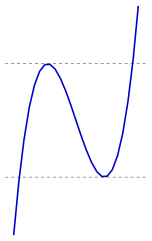 Therefore there will be either \(1\) (if it meets it in the \(\cup\) area) or \(3\) (if it meets it on the far left) positive roots.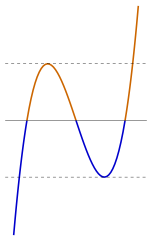
- First notice that if \(c > 0\) we cannot have three positive real roots since the function would need to pass \(0\) between \(0\) and \(-\infty\). Secondly, notice both turning points must be larger than zero, ie \begin{align*} && 0 &= 3x^2 + 6ax + 3b \\ \Leftrightarrow && 0 &= (x+a)^2 + b - a^2 \end{align*} has both roots larger than zero, (and it needs to have two roots, so \(a^2 > b\) and \(-a > 0\), ie \(a < 0\). If \(b < 0\), then just looking at \(x^2+2ax+b\) we can see that it is \(<0\) at \(0\) and one of the roots will be negative, therefore \(c < 0\), \(a^2 > b > 0\) and \(a < 0\)
- Since \(c > 0\) we can see that at least one root is negative.
ie the \(y\)-axis passes through an orange section of this curve. What now matters is where the larger turning point is. Considering \(x^2 + 2ax + b\), we notice that \(ab < 0\) means that \((x-\alpha)(x-\beta)\) we must have \((\alpha + \beta)\alpha \beta > 0\) which isn't possible if both roots are negative. Therefore the \(y\)-axis passes through the orange \(\cap\) and there are \(2\) positive real roots.
- If we take \(a = 1, b = -1, c = 1\) then we have \(x^3 + 3x^2-3x+1\). This has turning points when \(x^2+2x-1 = 0\), ie \(x = -1 \pm \sqrt{2}\) Notice that \begin{align*} && y(-1\pm \sqrt2) &= (-1 \pm \sqrt{2})^3 + 3(-1 \pm \sqrt{2})^2-3(-1 \pm \sqrt{2}) + 1 \\ &&&= (-1\pm \sqrt{2}) \cdot (3 \mp 2\sqrt2) + 3(3 \mp \sqrt2) -3(-1\pm \sqrt2) + 1 \\ &&&= (-7 \pm 5 \sqrt2) + (9 \mp 3\sqrt2) +(3 \mp 3\sqrt2) + 1 \\ &&&= 24 \mp 16\sqrt2 = 8(3 \mp 2 \sqrt2) >0 \end{align*} ie both turning points are above zero and hence only one real root
If \(\p(x)\) and \(\q(x)\) are polynomials of degree \(m\) and \(n\), respectively, what is the degree of \(\p(\q(x))\)?
- The polynomial \(\p(x)\) satisfies \[ \p(\p(\p(x)))- 3 \p(x)= -2x\, \] for all \(x\). Explain carefully why \(\p(x)\) must be of degree 1, and find all polynomials that satisfy this equation.
- Find all polynomials that satisfy \[ 2\p(\p(x)) +3 [\p(x)]^2 -4\p(x) =x^4 \] for all \(x\).
- Suppose \(\p(\p(\p(x)))- 3 \p(x)= -2x\), and suppose \(p(x)\) has degree \(n = \geq 2\), then \(\p(\p(\p(x)))\) has degree \(n^3\) and so the left hand side has degree higher than \(1\) and the right hand side is degree \(1\). Therefore \(\p(x)\) is degree \(1\) or \(0\). If \(p(x) = c\) then \(c^3-3c = -2x\) but the LHS doesn't depend on \(x\) which is also a contradiction. Therefore \(\p(x)\) is degree \(1\). Suppose \(\p(x) = ax+b\) then: \begin{align*} && -2x &= \p(\p(\p(x))) - 3\p(x) \\ &&&= \p(\p(ax+b)) - 3(ax+b) \\ &&&= \p(a(ax+b)+b) - 3ax -3b \\ &&&= a(a^2x+ab+b) + b - 3ax - 3b \\ &&&= (a^3-3a)x + b(a^2+a-2) \\ \Rightarrow &&& \begin{cases} a^3-3a&=-2 \\ b(a^2+a-2) &= 0\end{cases} \\ \Rightarrow &&& \begin{cases} a^3-3a+2 = 0 \\ b = 0, a = 1, a = -2\end{cases} \\ \Rightarrow &&& \begin{cases} (a-1)(a^2+a-2) = 0 \\ b = 0, a = 1, a = -2\end{cases} \\ \Rightarrow && (a,b) &= (1, b), (-2,b) \end{align*}
- Suppose \(2\p(\p(x)) +3 [\p(x)]^2 -4\p(x) =x^4\) and let \(\deg \p(x) = n\), then LHS has degree \(\max(n^2,2n,n)\) and the right hand side has degree \(4\). Therefore \(\p(x)\) must have degree \(2\). Let \(\p(x) = ax^2 + bx + c\), then, considering the coefficient of \(x^4\) in \(2\p(\p(x)) + 3[\p(x)]^2 -4\p(x)\) we will have \(2a^3+3a^2=1 \Rightarrow 2a^3+3a^2-1 = (a+1)^2(2a-1) \Rightarrow a = -1, a=\frac12\). Consider the coefficient of \(x^3\) in \(2\p(\p(x)) + 3[\p(x)]^2 -4\p(x)\) we have \(4a^2b+6ab = 0 \Rightarrow 2ab(2a+3) = 0\) Since \(a = -1, \frac12\) this means \(b = 0\). Consider the constant coefficient in \(2\p(\p(x)) + 3[\p(x)]^2 -4\p(x)\) (using \(b = 0\)). \(2ac^2+c+3c^2-4c = 0 \Rightarrow c(2ac+3c-3) = 0\). Therefore \(c = 0\) or \(a = -1, c = 3, a = \frac12, c = \frac34\), so our possible polynomials are: \(\p(x) = -x^2, \frac12x^2, -x^2+3, \frac12x^2+\frac34\)
The polynomial \(\f(x)\) is defined by \[ \f(x) = x^n + a_{{n-1}}x^{n-1} + \cdots + a_{2} x^2+ a_{1} x + a_{0}\,, \] where \(n\ge2\) and the coefficients \(a_{0}\), \(\ldots,\) \(a_{{n-1}}\) are integers, with \(a_0\ne0\). Suppose that the equation \(\f(x)=0\) has a rational root \(p/q\), where \(p\) and \(q\) are integers with no common factor greater than \(1\), and \(q>0\). By considering \(q^{n-1}\f(p/q)\), find the value of \(q\) and deduce that any rational root of the equation \(\f(x)=0\) must be an integer.
- Show that the \(n\)th root of \(2\) is irrational for \(n\ge2\).
- Show that the cubic equation \[ x^3- x +1 =0 \] has no rational roots.
- Show that the polynomial equation \[ x^n- 5x +7 =0 \] has no rational roots for \(n\ge2\).
- Note that \(\sqrt[n]2\) is a root of \(x^n - 2 =0\), but this has no integer solutions. (We can try all factors of \(2\)). Therefore all its roots must be irrational, ie \(\sqrt[n]2\) is irrational for \(n \geq 2\)
- If \(n\) is a root of \(x^3 - x+1\) then it must be \(1\) or \(-1\) by the rational root theorem, ie \(1-1+1 \neq 0\) and \(-1 + 1 +1 \neq 0\), therefore no integer roots, therefore no rational roots.
- Suppose \(m\) is an integer root of \(x^n - 5x + 7 = 0\) then by considering parity we must have \(m^n - 5m + 7 \equiv 1 \pmod{2}\) therefore we cannot have any rational roots.
- By considering the positions of its turning points, show that the curve with equation \[ y=x^3-3qx-q(1+q)\,, \] where \(q>0\) and \(q\ne1\), crosses the \(x\)-axis once only.
- Given that \(x\) satisfies the cubic equation \[ x^3-3qx-q(1+q)=0\,, \] and that \[ x=u+q/u\,, \] obtain a quadratic equation satisfied by \(u^3\). Hence find the real root of the cubic equation in the case \(q>0\), \(q\ne1\).
- The quadratic equation \[ t^2 -pt +q =0\, \] has roots \(\alpha \) and \(\beta\). Show that \[ \alpha^3+\beta^3 = p^3 -3qp\,. \] It is given that one of these roots is the square of the other. By considering the expression \((\alpha^2 -\beta)(\beta^2-\alpha)\), find a relationship between \(p\) and \(q\). Given further that \(q>0\), \(q\ne1\) and \(p\) is real, determine the value of \(p\) in terms of \(q\).
- The number \(\alpha\) is a common root of the equations \(x^2 +ax +b=0\) and \(x^2+cx+d=0\) (that is, \(\alpha\) satisfies both equations). Given that \(a\ne c\), show that \[ \alpha =- \frac{b-d}{a-c}\,. \] Hence, or otherwise, show that the equations have at least one common root if and only if \[ (b-d)^2 -a(b-d)(a-c) + b(a-c)^2 =0\,. \] Does this result still hold if the condition \(a\ne c\) is not imposed?
- Show that the equations \(x^2+ax+b=0\) and \(x^3+(a+1)x^2+qx+r=0\) have at least one common root if and only if \[ (b-r)^2-a(b-r)(a+b-q) +b(a+b-q)^2=0\,. \] Hence, or otherwise, find the values of \(b\) for which the equations \(2x^2+5 x+2 b=0\) and \(2x^3+7x^2+5x+1=0\) have at least one common root.
- \begin{align*} && 0 &= \alpha^2 + a \alpha + b \tag{1} \\ && 0 &= \alpha^2 + c \alpha + d \tag{2} \\ \\ (1) - (2): && 0 & =\alpha ( a-c) + (b-d) \\ \Rightarrow && \alpha &= - \frac{b-d}{a-c} \tag{\(a\neq c\)} \end{align*} (\(\Rightarrow\)) Suppose they have a common root, then given we know it's form, we must have: \begin{align*} && 0 &= \left ( - \frac{b-d}{a-c} \right)^2 +a\left ( - \frac{b-d}{a-c} \right) + b \\ \Rightarrow && 0 &= (b-d)^2 - a(b-d)(a-c) + b(a-c)^2 \end{align*} (\(\Leftarrow\)) Suppose the equation holds, then \begin{align*} && 0 &= (b-d)^2 - a(b-d)(a-c) + b(a-c)^2 \\ \Rightarrow && 0 &= \left ( - \frac{b-d}{a-c} \right)^2 +a\left ( - \frac{b-d}{a-c} \right) + b \\ \end{align*} So \(\alpha\) is a root of the first equation. Considering \((1) - (2)\) we must have that \(\alpha(a-c) +(b-d) = t\) (whatever the second equation is), but that value is clearly \(0\), therefore \(\alpha\) is a root of both equations. If \(a = c\) then the equation becomes \(0 = (b-d)^2\), ie the two equations are the same, therefore they must have common roots!
- \begin{align*} && 0 &= x^2+ax+b \tag{1} \\ && 0 &= x^3+(a+1)x^2+qx+r \tag{2} \\ \\ (2) - x(1) && 0 &= x^2 + (q-b)x + r \tag{3} \end{align*} Therefore if the equations have a common root, \((1)\) and \((3)\) have a common root, ie \((b-r)^2-a(b-r)(a-(q-b))+b(a-(q-b))^2 = 0\) which is exactly our condition. \(a = \frac52, q = \frac52, r = \frac12\) \begin{align*} && 0 &= \left (b-\frac12 \right)^2 - \frac52\left (b-\frac12\right) b + b^3 \\ &&&= b^2 -b + \frac14 - \frac52 b^2+\frac54b + b^3 \\ &&&= b^3 -\frac32 b^2 +\frac14 b + \frac14 \\\Rightarrow && 0 &= 4b^3 - 6b^2+b + 1 \\ &&&= (b-1)(4b^2-2b-1) \\ \Rightarrow && b &= 1, \frac{1 \pm \sqrt{5}}{4}\end{align*}
The polynomial \(\p(x)\) is of degree 9 and \(\p(x)-1\) is exactly divisible by \((x-1)^5\).
- Find the value of \(\p(1)\).
- Show that \(\p'(x)\) is exactly divisible by \((x-1)^4\).
- Given also that \(\p(x)+1\) is exactly divisible by \((x+1)^5\), find \(\p(x)\).
- \(p(1) = q(1)(1-1)^5 + 1 = 1\).
- \(p'(x) = q'(x)(x-1)^5 + 5(x-1)^4q(x) + 0 = (x-1)^4((x-1)q'(x) + 5q(x))\) so \(p'(x)\) is divisible by \((x-1)^4\)
- \(p(x)+1\) divisible by \((x+1)^5\) means that \(p(-1) = -1\) and \(p'(x)\) is divisible by \((x+1)^4\). Since \(p'(x)\) is degree \(8\) it must be \(c(x+1)^4(x-1)^4 = c(x^2 - 1)^4\). Expanding and integrating, we get \(p(x) = c(\frac{1}{9}x^9 -\frac{4}{7}x^7 + \frac{6}{5}x^5 - \frac{4}{3}x^3 + x) + d\). When \(x = 1\) we get \(c \frac{128}{315} + d = 1\) and when \(x = -1\) we get \(-c \frac{128}{315} + d = -1\) so \(2d = 0 \Rightarrow d = 0, c = \frac{315}{128}\) and \[ p(x) =\frac{315}{128} \l \frac{1}{9}x^9 -\frac{4}{7}x^7 + \frac{6}{5}x^5 - \frac{4}{3}x^3 + x\r \]
The points \(S\), \(T\), \(U\) and \(V\) have coordinates \((s,ms)\), \((t,mt)\), \((u,nu)\) and \((v,nv)\), respectively. The lines \(SV\) and \(UT\) meet the line \(y=0\) at the points with coordinates \((p,0)\) and \((q,0)\), respectively. Show that \[ p = \frac{(m-n)sv}{ms-nv}\,, \] and write down a similar expression for \(q\). Given that \(S\) and \(T\) lie on the circle \(x^2 + (y-c)^2 = r^2\), find a quadratic equation satisfied by \(s\) and by \(t\), and hence determine \(st\) and \(s+t\) in terms of \(m\), \(c\) and \(r\). Given that \(S\), \(T\), \(U\) and \(V\) lie on the above circle, show that \(p+q=0\).
Show that \(x^3-3xbc + b^3 + c^3\) can be written in the form \(\left( x+ b+ c \right) {\rm Q}( x)\), where \({\rm Q}( x )\) is a quadratic expression. Show that \(2{\rm Q }( x )\) can be written as the sum of three expressions, each of which is a perfect square. It is given that the equations \(ay^2 + by + c =0\) and \(by^2 + cy + a = 0\) have a common root \(k\). The coefficients \(a\), \(b\) and \(c\) are real, \(a\) and \(b\) are both non-zero, and \(ac \neq b^2\). Show that \[ \left( ac - b^2 \right) k = bc - a^2 \] and determine a similar expression involving \(k^2\). Hence show that \[ \left( ac - b^2 \right) \left(ab-c^2 \right) = \left( bc - a^2 \right)^2 \] and that \( a^3 -3abc + b^3 +c^3 = 0\,\). Deduce that either \(k=1\) or the two equations are identical.
Show Solution- Given that \(x^2 - y^2 = \left( x - y \right)^3\) and that \(x-y = d\) (where \(d \neq 0\)), express each of \(x\) and \(y\) in terms of \(d\). Hence find a pair of integers \(m\) and \(n\) satisfying \(m-n = \left( \sqrt {m} - \sqrt{n} \right)^3\) where \(m > n > 100\).
- Given that \(x^3 - y^3 = \left( x - y \right)^4\) and that \(x-y = d\) (where \(d \neq 0\)), show that \(3xy = d^3 - d^2\). Hence show that \[ 2x = d \pm d \sqrt {\frac{4d-1 }{3}} \] and determine a pair of distinct positive integers \(m\) and \(n\) such that \(m^3 - n^3 = \left( m - n \right)^4\).
- \(\,\) \begin{align*} && x^2-y^2 &=(x-y)^3 \\ \Rightarrow && x+y &=d^2 \\ && x-y &= d \\ \Rightarrow && x &= \tfrac12(d^2+d) \\ && y &= \tfrac12(d^2-d) \end{align*} Therefore consider \(x^2 = m, y^2 = n\), so \(m = \tfrac14(d^2+d)^2, n = \tfrac14(d^2-d)^2\) so we want \(d^2-d > 20\), so \(d = 6, n = 225, m = 441\).
- \(\,\) \begin{align*} && x^3-y^3 &= (x-y)^4 \\ \Rightarrow && x^2+xy+y^2 &= (x-y)^3 \\ && d^3 &= (x-y)^2+3xy \\ && d^3 &= d^2 + 3xy \\ \Rightarrow && 3xy &= d^3 - d^2 \\ \Rightarrow && 3x(x-d) &= d^3-d^2 \\ \Rightarrow && 0 &= 3x^2-3dx-(d^3-d^2) \\ \Rightarrow && 2x &=d \pm \sqrt{d^2+4\frac{(d^3-d^2)}{3}} \\ &&&= d \pm d \sqrt{\frac{3+4d-4}{3}} \\ &&&= d \pm d \sqrt{\frac{4d-1}{3}} \end{align*} Therefore we need \(\frac{4d-1}{3}\) to be an odd square. \(y = x-d = -\frac{d}{2} \pm \frac{d}{2} \sqrt{\frac{4d-1}{3}}\). Since we want positive values, we should take the positive square roots. \(d = \frac{3 \cdot 3^2 + 1}{4} = 7\) we have \(2x = 7 +7 \cdot 3 = 28 \Rightarrow x = 14, y = 7\)
A curve is given by the equation \[ y = ax^3 - 6ax^2+ \left( 12a + 12 \right)x - \left( 8a + 16 \right)\,, \tag{\(*\)} \] where \(a\) is a real number. Show that this curve touches the curve with equation \[ y=x^3 \tag{\(**\)} \] at \(\left( 2 \, , \, 8 \right)\). Determine the coordinates of any other point of intersection of the two curves.
- Sketch on the same axes the curves \((*)\) and \((**)\) when \(a = 2\).
- Sketch on the same axes the curves \((*)\) and \((**)\) when \(a = 1\).
- Sketch on the same axes the curves \((*)\) and \((**)\) when \(a = -2\).


- Show that \(x-3\) is a factor of \begin{equation} x^3-5x^2+2x^2y+xy^2-8xy-3y^2+6x+6y \;. \tag{\(*\)} \end{equation} Express (\( * \)) in the form \((x-3)(x+ay+b)(x+cy+d)\) where \(a\), \(b\), \(c\) and \(d\) are integers to be determined.
- Factorise \(6y^3-y^2-21y+2x^2+12x-4xy+x^2y-5xy^2+10\) into three linear factors.
- Let \(f(x,y) = x^3-5x^2+2x^2y+xy^2-8xy-3y^2+6x+6y\), then \begin{align*} f(3,y) &= 27 - 5 \cdot 9 +18y + 3y^2-24y-3y^2+18 + 6y \\ &= 0 \end{align*}, therefore \(x-3\) is a factor of \(f(x,y)\). \begin{align*} f(x,y) &= x^3-5x^2+6x+y(2x^2-8x+6) + y^2(x-3) \\ &= (x-3)(x^2-2x)+y(x-3)(2x-2)+y^2(x-3) \\ &= (x-3)(x^2-2x+2y(x-1)+y^2) \\ &= (x-3)(x+y)(x+y-2) \end{align*}
- Let \(g(x,y) = 6y^3-y^2-21y+2x^2+12x-4xy+x^2y-5xy^2+10\), notice that \(g(x,-2) = 0\), so \(y+2\) is a factor, \begin{align*} g(x,y) &= 6y^3-y^2-21y+2x^2+12x-4xy+x^2y-5xy^2+10 \\ &= x^2(2+y) + x(12-4y-5y^2) + 6y^3-y^2-21y+10 \\ &= x^2(y+2) + x(y+2)(6-5y) + (y+2)(6y^2-13y+5) \\ &= (y+2)(x^2+(6-5y)x+(6y^2-13y+5)) \\ &= (y+2)(x-2y +1)(x-3y+5) \end{align*}
Let \[ \f(x) = x^n + a_1 x^{n-1} + \cdots + a_n\;, \] where \(a_1\), \(a_2\), \(\ldots\), \(a_n\) are given numbers. It is given that \(\f(x)\) can be written in the form \[ \f(x) = (x+k_1)(x+k_2)\cdots(x+k_n)\;. \] By considering \(\f(0)\), or otherwise, show that \(k_1k_2 \ldots k_n =a_n\). Show also that $$(k_1+1)(k_2+1)\cdots(k_n+1)= 1+a_1+a_2+\cdots+a_n$$ and give a corresponding result for \((k_1-1)(k_2-1)\cdots(k_n-1)\). Find the roots of the equation \[ x^4 +22x^3 +172x^2 +552x+576=0\;, \] given that they are all integers.
Show SolutionSketch, without calculating the stationary points, the graph of the function \(\f(x)\) given by \[ \f(x) = (x-p)(x-q)(x-r)\;, \] where \(p < q < r\). By considering the quadratic equation \(\f'(x)=0\), or otherwise, show that \[ (p+q+r)^2 > 3(qr+rp+pq)\;. \] By considering \((x^2+gx+h)(x-k)\), or otherwise, show that \(g^2>4h\,\) is a sufficient condition but not a necessary condition for the inequality \[ (g-k)^2>3(h-gk) \] to hold.
Show Solution
Prove that if \({(x-a)^{2}}\) is a factor of the polynomial \(\p(x)\), then \(\p'(a)=0\). Prove a corresponding result if \((x-a)^4\) is a factor of \(\p(x).\) Given that the polynomial $$ x^6+4x^5-5x^4-40x^3-40x^2+32x+k $$ has a factor of the form \({(x-a)}^4\), find \(k\).
Show SolutionGiven that \[ x^4 + p x^2 + q x + r = ( x^2 - a x + b ) ( x^2 + a x + c ) , \] express \(p\), \(q\) and \(r\) in terms of \(a\), \(b\) and \(c\). Show also that \( a^2\) is a root of the cubic equation $$ u^3 + 2 p u^2 + ( p^2 - 4 r ) u - q^2 = 0 . $$ Explain why this equation always has a non-negative root, and verify that \(u = 9\) is a root in the case \(p = -1\), \(q = -6\), \(r = 15\) . Hence, or otherwise, express $$y^4 - 8 y^3 + 23 y^2 - 34 y + 39$$ as a product of two quadratic factors.
Show Solution