Normal Distribution
- \(X_1\) and \(X_2\) are both random variables which take values \(x_1, x_2, \ldots, x_n\), with probabilities \(a_1, a_2, \ldots, a_n\) and \(b_1, b_2, \ldots, b_n\) respectively. The value of random variable \(Y\) is defined to be that of \(X_1\) with probability \(p\) and that of \(X_2\) with probability \(q = 1-p\). If \(X_1\) has mean \(\mu_1\) and variance \(\sigma_1^2\), and \(X_2\) has mean \(\mu_2\) and variance \(\sigma_2^2\), find the mean of \(Y\) and show that the variance of \(Y\) is \(p\sigma_1^2 + q\sigma_2^2 + pq(\mu_1 - \mu_2)^2\).
- To find the value of random variable \(B\), a fair coin is tossed and a fair six-sided die is rolled. If the coin shows heads, then \(B = 1\) if the die shows a six and \(B = 0\) otherwise; if the coin shows tails, then \(B = 1\) if the die does not show a six and \(B = 0\) if it does. The value of \(Z_1\) is the sum of \(n\) independent values of \(B\), where \(n\) is large. Show that \(Z_1\) is a Binomial random variable with probability of success \(\frac{1}{2}\). Using a Normal approximation, show that the probability that \(Z_1\) is within \(10\%\) of its mean tends to \(1\) as \(n \longrightarrow \infty\).
- To find the value of random variable \(Z_2\), a fair coin is tossed and \(n\) fair six-sided dice are rolled, where \(n\) is large. If the coin shows heads, then the value of \(Z_2\) is the number of dice showing a six; if the coin shows tails, then the value of \(Z_2\) is the number of dice not showing a six. Use part (i) to write down the mean and variance of \(Z_2\). Explain why a Normal distribution with this mean and variance will not be a good approximation to the distribution of \(Z_2\). Show that the probability that \(Z_2\) is within \(10\%\) of its mean tends to \(0\) as \(n \longrightarrow \infty\).
- The random variable \(Z\) has a Normal distribution with mean \(0\) and variance \(1\). Show that the expectation of \(Z\) given that \(a < Z < b\) is \[ \frac{\exp(- \frac12 a^2) - \exp(- \frac12 b^2) } {\sqrt{2\pi\,} \,\big(\Phi(b) - \Phi(a)\big)}, \] where \(\Phi\) denotes the cumulative distribution function for \(Z\).
- The random variable \(X\) has a Normal distribution with mean \(\mu\) and variance \(\sigma^2\). Show that \[ \E(X \,\vert\, X>0) = \mu + \sigma \E(Z \,\vert\,Z > -\mu/\sigma). \] Hence, or otherwise, show that the expectation, \(m\), of \(\vert X\vert \) is given by \[ m= \mu \big(1 - 2 \Phi(- \mu / \sigma)\big) + \sigma \sqrt{2 / \pi}\; \exp(- \tfrac12 \mu^2 / \sigma^2) \,. \] Obtain an expression for the variance of \(\vert X \vert\) in terms of \(\mu \), \(\sigma \) and \(m\).
- \(\,\) \begin{align*} && \mathbb{E}(Z| a < Z < b) &= \mathbb{E}(Z\mathbb{1}_{(a,b)}) /\mathbb{E}(\mathbb{1}_{(a,b)}) \\ &&&= \int_a^b z \phi(z) \d z \Big / (\Phi(b) - \Phi(a)) \\ &&&= \frac{\int_a^b \frac{1}{\sqrt{2 \pi}}z e^{-\frac12 z^2} \d z}{\Phi(b) - \Phi(a)} \\ &&&= \frac{\frac1{\sqrt{2\pi}} \left [-e^{-\frac12 z^2} \right]_a^b}{\Phi(b) - \Phi(a)} \\ &&&= \frac{\frac1{\sqrt{2\pi}} \left (e^{-\frac12 a^2}-e^{-\frac12 b^2} \right)}{\Phi(b) - \Phi(a)} \\ \end{align*}
- \(\,\) \begin{align*} && \mathbb{E}(X |X > 0) &= \mathbb{E}(\mu + \sigma Z | \mu + \sigma Z > 0) \\ &&&= \mathbb{E}(\mu + \sigma Z | Z > -\tfrac{\mu}{\sigma}) \\ &&&= \mathbb{E}(\mu| Z > -\tfrac{\mu}{\sigma})+ \sigma \mathbb{E}(Z | Z > -\tfrac{\mu}{\sigma})\\ &&&= \mu+ \sigma \mathbb{E}(Z | Z > -\tfrac{\mu}{\sigma})\\ \end{align*} Hence \begin{align*} &&\mathbb{E}(|X|) &= \mathbb{E}(X | X > 0)\mathbb{P}(X > 0) - \mathbb{E}(X | X < 0)\mathbb{P}(X < 0) \\ &&&=\left ( \mu+ \sigma \mathbb{E}(Z | Z > -\mu /\sigma)\right)(1-\Phi(-\mu/\sigma)) - \left ( \mu+ \sigma \mathbb{E}(Z | Z < -\mu /\sigma)\right)\Phi(-\mu/\sigma) \\ &&&= \mu(1 - 2\Phi(-\mu/\sigma)) + \sigma \frac{e^{-\frac12\mu^2/\sigma^2}}{\sqrt{2\pi}(1-\Phi(-\mu/\sigma))}(1-\Phi(-\mu/\sigma)) + \sigma \frac{e^{-\frac12\mu^2/\sigma^2}}{\sqrt{2 \pi} \Phi(-\mu/\sigma)} \Phi(-\mu/\sigma) \\ &&&= \mu(1 - 2\Phi(-\mu/\sigma)) + \sigma \sqrt{\frac{2}{\pi}} \exp(-\tfrac12 \mu^2/\sigma^2) \end{align*} Finally, \begin{align*} && \textrm{Var}(|X|) &= \mathbb{E}(|X|^2) - [\mathbb{E}(|X|)]^2 \\ &&&= \mu^2 + \sigma^2 - m^2 \end{align*}
A continuous random variable \(X\) has probability density function given by \[ \f(x) = \begin{cases} 0 & \mbox{for } x<0 \\ k\e^{-2 x^2} & \mbox{for } 0\le x< \infty \;,\\ \end{cases} \] where \(k\) is a constant.
- Sketch the graph of \(\f(x)\).
- Find the value of \(k\).
- Determine \(\E(X)\) and \(\var(X)\).
- Use statistical tables to find, to three significant figures, the median value of \(X\).
- \par

- Let \(Y \sim N(0,\frac14)\), then: \begin{align*} &&\int_0^\infty \frac{1}{\sqrt{2 \pi \cdot \frac14}} e^{-2x^2} \, dx &= \frac12\\ \Rightarrow && \int_0^\infty e^{-2x^2} &= \frac{\sqrt{\pi}}{2 \sqrt{2}} \\ \Rightarrow && k &= \boxed{\frac{2\sqrt{2}}{\sqrt{\pi}}} \end{align*}
- \begin{align*} \mathbb{E}[X] &= \int_0^\infty x f(x) \, dx \\ &= \frac{2\sqrt{2}}{\sqrt{\pi}}\int_0^\infty x e^{-2x^2}\, dx \\ &= \frac{2\sqrt{2}}{\sqrt{\pi}} \left [-\frac{1}{4}e^{-2x^2} \right]_0^\infty \\ &= \frac{1}{\sqrt{2\pi}} \\ \end{align*} In order to calculate \(\mathbb{E}(X^2)\) it is useful to consider the related computation \(\mathbb{E}(Y^2)\). In fact, by symmetry, these will be the same values. Therefore \(\mathbb{E}(X^2) = \mathbb{E}(Y^2) = \mathrm{Var}(Y) = \frac{1}{4}\) (since \(\mathbb{E}(Y) = 0\)). Therefore \(\mathrm{Var}(Y) = \mathbb{E}(Y^2) - \mathbb{E}(Y)^2 = \frac14 - \frac{1}{2\pi}\)
- \begin{align*} && \mathbb{P}(X < x) &= \frac12 \\ \Leftrightarrow && 2\mathbb{P}(0 \leq Y < x) &= \frac12 \\ \Leftrightarrow && 2\l \mathbb{P}(Y < x) - \frac12 \r &= \frac12 \\ \Leftrightarrow && \mathbb{P}(Y < x)&= \frac34 \\ \Leftrightarrow && \mathbb{P}(\frac{Y-0}{1/2} < \frac{x}{1/2})&= \frac34 \\ \Leftrightarrow && \mathbb{P}(Z < \frac{x}{1/2})&= \frac34 \\ \Leftrightarrow && \Phi(2x)&= \frac34 \\ \Leftrightarrow && 2x &= 0.6744895\cdots \\ \Leftrightarrow && x &= 0.3372\cdots \\ \Leftrightarrow && &= 0.337 \, (3 \text{sf}) \\ \end{align*}
The random variable \(X\) has mean \(\mu\) and standard deviation \(\sigma\). The distribution of \(X\) is symmetrical about \(\mu\) and satisfies: \[\P \l X \le \mu + \sigma \r = a \mbox{ and } \P \l X \le \mu + \tfrac{1}{ 2}\sigma \r = b\,,\] where \(a\) and \(b\) are fixed numbers. Do not assume that \(X\) is Normally distributed.
- Determine expressions (in terms of \(a\) and \(b\)) for \[ \P \l \mu-\tfrac12 \sigma \le X \le \mu + \sigma \r \mbox{ and } \P \l X \le \mu +\tfrac12 \sigma \; \vert \; X \ge \mu - \tfrac12 \sigma \r.\]
- My local supermarket sells cartons of skimmed milk and cartons of full-fat milk: \(60\%\) of the cartons it sells contain skimmed milk, and the rest contain full-fat milk.
The volume of skimmed milk in a carton is modelled by \(X\) ml, with \(\mu = 500\) and \(\sigma =10\,\). The volume of full-fat milk in a carton is modelled by \(X\) ml, with \(\mu = 495\) and \(\sigma = 10\,\).
- Today, I bought one carton of milk, chosen at random, from this supermarket. When I get home, I find that it contains less than 505 ml. Determine an expression (in terms of \(a\) and \(b\)) for the probability that this carton of milk contains more than 500 ml.
- Over the years, I have bought a very large number of cartons of milk, all chosen at random, from this supermarket. \(70\%\) of the cartons I have bought have contained at most 505 ml of milk. Of all the cartons that have contained at least 495 ml of milk, one third of them have contained full-fat milk. Use this information to estimate the values of \(a\) and \(b\).
- \(\,\) \begin{align*} && \mathbb{P}\left (\mu - \tfrac12 \sigma \leq X \right) &= \mathbb{P}\left (X \leq \mu + \tfrac12 \sigma \right) \tag{by symmetry} \\ &&&= b \\ \Rightarrow && \mathbb{P} \left (\mu - \tfrac12 \sigma \leq X \leq \mu + \sigma \right) &= a - (1-b) = a+b - 1\\ \\ && \mathbb{P} \left ( X \le \mu +\tfrac12 \sigma \vert X \ge \mu - \tfrac12 \sigma \right ) &= \frac{ \mathbb{P} \left (\mu - \tfrac12 \sigma \leq X \leq \mu + \tfrac12 \sigma \right)}{\mathbb{P} \left ( X \ge \mu - \tfrac12 \sigma \right )} \\ &&&= \frac{b-(1-b)}{1-(1-b)} \\ &&&= \frac{2b-1}{b} \end{align*}
- Let \(Y\) be the volume of milk in the carton I bring home, we are interested in: \begin{align*} && \mathbb{P}(Y \geq 500 | Y \leq 505) &= \frac{\mathbb{P}(500 \leq Y \leq 505)}{\mathbb{P}(Y \leq 505)} \\ &&&=\frac{\mathbb{P}(500 \leq Y \leq 505|\text{skimmed})\mathbb{P}(\text{skimmed})+\mathbb{P}(500 \leq Y \leq 505|\text{full fat})\mathbb{P}(\text{full fat})}{\mathbb{P}(Y \leq 505|\text{skimmed})\mathbb{P}(\text{skimmed})+\mathbb{P}(Y \leq 505|\text{full fat})\mathbb{P}(\text{full fat})} \\ &&&= \frac{\frac35 \cdot \mathbb{P}(\mu \leq X \leq \mu + \tfrac12 \sigma) + \frac25 \cdot \mathbb{P}(\mu+\tfrac12 \sigma \leq X \leq \mu +\sigma)}{\frac35 \cdot \mathbb{P}(X \leq \mu + \tfrac12 \sigma) + \frac25 \cdot \mathbb{P}(X \leq \mu +\sigma)} \\ &&&= \frac{\frac35 \cdot(b-\tfrac12) + \frac25 \cdot (a-b)}{\frac35 \cdot b + \frac25 \cdot a} \\ &&&= \frac{b+2a-\frac32}{3b+2a} \\ &&&= \frac{4a+2b-3}{4a+6b} \end{align*}
- \(70\%\) of cartons have contained at most 505 ml, so: \begin{align*} && \tfrac7{10} &= \mathbb{P}(Y \leq 505) \\ &&&= \mathbb{P}(Y \leq 505 | \text{ skimmed}) \mathbb{P}(\text{skimmed}) + \mathbb{P}(Y \leq 505 | \text{ full fat}) \mathbb{P}(\text{full fat}) \\ &&&= \mathbb{P}(X \leq \mu + \tfrac12 \sigma) \cdot \tfrac35 + \mathbb{P}(X\leq \mu + \sigma ) \cdot \tfrac25 \\ \Rightarrow && 7 &= 6b+ 4a \end{align*} \(\tfrac13\) of cartons containing 495 ml contained full fat milk: \begin{align*} && \tfrac13 &= \mathbb{P}(\text{full fat} | Y \geq 495) \\ &&&= \frac{\mathbb{P}(\text{full fat and} Y \geq 495) }{\mathbb{P}(Y \geq 495)} \\ &&&= \frac{\mathbb{P}(X \geq \mu)\frac25}{\mathbb{P}(X \geq \mu)\cdot \frac25+\mathbb{P}(X \geq \mu-\tfrac12 \sigma)\cdot \frac35} \\ &&&= \frac{\frac15}{\frac12 \cdot \frac25 + b\frac35}\\ &&&= \frac{1}{1+ 3b }\\ \Rightarrow && 3b+1 &= 3 \\ \Rightarrow && b &= \frac23 \\ && a &= \frac34 \end{align*}
The probability density function \(\f(x)\) of the random variable \(X\) is given by $$\f(x) = k\left[{\phi}(x) + {\lambda}\g(x)\right]$$ where \({\phi}(x)\) is the probability density function of a normal variate with mean 0 and variance 1, \(\lambda \) is a positive constant, and \(\g(x)\) is a probability density function defined by \[ \g(x)= \begin{cases} 1/\lambda & \mbox{for \(0 \le x \le {\lambda}\)}\,;\\ 0& \mbox{otherwise} . \end{cases} \] Find \(\mu\), the mean of \(X\), in terms of \(\lambda\), and prove that \(\sigma\), the standard deviation of \(X\), satisfies. $$\sigma^2 = \frac{\lambda^4 +4{\lambda}^3+12{\lambda}+12} {12(1 + \lambda )^2}\;.$$ In the case \(\lambda=2\):
- draw a sketch of the curve \(y=\f(x)\);
- express the cumulative distribution function of \(X\) in terms of \(\Phi(x)\), the cumulative distribution function corresponding to \(\phi(x)\);
- evaluate \(\P(0 < X < \mu+2\sigma)\), given that \(\Phi (\frac 23 + \frac23 \surd7)=0.9921\).
- \(\,\)
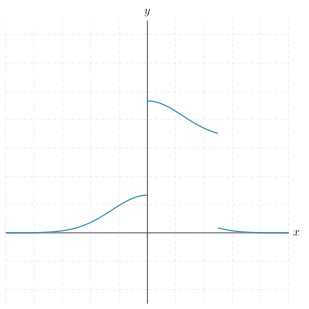
- \(\,\) \begin{align*} && \mathbb{P}(X \leq x) &= \int_{-\infty}^x f(x) \d x \\ &&&= \begin{cases} \frac13 \Phi(x) & \text{if } x < 0 \\ \frac13\Phi(x) + \frac13x & \text{if } 0 \leq x \leq 2 \\ \frac13 \Phi(x) + \frac23 & \text{if } 2 < x \end{cases} \end{align*} When \(\lambda = 2\), \(\mu = \frac{4}{6} = \frac23\), \(\sigma^2 = \frac{16+32+24+12}{12 \cdot 9} = \frac{7}{9}\), so \(\mu + 2 \sigma = \frac23 + \frac{2\sqrt7}{3}>2\). Therefore \begin{align*} && \P(0 < X < \mu + 2\sigma) &= \frac13 \Phi\left (\frac{2+2\sqrt{7}}{3} \right) + \frac23 - \Phi(0) \\ &&&= \tfrac13 \cdot 0.9921 +\tfrac23 - \tfrac12 \\ &&&= 0.4974 \end{align*}
Tabulated values of \({\Phi}(\cdot)\), the cumulative distribution function of a standard normal variable, should not be used in this question. Henry the commuter lives in Cambridge and his working day starts at his office in London at 0900. He catches the 0715 train to King's Cross with probability \(p\), or the 0720 to Liverpool Street with probability \(1-p\). Measured in minutes, journey times for the first train are \(N(55,25)\) and for the second are \(N(65,16)\). Journey times from King's Cross and Liverpool Street to his office are \(N(30,144)\) and \(N(25,9)\), respectively. Show that Henry is more likely to be late for work if he catches the first train. Henry makes \(M\) journeys, where \(M\) is large. Writing \(A\) for \(1-{\Phi}(20/13)\) and \(B\) for \(1-{\Phi}(2)\), find, in terms of \(A\), \(B\), \(M\) and \(p\), the expected number, \(L\), of times that Henry will be late and show that for all possible values of \(p\), $$BM \le L \le AM.$$ Henry noted that in 3/5 of the occasions when he was late, he had caught the King's Cross train. Obtain an estimate of \(p\) in terms of \(A\) and \(B\). [A random variable is said to be \(N\left({{\mu}, {\sigma}^2}\right)\) if it has a normal distribution with mean \({\mu}\) and variance \({\sigma}^2\).]
Show SolutionThe time taken for me to set an acceptable examination question it \(T\) hours. The distribution of \(T\) is a truncated normal distribution with probability density \(\f\) where \[ \mathrm{f}(t)=\begin{cases} \dfrac{1}{k\sigma\sqrt{2\pi}}\exp\left(-\dfrac{1}{2}\left(\dfrac{t-\sigma}{\sigma}\right)^{2}\right) & \mbox{ for }t\geqslant0\\ 0 & \mbox{ for }t<0. \end{cases} \] Sketch the graph of \(\f(t)\). Show that \(k\) is approximately \(0.841\) and obtain the mean of \(T\) as a multiple of \(\sigma\). Over a period of years, I find that the mean setting time is 3 hours.
- Find the approximate probability that none of the 16 questions on next year's paper will take more than 4 hours to set.
- Given that a particular question is unsatisfactory after 2 hours work, find the probability that it will still be unacceptable after a further 2 hours work.
Find the probability that the quadratic equation \[ X^{2}+2BX+1=0 \] has real roots when \(B\) is normally distributed with zero mean and unit variance. Given that the two roots \(X_{1}\) and \(X_{2}\) are real, find:
- the probability that both \(X_{1}\) and \(X_{2}\) are greater than \(\frac{1}{5}\);
- the expected value of \(\left|X_{1}+X_{2}\right|\);
- The smallest root will be \(-B - \sqrt{B^2-1}\). For this to be larger than \(\frac15\) we must have, \begin{align*} && -B -\sqrt{B^2-1} &\geq \frac15 \\ \Rightarrow && -B - \frac15 &\geq \sqrt{B^2 - 1} \\ \Rightarrow && B^2 + \frac25 B + \frac1{25} &\geq B^2 - 1 \\ \Rightarrow && \frac25 B \geq -\frac{26}{25} \\ \Rightarrow && B \geq -\frac{13}{5} \end{align*} Therefore \(-\frac{13}5 \leq B \leq -1\). Therefore we want: \begin{align*} \frac{\P(-\frac{13}5 \leq B \leq -1)}{\P(B < -1) + \P(B > 1)} &= \frac{\Phi(-1) - \Phi(-\frac{13}{5})}{\Phi(-1)+1-\Phi(1)} \\ &= \frac{0.1586\ldots - 0.0046\ldots}{0.1586\ldots + 1- 0.8413\ldots} \\ &= 0.4853\ldots \\ &= 0.485 \,\,(3 \text{ s.f.}) \end{align*}
- \(X_1 + X_2 = -2B\). Therefore we want: \begin{align*} \mathbb{E}(|X_1 + X_2| &= \mathbb{E}(|2B|) \\ &= 2 \l\frac{1}{2\Phi(-1)} \int_1^{\infty} B \frac{1}{\sqrt{2 \pi}} e^{-\frac12 B^2} \, \d B+\frac{1}{2\Phi(-1)} \int_{-\infty}^{-1} B \frac{1}{\sqrt{2 \pi}} e^{-\frac12 B^2} \, \d B \r \\ &= \frac{4}{2\Phi(-1)} \int_1^{\infty} B \frac{1}{\sqrt{2 \pi}} e^{-\frac12 B^2} \, \d B \\ &=\frac{4}{2\sqrt{2 \pi} \Phi(-1)} \left [ -e^{-\frac12 B^2}\right]_1^{\infty} \\ &= \frac{4}{2\sqrt{2 \pi} \Phi(-1) \sqrt{e}} \\ &= 3.0502\ldots \\ &= 3.05\,\, (3\text{ s.f.}) \end{align*}