Binomial Distribution
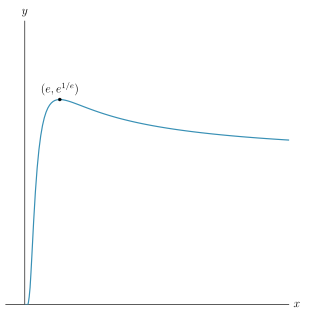
- Sketch a graph of \(y = x^{\frac{1}{x}}\) for \(x > 0\), showing the location of any turning points. Find the maximum value of \(n^{\frac{1}{n}}\), where \(n\) is a positive integer.
- The people to be tested are split into \(r\) groups of size \(k\), with \(k > 1\) and \(rk = N\).
- In every group, a sample from each person in that group is mixed into one large sample, which is then tested.
- If the enzyme is not present in the combined sample from a group, no further testing of the people in that group is needed.
- If the enzyme is present in the combined sample from a group, a second sample from each person in that group is tested separately.
- Find, in terms of \(N\), \(k\) and \(p\), the expected number of tests.
- Given that \(N\) is a multiple of \(3\), find the largest value of \(p\) for which it is possible to find an integer value of \(k\) such that \(k > 1\) and the expected number of tests is at most \(N\). Show that this value of \(p\) is greater than \(\frac{1}{4}\).
- Show that, if \(pk\) is sufficiently small, the expected number of tests is approximately \[ N\!\left(\frac{1}{k} + pk\right). \] In the case where \(p = 0.01\), show that choosing \(k = 10\) gives an expected number of tests which is only about \(20\%\) of \(N\).
- \(\,\)
\begin{align*} && y & = x^{1/x} = \exp \left ( \tfrac1x \ln x \right ) \\ \Rightarrow && y' &= \exp \left ( \tfrac1x \ln x \right ) \cdot \left ( \frac{1}{x^2} - \frac{\ln x}{x^2} \right ) \\ &&&= \frac{\exp \left ( \tfrac1x \ln x \right ) }{x^2}(1 - \ln x) \\ y' =0: && x &= e \end{align*} Therefore the largest integer values will be \(2\) or \(3\). Comparing \((2^{\frac12})^6 = 8 < 9 = (3^{1/3})^6\) we see the maximum value of \(n^{1/n}\) where \(n\) is an integer is \(\sqrt[3]{3}\)
- The number of tests is \(r\) plus however many groups fail times \(k\). The probability of a group failing is \(g = 1-(1-p)^k\) and the number of failing groups is \(\sim B(r, g)\) so the expected number of additional groups is \(rg\) and the expected total number of tests is \[ \frac{N}{k} + N(1-(1-p)^k) \]
- \(\,\) \begin{align*} && N &\geq E = \frac{N}{k} + N(1-(1-p)^k) \\ \Rightarrow && 1 &\geq \frac{1}{k} + 1-(1-p)^k \\ \Rightarrow && (1-p)^k &\geq \frac1k \\ \Rightarrow && k \ln(1-p) &\geq - \ln k \\ \Rightarrow && \ln(1 - p) &\geq -\frac{1}{k} \ln k \geq -\frac13 \ln 3 \\ \Rightarrow && 1-p &\geq \frac{1}{\sqrt[3]{3}} \\ \Rightarrow && p &\leq 1-\frac{1}{\sqrt[3]{3}} \end{align*} (taking \(k=3\)) Claim: \(1 - \frac{1}{\sqrt[3]{3}} > \frac14\) Proof: This is equivalent to \(\sqrt[3]{3} > \frac43\) or \(81 > 4^3 = 64\) which is clearly true.
- If \(pk\) is small then \((1-p)^k \approx 1 - pk\) and so we obtain \(N \left ( \frac1k +pk \right)\) as required. If \(p = 0.01\) and \(k = 10\) then \(\frac{1}{10} + 0.01 \cdot 10 = 0.2\) so the expected number of tests is \(\sim 20\%\) of \(N\)
In this question, you may use without proof the results \[\sum_{r=0}^{n} \binom{n}{r} = 2^n \quad \text{and} \quad \sum_{r=0}^{n} r\binom{n}{r} = n\,2^{n-1}.\]
- Show that \[r\binom{2n}{r} = (2n+1-r)\binom{2n}{2n+1-r}\] for \(1 \leqslant r \leqslant 2n\). Hence show that \[\sum_{r=0}^{2n} r\binom{2n}{r} = 2\sum_{r=n+1}^{2n} r\binom{2n}{r}.\]
- A fair coin is tossed \(2n\) times. The value of the random variable \(X\) is whichever is the larger of the number of heads and the number of tails shown. If \(n\) heads and \(n\) tails are shown, then \(X = n\). Show that \[\mathrm{E}(X) = n\left(1 + \frac{1}{2^{2n}}\binom{2n}{n}\right).\]
- Show that \(\dfrac{1}{2^{2n}}\dbinom{2n}{n}\) decreases as \(n\) increases.
- In a game, you choose a value of \(n\) and pay \(\pounds n\); then a fair coin is tossed \(2n\) times. You win an amount in pounds equal to the larger of the number of heads and the number of tails shown. If \(n\) heads and \(n\) tails are shown, then you win \(\pounds n\). How should you choose \(n\) to maximise your expected winnings per pound paid?
A fair coin is tossed \(N\) times and the random variable \(X\) records the number of heads. The mean deviation, \(\delta\), of \(X\) is defined by \[ \delta = \mathrm{E}\big(|X - \mu|\big) \] where \(\mu\) is the mean of \(X\).
- Let \(N = 2n\) where \(n\) is a positive integer.
- Show that \(\mathrm{P}(X \leqslant n-1) = \frac{1}{2}\big(1 - \mathrm{P}(X=n)\big)\).
- Show that \[ \delta = \sum_{r=0}^{n-1}(n-r)\binom{2n}{r}\frac{1}{2^{2n-1}}\,. \]
- Show that for \(r > 0\), \[ r\binom{2n}{r} = 2n\binom{2n-1}{r-1}\,. \] Hence show that \[ \delta = \frac{n}{2^{2n}}\binom{2n}{n}\,. \]
- Find a similar expression for \(\delta\) in the case \(N = 2n+1\).
- When \(N = 2n+1\), \(\mu = n +\frac12\) and so \begin{align*} && \delta &= \E[|X-\mu|] \\ &&&= \sum_{i=0}^n (n + \tfrac12 - i) \frac{1}{2^{2n+1}} \binom{2n+1}{i} + \sum_{i=n+1}^{2n+1} (i-n - \tfrac12) \frac{1}{2^{2n+1}} \binom{2n+1}{i} \\ &&&= 2\sum_{i=0}^n (n + \tfrac12 - i) \frac{1}{2^{2n+1}} \binom{2n+1}{i} \\ &&&= \frac{(2n +1)}{2^{2n+1}}\sum_{i=0}^n \binom{2n+1}i - \frac{2}{2^{2n+1}}\sum_{i=0}^n i \binom{2n+1}{i} \\ &&&= \frac{(2n +1)}{2^{2n+1}}\sum_{i=0}^n \binom{2n+1}i - \frac{2}{2^{2n+1}}\sum_{i=1}^n (2n+1) \binom{2n}{i-1} \\ &&&= \frac{(2n +1)}{2^{2n+1}}2^{2n} - \frac{2(2n+1)}{2^{2n+1}}\sum_{i=0}^{n-1} \binom{2n}{i} \\ &&&= \frac{(2n +1)}{2} - \frac{2(2n+1)}{2^{2n+1}} \frac12\left (2^{2n} - \binom{2n}{n} \right) \\ &&&= \frac{2n+1}{2^{2n+1}}\binom{2n}{n} \end{align*}
A cricket team has only three bowlers, Arthur, Betty and Cuba, each of whom bowls 30 balls in any match. Past performance reveals that, on average, Arthur takes one wicket for every 36 balls bowled, Betty takes one wicket for every 25 balls bowled, and Cuba takes one wicket for every 41 balls bowled.
- In one match, the team took exactly one wicket, but the name of the bowler was not recorded. Using a binomial model, find the probability that Arthur was the bowler.
- Show that the average number of wickets taken by the team in a match is approximately 3. Give with brief justification a suitable model for the number of wickets taken by the team in a match and show that the probability of the team taking at least five wickets in a given match is approximately \(\frac15\). [You may use the approximation \(\e^3 = 20\).]
- \(\,\) \begin{align*} && \mathbb{P}(\text{Arthur took wicket and exactly one wicket}) &= \binom{30}{1} \frac{1}{36} \left ( \frac{35}{36} \right)^{29} \binom{30}{0} \left ( \frac{24}{25} \right)^{30} \binom{30}{0} \left ( \frac{40}{41} \right)^{30}\\ &&&= \frac{30 \cdot 35^{29} \cdot 24^{30} \cdot 40^{30}}{36^{30} \cdot 25^{30} \cdot {41}^{30}}\\ &&&= \frac{1}{35} N\\ && \mathbb{P}(\text{B took wicket and exactly one wicket}) &= \binom{30}{0}\left ( \frac{35}{36} \right)^{30} \binom{30}{1} \frac{1}{25} \left ( \frac{24}{25} \right)^{29} \binom{30}{0} \left ( \frac{40}{41} \right)^{30}\\ &&&= \frac{1}{24} N \\ && \mathbb{P}(\text{C took wicket and exactly one wicket}) &= \binom{30}{0}\left ( \frac{35}{36} \right)^{30} \binom{30}{0}\left ( \frac{24}{25} \right)^{30} \binom{30}{1} \frac{1}{41} \left ( \frac{40}{41} \right)^{29}\\ &&&= \frac{1}{40} N \\ && \mathbb{P}(\text{Arthur took wicket} | \text{exactly one wicket}) &= \frac{ \mathbb{P}(\text{Arthur took wicket and exactly one wicket}) }{ \mathbb{P}(\text{exactly one wicket}) } \\ &&&= \frac{ \frac{1}{35} N}{\frac1{35} N + \frac{1}{24}N + \frac{1}{40} N} \\ &&&= \frac{3}{10} \end{align*} Alternatively, we could look at: \begin{align*} && \mathbb{P}(X_A = 1 | X_A + X_B + X_C =1) &= \frac{\mathbb{P}(X_A = 1, X_B = 0,X_C = 0)}{\mathbb{P}(X_A = 1, X_B = 0,X_C = 0)+\mathbb{P}(X_A = 0, X_B = 1,X_C = 0)+\mathbb{P}(X_A = 0, X_B = 0,X_C = 1)} \\ &&&= \frac{\frac{\mathbb{P}(X_A = 1)}{\mathbb{P}(X_A=0)}}{\frac{\mathbb{P}(X_A = 1)}{\mathbb{P}(X_A=0)}+\frac{\mathbb{P}(X_B = 1)}{\mathbb{P}(X_B=0)}+\frac{\mathbb{P}(X_C = 1)}{\mathbb{P}(X_C=0)}} \end{align*} and we can calculate these relatively likelihoods in a similar way to above.
- \(\,\) \begin{align*} && \mathbb{E}(\text{number of wickets}) &= \mathbb{E} \left ( \sum_{i=1}^{90} \mathbb{1}_{i\text{th ball is a wicket}} \right) \\ &&&= \sum_{i=1}^{90} \mathbb{E} \left (\mathbb{1}_{i\text{th ball is a wicket}} \right) \\ &&&= 30 \cdot \frac{1}{36} + 30 \cdot \frac{1}{25} + 30 \cdot \frac{1}{41} \\ &&&\approx 1 + 1 + 1 = 3 \end{align*} We might model the number of wickets taken as \(Po(\lambda)\), where \(\lambda\) is the average number of wickets taken. We can think of this roughly as the Poisson approximation to the binomial where \(N\) is large and \(Np\) is small. Assuming we use \(Po(3)\) we have \begin{align*} && \mathbb{P}(\text{at least 5 wickets}) &= 1-\mathbb{P}(\text{4 or fewer wickets}) \\ &&&= 1- e^{-3} \left (1 + \frac{3}{1} + \frac{3^2}{2} + \frac{3^3}{6} + \frac{3^4}{24} \right) \\ &&&= 1 - \frac{1}{20} \left ( 1 + 3 + \frac{9}{2} + \frac{9}{2} + \frac{27}{8} \right) \\ &&&= 1 - \frac{1}{20} \left (13 + 3\tfrac38 \right) \\ &&&\approx 1 - \frac{16}{20} = \frac15 \end{align*}
Bar magnets are placed randomly end-to-end in a straight line. If adjacent magnets have ends of opposite polarities facing each other, they join together to form a single unit. If they have ends of the same polarity facing each other, they stand apart. Find the expectation and variance of the number of separate units in terms of the total number \(N\) of magnets.
Show SolutionBy considering the coefficients of \(t^{n}\) in the equation \[(1+t)^{n}(1+t)^{n}=(1+t)^{2n},\] or otherwise, show that \[\binom{n}{0}\binom{n}{n}+\binom{n}{1}\binom{n}{n-1}+\cdots +\binom{n}{r}\binom{n}{n-r}+\cdots+\binom{n}{n}\binom{n}{0} =\binom{2n}{n}.\] The large American city of Triposville is laid out in a square grid with equally spaced streets running east-west and avenues running north-south. My friend is staying at a hotel \(n\) avenues west and \(n\) streets north of my hotel. Both hotels are at intersections. We set out from our own hotels at the same time. We walk at the same speed, taking 1 minute to go from one intersection to the next. Every time I reach an intersection I go north with probability \(1/2\) or west with probability \(1/2\). Every time my friend reaches an intersection she goes south with probability \(1/2\) or east with probability \(1/2\). Our choices are independent of each other and of our previous decisions. Indicate by a sketch or by a brief description the set of points where we could meet. Find the probability that we meet. Suppose that I oversleep and leave my hotel \(2k\) minutes later than my friend leaves hers, where \(k\) is an integer and \(0\leqslant 2k\leqslant n\). Find the probability that we meet. Have you any comment? If \(n=1\) and I leave my hotel \(1\) minute later than my friend leaves hers, what is the probability that we meet and why?
Show Solution
Widgets are manufactured in batches of size \((n+N)\). Any widget has a probability \(p\) of being faulty, independent of faults in other widgets. The batches go through a quality control procedure in which a sample of size \(n\), where \(n\geqslant2\), is taken from each batch and tested. If two or more widgets in the sample are found to be faulty, all widgets in the batch are tested and all faults corrected. If fewer than two widgets in the sample are found to be faulty, the sample is replaced in the batch and no faults are corrected. Show that the probability that the batch contains exactly \(k\), where \(k\leqslant N\), faulty widgets after quality control is \[ \frac{\left[N+1+k\left(n-1\right)\right]N!}{\left(N-k+1\right)!k!}p^{k}\left(1-p\right)^{N+n-k}, \] and verify that this formula also gives the correct answer for \(k=N+1\). Show that the expected number of faulty widgets in a batch after quality control is \[ \left[N+n+pN(n-1)\right]p(1-p)^{n-1}. \]
Show Solution