Problems
Filters
3 problems found
2010 Paper 1 Q2
The curve \(\displaystyle y=\Bigl(\frac{x-a}{x-b}\Bigr)\e^{x}\), where \(a\) and \(b\) are constants, has two stationary points. Show that \[ a-b<0 \ \ \ \text{or} \ \ \ a-b>4 \,. \]
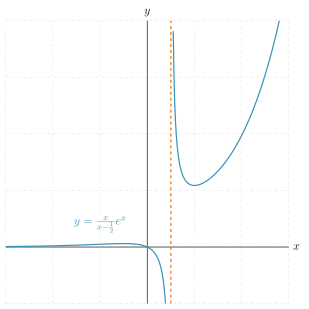
- Show that, in the case \(a=0\) and \(b= \frac12\), there is one stationary point on either side of the curve's vertical asymptote, and sketch the curve.
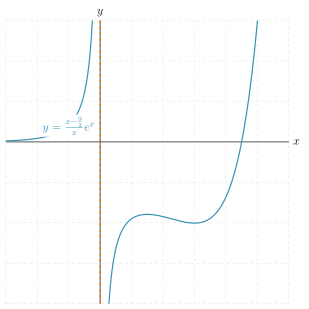
- Sketch the curve in the case \( a=\tfrac{9}{2}\) and \(b=0\,\).
Solution: \begin{align*} && y &= \left ( \frac{x-a}{x-b} \right )e^x \\ &&y'& = \left ( \frac{x-a}{x-b} \right )e^x + \left ( \frac{(x-b)-(x-a)}{(x-b)^2}\right )e^x \\ &&&= \left ( \frac{(x-b)(x-a) +a-b}{(x-b)^2} \right)e^x \\ &&&= \left ( \frac{x^2-(a+b)x+a-b+ab}{(x-b)^2} \right)e^x \\ && 0 &< \Delta = (a+b)^2 - 4 \cdot 1 \cdot (a-b+ab) \\ &&&= a^2+2ab+b^2-4a+4b-4ab \\ &&&= a^2-2ab+b^2-4a+4b\\ &&&= (a-b)^2-4(a-b) \\ &&&= (a-b)(a-b-4) \\ \end{align*} Considered as a quadratic in \(a-b\) we can see \(a-b < 0\) or \(a-b > 4\)
- If \(a = 0, b = \frac12\), we have \(x^2-\frac12x -\frac12 = 0 \Rightarrow (2x+1)(x-1) = 0 \Rightarrow x = -\frac12, x=1\). The asymptote is at \(x = \frac12\) so they are on either side.
- \(\,\)
2006 Paper 1 Q10
A particle \(P\) is projected in the \(x\)-\(y\) plane, where the \(y\)-axis is vertical and the \(x\)-axis is horizontal. The particle is projected with speed \(V\) from the origin at an angle of \(45 ^\circ\) above the positive \(x\)-axis. Determine the equation of the trajectory of \(P\). The point of projection (the origin) is on the floor of a barn. The roof of the barn is given by the equation \(y= x \tan \alpha +b\,\), where \(b>0\) and \(\alpha\) is an acute angle. Show that, if the particle just touches the roof, then \(V(-1+ \tan\alpha) =-2 \sqrt{bg}\); you should justify the choice of the negative root. If this condition is satisfied, find, in terms of \(\alpha\), \(V\) and \(g\), the time after projection at which touching takes place. A particle \(Q\) can slide along a smooth rail fixed, in the \(x\)-\(y\) plane, to the under-side of the roof. It is projected from the point \((0,b)\) with speed \(U\) at the same time as \(P\) is projected from the origin. Given that the particles just touch in the course of their motions, show that \[ 2 \sqrt 2 \, U \cos \alpha = V \big(2 + \sin\alpha\cos\alpha -\sin^2\alpha) . \]
1998 Paper 3 Q8
- Consider the sphere of radius \(a\) and centre the origin. %Show that the line through the point with position vector %\({\bf b}\) and parallel to a unit %vector \({\bf m}\) intersects the sphere at two points if %$$ %a^2 > {\bf b}.{\bf b} -({\bf b}.{\bf m})^2 \,. %$$ %What is the corresponding condition for there to be precisely one %point of intersection? %If this point has position vector \({\bf p}\), show that the line %is perpendicular to \({\bf p}\).
- Show that the line \({\bf r} ={\bf b} + \lambda {\bf m}\), where \(\bf m\) is a unit vector, intersects the sphere \({\bf r}\cdot {\bf r} = a^2\) at two points if $$ a^2 > {\bf b}\cdot{\bf b} -({\bf b}\cdot{\bf m})^2 \,. $$ Write down the corresponding condition for there to be precisely one point of intersection. If this point has position vector \({\bf p}\), show that \({\bf m}\cdot{\bf p}=0\).
- Now consider a second sphere of radius \(a\) and a plane perpendicular to a unit vector~\({\bf n}\). The centre of the sphere has position vector \({\bf d}\) and the minimum distance from the origin to the plane is \(l\). What is the condition for the plane to be tangential to this second sphere?
- Show that the first and second spheres intersect at right angles ({\em i.e.\ }the two radii to each point of intersection are perpendicular) if $$ {\bf d}\cdot{\bf d} = 2 a^2 \,. $$