Problems
Filters
8 problems found
2018 Paper 1 Q6
Use the identity \[ 2 \sin P\,\sin Q = \cos(Q-P)-\cos(Q+P)\, \] to show that \[ 2\sin\theta \,\big (\sin\theta + \sin 3\theta + \cdots + \sin (2n-1)\theta\,\big ) = 1-\cos 2n\theta \,. \]
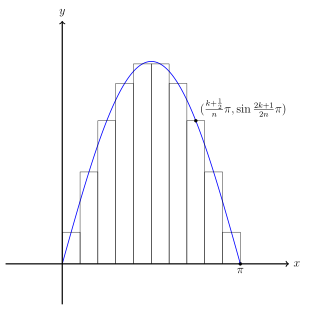
- Let \(A_n\) be the approximation to the area under the curve \(y=\sin x\) from \(x=0\) to \(x=\pi\), using \(n\) rectangular strips each of width \(\frac{{\displaystyle \pi}}{\displaystyle n}\), such that the midpoint of the top of each strip lies on the curve. Show that \[ A_n \sin \left( \frac{\pi}{2n} \right) = \frac \pi n\,. \]
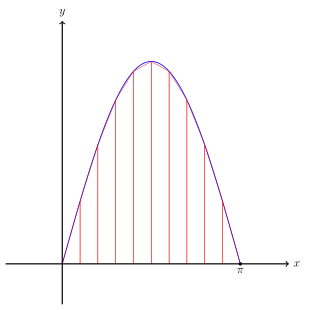
- Let \(B_n\) be the approximation to the area under the curve \(y=\sin x\) from \(x=0\) to \(x=\pi\,\), using the trapezium rule with \(n\) strips each of width \(\frac{\displaystyle \pi}{ \displaystyle n}\). Show that \[B_n \sin \left( \frac{\pi}{2n} \right) = \frac{\pi}{n} \cos \left( \frac{\pi}{2n} \right) . \]
- Show that \[ \frac{1}{2}(A_n + B_n) = B_{2n}\,, \] and that \[ A_n B_{2n} = A^2_{2n}\, . \]
Solution: \begin{align*} && 2\sin\theta \,\big (\sin\theta + \sin 3\theta + \cdots + \sin (2n-1)\theta\,\big ) &= 2\sin\theta\sin\theta + 2\sin\theta\sin 3\theta + \cdots + 2\sin\theta\sin (2n-1)\theta \\ &&&= \cos((1-1)\theta) - \cos((1+1)\theta)+\cos((3-1)\theta)-\cos((3+1)\theta) + \cdots + \cos (((2n-1)-1)\theta) -\cos(((2n-1)+1)\theta) \\ &&&= \cos 0 - \cos(2n\theta) \\ &&&= 1 - \cos 2n \theta \end{align*}
- \(\,\)
Therefore the area is: \begin{align*} A_n &= \frac{\pi}{n} \sin \left ( \frac{\pi}{2n} \right) + \frac{\pi}{n} \sin \left ( \frac{3\pi}{2n} \right) + \frac{\pi}{n} \sin \left ( \frac{5\pi}{2n} \right) + \cdots \frac{\pi}{n} \sin \left ( \frac{(2n-1)\pi}{2n} \right) \\ &= \frac{\pi}{n} \left( \frac{1-\cos \frac{2n \pi}{2n}}{2\sin \frac{\pi}{2n}} \right) \\ &= \frac{\pi}{n} \frac{1}{\sin \frac{\pi}{2n}} \end{align*} as required
- Therefore the area is: \begin{align*} && B_n &= \frac{\pi}{n} \frac{\sin(0)+\sin(\frac{\pi}{n})}{2}+\frac{\pi}{n} \frac{\sin(\frac{\pi}n)+\sin(\frac{2\pi}{n})}{2} + \cdots \frac{\pi}{n} \frac{\sin(\frac{(n-1)\pi}{n})+\sin(\frac{n\pi}{n})}{2} \\ &&&= \frac{\pi}{n} \left ( \sin \frac{\pi}{n} + \sin \frac{2\pi}{n} + \cdots+\sin \frac{(n-1)\pi}{n} \right) \\ \Rightarrow && 2\sin \left ( \frac{\pi}{2n} \right)B_n &= \frac{\pi}{2} \left (2\sin \left ( \frac{\pi}{2n} \right)\sin \frac{\pi}{n} + 2\sin \left ( \frac{\pi}{2n} \right)\sin \frac{2\pi}{n} + \cdots+2\sin \left ( \frac{\pi}{2n} \right)\sin \frac{(n-1)\pi}{n} \right) \\ &&&= \frac{\pi}2 \left ( \cos \frac{\pi}{2n} - \cos \frac{3\pi}{n} + \cos\frac{3\pi}{2n} - \cos \frac{5\pi}{2n} + \cos \frac{(2n-3)\pi}{2n} - \cos \frac{(2n-1)\pi}{2n} \right) \\ &&&= \frac{\pi}{n} \left ( \cos \frac{\pi}{2n} - \cos \left ( \pi - \frac{\pi}{2n} \right) \right) \\ &&&= 2 \frac{\pi}{n} \cos \frac{\pi}{2n} \\ \Rightarrow && \sin \left ( \frac{\pi}{2n} \right)B_n &= \frac{\pi}n \cos \frac{\pi}{2n} \end{align*} as required
- \begin{align*} \frac12(A_n+B_n) &= \frac12 \frac{\pi}{n} \frac{1}{\sin \frac{\pi}{2n}} \left ( 1 + \cos \frac{\pi}{2n} \right) \\ &= \frac{\pi}{n}\frac1{2 \sin \frac{\pi}{2n}} \left (2 \cos^2 \frac{\pi}{4n} \right) \\ &=\frac{\pi}{n} \frac{1}{4 \sin \frac{\pi}{4n} \cos \frac{\pi}{4n}} \left (2 \cos^2 \frac{\pi}{4n} \right) \\ &= \frac{\pi}{2n} \frac{\cos \frac{\pi}{4n}}{\sin \frac{\pi}{4n}} \\ &= B_{2n} \\ \\ A_nB_{2n} &= \frac{\pi}{n\sin \frac{\pi}{2n}} \cdot \frac{\pi}{2n} \frac{\cos \frac{\pi}{4n}}{\sin \frac{\pi}{4n}} \\ &= \frac{\pi^2}{(2n)^2} \frac{\cos \frac{\pi}{4n}}{\sin^2 \frac{\pi}{4n} \cos \frac{\pi}{4n}} \\ &= \left ( \frac{\pi}{2n} \frac{1}{\sin \frac{\pi}{4n}}\right)^2 \\ &= A_{2n}^2 \end{align*}
2018 Paper 2 Q4
In this question, you may use the following identity without proof: \[ \cos A + \cos B = 2\cos\tfrac12(A+B) \, \cos \tfrac12(A-B) \;. \]
- Given that \(0\le x \le 2\pi\), find all the values of \(x\) that satisfy the equation \[ \cos x + 3\cos 2x + 3\cos 3 x + \cos 4x= 0 \,. \]
- Given that \(0\le x \le \pi\) and \(0\le y \le \pi\) and that \[ \cos (x+y) + \cos (x-y) -\cos2x = 1 \,, \] show that either \(x=y\) or \(x\) takes one specific value which you should find.
- Given that \(0\le x \le \pi\) and \(0\le y \le \pi\,\), find the values of \(x\) and \(y\) that satisfy the equation \[ \cos x + \cos y -\cos (x+y) = \tfrac32 \,. \]
Solution:
- \(\,\) \begin{align*} && 0 &= \cos x + 3 \cos 2x + 3 \cos 3x + \cos 4 x \\ &&&= \cos x + \cos 4x + 3 \left (\cos 2x + \cos 3 x \right) \\ &&&= 2 \cos \frac{5x}{2} \cos \frac{3x}{2} + 6 \cos \frac{x}{2}\cos\frac{5x}{2} \\ &&&= 2 \cos \frac{5x}{2} \left (\cos \frac{3x}{2} + 3 \cos \frac{x}{2} \right)\\ &&&= 2 \cos \frac{5x}{2} \left ( \cos \frac{2x}{2}\cos \frac{x}{2} - \sin \frac{2x}{2} \sin \frac{x}{2}+3 \cos \frac{x}{2} \right) \\ &&&= 2 \cos \frac{5x}{2} \left ( \left (2\cos^2 \frac{x}{2} - 1 \right)\cos \frac{x}{2} - 2\sin \frac{x}{2} \cos \frac{x}{2} \sin \frac{x}{2}+3 \cos \frac{x}{2} \right) \\ &&&= 2 \cos \frac{5x}{2} \left ( 4\cos^3 \frac{x}{2} \right) \\ &&&= 8 \cos \frac{5x}{2} \cos^3 \frac{x}{2} \\ \Rightarrow && \frac{x}{2} &= \frac{\pi}{2}, \frac{3\pi}{2}, \cdots \\ && \frac{5x}{2} &= \frac{\pi}{2}, \frac{3\pi}{2}, \cdots \\ \Rightarrow && x &= \frac{\pi}{5}, \frac{3\pi}{5}, \pi, \frac{7\pi}{5}, \frac{9\pi}{5} \end{align*}
- \(\,\) \begin{align*} && 1 &= \cos (x + y) + \cos(x-y) - \cos 2x \\ &&&= 2 \cos x \cos y - 2\cos^2 x + 1 \\ \Rightarrow && 0 &= \cos x (\cos y - \cos x) \\ \Rightarrow && 0 &=\cos x \left ( \cos y + \cos (\pi - x) \right) \\ &&&= 2\cos x \cos \frac{y+x-\pi}{2} \cos \frac{y-x+\pi}{2} \\ \Rightarrow && x &= \frac{\pi}{2} \\ && y+x - \pi&= \pi ,3\pi, \cdots \\ && y-x + \pi&=\pi, 3 \pi, \cdots \\ \Rightarrow && x &= \frac{\pi}{2} \\ && y+x &= 2\pi \Rightarrow x = y = \pi \\ && y&= x \end{align*} So the only solutions are \(x =y\) and \(x = \frac{\pi}{2}\)
- \(\,\) \begin{align*} && \frac32 &= \cos x + \cos y - \cos (x+y) \\ &&&= 2 \cos \frac{x+y}{2} \cos \frac{x-y}{2} - 2 \cos^2 \frac{x+y}{2} + 1 \\ \Rightarrow && \frac14 &= \cos \frac{x+y}{2} \left ( \cos \frac{x-y}{2} - \cos \frac{x+y}{2} \right) \\ \Rightarrow && 0 &= \cos^2 \frac{x+y}{2} - \cos \frac{x-y}{2}\cos \frac{x+y}{2} + \frac14 \\ \Rightarrow && \cos \frac{x+y}{2} &= \frac{\cos \frac{x-y}{2} \pm \sqrt{\cos^2 \frac{x-y}{2}-1}}{2} \\ \Rightarrow && \cos \frac{x-y}{2} &= \pm 1\\ && \cos \frac{x+y}{2} &= \pm \frac12 \\ \Rightarrow && x-y &= -4\pi, 0, 4\pi, \cdots \\ \Rightarrow && x &= y \\ \Rightarrow && \cos x &= \frac12 \\ \Rightarrow && x &= \frac{\pi}{3} \\ \Rightarrow && (x, y) &= \left ( \frac{\pi}{3}, \frac{\pi}{3}\right) \end{align*}
2009 Paper 1 Q7
Show that, for any integer \(m\), \[ \int_0^{2\pi} \e^x \cos mx \, \d x = \frac {1}{m^2+1}\big(\e^{2\pi}-1\big)\,. \]
- Expand \(\cos(A+B) +\cos(A-B)\). Hence show that \[\displaystyle \int_0^{2\pi} \e^x \cos x \cos 6x \, \d x\, = \tfrac{19}{650}\big( \e^{2\pi}-1\big)\,. \]
- Evaluate $\displaystyle \int_0^{2\pi} \e^x \sin 2x \sin 4x \cos x \, \d x\,$.
Solution: \begin{align*} && I &= \int_0^{2 \pi} e^{x} \cos m x \d x \\ &&&= \left [e^x \cos m x \right]_0^{2 \pi}-\int_0^{2 \pi} e^x m (-\sin mx) \d x\\ &&&= e^{2\pi}-1 + m\int_0^{2\pi}e^x \sin m x \d x \\ &&&= e^{2\pi}-1 + m\left [e^x \sin m x \right]_0^{2\pi} - m \int_0^{2\pi} e^x m \cos x \d x \\ &&&= e^{2\pi}-1+0 - m^2 I\\ \Rightarrow && (m^2+1)I &= e^{2\pi}-1 \\ \Rightarrow && I &= \frac{1}{m^2+1} (e^{2\pi}-1) \end{align*}
- \(\,\) \begin{align*} && \cos(A+B) + \cos(A-B) &= \cos A\cos B - \sin A \sin B + \cos A \cos B + \sin A \sin B \\ &&&= 2 \cos A \cos B \end{align*} Therefore \begin{align*} && I &= \int_0^{2\pi} e^x \cos x \cos 6x \d x \\ &&&= \int_0^{2\pi} e^x \frac12\left (\cos 7x + \cos 5x \right) \d x\\ &&&= \left ( \frac{1}{2(1+7^2)} + \frac1{2(1+5^2)}\right)(e^{2\pi}-1) \\ &&&= \left (\frac{1}{100}+\frac{1}{52} \right) (e^{2\pi}-1) \\ &&&= \frac{19}{650}(e^{2\pi}-1) \end{align*}
- \(\,\) \begin{align*} && I &= \int_0^{2\pi} e^x \sin 2x \sin 4x \cos x \d x\\ &&&= \int_0^{2\pi} e^x \tfrac12(\cos2x-\cos 6x) \cos x \d x\\ &&&= \frac12 \int_0^{2\pi} e^x \left (\cos 2x \cos x -\cos 6x \cos x \right) \d x \\ &&&= \frac14 \int_0^{2\pi} e^x \left (\cos 3x + \cos x-\cos 7x-\cos 5x \right) \d x \\ &&&= \frac14 \left (\frac{1}{1+3^2}+\frac{1}{1+1^2}-\frac{1}{1+7^2} - \frac{1}{1+5^2} \right)(e^{2\pi}-1) \\ &&&= \frac14 \left (\frac{1}{10}+\frac{1}{2}-\frac{1}{50} - \frac{1}{26} \right)(e^{2\pi}-1) \\ &&&= \frac{44}{325}(e^{2\pi}-1) \end{align*}
2003 Paper 3 Q6
Show that \[ 2\sin \frac12 \theta \, \cos r\theta = \sin\big(r+\frac12\big)\theta - \sin\big(r-\frac12\big)\theta \;. \] Hence, or otherwise, find all solutions of the equation \[ \cos a\theta + \cos (a + 1) \theta + \dots + \cos(b-2)\theta+\cos (b - 1 ) \theta = 0 \;, \] where \(a\) and \(b\) are positive integers with \(a < b-1\,\).
Solution: \begin{align*} && \sin\left(r+\frac12\right)\theta - \sin\left(r-\frac12\right)\theta &= \sin r \theta \cos \tfrac12 \theta+\cos r \theta \sin \tfrac12 \theta- \left (\sin r \theta \cos \tfrac12 \theta-\cos r \theta \sin \tfrac12 \theta \right)\\ &&&= 2 \cos r\theta \sin \tfrac12 \theta \end{align*} \begin{align*} && S &= \cos a\theta + \cos (a + 1) \theta + \dots + \cos(b-2)\theta+\cos (b - 1 ) \theta \\ && 2\sin\tfrac12 \theta S &= \sum_{r=a}^{b-1} 2\sin\tfrac12 \theta \cos r \theta \\ &&&= \sum_{r=a}^{b-1} \left ( \sin\left(r+\frac12\right)\theta - \sin\left(r-\frac12\right)\theta \right) \\ &&&= \sin \left (b-\frac12 \right)\theta - \sin \left (a -\frac12 \right)\theta \\ \Rightarrow && \sin \left (b-\frac12 \right)\theta &= \sin \left (a -\frac12 \right)\theta \\ \end{align*} Case 1: \(A = B + 2n\pi\) \begin{align*} && \left (b-\frac12 \right)\theta &= \left (a -\frac12 \right)\theta + 2n\pi \\ \Rightarrow && (b-a) \theta &= 2n \pi \\ \Rightarrow && \theta &= \frac{2n\pi}{b-a} \end{align*} Case 2: \(A = (2n+1)\pi - B\) \begin{align*} && \left (b-\frac12 \right)\theta &= (2n+1)\pi -\left (a -\frac12 \right)\theta \\ \Rightarrow && (b+a-1) \theta &= (2n+1) \pi \\ \Rightarrow && \theta &= \frac{2n\pi}{b+a-1} \end{align*}
1998 Paper 2 Q4
The integral \(I_n\) is defined by $$I_n=\int_0^\pi(\pi/2-x)\sin(nx+x/2)\,{\rm cosec}\,(x/2)\,\d x,$$ where \(n\) is a positive integer. Evaluate \(I_n-I_{n-1}\), and hence evaluate \(I_n\) leaving your answer in the form of a sum.
Solution: \begin{align*} && I_n - I_{n-1} &= \int_0^\pi \left ( \frac{\pi}{2} - x \right) \left ( \sin\left(nx + \frac{x}{2}\right) - \sin \left ((n-1)x + \frac{x}{2} \right)\right) \cosec \frac{x}{2} \d x \\ &&&= \int_0^\pi \left ( \frac{\pi}{2} - x \right) \left (2 \sin \left ( \frac{nx + \frac{x}{2} - (n-1)x - \frac{x}{2} }{2}\right)\cos nx \right) \cosec \frac{x}{2} \d x \\ &&&= \int_0^\pi \left ( \frac{\pi}{2} - x \right) \left (2 \sin \left ( \frac{x}{2}\right)\cos nx \right) \cosec \frac{x}{2} \d x \\ &&&=2 \int_0^\pi \left ( \frac{\pi}{2} - x \right) \cos nx \d x \\ &&&=\pi \left [ \frac{\sin nx}{n}\right]_0^{\pi} - 2\int_0^\pi x \cos n x \d x \\ &&&= 0 - 2\left[ \frac{x \sin nx}{n} \right]_0^{\pi} + 2\int_0^\pi \frac{\sin nx}{n} \d x \\ &&&= 2\left[ -\frac{\cos nx}{n^2} \right]_0^{\pi} \\ &&&=2 \frac{1-(-1)^{n}}{n^2} \\ \\ && I_0 &= \int_0^\pi (\pi/2 - x) \d x =0 \\ \Rightarrow && I_{2k+2} = I_{2k+1} &= 4 \left (\frac{1}{1^2} + \frac{1}{3^2} + \cdots + \frac{1}{(2k+1)^2} \right) \end{align*}
1996 Paper 1 Q6
Let \(\mathrm{f}(x)=\dfrac{\sin(n+\frac{1}{2})x}{\sin\frac{1}{2}x}\) for \(0 < x\leqslant\pi.\)
- Using the formula \[ 2\sin\tfrac{1}{2}x\cos kx=\sin(k+\tfrac{1}{2})x-\sin(k-\tfrac{1}{2})x \] (which you may assume), or otherwise, show that \[ \mathrm{f}(x)=1+2\sum_{k=1}^{n}\cos kx\,. \]
- Find \({\displaystyle \int_{0}^{\pi}\mathrm{f}(x)\,\mathrm{d}x}\) and \({\displaystyle \int_{0}^{\pi}\mathrm{f}(x)\cos x\,\mathrm{d}x}.\)
Solution:
- \(\,\) \begin{align*} && 2\sin \tfrac12 x \sum_{k=1}^n \cos kx &= \sum_{k=1}^n 2\sin \tfrac12 x \cos kx \\ &&&= \sum_{k=1}^n \left ( \sin(k+\tfrac12)x - \sin(k - \tfrac12)x \right) \\ &&&= \left ( \sin\tfrac32x - \sin\tfrac12x \right) + \\ &&&\quad \quad \left ( \sin\tfrac52x - \sin \tfrac32 x \right) + \\ &&&\quad \quad \quad +\cdots + \\ &&&\quad \quad \quad \quad +\left ( \sin(n+\tfrac12)x - \sin(n - \tfrac12)x \right) \\ &&&= \sin(n+\tfrac12)x - \sin \tfrac12 x \\ \Rightarrow && \sin(n+\tfrac12)x &= \sin \tfrac12 x + 2\sin \tfrac12 x \sum_{k=1}^n \cos kx \\ \Rightarrow && f(x) &= 1 + 2 \sum_{k=1}^n \cos kx \end{align*}
- \(\,\) \begin{align*} && \int_0^{\pi} f(x) \d x &= \int_0^{\pi} \left (1 + 2 \sum_{k=1}^n \cos kx \right) \d x \\ &&&= \pi + 2 \left [ \sum_{k=1}^n \frac{1}{k} \sin k x\right]_0^\pi \\ &&&= \pi \\ \\ && \int_0^{\pi} f(x) \cos x \d x &= \int_0^{\pi} \left (\cos x + 2 \sum_{k=1}^n \cos kx \cos x \right) \d x \\ &&&= 0 + \sum_{k=1}^n \left ( \int_0^{\pi} 2 \cos k x \cos x \d x \right) \\ &&&= \sum_{k=1}^n \left ( \int_0^{\pi} (\cos (k+1)x - \cos (k-1) x)\d x\right) \\ &&&= -\pi \end{align*}
1993 Paper 2 Q2
- Evaluate \[ \int_{0}^{2\pi}\cos(mx)\cos(nx)\,\mathrm{d}x, \] where \(m,n\) are integers, taking into account any special cases that arise.
- Find \({\displaystyle \int\sqrt{1+\frac{1}{x}}\,\mathrm{d}x}.\)
1988 Paper 3 Q6
Let \(\mathrm{f}(x)=\sin2x\cos x.\) Find the 1988th derivative of \(\mathrm{f}(x).\) Show that the smallest positive value of \(x\) for which this derivative is zero is \(\frac{1}{3}\pi+\epsilon,\) where \(\epsilon\) is approximately equal to \[ \frac{3^{-1988}\sqrt{3}}{2}. \]
Solution: \begin{align*} && f(x) &= \sin 2x \cos x \\ &&&= \frac12 \l \sin 3x + \sin x \r \\ \Rightarrow && f^{(1988)}(x) &= \frac12 \l 3^{1988} (-1)^{994} \sin 3x+ (-1)^{994} \sin x \r \\ &&&= \boxed{\frac12 \left (3^{1998} \sin 3x + \sin x \right)} \\ \\ f^{(1988)}(x) = 0: && 0 &= 3^{1988} \sin 3x + \sin x \\ \Rightarrow && 0 &= 3^{1988} ( 3\sin x-4\sin^3 x) + \sin x \\ \Rightarrow && 0 &= \sin x \left (1+3^{1989}-4\cdot 3^{1988}\sin^{2} x \right) \end{align*} Since \(\sin x\) will first contribute a zero when \(x = \frac{\pi}{2}\) we focus on the second bracket, in particular, we need: \begin{align*} && \sin^2 x &= \frac{3}{4} \left ( 1 + \frac{1}{3^{1988}} \right) \\ \Rightarrow && \sin x &= \frac{\sqrt{3}}2 \left (1 + \frac{1}{2 \cdot 3^{1988}} + \cdots \right ) \end{align*} Since near \(\frac{\pi}{3}\), \begin{align*} \sin (\frac{\pi}{3} + \epsilon) &= \sin \frac{\pi}{3} \cos \epsilon + \cos \frac{\pi}{3} \sin \epsilon \\ &\approx \frac{\sqrt{3}}{2} (1-\epsilon^2 + \cdots ) + \frac{1}{2}(\epsilon + \cdots) \\ &= \frac{\sqrt{3}}2 + \frac12 \epsilon + \cdots \end{align*} Therefore by comparison we can see that \(x = \frac{\pi}{3} + \frac{\sqrt{3}}{2} 3^{-1988}\) will be a very good approximation for the root.