Problems
Filters
1 problem found
2015 Paper 1 Q4
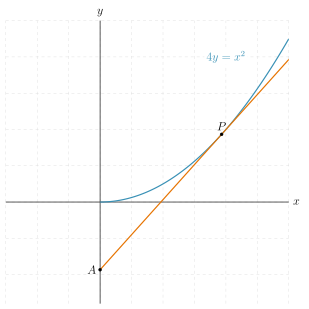
The midpoint of a rod of length \(2b\) slides on the curve \(y =\frac14 x^2\), \(x\ge0\), in such a way that the rod is always tangent, at its midpoint, to the curve. Show that the curve traced out by one end of the rod can be written in the form \begin{align*} x& = 2 \tan\theta - b \cos\theta \\ y& = \tan^2\theta - b \sin\theta \end{align*} for some suitably chosen angle \(\theta\) which satisfies \(0\le \theta < \frac12\pi\,\). When one end of the rod is at a point \(A\) on the \(y\)-axis, the midpoint is at point \(P\) and \(\theta = \alpha\). Let \(R\) be the region bounded by the following:
- the curve \(y=\frac14x^2\) between the origin and \(P\);
- the \(y\)-axis between \(A\) and the origin;
- the half-rod \(AP\).
Solution: At the point \((2t, t^2)\) the gradient is \(t\). Suppose \(\tan \theta = t\), then the point \(b\) away in each direction is \(\binom{2t}{t^2} \pm b \binom{\cos \theta}{\sin \theta}\), ie one end can be written in the form \((x,y) = (2\tan \theta - b \cos \theta, \tan^2 \theta - b \sin \theta)\). Notice we must have \(2\tan \alpha- b \cos \alpha= 0 \Rightarrow b = 2 \frac{\sin \alpha}{\cos ^2 \alpha}\), therefore the coordinates are \((2 \tan \alpha - 2 \tan \alpha, \tan^2 \alpha - 2\tan^2 \alpha) = (0, -\tan^2 \alpha)\) and \((4 \tan \alpha, 3\tan^2 \alpha)\)