Problems

Filters
Clear Filters

1 problem found

1990 Paper 3 Q11
D: 1700.0 B: 1484.0

The points \(O,A,B\) and \(C\) are the vertices of a uniform square lamina of mass \(M.\) The lamina can turn freely under gravity about a horizontal axis perpendicular to the plane of the lamina through \(O\). The sides of the lamina are of length \(2a.\) When the lamina is haning at rest with the diagonal \(OB\) vertically downwards it is struck at the midpoint of \(OC\) by a particle of mass \(6M\) moving horizontally in the plane of the lamina with speed \(V\). The particle adheres to the lamina. Find, in terms of \(a,M\) and \(g\), the value which \(V^{2}\) must exceed for the lamina and particle to make complete revolutions about the axis.


Solution:
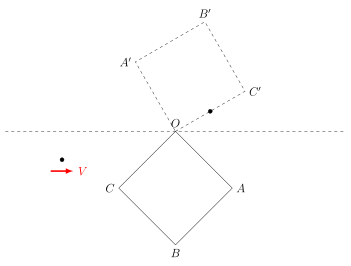
TikZ diagram
Consider the moment of inertia of the lamina. The MoI about the centre of mass is \(\frac1{12}M((2a)^2 + (2a)^2) = \frac23Ma^2\). //el axis theorem, tells us the moment of inertia about \(O\) is \(I_O = I_G + Md^2_{OG} = \frac23Ma^2 + M2a^2 = \frac83Ma^2\) Moment of inertia of particle is \(6Ma^2\) Total moment of inertial is: \(\frac{26}{3}Ma^2\). Conservation of angular momentum states that \(6M \frac{\sqrt{2}}2Va = \frac{26}{3}Ma^2 \omega \Rightarrow \omega = \frac{9\sqrt{2}V}{26a}\) Consider the centre of mass (in the frame drawn) \begin{array}{c|c|c} \text{Shape} & \text{Mass} & \text{COM} \\ \hline \text{Square} & M & (0,-\sqrt{2}a) \\ \text{Particle} & 6M & (-\frac{\sqrt{2}}2a, -\frac{\sqrt{2}}{2}a) \\ \text{combined} & 7M & \left ( \frac{-3\sqrt{2}}{7} a, -\frac{4\sqrt{2}}{7}a \right) \end{array} The lamina/particle system will complete full circles if it still has positive angular velocity at the peak, ie: \begin{align*} && \underbrace{\frac12 I \omega^2}_{\text{initial rotational energy}} + mgh_{start} &\geq mgh_{top} \\ && \frac 12 \frac{26}{3} Ma^2 \frac{9^2 \cdot 2 V^2}{26^2 a^2} - (7M)g\frac{4\sqrt{2}}{7}a &\geq (7M)g\frac{5\sqrt{2}}{7}a \\ \Rightarrow && \frac{V^2 \cdot 27}{26} &\geq 9\sqrt{2}ga \\ \Rightarrow && V^2 & \geq \frac{26\sqrt{2}}{3}ga \end{align*}