Problems
Filters
1 problem found
2008 Paper 2 Q3
D: 1600.0
B: 1516.0
curve sketching
turning points
inequality
proof by contradiction
cubic
optimisation
AM-GM style inequality
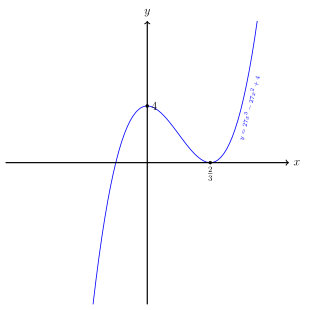
- Find the coordinates of the turning points of the curve \(y=27x^3-27x^2+4\). Sketch the curve and deduce that \(x^2(1-x)\le 4/27\) for all \(x\ge0\,\). Given that each of the numbers \(a\), \(b\) and \(c\) lies between \(0\) and \(1\), prove by contradiction that at least one of the numbers \(bc(1-a)\), \(ca(1-b)\) and \(ab(1-c)\) is less than or equal to \(4/27\).
- Given that each of the numbers \(p\) and \(q\) lies between \(0\) and \(1\), prove that at least one of the numbers \(p(1-q)\) and \(q(1-p)\) is less than or equal to \(1/4\).
Solution:
- \(\,\)
\begin{align*}
&& y & = 27x^3 - 27x^2 + 4 \\
\Rightarrow && \frac{\d y}{\d x} &= 81x^2 - 54x \\
\Rightarrow && x &= 0, \frac23 \\
\Rightarrow && (x,y) &= (0, 4), \left (\frac23, 0 \right)
\end{align*}
Since \(f(x) \geq 0\) for \(x \geq 0\) we must have \(27x^2(1-x) \leq 4 \Rightarrow x^2(1-x) \leq \frac{4}{27}\) Suppose for contradiction that \(bc(1-a) > \frac{4}{27}, ca(1-b) > \frac{4}{27}, ab(1-c) > \frac{4}{27}\) then taking the product we see \begin{align*} && \left ( \frac{4}{27} \right)^3 &< bc(1-a) \cdot ca(1-b) \cdot ab(1-c) \\ &&&= a^2(1-c) \cdot b^2(1-b) \cdot c^2(1-c) \leq \left ( \frac{4}{27}\right)^3 \end{align*} which is a contradiction.
- Notice that \(f(x) = x(1-x)\) has a turning point at \((\frac12, \frac14)\), and so \(f(x) \leq \frac14\). Suppose for contradiction that both \(p(1-q)\) and \(q(1-p)\) are larger than \(1/4\) \begin{align*} && \left ( \frac14 \right)^2 &< p(1-q) \cdot q(1-p) \\ &&&= p(1-p) \cdot q(1-q) \\ &&&\leq \left ( \frac14 \right)^2 \end{align*} which is a contradiction.