Problems
Filters
14 problems found
2003 Paper 1 Q1
It is given that \(\sum\limits_{r=-1}^ {n} r^2\) can be written in the form \(pn^3 +qn^2+rn+s\,\), where \(p\,\), \(q\,\), \(r\,\) and \(s\) are numbers. By setting \(n=-1\), \(0\), \(1\) and \(2\), obtain four equations that must be satisfied by \(p\,\), \(q\,\), \(r\,\) and \(s\) and hence show that \[ { \sum\limits_{r=0} ^n} r^2= {\textstyle \frac16} n(n+1)(2n+1)\;. \] Given that \(\sum\limits_{r=-2}^ nr^3\) can be written in the form \(an^4 +bn^3+cn^2+dn +e\,\), show similarly that \[ { \sum\limits_{r=0} ^n} r^3= {\textstyle \frac14} n^2(n+1)^2\;. \]
Solution: \begin{align*} n = -1: && (-1)^2 &= s - r+q -p \\ n = 0: && 1 + 0 &= s \\ n = 1: && 1 + 1 &= s + r + q + p \\ n = 2: && 2 + 2^2 &= s + 2r + 4q + 8p \\ \Rightarrow &&& \begin{cases} 1 &= s \\ 1 &= s - r + q - p \\ 2 &= s + r + q + p \\ 6 &= s + 2r + 4q + 8p \end{cases} \\ \Rightarrow && s &= 1 \\ && q &= \frac12 \\ &&& \begin{cases} \frac12 &= r + p \\ 3 &= 2r + 8p \end{cases} \\ \Rightarrow && r &= \frac16 \\ && p &= \frac13 \\ \Rightarrow && \sum_{r=0}^n r^2 &= 1 + \frac16 n + \frac12 n^2 + \frac13 n^3 - (-1)^2 \\ &&&= \frac{n}{6} \l 1 + 3n + 2n^2 \r \\ &&&= \frac{n(n+1)(2n+1)}{6} \end{align*} Similarly, \begin{align*} n = -2: && (-2)^3 &= e - 2d + 4c - 8b + 16a \\ n = -1: && -8 + (-1)^3 &= e -d+c-b+a \\ n = 0: && -9 + 0^3 &= e \\ n = 1: && -9 + 1^3 &= e+d+c+b+a \\ n = 2: && -8 + 2^3 &= e+2d+4c+8b+16a \\ \Rightarrow &&& \begin{cases} -9 &= e \\ -9 &= e - d+c -b + a \\ -8 &= e +d+c+b+a \\ -8 &= e-2d+4c-8b+16a \\ 0 &= e+2d+4c+8b+16a \\ \end{cases} \\ \Rightarrow && e &= -9 \\ \Rightarrow &&& \begin{cases} 1 &= 2c+2a \\ 10 &= 8c+32a \\ 1 &= 2d+2b \\ 8 &= 4d+16b \\ \end{cases} \\ \Rightarrow && a &= \frac14 \\ && c &= \frac14 \\ && b &= \frac12 \\ && d &= 0 \\ \\ \Rightarrow && \sum_{r=0}^n r^3 &= -9 + \frac14n^2 + \frac12 n^3+\frac14 n^4 -((-1)^3+(-2)^3) \\ &&&= \frac14n^2 \l1 + 2n+n^2\r \\ &&&= \frac{n^2(n+1)^2}{4} \end{align*} as required
2003 Paper 1 Q2
The first question on an examination paper is: Solve for \(x\) the equation \(\displaystyle \frac 1x = \frac 1 a + \frac 1b \;.\) where (in the question) \(a\) and \(b\) are given non-zero real numbers. One candidate writes \(x=a+b\) as the solution. Show that there are no values of \(a\) and \(b\) for which this will give the correct answer. The next question on the examination paper is: Solve for \(x\) the equation \(\displaystyle \frac 1x = \frac 1 a + \frac 1b +\frac 1c \;.\) where (in the question) \(a\,\), \(b\) and \(c\) are given non-zero numbers. The candidate uses the same technique, giving the answer as \(\displaystyle x = a + b +c \;.\) Show that the candidate's answer will be correct if and only if \(a\,\), \(b\) and \(c\) satisfy at least one of the equations \(a+b=0\,\), \(b+c=0\) or \(c+a=0\,\).
Solution: Suppose \begin{align*} && \frac{1}{a+b} &= \frac{1}{a} + \frac{1}{b} \\ \Rightarrow && ab &= b(a+b)+a(a+b) \\ &&&= (a+b)^2 \\ \Rightarrow && 0 &= a^2+ab + b^2 \\ &&&= \tfrac12 (a^2+(a+b)^2+b^2) \end{align*} Which clearly has no solution for non-zero \(a,b\). Suppose \begin{align*} && \frac{1}{a+b+c} &= \frac1a + \frac1b+\frac1c \\ \Leftrightarrow && abc &= (a+b+c)(bc+ca+ab) \\ \Leftrightarrow && 0 &= (a+b+c)(bc+ca+ab) - abc \\ &&&= (a+b)(b+c)(c+a) \end{align*} Therefore it is true iff \(a+b = 0\) or \(b+c=0\) or \(c+a =0\) as required.
2003 Paper 1 Q3
- Show that \( 2\sin(\frac12\theta)=\sin \theta\) if and only if \(\sin(\frac12\theta)=0\,\).
- Solve the equation \(2\tan (\frac12\theta) = \tan\theta\,\).
- Show that \(2\cos(\frac12\theta)=\cos \theta\) if and only if \(\theta=(4n+2)\pi\pm 2\phi\) where \(\phi\) is defined by \(\cos \phi=\frac12(\sqrt 3-1)\;\), \(0\le \phi\le \frac{1}{2}\pi\), and \(n\) is any integer.
Solution:
- \(\,\) \begin{align*} && 2 \sin (\tfrac12 \theta) &= \sin \theta \\ \Leftrightarrow && 2 \sin (\tfrac12 \theta) &= 2\sin (\tfrac12 \theta) \cos (\tfrac12 \theta) \\ \Leftrightarrow && 0 &= 2\sin(\tfrac12\theta)(1-\cos(\tfrac12 \theta)) \\ \Leftrightarrow && 0 = \sin(\tfrac12 \theta) &\text{ or } 1 = \cos(\tfrac12 \theta) \\ \Leftrightarrow && 0 &= \sin(\tfrac12 \theta) \end{align*}
- Let \(= \tan(\tfrac12 \theta)\), then \begin{align*} && 2t &= \frac{2t}{1-t^2} \\ \Leftrightarrow && 0 &= \frac{2t(1-(1-t^2)}{1-t^2} \\ &&&= \frac{2t^3}{1-t^2} \\ \Leftrightarrow && t&= 0 \\ \Leftrightarrow && \frac12\theta &= n \pi \\ \Leftrightarrow && \theta &= 2n\pi \end{align*}
- Let \(c = \cos(\tfrac12 \theta)\), then \begin{align*} && 2c &= 2c^2 - 1 \\ && 0 &= 2c^2-2c-1 \\ \Leftrightarrow && c &= \frac{2 \pm \sqrt{4+8}}{4} \\ &&&= \frac{1 \pm \sqrt{3}}{2} \\ \Leftrightarrow && c &= \frac{1 - \sqrt{3}}{2} \\ \Leftrightarrow && \frac12 \theta &= \pm \cos^{-1} \frac{1 - \sqrt{3}}{2} + 2n \pi \\ &&&= \mp (\phi+\pi) + 2n \pi \\ \Leftrightarrow && \theta &= (4n+2)\pi \pm 2\phi \end{align*}
2003 Paper 1 Q4
Solve the inequality $$\frac{\sin\theta+1}{\cos\theta}\le1\;$$ where \(0\le\theta<2\pi\,\) and \(\cos\theta\ne0\,\).
Solution:

2003 Paper 1 Q5
- In the binomial expansion of \((2x+1/x^{2})^{6}\;\) for \(x\ne0\), show that the term which is independent of \(x\) is \(240\). Find the term which is independent of \(x\) in the binomial expansion of \((ax^3+b/x^{2})^{5n}\,\).
- Let \(\f(x) =(x^6+3x^5)^{1/2}\,\). By considering the expansion of \((1+3/x)^{1/2}\,\) show that the term which is independent of \(x\) in the expansion of \(\f(x)\) in powers of \(1/x\,\), for \( \vert x\vert>3\,\), is \(27/16\,\). Show that there is no term independent of \(x\,\) in the expansion of \(\f(x)\) in powers of \(x\,\), for \( \vert x\vert<3\,\).
Solution:
- The terms will all be of the form \(x^{6-3k}\), so we are looking for \(\binom{6}{2}2^{4} \cdot 1^2 = 6 \cdot 5 \cdot 8 = 240\) The terms will be \(x^{(5n-k)3 -2k} = x^{15n-5k}\), so we want \(k = 3n\), \(\binom{5n}{3n}a^{5n-3n}b^{5n-2n} = \binom{5n}{3n}a^{2n}b^{3n}\)
- Let \(f(x) = (x^6+3x^5)^{1/2}\) If \(|x| > 3\), then consider \begin{align*} && f(x) &= x^3(1+3/x)^{1/2} \\ &&&= x^3 \left (1 + \frac12 \frac{3}{x} +\frac{1}{2!} \frac12\cdot \frac{-1}{2} \left ( \frac{3}{x} \right)^2 + \frac{1}{3!} \frac{1}{2} \cdot \frac{-1}{2} \cdot \frac{-3}{2} \left (\frac{3}{x} \right)^3 + \cdots \right) \\ &&&= \cdots \frac{1}{6} \frac{3}{8} 27x^0 + \cdots \\ &&&= \cdots + \frac{27}{16} + \cdots \end{align*} If \(|x| < 3\) we can consider \(f(0) = 0\) and notice that there must be no term independent of \(x\)
2003 Paper 1 Q6
Evaluate the following integrals, in the different cases that arise according to the value of the positive constant \(a\,\):
- \[ \displaystyle \int_0^1 \frac 1 {x^2 + (a+2)x +2a} \; \d x \]
- \[\displaystyle \int _{1}^2\frac 1 {u^2 +au +a-1} \; \d u\]
Solution:
- \(\,\) \begin{align*} && I &= \int_0^1 \frac 1 {x^2 + (a+2)x +2a} \; \d x \\ &&&= \int_0^1 \frac{1}{(x+a)(x+2)} \d x\\ \end{align*} Case 1: \(a = 2\) \begin{align*} && I &= \int_0^1 \frac{1}{(x+2)^2} \d x \\ &&&= \left [ -(x+2)^{-1}\right]_0^1 = \frac12 - \frac13 = \frac16 \end{align*} Case 2: \(a \neq 2, a \not \in [0,1]\) \begin{align*} && I &=\frac{1}{a-2} \int_0^1 \left ( \frac{1}{x+2} - \frac{1}{x+a} \right) \d x \\ &&&= \frac{1}{a-2} \left [ \ln |x+2| - \ln |x + a|\right]_0^1 \\ &&&= \frac{1}{a-2} \left ( \ln \frac{3}{|1+a|} - \ln \frac{2}{|a|} \right) \\ &&&= \frac{1}{a-2} \ln \frac{3|a|}{2|a+1|} \end{align*} Case 3: \(a \in [0, 1]\), \(I\) does not converge
- \(\,\) \begin{align*} && J &= \int _{1}^2\frac 1 {u^2 +au +a-1} \; \d u \\ &&&= \int_1^2 \frac{1}{(u+a-1)(u+1)} \d u \\ x = u-1:&&&= \int_0^1 \frac{1}{(x+a)(x+2)} \d x \end{align*} So it's the same as the previous integral
2003 Paper 1 Q7
Let \(k\) be an integer satisfying \(0\le k \le 9\,\). Show that \(0\le 10k-k^2\le 25\) and that \(k(k-1)(k+1)\) is divisible by \(3\,\). For each \(3\)-digit number \(N\), where \(N\ge100\), let \(S\) be the sum of the hundreds digit, the square of the tens digit and the cube of the units digit. Find the numbers \(N\) such that \(S=N\). [Hint: write \(N=100a+10b+c\,\) where \(a\,\), \(b\,\) and \(c\) are the digits of \(N\,\).]
Solution: First note that \(10k - k^2 = 25 - (5-k)^2\) which is clearly bounded above by \(25\). The smallest it can be is when \(|5-k|\) is as large as possible, ie when \(k =0\) and we get a lower bound of \(0\). For \((k-1)k(k+1)\) notice this is the product of \(3\) consecutive integers, and therefore must be divisible by \(3\). (In fact, it's divisible by six, since \(\binom{k+1}{3}\) is the number of ways to choose \(3\) objects from \(k+1\). Let \(N = 100a + 10b + c\) where \(0 \leq a,b,c < 10\) and \(1 \leq a\). \(S = a + b^2 + c^3\) we want to find \begin{align*} && 100a +10b + c &= a + b^2 + c^3 \\ \Rightarrow && 0 &= \underbrace{99a}_{3 \mid 99 } + 10b - b^2 -\underbrace{c(c+1)(c-1)}_{3 \mid c(c+1)(c-1)} \\ \end{align*} Therefore \(3 \mid 10b - b^2 = b(10-b)\). Therefore \(3 \mid b\) or \(3 \mid 10-b\) so \(b = 0, 3, 6, 1, 4, 7\) We also have \(99a \geq 99\) and \(10b-b^2 \in [0, 25]\) so we need \(c^3-c \geq 99\), so \(c \geq 5\) Case \(c = 5\), Then \(c^3-c = 120\) so \(a = 1\) and \(10b-b^2 = 21\) so \(b= 3, 7\) \(N = 135, 175\) Case \(c = 6\), so \(c^3 - c = 210\) so \(a = 2\) and \(25-(5-k)^2 = 12\) so no solutions. Case \(c = 7\), so \(7^3 - 7 = 336\) so \(a = 3\) and \(25-(5-k)^2 = 39\) so no solutions. Case \(c = 8\) so \(8^3-8 = 504\) so \(a = 5\) and \(25-(5-k)^2 = 9\), so \(b = 1, 9\) and \(N = 518, 598\) Case \(c = 9\) so \(9^3 - 9 = 720\), so \(a = 7\) and \(25-(5-k)^2 = 27\) so no solutions. Therefore all the solutions are \(N = 135, 175, 518, 598\)
2003 Paper 1 Q8
A liquid of fixed volume \(V\) is made up of two chemicals \(A\) and \(B\,\). A reaction takes place in which \(A\) converts to \(B\,\). The volume of \(A\) at time \(t\) is \(xV\) and the volume of \(B\) at time \(t\) is \(yV\) where \(x\) and \(y\) depend on \(t\) and \(x+y=1\,\). The rate at which \(A\) converts into \(B\) is given by \(kVxy\,\), where \(k\) is a positive constant. Show that if both \(x\) and \(y\) are strictly positive at the start, then at time \(t\) \[ y= \frac {D\e^{kt}}{1+D \e^{kt}} \;, \] where \(D\) is a constant. Does \(A\) ever completely convert to \(B\,\)? Justify your answer.
Solution: We have \(\dot{A} = -kVxy\) or \(\dot{x}V = -kVxy\), ie \(\dot{x} = -kxy\) and similarly \(\dot{y} = kxy = k(1-y)y\). \begin{align*} && \frac{\d y}{\d t} &= ky(1-y) \\ \Rightarrow && \int k \d t &= \int \frac{1}{y(1-y)} \d y \\ \Rightarrow && kt &= \int \left ( \frac{1}{y} + \frac{1}{1-y} \right) \d y \\ &&&= \ln y - \ln (1-y) + C\\ \Rightarrow && kt &= \ln \frac{y}{D(1-y)} \\ \Rightarrow && De^{kt} &= \frac{y}{1-y} \\ \Rightarrow && y(1+De^{kt}) &= De^{kt} \\ \Rightarrow && y &= \frac{De^{kt}}{1+De^{kt}} \end{align*} As \(t \to \infty\) \(y \to \frac{D}{D} = 1\) so depending on how fine grained we want to go we might say that 'yes it completely converts' when there is an immeasurably small amount of \(A\) left, or we might say it doesn't since it only tends to \(1\) and never actually reaches it.
2003 Paper 1 Q9
A particle is projected with speed \(V\) at an angle \(\theta\) above the horizontal. The particle passes through the point \(P\) which is a horizontal distance \(d\) and a vertical distance \(h\) from the point of projection. Show that \[ T^2 -2kT + \frac{2kh}{d}+1=0\;, \] where \(T=\tan\theta\) and \(\ds k= \frac{V^2}{gd}\,\). %Derive an equation relating \(\tan \theta\), \(V\), \(g\), \(d\) and \(h\). Show that, if \(\displaystyle {kd > h + \sqrt {h^2 + d^2}}\;\), there are two distinct possible angles of projection. Let these two angles be \(\alpha\) and \(\beta\). Show that \(\displaystyle \alpha + \beta = \pi - \arctan ( {d/ h}) \,\).
2003 Paper 1 Q10
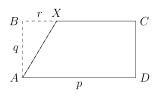
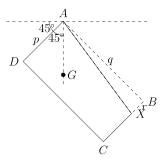
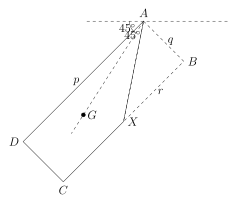
\(ABCD\) is a uniform rectangular lamina and \(X\) is a point on \(BC\,\). The lengths of \(AD\), \(AB\) and \(BX\) are \(p\,\), \(q\) and \(r\) respectively. The triangle \(ABX\) is cut off the lamina. Let \((a,b)\) be the position of the centre of gravity of the lamina, where the axes are such that the coordinates of \(A\,\), \(D\) and \(C\) are \((0,0)\,\), \((p,0)\) and \((p,q)\) respectively. Derive equations for \(a\) and \(b\) in terms of \(p\,\), \(q\) and \(r\,\). When the resulting trapezium is freely suspended from the point \(A\,\), the side \(AD\) is inclined at \(45^\circ\) below the horizontal. Show that \(\displaystyle r = q - \sqrt{q^2 - 3pq + 3p^2}\,\). You should justify carefully the choice of sign in front of the square root.
Solution:
2003 Paper 1 Q11
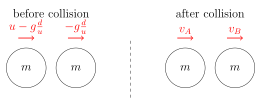
A smooth plane is inclined at an angle \(\alpha\) to the horizontal. \(A\) and \(B\) are two points a distance \(d\) apart on a line of greatest slope of the plane, with \(B\) higher than \(A\). A particle is projected up the plane from \(A\) towards \(B\) with initial speed \(u\), and simultaneously another particle is released from rest at \(B\,\). Show that they collide after a time \(\displaystyle {d /u}\,\). The coefficient of restitution between the two particles is \(e\) and both particles have mass \(m\,\). Show that the loss of kinetic energy in the collision is \(\frac14 {m u^2 \big( 1 - e^2 \big) }\,\).
Solution: We can `ignore' the fact that they are both accelerating, because the acceleration is the same for both object so it will "cancel" out. Therefore the time taken is the same as if the object has to travel distance \(d\) at speed \(u\), ie \(d/u\). \begin{align*} && u_A &= u - g \frac{d}{u} \\ && u_B &= -g\frac{d}{u} \end{align*}
2003 Paper 1 Q12
In a bag are \(n\) balls numbered 1, 2, \(\ldots\,\), \(n\,\). When a ball is taken out of the bag, each ball is equally likely to be taken.
- A ball is taken out of the bag. The number on the ball is noted and the ball is replaced in the bag. The process is repeated once. Explain why the expected value of the product of the numbers on the two balls is \[ \frac 1 {n^2} \sum_{r=1}^n\sum_{s=1}^n rs \] and simplify this expression.
- A ball is taken out of the bag. The number on the ball is noted and the ball is not replaced in the bag. Another ball is taken out of the bag and the number on this ball is noted. Show that the expected value of the product of the two numbers is \[ \frac{(n+1)(3n+2)}{12}\;. \]
Solution:
- Since the second draw is independently of the first draw \(\mathbb{P}(F=r, S=s) = \mathbb{P}(F=r)\mathbb{P}(S=s) = \frac{1}{n^2}\) and so \begin{align*} && \E[FS] &= \sum_{r=1}^n \sum_{s=1}^n rs \mathbb{P}(F=r, S = s) \\ &&&= \frac{1}{n^2} \sum_{r=1}^n \sum_{s=1}^n rs \\ &&&= \frac{1}{n^2} \left ( \sum_{r=1}^n r \right)\left ( \sum_{s=1}^n s \right) \\ &&&= \frac{1}{n^2} \left ( \frac{n(n+1)}{2} \right)^2 \\ &&&= \frac{(n+1)^2}{4} \end{align*}
- Under this methodology, \(\mathbb{P}(F=r, S=s) = \frac{1}{n(n-1)}\) as long as \(r \neq s\), therefore \begin{align*} && \E[FS] &= \sum_{r=1}^n \sum_{s\neq r} rs \mathbb{P}(F = r, S = s) \\ &&&= \frac{1}{n(n-1)} \sum_{r=1}^n \left ( \sum_{s=1}^n rs - r^2 \right) \\ &&&= \frac{1}{n(n-1)} \left ( \frac{n^2(n+1)^2}{4} - \frac{n(n+1)(2n+1)}{6} \right) \\ &&&= \frac{n+1}{12(n-1)} \left ( 3n(n+1)-2(2n+1) \right) \\ &&&= \frac{n+1}{12(n-1)} \left ( 3n^2 -n -2 \right) \\ &&&= \frac{n+1}{12(n-1)} (3n+2)(n-1)\\ &&&= \frac{(n+1)(3n+2)}{12} \end{align*}
2003 Paper 1 Q13
If a football match ends in a draw, there may be a "penalty shoot-out". Initially the teams each take 5 shots at goal. If one team scores more times than the other, then that team wins. If the scores are level, the teams take shots alternately until one team scores and the other team does not score, both teams having taken the same number of shots. The team that scores wins. Two teams, Team A and Team B, take part in a penalty shoot-out. Their probabilities of scoring when they take a single shot are \(p_A\) and \(p_B\) respectively. Explain why the probability \(\alpha\) of neither side having won at the end of the initial \(10\)-shot period is given by $$\alpha =\sum_{i=0}^5\binom{5}{i}^2(1-p_A)^i(1-p_B)^i\,p_A^{5-i}p_B^{5-i}.$$ Show that the expected number of shots taken is \(\displaystyle 10+ \frac{2\alpha}\beta\;,\) where \(\beta=p_A+p_B-2p_Ap_B\,.\)
Solution: Note that in the first \(10\)-short period the number of goals scored by each team is \(B(5, \p_i)\). For them to be equal they must both have scored the same number of goals, ie \begin{align*} && \alpha &= \sum_{i=0}^5 \mathbb{P}(\text{both teams score }5-i) \\ &&&= \sum_{i=0}^5 \binom{5}{i} (1-p_A)^ip_A^{5-i} \binom{5}{i} (1-p_B)^i p_B^{5-i} \\ &&&= \sum_{i=0}^5 \binom{5}{i} ^2(1-p_A)^i (1-p_B)^i p_A^{5-i} p_B^{5-i} \\ \end{align*} Suppose we make it to the end of the shoot out with scores tied. The probability that we finish each round is \(p_A(1-p_B) + p_B(1-p_A)\) (the probability \(A\) wins or \(B\) wins). This is \(p_A + p_B - 2p_Ap_B = \beta\)). Therefore the number of additional rounds is geometric with parameter \(\beta\) and the expected number of rounds is \(\frac{1}{\beta}\). Each round has two shots, and there is a probability \(\alpha\) of this occuring, ie \(\frac{2\alpha}{\beta}\). Added to the \(10\) guaranteed shots we get the desired result
2003 Paper 1 Q14
Jane goes out with any of her friends who call, except that she never goes out with more than two friends in a day. The number of her friends who call on a given day follows a Poisson distribution with parameter \(2\). Show that the average number of friends she sees in a day is~\(2-4\e^{-2}\,\). Now Jane has a new friend who calls on any given day with probability \(p\). Her old friends call as before, independently of the new friend. She never goes out with more than two friends in a day. Find the average number of friends she now sees in a day.