Problems
Filters
16 problems found
1987 Paper 1 Q1
Find the stationary points of the function \(\mathrm{f}\) given by \[ \mathrm{f}(x)=\mathrm{e}^{ax}\cos bx,\mbox{ }(a>0,b>0). \] Show that the values of \(\mathrm{f}\) at the stationary points with \(x>0\) form a geometric progression with common ratio \(-\mathrm{e}^{a\pi/b}\). Give a rough sketch of the graph of \(\mathrm{f}\).
Solution: Let \(f(x) = e^{ax} \cos bx\) then, \(f'(x) = ae^{ax} \cos bx - be^{ax} \sin bx = e^{ax} \l a\cos bx - b \sin bx \r\). Therefore the stationary points are where \(f'(x) = 0 \Leftrightarrow \tan bx = \frac{b}a\), ie \(x = \tan^{-1} \frac{a}{b} + \frac{n}{b} \pi, n \in \mathbb{Z}\). \begin{align*} f(\tan^{-1} \frac{a}{b} + \frac{n}{b} \pi) &= e^{a \tan^{-1} \frac{a}{b} + \frac{an}{b} \pi} \cos \l b \tan^{-1} \frac{a}{b} +n \pi\r \\ &= e^{a \tan^{-1} \frac{a}{b}} \cos \l b \tan^{-1} \frac{a}{b}\r \cdot e^{\frac{an}{b} \pi}(-1)^n \\ &= e^{a \tan^{-1} \frac{a}{b}} \cos \l b \tan^{-1} \frac{a}{b}\r \cdot (-e^{\frac{a}{b} \pi})^n \\ \end{align*} showing the form the desired geometric progression.

1987 Paper 1 Q2

Solution:

1987 Paper 1 Q3
By substituting \(y(x)=xv(x)\) in the differential equation \[ x^{3}\frac{\mathrm{d}v}{\mathrm{d}x}+x^{2}v=\frac{1+x^{2}v^{2}}{\left(1+x^{2}\right)v}, \] or otherwise, find the solution \(v(x)\) that satisfies \(v=1\) when \(x=1\). What value does this solution approach when \(x\) becomes large?
Solution: Let \(y = xv\) then \(y' = v + xv'\) and so \(x^2y' = x^2v + x^3v'\) Our differential equation is now: \begin{align*} && x^2 y' &= \frac{1+y^2}{(1+x^2)\frac{y}{x}} \\ \Rightarrow && xy' &= \frac{(1+y^2)}{(1+x^2)y} \\ \Rightarrow && \frac{y}{1+y^2} \frac{\d y}{\d x} &= \frac{1}{x(1+x^2)} \\ \Rightarrow && \frac{y}{1+y^2} \frac{\d y}{\d x} &= \frac{1}{x} - \frac{x}{1+x^2} \\ \Rightarrow && \frac12 \ln(1+y^2) &= \ln x - \frac12 \ln(1+x^2) + C \\ \Rightarrow && \frac12 \ln (1 + y^2) &= \frac12 \ln \l \frac{x^2}{1+x^2}\r + C \\ \Rightarrow && 1+y^2 &= \frac{Dx^2}{1+x^2} \\ \Rightarrow && D &= 4 \quad \quad: (x = 1, v = 1, y = 1) \\ \Rightarrow && 1 + x^2v^2&= \frac{4x^2}{1+x^2}\\ \Rightarrow && v^2 &= \frac{3x^2-1}{x^2(1+x^2)} \\ \Rightarrow && v &= \sqrt{\frac{3x^2-1}{x^2(1+x^2)}} \\ \end{align*} As \(x \to \infty\), \(v \to 0\)
1987 Paper 1 Q4
Show that the sum of the infinite series \[ \log_{2}\mathrm{e}-\log_{4}\mathrm{e}+\log_{16}\mathrm{e}-\ldots+(-1)^{n}\log_{2^{2^{n}}}\mathrm{e}+\ldots \] is \[ \frac{1}{\ln(2\sqrt{2})}. \] {[}\(\log_{a}b=c\) is equivalent to \(a^{c}=b\).{]}
Solution: Let \(S = \log_{2}\mathrm{e}-\log_{4}\mathrm{e}+\log_{16}\mathrm{e}-\ldots+(-1)^{n}\log_{2^{2^{n}}}\mathrm{e}+\ldots\) then \begin{align*} S &= \sum_{n=0}^{\infty} (-1)^n \log_{2^{2^n}} e \\ &= \sum_{n=0}^{\infty} (-1)^n \frac{\log e}{\log {2^{2^n}}} \\ &= \sum_{n=0}^{\infty} (-1)^n \frac{\log e}{2^n\log {2}} \\ &= \frac{\log e}{\log 2} \sum_{n=0}^{\infty} \frac{(-1)^n}{2^n} \\ &= \frac{1}{\log_e 2} \frac{1}{1+\frac12} \\ &= \frac{1}{\ln (2^{3/2})} \\ &= \frac{1}{\ln (2 \sqrt{2})} \end{align*}
1987 Paper 1 Q5
Using the substitution \(x=\alpha\cos^{2}\theta+\beta\sin^{2}\theta,\) show that, if \(\alpha<\beta\), \[ \int_{\alpha}^{\beta}\frac{1}{\sqrt{(x-\alpha)(\beta-x)}}\,\mathrm{d}x=\pi. \] What is the value of the above integral if \(\alpha>\beta\)? Show also that, if \(0<\alpha<\beta\), \[ \int_{\alpha}^{\beta}\frac{1}{x\sqrt{(x-\alpha)(\beta-x)}}\,\mathrm{d}x=\frac{\pi}{\sqrt{\alpha\beta}}. \]
Solution: Using the suggested substitution, we can find. \begin{align*} && x &=\alpha\cos^{2}\theta+\beta\sin^{2}\theta \\ && x-\alpha &=\alpha(\cos^{2}\theta-1)+\beta\sin^{2}\theta \\ &&& = (\beta - \alpha) \sin^2 \theta \\ && \beta - x &= -\alpha\cos^{2}\theta+\beta(1-\sin^{2}\theta) \\ &&&= (\beta-\alpha)\cos^2 \theta \\ && x &=\alpha\cos^{2}\theta+\beta\sin^{2}\theta \\ \Rightarrow && \frac{dx}{d\theta} &= (\beta - \alpha) 2 \cos \theta \sin\theta \\ \\ &&\int_{\alpha}^{\beta}\frac{1}{\sqrt{(x-\alpha)(\beta-x)}}\,\mathrm{d}x &= \int_0^{\pi/2} \frac{1}{(\beta - \alpha)\sin\theta \cos \theta} (\beta - \alpha) 2 \cos \theta \sin \theta \, d \theta \\ &&&= \int_0^{\pi/2} \frac{1}{\bcancel{(\beta - \alpha)}\bcancel{\sin\theta \cos \theta}} \bcancel{(\beta - \alpha)} 2 \bcancel{\cos \theta \sin \theta} \, d \theta \\ &&&= \int_0^{\pi/2} 2 d \theta \\ && &= 2 \frac{\pi}{2} = \boxed{\pi} \end{align*} If \(\alpha > \beta\) we can rewrite the integral as: \begin{align*} \int_{\alpha}^{\beta}\frac{1}{\sqrt{(x-\alpha)(\beta-x)}}\,\mathrm{d}x &= \int_{\alpha}^{\beta}\frac{1}{\sqrt{(x-\beta)(\alpha-x)}}\,\mathrm{d}x \\ &= -\int_{\beta}^{\alpha}\frac{1}{\sqrt{(x-\beta)(\alpha-x)}}\,\mathrm{d}x \\ &= -\pi \end{align*} Where the last step we are directly using the first integral with the use of \(\alpha\) and \(\beta\) reversed. Finally, using the substitution \(xt = 1\), we fortunately lose the \(\frac1{x}\) term: \begin{align*} && x &= \frac{1}{t} \\ && \frac{dx}{dt} &= -\frac1{t^2} \\ \\ && \int_{\alpha}^{\beta}\frac{1}{x\sqrt{(x-\alpha)(\beta-x)}}\,\mathrm{d}x &= \int_{\alpha}^{\beta}\frac{t}{\sqrt{(\frac{1}{t}-\alpha)(\beta-\frac{1}{t})}} \frac{-1}{t^2}\,\mathrm{d}t \\ && &= \int_{\frac1{\alpha}}^{\frac1\beta}\frac{-1}{\sqrt{(1-t\alpha)(t\beta-1)}}\,\mathrm{d}t \\ && &= \int_{\frac1{\alpha}}^{\frac1\beta}\frac{-1}{\sqrt{\alpha\beta}\sqrt{(\frac1{\alpha}-t)(t-\frac1{\beta})}}\,\mathrm{d}t \\ && &= \frac1{\sqrt{\alpha\beta}}\int_{\frac1{\alpha}}^{\frac1\beta}\frac{-1}{\sqrt{(\frac1{\alpha}-t)(t-\frac1{\beta})}}\,\mathrm{d}t \\ &&&= \boxed{\frac{\pi}{\sqrt{\alpha\beta}}} \end{align*} Where again the last step we are using the intermediate integral, with the roles of \(\alpha\) and \(\beta\) replaced with \(\frac{1}{\beta}\) and \(\frac1{\alpha}\)
1987 Paper 1 Q6
Let \(y=\mathrm{f}(x)\), \((0\leqslant x\leqslant a)\), be a continuous curve lying in the first quadrant and passing through the origin. Suppose that, for each non-negative value of \(y\) with \(0\leqslant y\leqslant\mathrm{f}(a)\), there is exactly one value of \(x\) such that \(\mathrm{f}(x)=y\); thus we may write \(x=\mathrm{g}(y)\), for a suitable function \(\mathrm{g}.\) For \(0\leqslant s\leqslant a,\) \(0\leqslant t\leqslant \mathrm{f}(a)\), define \[ \mathrm{F}(s)=\int_{0}^{s}\mathrm{f}(x)\,\mathrm{d}x,\qquad\mathrm{G}(t)=\int_{0}^{t}\mathrm{g}(y)\,\mathrm{d}y. \] By a geometrical argument, show that \[ \mathrm{F}(s)+\mathrm{G}(t)\geqslant st.\tag{*} \] When does equality occur in \((*)\)? Suppose that \(y=\sin x\) and that the ranges of \(x,y,s,t\) are restricted to \(0\leqslant x\leqslant s\leqslant\frac{1}{2}\pi,\) \(0\leqslant y\leqslant t\leqslant1\). By considering \(s\) such that the equality holds in \((*)\), show that \[ \int_{0}^{t}\sin^{-1}y\,\mathrm{d}y=t\sin^{-1}t-\left(1-\cos(\sin^{-1}t)\right). \] Check this result by differentiating both sides with respect to \(t\).
Solution:

1987 Paper 1 Q7
Sum each of the series \[ \sin\left(\frac{2\pi}{23}\right)+\sin\left(\frac{6\pi}{23}\right)+\sin\left(\frac{10\pi}{23}\right)+\cdots+\sin\left(\frac{38\pi}{23}\right)+\sin\left(\frac{42\pi}{23}\right) \] and \[ \sin\left(\frac{2\pi}{23}\right)-\sin\left(\frac{6\pi}{23}\right)+\sin\left(\frac{10\pi}{23}\right)-\cdots-\sin\left(\frac{38\pi}{23}\right)+\sin\left(\frac{42\pi}{23}\right), \] giving each answer in terms of the tangent of a single angle. {[}No credit will be given for a numerical answer obtained purely by use of a calculator.{]}
Solution: \(\sin x = \frac{e^{ix} - e^{-ix}}{2i}\). Also let \(z = e^{ \frac{2\pi i}{23}}\) \begin{align*} \sum_{k=0}^{10} \sin \l \frac{(4k +2)\pi}{23} \r &= \sum_{k=0}^{10} \textrm{Im} \l \exp\l \frac{(4k +2)\pi i}{23} \r \r \\ &= \textrm{Im} \l \sum_{k=0}^{10} \exp\l \frac{(4k +2)\pi i}{23} \r \r \\ &= \textrm{Im} \l e^{ \frac{2\pi i}{23}} \sum_{k=0}^{10} z^{2k} \r \\ &= \textrm{Im} \l z \l \frac{z^{22}-1}{z^2-1} \r \r \\ &= \textrm{Im} \l z \l \frac{z^{11}(z^{11}-z^{-11})}{z(z-z^{-1})} \r \r \\ &= \textrm{Im} \l \frac{z^{11}2i \sin \frac{22 \pi}{23} }{2i \sin \frac{2 \pi}{23}} \r \r \\ &= \frac{\sin \frac{22 \pi}{23}}{\sin \frac{2 \pi}{23}} \textrm{Im} ( z^{11}) \\ &= \frac{\sin^2 \frac{22 \pi}{23}}{\sin \frac{2 \pi}{23}} \\ &= \frac{\sin^2 \frac{\pi}{23}}{2\sin \frac{\pi}{23}\cos \frac{\pi}{23}} \\ &= \frac12 \tan \frac{\pi}{23} \end{align*} Similarly, \begin{align*} \sum_{k=0}^{10} (-1)^k\sin \l \frac{(4k +2)\pi}{23} \r &= \sum_{k=0}^{10} \textrm{Im} \l (-1)^k\exp\l \frac{(4k +2)\pi i}{23} \r \r \\ &= \textrm{Im} \l \sum_{k=0}^{10} (-1)^k\exp\l \frac{(4k +2)\pi i}{23} \r \r \\ &= \textrm{Im} \l e^{ \frac{2\pi i}{23}} \sum_{k=0}^{10} (-1)^kz^{2k} \r \\ &= \textrm{Im} \l z \l \frac{z^{22}+1}{z^2+1} \r \r \\ &= \textrm{Im} \l z \l \frac{z^{11}(z^{11}+z^{-11})}{z(z+z^{-1})} \r \r \\ &= \textrm{Im} \l \frac{z^{11}2 \cos \frac{22 \pi}{23} }{2 \cos\frac{2 \pi}{23}} \r \r \\ &= \frac{\cos\frac{22 \pi}{23}}{\cos \frac{2 \pi}{23}} \textrm{Im} ( z^{11}) \\ &= \frac{\cos \frac{22 \pi}{23}\sin \frac{22 \pi}{23}}{\cos\frac{2 \pi}{23}} \\ &= \frac12 \frac{\sin \frac{44 \pi}{23}}{\cos\frac{2 \pi}{23}} \\ &= \frac12 \frac{-\sin \frac{2\pi}{23}}{\cos\frac{2 \pi}{23}} \\ &= -\frac12 \tan \frac{2\pi}{23} \end{align*}
1987 Paper 1 Q8
Explain why the use of the substitution \(x=\dfrac{1}{t}\) does not demonstrate that the integrals \[ \int_{-1}^{1}\frac{1}{(1+x^{2})^{2}}\,\mathrm{d}x\quad\mbox{ and }\quad\int_{-1}^{1}\frac{-t^{2}}{(1+t^{2})^{2}}\,\mathrm{d}t \] are equal. Evaluate both integrals correctly.
Solution: When we apply the substitution \(x = \frac1{t}\), \(t\) runs from \(-1 \to -\infty\) as \(x\) goes from \(-1 \to 0\). Then it runs from \(\infty \to 1\) as \(x\) runs from \(0 \to 1\). So we would be able to show that: \[ \int_{-1}^{1}\frac{1}{(1+x^{2})^{2}}\,\mathrm{d}x = \int_{-1}^{-\infty}\frac{-t^{2}}{(1+t^{2})^{2}}\,\mathrm{d}t + \int_{\infty}^1 \frac{-t^{2}}{(1+t^{2})^{2}}\,\mathrm{d}t \] Let \(x = \tan u, \d x = \sec^2 u \d u\) \begin{align*} \int_{-1}^1 \frac1{(1+x^2)^2} \d x &= \int_{u = -\pi/4}^{u = \pi/4} \frac{\sec^2 u}{(1+\tan^2 u)^2} \d u \\ &= \int_{u = -\pi/4}^{u = \pi/4} \frac{1}{\sec^2 u} \d u \\ &= \int_{-\pi/4}^{\pi/4} \cos^2 u \d u \\ &= \int_{-\pi/4}^{\pi/4} \frac{1 + \cos 2 u}{2} \d u \\ &= \left [ \frac{2u + \sin 2u}{4} \right]_{-\pi/4}^{\pi/4} \\ &= \frac{\pi}{4} + \frac{1}{2} \end{align*} Let \(t = \tan u, \d t = \sec^2 u \d u\) \begin{align*} \int_{-1}^1 \frac{-t^2}{(1+t^2)^2} \d x &= \int_{u = -\pi/4}^{u = \pi/4} \frac{-\tan^2 u \sec^2 u}{(1+\tan^2 u)^2} \d u \\ &= -\int_{u = -\pi/4}^{u = \pi/4} \frac{\tan^2 u}{\sec^2 u} \d u \\ &= -\int_{-\pi/4}^{\pi/4} \sin^2 u \d u \\ &= -\int_{-\pi/4}^{\pi/4} \frac{1 - \cos 2 u}{2} \d u \\ &= -\left [ \frac{2u - \sin 2u}{4} \right]_{-\pi/4}^{\pi/4} \\ &= \frac{1}{2}-\frac{\pi}{4} \end{align*}
1987 Paper 1 Q9
\(ABC\) is a triangle whose vertices have position vectors \(\mathbf{a,b,c}\)brespectively, relative to an origin in the plane \(ABC\). Show that an arbitrary point \(P\) on the segment \(AB\) has position vector \[ \rho\mathbf{a}+\sigma\mathbf{b}, \] where \(\rho\geqslant0\), \(\sigma\geqslant0\) and \(\rho+\sigma=1\). Give a similar expression for an arbitrary point on the segment \(PC\), and deduce that any point inside \(ABC\) has position vector \[ \lambda\mathbf{a}+\mu\mathbf{b}+\nu\mathbf{c}, \] where \(\lambda\geqslant0\), \(\mu\geqslant0\), \(\nu\geqslant0\) and \(\lambda+\mu+\nu=1\). Sketch the region of the plane in which the point \(\lambda\mathbf{a}+\mu\mathbf{b}+\nu\mathbf{c}\) lies in each of the following cases:
- \(\lambda+\mu+\nu=-1\), \(\lambda\leqslant0\), \(\mu\leqslant0\), \(\nu\leqslant0\);
- \(\lambda+\mu+\nu=1\), \(\mu\leqslant0\), \(\nu\leqslant0\).
Solution:

- This is equivalent to the area inside the triangle where every point (\(\mathbf{a}, \mathbf{b}, \mathbf{c}\)) has been send to it's negative (\(-\mathbf{a}, -\mathbf{b}, -\mathbf{c}\)),
ie
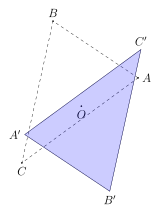
- Writing points as:
\begin{align*}
\lambda\mathbf{a}+\mu\mathbf{b}+\nu\mathbf{c} &= (1-\mu - \nu)\mathbf{a}+\mu\mathbf{b}+\nu\mathbf{c} \\
&= \mathbf{a} + (-\mu)(\mathbf{a}-\mathbf{b}) + (-\nu)(\mathbf{a} - \mathbf{c}) \\
&= \mathbf{a} + (-\mu)(\mathbf{a}-\mathbf{b}) + (-\nu)(\mathbf{a} - \mathbf{c}) + (1+\mu+\nu)\mathbf{0}\\
\end{align*}
So this is a translation of \(\mathbf{a}\) of the triangle with vertices at \(\mathbf{0}, \mathbf{a-b}, \mathbf{a-c}\), or a triangle with vertices \(\mathbf{a}, 2\mathbf{a-b}, 2\mathbf{a-c}\).
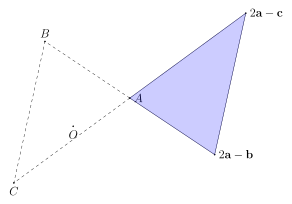
1987 Paper 1 Q10
A rubber band band of length \(2\pi\) and modulus of elasticity \(\lambda\) encircles a smooth cylinder of unit radius, whose axis is horizontal. A particle of mass \(m\) is attached to the lowest point of the band, and hangs in equilibrium at a distance \(x\) below the axis of the cylinder. Obtain an expression in terms of \(x\) for the stretched length of the band in equilibrium. What is the value of \(\lambda\) if \(x=2\)?
Solution:

1987 Paper 1 Q11
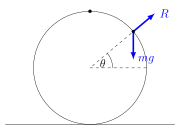
A smooth sphere of radius \(r\) stands fixed on a horizontal floor. A particle of mass \(m\) is displaced gently from equilibrium on top of the sphere. Find the angle its velocity makes with the horizontal when it loses contact with the sphere during the subsequent motion. By energy considerations, or otherwise, find the vertical component of the momentum of the particle as it strikes the floor.
Solution:
1987 Paper 1 Q12
\(\,\) \vspace{-1cm}
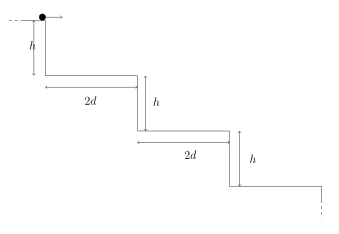
Solution: Considering the horizontal component, this will be constant as there are no forces acting in that direction. The first step will take the particle \(t = \sqrt{\frac{2h}g}\) to reach. At which point it will be travelling with speed \(v = \sqrt{2gh} \) (by energy considerations, \(mgh = \frac12 mv^2\)). To reach the second step must take twice as long (since the ball has to travel \(2d\) horizontally, rather than \(d\)). Since \(t = 2\sqrt{\frac{2h}g}\) we must have that: \begin{align*} && s &= ut + \frac12 gt^2 \\ \Rightarrow && h &= u 2\sqrt{\frac{2h}g} + \frac12 g \frac{8h}g \\ \Rightarrow && u &= -\frac{3}{2} h\sqrt{\frac{g}{2h}} \\ &&&= -\frac{3}{2\sqrt{2}} \sqrt{gh} \end{align*} Therefore, using Newton's experimental law, we must have that \(e = \frac{\frac{3}{2 \sqrt{2}} \sqrt{gh}}{\sqrt{2} \sqrt{gh}} = \frac{3}{4}\). Again by conservation of energy \(mgh + \frac12 \frac{9}{8} mgh = \frac12 mv^2 \Rightarrow v = \frac{5}{2\sqrt{2}} \sqrt{gh}\) when it lands on the next step. Therefore we would need the coefficient of restitution for the second (and subsequent steps) to be: \(\displaystyle \frac{\frac{3}{2\sqrt{2}} \sqrt{gh}}{\frac{5}{2\sqrt{2}} \sqrt{gh}} = \frac35\)
1987 Paper 1 Q13
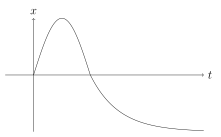
A particle of mass \(m\) moves along the \(x\)-axis. At time \(t=0\) it passes through \(x=0\) with velocity \(v_{0} > 0\). The particle is acted on by a force \(\mathrm{F}(x)\), directed along the \(x\)-axis and measured in the direction of positive \(x\), which is given by \[ \mathrm{F}(x)=\begin{cases} -m\mu^{2}x & \qquad(x\geqslant0),\\ -m\kappa\dfrac{\mathrm{d}x}{\mathrm{d}t} & \qquad(x < 0), \end{cases} \] where \(\mu\) and \(\kappa\) are positive constants. Obtain the particle's subsequent position as a function of time, and give a rough sketch of the \(x\)-\(t\) graph.
Solution: Using Newton's second law in the form, \(\F(x) = m \ddot{x}\). Our two different differential equations can be solved as follows: When \(x \geq 0\) \(-\mu^2x = \ddot{x} \Rightarrow x = A\sin \mu t + B \cos \mu t\) when \(x \geq 0\). And when \(x < 0\) \(-\kappa \dot{x} = \ddot{x} \Rightarrow \dot{x} = Ce^{-\kappa t} \Rightarrow x = De^{-\kappa t} + E\) when \(x < 0\) Following the trajectory of the particle: At \(t = 0, x = 0, \dot{x} = v_0 > 0\), so \(x = \frac{v_0}{\mu} \sin \mu t\) until \(t = \frac{\pi}{\mu}\). When \(t = \frac{\pi}{\mu}\) the particle will head into the negative \(x\)-axis with velocity \(-v_0\). At which point our initial conditions for our differential equations give us that \(De^{-\frac{\pi\kappa}{\mu}} + E = 0, -\kappa De^{-\frac{\pi\kappa}{\mu}} = -v_0 \Rightarrow De^{-\frac{\pi\kappa}{\mu}} = \frac{v_0}{\kappa}, E = -\frac{v_0}{\kappa}\). To summarise: \[ x(t) = \begin{cases} \frac{v_0}{\mu} \sin \mu t & 0 \leq t \leq \frac{\pi}{\mu} \\ -\frac{v_0}{\kappa} \l 1-e^{-\kappa(t-\frac{\pi}{\mu})}\r & t > \frac{\pi}{\mu}\end{cases}\]
1987 Paper 1 Q14
\(A,B\) and \(C\) play a table tennis tournament. The winner of the tournament will be the first person to win two games in a row. In any game, whoever is not playing acts as a referee, and each playerhas equal chance of winning the game. The first game of the tournament is played between \(A\) and \(B\), with \(C\) as referee. Thereafter, if the tournament is still undecided at the end of any game, the winner and referee of that game play the next game. The tournament is recorded by listing in order the winners of each game, so that, for example, \(ACC\) records a three-game tournament won by \(C\), the first game having been won by \(A\). Determine which of the following sequences of letters could be the record of a complete tournament, giving brief reasons for your answers:
- \(ACB\),
- \(ABB\),
- \(ACBB\).
Solution:
- \(ACB\) is not a complete tournament since no-one has won two matches.
- \(ABB\) is not a possible complete tournament since it implies \(B\) won game 2, which is between \(A\) (winner of game 1) and \(C\) (referee of game 1).
- \(ACBB\) is a valid tournament, \(A\) beat \(B\), then \(C\) beat \(A\), then \(B\) beat \(C\) and finally \(B\) beat \(A\) to win.
1987 Paper 1 Q15
A point \(P\) is chosen at random (with uniform distribution) on the circle \(x^{2}+y^{2}=1\). The random variable \(X\) denotes the distance of \(P\) from \((1,0)\). Find the mean and variance of \(X\). Find also the probability that \(X\) is greater than its mean.
Solution: Consider the angle from the origin, then \(P = (\cos \theta, \sin \theta)\) where \(\theta \sim U(0, 2\pi)\), and \(X = \sqrt{(\cos \theta - 1)^2 + \sin^2 \theta}\) \begin{align*} \mathbb{E}[X] &= \int_0^{2\pi} \sqrt{(\cos \theta - 1)^2 + \sin^2 \theta} \frac1{2\pi} \d \theta \\ &= \frac1{2\pi}\int_0^{2\pi} \sqrt{2 - 2\cos \theta} \d \theta \\ &= \frac{1}{2\pi}\int_0^{2\pi} \sqrt{4\sin^2 \frac{\theta}{2}} \d \theta \\ &= \frac{1}{\pi}\int_0^{2\pi} \left |\sin \frac{\theta}{2} \right| \d \theta \\ &= \frac{1}{\pi} \left [ -2\cos \frac{\theta}{2} \right]_0^{2\pi} \\ &= \frac1{\pi} \l 2 + 2\r \\ &= \frac{4}{\pi} \end{align*} \begin{align*} \mathbb{E}(X^2) &= \frac1{2\pi}\int_0^{2\pi} (\cos \theta - 1)^2 + \sin^2 \theta \d \theta \\ &= \frac1{2\pi}\int_0^{2\pi} 2 - 2 \cos \theta \d \theta \\ &= \frac{4\pi}{2\pi} \\ &= 2 \\ \end{align*} \(\Rightarrow\) \(\mathrm{Var}(X) = \mathbb{E}(X^2) - \mathbb{E}(X)^2 = 2 - \frac{16}{\pi^2} = \frac{2\pi^2 - 16}{\pi^2}\).
