Problems
Filters
1531 problems found
2002 Paper 2 Q10
A competitor in a Marathon of \(42 \frac38\) km runs the first \(t\) hours of the race at a constant speed of 13 km h\(^{-1}\) and the remainder at a constant speed of \(14 + 2t/T\) km h\(^{-1}\), where \(T\) hours is her time for the race. Show that the minimum possible value of \(T\) over all possible values of \(t\) is 3. The speed of another competitor decreases linearly with respect to time from 16~km~h\(^{-1}\) at the start of the race. If both of these competitors have a run time of 3 hours, find the maximum distance between them at any stage of the race.
2002 Paper 2 Q11
A rigid straight beam \(AB\) has length \(l\) and weight \(W\). Its weight per unit length at a distance \(x\) from \(B\) is \(\alpha Wl^{-1} (x/l)^{\alpha-1}\,\), where \(\alpha\) is a positive constant. Show that the centre of mass of the beam is at a distance \(\alpha l/(\alpha+1)\) from \(B\). The beam is placed with the end \(A\) on a rough horizontal floor and the end \(B\) resting against a rough vertical wall. The beam is in a vertical plane at right angles to the plane of the wall and makes an angle of \(\theta\) with the floor. The coefficient of friction between the floor and the beam is \(\mu\) and the coefficient of friction between the wall and the beam is also \(\mu\,\). Show that, if the equilibrium is limiting at both \(A\) and \(B\), then \[ \tan\theta = \frac{1-\alpha \mu^2}{(1+\alpha)\mu}\;. \] Given that \(\alpha =3/2\,\) and given also that the beam slides for any \(\theta<\pi/4\,\) find the greatest possible value of \(\mu\,\).
2002 Paper 2 Q12
On \(K\) consecutive days each of \(L\) identical coins is thrown \(M\) times. For each coin, the probability of throwing a head in any one throw is \(p\) (where \(0 < p < 1\)). Show that the probability that on exactly \(k\) of these days more than \(l\) of the coins will each produce fewer than \(m\) heads can be approximated by \[ {K \choose k}q^k(1-q)^{K-k}, \] where \[ q=\Phi\left( \frac{2h-2l-1}{2\sqrt{h} }\right), \ \ \ \ \ \ h=L\Phi\left( \frac{2m-1-2Mp}{2\sqrt{ Mp(1-p)}}\right) \] and \(\Phi(\cdot)\) is the cumulative distribution function of a standard normal variate. Would you expect this approximation to be accurate in the case \(K=7\), \(k=2\), \(L=500\), \(l=4\), \(M=100\), \(m=48\) and \(p=0.6\;\)?
Solution: Let \(H_i\) be the random variable of how many heads the \(i\)th coin throws on a given day. Then \(H_i \sim B(M,p)\), and the probability that a given coin produces fewer than \(m\) heads is \(p_h = \P(H_i < m)\) Let \(C\) be the random variable the number of coins producing fewer than \(m\) heads, then \(C \sim B(L, p_h)\). The probability that more than \(l\) of the coins produce fewer than \(m\) heads is therefore \(\P(C > l)\). Finally, the probability that on exactly \(k\) days more than \(l\) of the coins will produce fewer than \(m\) heads is: \[ \binom{K}{k} \cdot \P(C > l)^k \cdot (1-\P(C > l))^{K-k} \] Let's start by assuming that all our Binomials can be approximated by a normal distribution. \(B(M,p) \approx N(Mp, Mp(1-p))\) and so: \begin{align*} p_h &= \P(H_i < m) \\ &\approx \P( \sqrt{Mp(1-p)}Z+Mp < m-\frac12) \\ &= \P \l Z < \frac{2m-2Mp-1}{2\sqrt{Mp(1-p)}} \r \\ &= \Phi\l\frac{2m-2Mp-1}{2\sqrt{Mp(1-p)}} \r \end{align*} \(B(L, p_h) \approx B \l L, \P \l Z < \frac{2m-2Mp-1}{2\sqrt{Mp(1-p)}} \r\r = B(L, \frac{h}{L}) \approx N(h, \frac{h(L-h)}{L})\) Therefore \begin{align*} \P(C > l) &= 1-\P(C \leq l) \\ &\approx 1- \P \l \sqrt{\frac{h(L-h)}{L}} Z + h \leq l+\frac12 \r \\ &= 1 - \P \l Z \leq \frac{2l-2h+1}{2\sqrt{\frac{h(L-h)}{L}}}\r \\ &= 1- \Phi\l \frac{2l-2h+1}{2\sqrt{\frac{h(L-h)}{L}}} \r \\ &= \Phi\l \frac{2h-2l-1}{2\sqrt{\frac{h(L-h)}{L}}} \r \end{align*} If we can approximate \(\sqrt{1-\frac{h}{L}}\) by \(1\) then we obtain the approximation in the question. Alternatively, \(B(L, \frac{h}{L}) \approx Po(h)\) and \(Po(h) \approx N(h,h)\) so we obtain: \begin{align*} \P(C > l) &= 1-\P(C \leq l) \\ &\approx 1 - \P(\sqrt{h} Z +h < l + \frac12) \\ &= 1 - \P \l Z < \frac{2l-2h+1}{2\sqrt{h}} \r \\ &= \Phi \l \frac{2h - 2l -1}{2\sqrt{h}}\r \end{align*} as required. [I think this is what the examiners expected]. Considering the case \(K=7\), \(k=2\), \(L=500\), \(l=4\), \(M=100\), \(m=48\) and \(p=0.6\), we have the first normal approximation depends on \(Mp\) and \(M(1-p)\) being large. They are \(60\) and \(40\) respectively, so this is likely a good approximation. The first approximation finds that \begin{align*} h &= 500 \cdot \Phi \l \frac{2 \cdot 48 - 2 \cdot 60 - 1}{2\sqrt{24}} \r \\ &= 500 \cdot \Phi \l \frac{2 \cdot 48 - 2 \cdot 60 - 1}{2\sqrt{24}} \r \\ &= 500 \cdot \Phi \l \frac{-25}{2 \sqrt{24}} \r \\ &\approx 500 \cdot \Phi (-2.5) \\ &= 500 \cdot 0.0062 \\ &\approx 3.1 \end{align*} The second binomial approximation will be good if \(500 \cdot \frac{3.1}{500} = 3.1\) is large, but this is quite small. Therefore, we shouldn't expect this to be a good approximation. However, since \(m = 48\) is far from the mean (in a normalised sense), we might expect the percentage error to be large. [Alternatively, using what I expect the desired approach] The approximation of \(B(L, \frac{h}{L}) \approx Po(h)\) is acceptable since \(n>50\) and \(h < 5\). The approximation of \(Po(h) \sim N(h,h)\) is not acceptable since \(h\) is small (in particular \(h < 15\)) Finally, we can compute all these values exactly using a modern calculator. \begin{array}{l|cc} & \text{correct} & \text{approx} \\ \hline p_h & 0.005760\ldots & 0.005362\ldots \\ \P(C > l) & 0.164522\ldots & 0.133319\ldots \\ \text{ans} & 0.231389\ldots & 0.182516\ldots \end{array} We can also see how the errors propagate, by doing the calculations assuming the previous steps are correct, and also including the Poisson step. \begin{array}{lccc} & \text{correct} & \text{approx} & \text{using approx } p_h \\ \hline p_h & 0.005760\ldots & 0.005362\ldots & - \\ \P(C > l)\quad [Po(h)] & 0.164522\ldots & 0.165044\ldots & 0.134293\ldots \\ \P(C > l)\quad [N(h,h)] & 0.164522\ldots & 0.169953\ldots & 0.133319\ldots \\ \P(C > l)\quad [N(h,h(1-\frac{h}{L})] & 0.164522\ldots & 0.169255\ldots & 0.132677\ldots \\ \text{ans} & 0.231389\ldots & 0.231389\ldots \end{array} By doing this, we discover that the largest errors are actually coming not from approximating the second approximation but from the small absolute (but large relative error) in the first approximation. This is, in fact, a coincidence; we can observe it by investigating the specific values being used. The first approximation looks as follows:


2002 Paper 2 Q13
Let \(\F(x)\) be the cumulative distribution function of a random variable \(X\), which satisfies \(\F(a)=0\) and \(\F(b)=1\), where \(a>0\). Let \[ \G(y) = \frac{\F(y)}{2-\F(y)}\;. \] Show that \(\G(a)=0\,\), \(\G(b)=1\,\) and that \(\G'(y)\ge0\,\). Show also that \[ \frac12 \le \frac2{(2-\F(y))^2} \le 2\;. \] The random variable \(Y\) has cumulative distribution function \(\G(y)\,\). Show that \[ { \tfrac12} \,\E(X) \le \E(Y) \le 2 \E(X) \;, \] and that \[ \var(Y) \le 2\var(X) +\tfrac 74 \big(\E(X)\big)^2\;. \]
Solution: \begin{align*} && G(a) &= \frac{F(a)}{2-F(a)}\\ &&&= 0 \tag{\(F(a)= 0\)}\\ \\ && G(b) &= \frac{F(b)}{2-F(b)} \\ &&&= \frac{1}{2-1} = 1 \tag{\(F(b)=1\)}\\ \\ && G'(y) &= \frac{F'(y)(2-F(y))+F(y)F'(y)}{(2-F(y))^2} \\ &&&= \frac{2F'(y)}{(2-F(y))^2} \geq 0 \tag{\(F'(y) \geq 0\)} \end{align*} \begin{align*} && 0 \leq F(y)\leq1\\ \Leftrightarrow&& 1\leq 2-F(y) \leq 2\\ \Leftrightarrow &&1 \leq (2-F(y))^2 \leq 4\\ \Leftrightarrow && 1 \geq \frac{1}{(2-F(y))^2} \geq \frac14 \\ \Leftrightarrow && 2 \geq \frac{2}{(2-F(y))^2} \geq\frac12 \end{align*} \begin{align*} && \mathbb{E}(Y) &= \int_a^b y G'(y) \d y \\ &&&= \int_a^b y F'(y) \underbrace{\frac{2}{(2-F(y))^2}}_{\in [\frac12, 2]} \d y \\ &&&\leq 2 \E[X] \\ &&&\geq \frac12 \E[X]\\ \\ && \E[Y^2] &\leq 2\E[X^2] \\ && \E[Y^2] &\geq \frac12\E[X^2] \\ \\ \Rightarrow && \var[Y] &= \E[Y^2]-\E[Y]^2 \\ &&& \leq 2 \E[X^2] - (\tfrac12\E[X])^2 \\ &&&= 2 \var[X] + \tfrac74(\E[X])^2 \end{align*}
2002 Paper 2 Q14
A densely populated circular island is divided into \(N\) concentric regions \(R_1\), \(R_2\), \(\ldots\,\), \(R_N\), such that the inner and outer radii of \(R_n\) are \(n-1\) km and \(n\) km, respectively. The average number of road accidents that occur in any one day in \(R_n\) is \(2-n/N\,\), independently of the number of accidents in any other region. Each day an observer selects a region at random, with a probability that is proportional to the area of the region, and records the number of road accidents, \(X\), that occur in it. Show that, in the long term, the average number of recorded accidents per day will be \[ 2-\frac16\left(1+\frac1N\right)\left(4-\frac1N\right)\;. \] [Note: \(\sum\limits_{n=1}^N n^2 = \frac16 N(N+1)(2N+1) \;\).] Show also that \[ \P(X=k) = \frac{\e^{-2}N^{-k-2}}{k!}\sum_{n=1}^N (2n-1)(2N-n)^k\e^{n/N} \;. \] Suppose now that \(N=3\) and that, on a particular day, two accidents were recorded. Show that the probability that \(R_2\) had been selected is \[ \frac{48}{48 + 45\e^{1/3} +25 \e^{-1/3}}\;. \]
Solution: The area of \(R_n\) is \(\pi(n^2 - (n-1)^2) = (2n-1)\pi\). The area of the whole region is \(\pi N^2\). \begin{align*} && \E[X] &= \E[\E[X | \text{choose region }n]] \\ &&&= \sum_{n=1}^N \left (2 - \frac{n}{N} \right) \cdot \frac{(2n-1)\pi}{N^2 \pi} \\ &&&= \sum_{n=1}^N \left (2\cdot \frac{(2n-1)\pi}{N^2 \pi} - \frac{n}{N}\cdot \frac{(2n-1)\pi}{N^2 \pi} \right) \\ &&&= 2 - \frac{1}{N^3} \sum_{n=1}^N (2n^2-n) \\ &&&= 2 - \frac{1}{N^3} \left (\frac{2N(N+1)(2N+1)}{6} - \frac{N(N+1)}{2} \right) \\ &&&= 2 - \frac{N+1}{6N^2} \left (2(2N+1)-3 \right) \\ &&&= 2 - \frac{N+1}{6N^2} (4N - 1) \\ &&&= 2 - \frac16 \left (1 + \frac1N \right) \left (4 - \frac1N \right) \end{align*} Modelling each region as \(Po(2 - n/N)\) we have \begin{align*} \mathbb{P}(X = k ) &= \sum_{n=1}^N \exp(-2 + n/N) \frac{(2-n/N)^k}{k!} \frac{2n-1}{N^2} \\ &= \frac{e^{-2}N^{-k-2}}{k!} \sum_{n=1}^N e^{n/N} (2N-n)^k(2n-1) \end{align*} as desired. Supposing \(N=3\) and two accidents then \begin{align*} \mathbb{P}(R_2 | X = 2) &= \frac{\frac{3}{9} e^{-4/3}\frac{(\frac43)^2}{2!}}{\mathbb{P}(X=2)} \\ &= \frac{\frac{3}{9} e^{-4/3} \frac{(\frac43)^2}{2!}}{\frac{1}{9} e^{-5/3} \frac{(\frac53)^2}{2!} + \frac{3}{9} e^{-4/3} \frac{(\frac43)^2}{2!} + \frac{5}{9} e^{-2/3} \frac{(\frac33)^2}{2!}} \\ &= \frac{3 \cdot 16}{25e^{-1/3} + 3 \cdot 16 + 5 \cdot 9e^{1/3}} \\ &= \frac{48}{25e^{-1/3} + 48 + 45e^{1/3}} \end{align*} as required.
2002 Paper 3 Q1
Find the area of the region between the curve \(\displaystyle y = {\ln x \over x}\,\) and the \(x\)-axis, for \(1 \le x \le a\). What happens to this area as \(a\) tends to infinity? Find the volume of the solid obtained when the region between the curve \(\displaystyle y = {\ln x \over x}\,\) and the \(x\)-axis, for \(1 \le x\le a\), is rotated through \(2 \pi\) radians about the \(x\)-axis. What happens to this volume as \(a\) tends to infinity?
Solution: \begin{align*} && \int_1^a \frac{\ln x}{x} \d x &= \left [ \ln x \cdot \ln x\right ]_1^a - \int_1^a \frac{\ln x}{x} \d x \\ \Rightarrow && \int_1^a \frac{\ln x}{x} \d x &= \frac12 \left ( \ln a \right) ^2 \\ && \int_1^\infty \frac{\ln x}{x} \d x &= \lim_{a \to \infty} \frac12 (\ln a)^2 \\ &&&= \infty \end{align*} \begin{align*} && \pi \int_1^a \left ( \frac{\ln x}{x} \right)^2 \d x &= \pi \int_{u=0}^{u=\ln a} \left ( \frac{u}{e^u} \right)^2 e^u \d u \\ &&&= \pi \int_0^{\ln a} u^2 e^{-u} \d u \\ &&&= \pi \left [-u^2e^{-u} \right]_0^{\ln a} +\pi \int_0^{\ln a} 2u e^{-u} \d u \\ &&&= -\frac{\pi}{a} (\ln a)^2 + \pi \left [-2u e^{-u} \right]_0^{\ln a} + \pi \int_0^{\ln a} e^{-u} \d u \\ &&&= -\frac{\pi}{a} (\ln a)^2- \frac{2 \pi}{a}\ln a+\pi \left (1 - \frac{1}{a} \right) \\ \\ && \pi \int_1^{\infty} \left ( \frac{\ln x}{x} \right)^2 \d x &= \lim_{a \to \infty} \left ( -\frac{\pi}{a} (\ln a)^2- \frac{2 \pi}{a}\ln a+\pi \left (1 - \frac{1}{a} \right) \right) \\ &&&= \pi \end{align*}
2002 Paper 3 Q2
Prove that \(\displaystyle \arctan a + \arctan b = \arctan \l {a + b \over 1-ab} \r\,\) when \(0 < a < 1\) and \(0 < b < 1\,\). Prove by induction that, for \(n \ge 1\,\), \[ \sum_{r = 1}^n \arctan \l {1 \over r^2 + r + 1} \r = \arctan \l {n \over n+2} \r \] and hence find \[ \sum_{r = 1}^\infty \arctan \l {1 \over r^2 + r + 1} \r\,. \] Hence prove that \[ \sum_{r = 1}^\infty \arctan \l {1 \over r^2 - r + 1} \r = {\pi \over 2}\,. \]
Solution: \begin{align*} && \arctan a &\in (0, \tfrac{\pi}{4}) \\ && \arctan b &\in (0, \tfrac{\pi}{4}) \\ \Rightarrow && \arctan a+\arctan b &\in (0, \tfrac{\pi}{2}) \\ && \tan \left ( \arctan a+\arctan b \right) &= \frac{\tan \arctan a + \tan \arctan b}{1 - \tan \arctan a \tan \arctan b} \\ &&&= \frac{a+b}{1-ab} \in (0, \infty) \\ \Rightarrow && \arctan \left ( \frac{a+b}{1-ab} \right) &\in (0, \tfrac{\pi}{2}) \\ \Rightarrow && \arctan a + \arctan b &= \arctan \left ( \frac{a+b}{1-ab} \right) \end{align*} Claim: \(\displaystyle \sum_{r = 1}^n \arctan \l {1 \over r^2 + r + 1} \r = \arctan \l {n \over n+2} \r\) Proof: (By Induction): Base case (\(n=1\)): \begin{align*} && LHS &= \sum_{r=1}^1 \arctan \left ( \frac{1}{r^2+r+1} \right) \\ &&&= \arctan \left ( \frac{1}{3} \right) \\ && RHS &= \arctan \left ( \frac{1}{1+2} \right)\\ &&&= \arctan \left ( \frac{1}{3} \right) = LHS \end{align*} Inductive step, suppose true for \(n = k\), ie \begin{align*} && \sum_{r = 1}^k \arctan \l {1 \over r^2 + r + 1} \r &= \arctan \l {k \over k+2} \r \\ \Rightarrow && \sum_{r = 1}^{k+1} \arctan \l {1 \over r^2 + r + 1} \r &= \sum_{r = 1}^k \arctan \l {1 \over r^2 + r + 1} \r+ \arctan \left ( \frac{1}{(k+1)^2+(k+1)+1} \right) \\ &&&= \arctan \l {k \over k+2} \r+\arctan \left ( \frac{1}{(k+1)^2+(k+1)+1} \right) \\ &&&= \arctan \left ( \frac{{k \over k+2}+\frac{1}{(k+1)^2+(k+1)+1} }{1-\frac{k}{k+2}\frac{1}{(k+1)^2+(k+1)+1} } \right) \\ &&&= \arctan \left ( \frac{k((k+1)^2+k+1+k)+(k+2) }{(k+2)((k+1)^2+(k+1)+1)-k} \right) \\ &&&= \arctan \left ( \frac{k^3+3k^2+4k+2 }{k^3+5k^2+8k+6} \right) \\ &&&= \arctan \left ( \frac{(k+1)(k^2+2k+2) }{(k+3)(k^2+2k+2)} \right) \\ &&&= \arctan \left ( \frac{k+1 }{(k+1)+2} \right) \\ \end{align*} Therefore it is true for \(n = k+1\), therefore it is true for all \(n \geq 1\) by the principle of mathematical induction. \begin{align*} && S &= \lim_{n \to \infty} \sum_{r = 1}^n \arctan \l {1 \over r^2 + r + 1} \r \\ &&&= \lim_{n \to \infty} \arctan \l \frac{n}{n+2} \r \\ &&&= \lim_{n \to \infty} \arctan \l \frac{1}{1+2/n} \r \\ &&&=\arctan\l \lim_{n \to \infty} \frac{1}{1+2/n} \r \\ &&&= \frac{\pi}{4} \end{align*} \begin{align*} && \sum_{r = 1}^\infty \arctan \l {1 \over r^2 - r + 1} \r &= \sum_{r = 0}^\infty \arctan \left( \frac{1}{ (r+1)^2 - (r+1) + 1} \right) \\ &&&= \sum_{r = 0}^\infty \arctan \left( \frac{1}{ r^2+r+1} \right) \\ &&&= \arctan \l \frac{1}{0^2+0+1} \r + \frac{\pi}{4} \\ &&&= \frac{\pi}{2} \end{align*}
2002 Paper 3 Q3
Let \[\f(x) = a \sqrt{x} - \sqrt{x - b}\;, \] where \(x\ge b >0\) and \(a>1\,\). Sketch the graph of \(\f(x)\,\). Hence show that the equation \(\f(x) = c\), where \(c>0\), has no solution when \(c^2 < b \l a^2 - 1 \r\,\). Find conditions on \(c^2\) in terms of \(a\) and \(b\) for the equation to have exactly one or exactly two solutions. Solve the equations
- \(3 \sqrt{x} - \sqrt{x - 2} = 4\, ,\)
- \(3 \sqrt{x} - \sqrt{x - 3} = 5\;\).
Solution: \begin{align*} && f'(x) &= \frac12 ax^{-1/2}-\frac12(x-b)^{-1/2} \\ \Rightarrow f'(x) = 0: && 0 &= \frac{a\sqrt{x-b}-\sqrt{x}}{\sqrt{x(x-b)}} \\ \Rightarrow && x &= a^2(x-b)\\ \Rightarrow && x &= \frac{a^2b}{a^2-1} \\ && f(x) &= a^2 \sqrt{\frac{b}{a^2-1}} - \sqrt{\frac{a^2b}{a^2-1}-b} \\ &&&= a^2 \sqrt{\frac{b}{a^2-1}} - \sqrt{\frac{b}{a^2-1}} \\ &&&= \sqrt{b(a^2-1)} \end{align*}

- \(c^2 = 16\), \(2 \cdot (3^2-1) = 16\), so we should have exactly one solution at \(x = \frac{3^2 \cdot 2}{3^2 -1 } = \frac{9}{4}\)
- \(c^2 = 25\) and \(3 \cdot (3^2 - 1) = 24, 3 \cdot (3^2) = 27\), so we look for two solutions. \begin{align*} && 5 & = 3 \sqrt{x} - \sqrt{x-3} \\ \Rightarrow && 25 &= 9x+x-3-6\sqrt{x(x-3)} \\ \Rightarrow && 3\sqrt{x(x-3)} &= 5x-14 \\ \Rightarrow && 9x(x-3) &= 25x^2-140x+196 \\ \Rightarrow && 0 &= 16x^2-113x+196 \\ &&&= (x-4)(16x-49) \\ \Rightarrow && x &= 4, \frac{49}{16} \end{align*}
2002 Paper 3 Q4
Show that if \(x\) and \(y\) are positive and \(x^3 + x^2 = y^3 - y^2\) then \(x < y\,\). Show further that if \(0 < x \le y - 1\), then \(x^3 + x^2 < y^3 - y^2\). Prove that there does not exist a pair of {\sl positive} integers such that the difference of their cubes is equal to the sum of their squares. Find all the pairs of integers such that the difference of their cubes is equal to the sum of their squares.
2002 Paper 3 Q5
Give a condition that must be satisfied by \(p\), \(q\) and \(r\) for it to be possible to write the quadratic polynomial \(px^2 + qx + r\) in the form \(p \l x + h \r^2\), for some \(h\). Obtain an equation, which you need not simplify, that must be satisfied by \(t\) if it is possible to write \[ \l x^2 + \textstyle{{1 \over 2}} bx + t \r^2 - \l x^4 + bx^3 + cx^2 +dx +e \r \] in the form \(k \l x + h \r^2\), for some \(k\) and \(h\). Hence, or otherwise, write \(x^4 + 6x^3 + 9x^2 -2x -7\) as a product of two quadratic factors.
2002 Paper 3 Q6
Find all the solution curves of the differential equation \[ y^4 \l {\mathrm{d}y \over \mathrm{d}x }\r^{\! \! 4} = \l y^2 - 1 \r^2 \] that pass through either of the points
- \(\l 0, \, \frac{1}{2}\sqrt3 \r\),
- \(\l 0, \, \frac{1}{2}\sqrt5 \r\).
Solution: \begin{align*} && y^4 \left (\frac{\d y}{\d x} \right)^4 &= (y^2 - 1)^2 \\ \Rightarrow && y^2 \left (\frac{\d y}{\d x} \right)^2 &= |y^2 - 1| \\ && y \left (\frac{\d y}{\d x} \right) &= \pm \sqrt{|y^2-1|} \\ \Rightarrow &&\int \frac{y}{\sqrt{|y^2-1|}} \d y &= \int \pm 1 \d x \\ \Rightarrow && \pm \sqrt{|y^2-1|} &= \pm x + C \\ \end{align*}
- Since \(y^2 < 1\), our solution curve should be of the from \(-\sqrt{1-y^2} = \pm x + C\) Plugging in \((0, \tfrac12 \sqrt{3})\), we obtain \(-\tfrac12 = C\), therefore our solution curves are \(\pm x = \frac12 - \sqrt{1-y^2}\)
- Since \(y^2 > 1\), our solution curve should be of the from \(\sqrt{y^2-1} = \pm x + C\) Plugging in \((0, \tfrac12 \sqrt{5})\), we obtain \(\tfrac12 = C\), therefore our solution curves are \(\pm x = \sqrt{y^2-1}-\frac12\)

2002 Paper 3 Q7
Given that \(\alpha\) and \(\beta\) are acute angles, show that \(\alpha + \beta = \tfrac{1}{2}\pi\) if and only if \(\cos^2 \alpha + \cos^2 \beta = 1\). In the \(x\)--\(y\) plane, the point \(A\) has coordinates \((0,s)\) and the point \(C\) has coordinates \((s,0)\), where \(s>0\). The point \(B\) lies in the first quadrant (\(x>0\), \(y>0\)). The lengths of \(AB\), \(OB\) and \(CB\) are respectively \(a\), \(b\) and \(c\). Show that \[ (s^2 +b^2 - a^2)^2 + (s^2 +b^2 -c^2)^2 = 4s^2b^2 \] and hence that \[ (2s^2 -a^2-c^2)^2 + (2b^2 -a^2-c^2)^2 =4a^2c^2\;. \] Deduce that $$ \l a - c \r^2 \le 2b^2 \le \l a + c \r^2\;. $$ %Show, %by considering the case \(a=1+\surd2\,\), \(b=c=1\,\), % that the condition \(\l \ast \r\,\) %is not sufficient to ensure that \(B\) lies in the first quadrant.
2002 Paper 3 Q8
Four complex numbers \(u_1\), \(u_2\), \(u_3\) and \(u_4\) have unit modulus, and arguments \(\theta_1\), \(\theta_2\), \(\theta_3\) and \(\theta_4\), respectively, with \(-\pi < \theta_1 < \theta_2 < \theta_3 < \theta_4 < \pi\). Show that \[ \arg \l u_1 - u_2 \r = \tfrac{1}{2} \l \theta_1 + \theta_2 -\pi \r + 2n\pi \] where \(n = 0 \hspace{4 pt} \mbox{or} \hspace{4 pt} 1\,\). Deduce that \[ \arg \l \l u_1 - u_2 \r \l u_4 - u_3 \r \r = \arg \l \l u_1 - u_4 \r \l u_3 - u_2 \r \r + 2n\pi \] for some integer \(n\). Prove that \[ | \l u_1 - u_2 \r \l u_4 - u_3 \r | + | \l u_1 - u_4 \r \l u_3 - u_2 \r | = | \l u_1 - u_3 \r \l u_4 - u_2 \r |\;. \]
2002 Paper 3 Q9
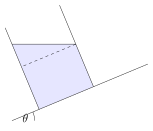
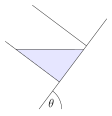
A tall container made of light material of negligible thickness has the form of a prism, with a square base of area \(a^2\). It contains a volume \(ka^3\) of fluid of uniform density. The container is held so that it stands on a rough plane, which is inclined at angle \(\theta\) to the horizontal, with two of the edges of the base of the container horizontal. In the case \(k > \frac12 \tan\theta\), show that the centre of mass of the fluid is at a distance \(x\) from the lower side of the container and at a distance \(y\) from the base of the container, where \[ \frac x a = \frac12 - \frac {\tan\theta}{12k}\;, \ \ \ \ \ \ \frac y a = \frac k 2 + \frac{\tan^2\theta}{24k}\;. \] Determine the corresponding coordinates in the case \(k < \frac12 \tan\theta\). The container is now released. Given that \(k < \frac12\), show that the container will topple if \(\theta >45^\circ\).
Solution:
2002 Paper 3 Q10
A light hollow cylinder of radius \(a\) can rotate freely about its axis of symmetry, which is fixed and horizontal. A particle of mass \(m\) is fixed to the cylinder, and a second particle, also of mass \(m\), moves on the rough inside surface of the cylinder. Initially, the cylinder is at rest, with the fixed particle on the same horizontal level as its axis and the second particle at rest vertically below this axis. The system is then released. Show that, if \(\theta\) is the angle through which the cylinder has rotated, then \[ \ddot{\theta} = {g \over 2a} \l \cos \theta - \sin \theta \r \,, \] provided that the second particle does not slip. Given that the coefficient of friction is \( (3 + \sqrt{3})/6\), show that the second particle starts to slip when the cylinder has rotated through \(60^\circ\).