Problems
Filters
70 problems found
1993 Paper 3 Q4
Sum the following infinite series.
- \[ 1 + \frac13 \bigg({\frac12}\bigg)^2 +\frac15\bigg(\frac12\bigg)^4 + \cdots + \frac{1}{2n+1} \bigg(\frac12\bigg)^{2n} + \cdots \] .
- \[ 2 -x -x^3 +2x^4 - \cdots + 2x^{4k} - x^{4k+1} - x^{4k+3} +\cdots \] where \(|x| < 1\).
- \[ \sum _{r=2}^\infty {r\, 2^{r-2} \over 3^{r-1} } \].
- \[ \sum_{r=2}^\infty {2 \over r(r^2-1) } \].
Solution:
- \begin{align*} && \sum_{i=0}^{\infty} x^{2i+1}&= \frac{x}{1-x^2} \\ \Rightarrow &&&=\frac12 \left ( \frac{1}{1-x} - \frac{1}{1+x} \right) \\ \underbrace{\Rightarrow}_{\int} && \sum_{i=0}^{\infty} \frac{1}{2i+1} x^{2i+2} &= \frac12 \left ( -\ln (1-x) - \ln(1+x) \right) \\ \underbrace{\Rightarrow}_{x = 1/2} && \sum_{i=0}^\infty \frac{1}{2i+1} \left (\frac12 \right)^{2i+2} &= -\frac12 \ln \frac12 - \frac12 \ln \frac32 \\ &&&= -\frac12 \ln \frac34 \\ &&\frac14\sum_{i=0}^\infty \frac{1}{2i+1} \left (\frac12 \right)^{2i}&= \frac12 \ln \frac43 \\ \Rightarrow&& S &= 2 \ln \frac43 \end{align*}
- \begin{align*} \sum_{k=0}^{\infty} \left (2x^{4k} - x^{4k+1} - x^{4k+3} \right) &= \sum_{k=0}^{\infty} \left (2 - x^{1} - x^{3} \right) x^{4k} \\ &= \frac{2-x-x^3}{1-x^4} \\ &= \frac{(1-x)(2+x+x^2)}{(1-x)(1+x+x^2+x^3)} \\ &= \frac{2+x+x^2}{1+x+x^2+x^3} \end{align*}
- \begin{align*} && \frac{1}{(1-x)^2} &= \sum_{r=0}^{\infty} r x^{r-1} \\ \Rightarrow && 9 &= \sum_{r=1}^{\infty} r \left ( \frac23 \right)^{r-1} \\ \Rightarrow && \sum_{r=2}^{\infty} r \left ( \frac{2^{r-2}}{3^{r-1}} \right) &= \frac12 \left ( 9 - 1 \right) \\ &&&= 4 \end{align*}
- \begin{align*} && \frac{2}{r(r^2-1)} &= \frac{1}{r-1} - \frac{2}{r} + \frac{1}{r+1} \\ \Rightarrow && \sum_{r=2}^{\infty} \left ( \frac{1}{r-1} - \frac{2}{r} + \frac{1}{r+1} \right) &= \sum_{r=2}^{\infty} \left ( \frac{1}{r-1} - \frac{1}{r} - \frac{1}{r} + \frac{1}{r+1} \right) \\ &&&= \sum_{r=2}^{\infty} \left ( \frac{1}{r-1} - \frac{1}{r} \right)-\sum_{r=2}^{\infty} \left ( \frac{1}{r} - \frac{1}{r+1} \right) \\ &&&= 1 - \frac12 \\ &&&= \frac12 \end{align*}
1990 Paper 1 Q4
The sequence \(a_{1},a_{2},\ldots,a_{n},\ldots\) forms an arithmetic progression. Establish a formula, involving \(n,\) \(a_{1}\) and \(a_{2}\) for the sum \(a_{1}+a_{2}+\cdots+a_{n}\) of the first \(n\) terms. A sequence \(b_{1},b_{2},\ldots,b_{n},\ldots\) is called a double arithmetic progression if the sequence of differences \[ b_{2}-b_{1},b_{3}-b_{2},\ldots,b_{n+1}-b_{n},\ldots \] is an arithmetic progression. Establish a formula, involving \(n,b_{1},b_{2}\) and \(b_{3}\), for the sum \(b_{1}+b_{2}+b_{3}+\cdots+b_{n}\) of the first \(n\) terms of such a progression. A sequence \(c_{1},c_{2},\ldots,c_{n},\ldots\) is called a factorial progression if \(c_{n+1}-c_{n}=n!d\) for some non-zero \(d\) and every \(n\geqslant1\). Suppose \(1,b_{2},b_{3},\ldots\) is a double arithmetic progression, and also that \(b_{2},b_{4},b_{6}\) and \(220\) are the first four terms in a factorial progression. Find the sum \(1+b_{2}+b_{3}+\cdots+b_{n}.\)
Solution: Since the common difference is \(a_2 - a_1\) we can find that \(a_n = a_1 + (n-1)(a_2-a_1)\), then \begin{align*} && a_1 &&+&& a_2 &&+&& \cdots &&+&& (a_1 + (n-2)(a_2 - a_1) && + && (a_1 + (n-1) (a_2 - a_1)) \\ + && (a_1 + (n-1) (a_2 - a_1))&&+&& (a_1 + (n-2)(a_2 - a_1)&&+&& \cdots &&+&& a_2 && + && a_1 \\ \hline \\ = && 2a_1 + (n-1)(a_2 - a_1) && + && 2a_1 + (n-1)(a_2 - a_1) && + && \cdots && + 2a_1 + (n-1)(a_2 - a_1) && + 2a_1 + (n-1)(a_2 - a_1) \\ = && n(2a_1 + (n-1) (a_2 - a_1)) \end{align*} Therefore the sum is \(a_1 n + \frac{n(n-1)}{2} (a_2 - a_1)\). Since \(b_n - b_1 = (b_n - b_{n-1}) + (b_{n-1} - b_{n-2}) + \cdots (b_2 - b_1)\), \(b_n - b_1 = a_1 (n-1) + \frac{(n-1)(n-2)}{2}(a_2 - a_1) = (b_2-b_1)(n-1) + \frac{(n-1)(n-2)}{2}(b_3 -2b_2 +b_1)\). So \(b_n = b_1 + (b_2 - b_1)(n-1) + \frac{(n-1)(n-2)}{2} (b_3 - 2b_2 + b_1)\). In particular \begin{align*} \sum_{i=1}^n b_i &= \sum_{i=1}^n \l b_1 + (b_2 - b_1)(n-1) + \frac{(n-1)(n-2)}{2} (b_3 - 2b_2 + b_1)\r \\ &= nb_1 + (b_2-b_1) \frac{n(n-1)}{2} + \frac{n(n-1)(n-2)}{6}(b_3-2b_2+b_1) \end{align*} Let \(b_2 - b_1 = x\) and \(b_3 - 2b_2+b_1 = y\), then \begin{align*} b_4 - b_2 &= d &= &2x + 3y \\ b_6-b_4 &= 2d &=& 2x +(10-3)y \\ &&=&2x + 7y \\ 220-b_6&=6d &=& 220-(1 + 5x + 10y) \\ \end{align*} \begin{align*} && 4x + 6y &= 2x + 7y \\ && 6x+21y &= 219-5x-10y \\ \Rightarrow && 2x - y &= 0 \\ && 11x + 31y &= 219 \\ \Rightarrow && x &= 3 \\ && y &= 6 \end{align*} Therefore the final sum is \begin{align*} n + 3 \frac{n(n-1)}{2} + 6 \frac{n(n-1)(n-2)}{6} &= n^3-\frac32n^2+\frac32n \end{align*}
1989 Paper 1 Q2
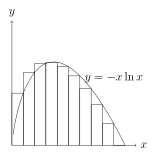
For \(x>0\) find \(\int x\ln x\,\mathrm{d}x\). By approximating the area corresponding to \(\int_{0}^{1}x\ln(1/x)\, \d x\) by \(n\) rectangles of equal width and with their top right-hand vertices on the curve \(y=x\ln(1/x)\), show that, as \(n\rightarrow\infty\), \[ \frac{1}{2}\left(1+\frac{1}{n}\right)\ln n-\frac{1}{n^{2}}\left[\ln\left(\frac{n!}{0!}\right)+\ln\left(\frac{n!}{1!}\right)+\ln\left(\frac{n!}{2!}\right)+\cdots+\ln\left(\frac{n!}{(n-1)!}\right)\right]\rightarrow\frac{1}{4}. \] {[}You may assume that \(x\ln x\rightarrow0\) as \(x\rightarrow0\).{]}
Solution: Integrating by parts we obtain: \begin{align*} \int x \ln x \, \d x &= [\frac12 x^2 \ln x] - \int \frac12x^2 \cdot \frac1x \d x \\ &= \frac12 x^2 \ln x - \frac14 x^2 + C \end{align*}
1989 Paper 3 Q9
Obtain the sum to infinity of each of the following series.
- \(1{\displaystyle +\frac{2}{2}+\frac{3}{2^{2}}+\frac{4}{2^{3}}+\cdots+\frac{r}{2^{r-1}}+\cdots;}\)
- \(1{\displaystyle +\frac{1}{2}\times\frac{1}{2}+\frac{1}{3}\times\frac{1}{2^{2}}+\cdots+\frac{1}{r}\times\frac{1}{2^{r-1}}+\cdots;}\)
- \({\displaystyle \dfrac{1\times3}{2!}\times\frac{1}{3}+\frac{1\times3\times5}{3!}\frac{1}{3^{2}}+\cdots+\frac{1\times3\times\cdots\times(2k-1)}{k!}\times\frac{1}{3^{k-1}}+\cdots.}\)
Solution:
- \begin{align*} && \frac1{1-x} &= \sum_{r=0}^{\infty} x^r \\ \underbrace{\Rightarrow}_{\frac{\d}{\d x}} && \frac{1}{(1-x)^2} &= \sum_{r=0}^\infty rx^{r-1} \\ \underbrace{\Rightarrow}_{x = \frac12} && 4 &= \sum_{r=0}^{\infty} \frac{r}{2^{r-1}} \end{align*}
- \begin{align*} && \frac1{1-x} &= \sum_{r=1}^{\infty} x^{r-1} \\ \underbrace{\Rightarrow}_{\int} && -\ln (1-x) &= \sum_{r=1}^{\infty} \frac1{r} x^r \\ \underbrace{\Rightarrow}_{x = \frac12} && \ln 2 &= \sum_{r=1}^{\infty} \frac1{r } \times \frac{1}{ 2^{r}} \\ \Rightarrow && 2 \ln 2 &= \sum_{r=1}^{\infty} \frac1{r } \times \frac{1}{ 2^{r-1}} \\ \end{align*}
- \begin{align*} && (1-x)^{-1/2} &= 1 + \frac{(-\tfrac12)}{1!} (-x) +\frac{(-\tfrac12)(-\tfrac32)}{2!}(-x)^2 + \cdots \\ &&&= \sum_{r=0}^{\infty} \frac{1 \cdot 3 \cdot 5 \cdots \cdot (2r-1)}{2^rr!} x^r \\ \underbrace{\Rightarrow}_{x = \frac23} && \sqrt{3} &= \sum_{r=0}^{\infty} \frac{1 \cdot 3 \cdot 5 \cdots \cdot (2r-1)}{r!} \frac1{3^r} \\ &&&= 1 + \frac{1}{1!} \frac23 + \frac13 \sum_{r=2}^{\infty} \frac{1 \cdot 3 \cdot 5 \cdots \cdot (2r-1)}{r!} \frac1{3^{r-1}} \\ \Rightarrow && 3\sqrt{3}-5 &= \sum_{r=2}^{\infty} \frac{1 \cdot 3 \cdot 5 \cdots \cdot (2r-1)}{r!} \frac1{3^{r-1}} \\ \end{align*}
1988 Paper 3 Q2
The real numbers \(u_{0},u_{1},u_{2},\ldots\) satisfy the difference equation \[ au_{n+2}+bu_{n+1}+cu_{n}=0\qquad(n=0,1,2,\ldots), \] where \(a,b\) and \(c\) are real numbers such that the quadratic equation \[ ax^{2}+bx+c=0 \] has two distinct real roots \(\alpha\) and \(\beta.\) Show that the above difference equation is satisfied by the numbers \(u_{n}\) defined by \[ u_{n}=A\alpha^{n}+B\beta^{n}, \] where \[ A=\frac{u_{1}-\beta u_{0}}{\alpha-\beta}\qquad\mbox{ and }\qquad B=\frac{u_{1}-\alpha u_{0}}{\beta-\alpha}. \] Show also, by induction, that these numbers provide the only solution. Find the numbers \(v_{n}\) \((n=0,1,2,\ldots)\) which satisfy \[ 8(n+2)(n+1)v_{n+2}-2(n+3)(n+1)v_{n+1}-(n+3)(n+2)v_{n}=0 \] with \(v_{0}=0\) and \(v_{1}=1.\)
Solution: First notice that \(u_n = \alpha^n\) and \(u_n = \beta^n\) both satisfy the recurrence, since: \begin{align*} && a \alpha^2 + b \alpha + c &= 0 \\ \Rightarrow && a \alpha^{n+2} + b \alpha^{n+1} + c \alpha^n &= 0 \\ \Rightarrow && a u_{n+2} + bu_{n+1} + cu_n &=0 \end{align*} Notice also that if \(u_n\) and \(v_n\) both satisfy the recurrence, then any linear combination of them will satisfy the recurrence: \begin{align*} && \begin{cases} au_{n+2} + bu_{n+1} + cu_n &= 0 \\ av_{n+2} + bv_{n+1} + cv_n &= 0 \\ \end{cases} \\ \Rightarrow && a (\lambda u_{n+2}+ \mu v_{n+2}) + b (\lambda u_{n+1}+ \mu v_{n+1}) + c (\lambda u_{n}+ \mu v_{n}) &= 0 \end{align*} by adding a linear combination of the top two equations. Therefore it suffices to check that the constants \(A\) and \(B\) are such that we match \(u_0\) and \(u_1\). \(\frac{u_1 - \beta u_0}{\alpha - \beta} + \frac{u_1 - \alpha u_0}{\beta - \alpha} = u_0\) and \(\frac{u_1 - \beta u_0}{\alpha - \beta}\alpha + \frac{u_1 - \alpha u_0}{\beta - \alpha}\beta = u_1\). So we are done. Suppose we have another sequence, then we first notice that the first and second terms must be identical to each other. Suppose the first \(k\) terms are identical, then since the \(k+1\)th term depends only on the \(k\) and \(k-1\)th terms (both of which are equal) the \(k+1\)th term is the same. Therefore, by the principle of mathematical induction, all terms are the same. First notice that if you put \(v_n = (n+1)w_n\) we have \begin{align*} && 8(n+3)(n+2)(n+1)w_{n+2} - 2(n+3)(n+2)(n+1)w_{n+1} - (n+3)(n+2)(n+1)w_n &= 0 \\ \Rightarrow && 8w_{n+2}-2w_{n+1}-w_n &= 0 \end{align*} This has characteristic equation \(8\lambda^2 - 2\lambda - 1 = 0 \Rightarrow \lambda = \frac12, -\frac14\). Therefore the general solution is \(w_n = A \l \frac12 \r^n + B \l -\frac14\r^n\) and \(v_n = (n+1)\l A \l \frac12 \r^n + B \l -\frac14\r^n \r\). When \(n = 0\) we have \(A+B = 0 \Rightarrow B =-A\). When \(n=1\) we have \(1 = 2 \l \frac{A}{2} + \frac{A}{4} \r \Rightarrow A = \frac{4}{3}\), therefore \[ v_n = \frac{4}{3}(n+1) \l \frac{1}{2^n} + \l -\frac14\r^n \r\]
1988 Paper 3 Q15
Each day, books returned to a library are placed on a shelf in order of arrival, and left there. When a book arrives for which there is no room on the shelf, that book and all books subsequently returned are put on a trolley. At the end of each day, the shelf and trolley are cleared. There are just two-sizes of book: thick, requiring two units of shelf space; and thin, requiring one unit. The probability that a returned book is thick is \(p\), and the probability that it is thin is \(q=1-p.\) Let \(M(n)\) be the expected number of books that will be put on the shelf, when the length of the shelf is \(n\) units and \(n\) is an integer, on the assumption that more books will be returned each day than can be placed on the shelf. Show, giving reasoning, that
- \(M(0)=0;\)
- \(M(1)=q;\)
- \(M(n)-qM(n-1)-pM(n-2)=1,\) for \(n\geqslant2.\)
Solution:
- \(M(0) = 0\) since if there's no space on the shelf, we wont be able to put any books on the shelf.
- If the shelf has length \(1\) it can only fit a thin book. For a thin book to be placed on the shelf, the very first book which comes to be placed must be thin. But this happens with probability \(q\). Therefore \(M(1) = q\).
- Suppose no books have been placed on the shelf, then with probability \(p\) a large book gets placed on the shelf, and the expected number of books to be placed on the shelf is equivalent to how many books will be placed on the shelf if the shelf only had \(n-2\) spaces. This is \(M(n-2)\). Similar if the book which arrives first is thin (with probability \(q\)) then there will be \(M(n-1)\) more books placed on the shelf in expectation. We've just added \(1\) more book, therefore \(M(n) = 1+pM(n-2) + qM(n-1)\) or rearranging \(M(n) - qM(n-1) - pM(n-2) = 1\).
1987 Paper 1 Q4
Show that the sum of the infinite series \[ \log_{2}\mathrm{e}-\log_{4}\mathrm{e}+\log_{16}\mathrm{e}-\ldots+(-1)^{n}\log_{2^{2^{n}}}\mathrm{e}+\ldots \] is \[ \frac{1}{\ln(2\sqrt{2})}. \] {[}\(\log_{a}b=c\) is equivalent to \(a^{c}=b\).{]}
Solution: Let \(S = \log_{2}\mathrm{e}-\log_{4}\mathrm{e}+\log_{16}\mathrm{e}-\ldots+(-1)^{n}\log_{2^{2^{n}}}\mathrm{e}+\ldots\) then \begin{align*} S &= \sum_{n=0}^{\infty} (-1)^n \log_{2^{2^n}} e \\ &= \sum_{n=0}^{\infty} (-1)^n \frac{\log e}{\log {2^{2^n}}} \\ &= \sum_{n=0}^{\infty} (-1)^n \frac{\log e}{2^n\log {2}} \\ &= \frac{\log e}{\log 2} \sum_{n=0}^{\infty} \frac{(-1)^n}{2^n} \\ &= \frac{1}{\log_e 2} \frac{1}{1+\frac12} \\ &= \frac{1}{\ln (2^{3/2})} \\ &= \frac{1}{\ln (2 \sqrt{2})} \end{align*}
1987 Paper 2 Q3
Let \(a\) and \(b\) be positive integers such that \(b<2a-1\). For any given positive integer \(n\), the integers \(N\) and \(M\) are defined by \[ [a+\sqrt{a^{2}-b}]^{n}=N-r, \] \[ [a-\sqrt{a^{2}-b}]^{n}=M+s, \] where \(0\leqslant r<1\) and \(0\leqslant s<1\). Prove that \begin{questionparts} \item \(M=0\), \item \(r=s\), \item \(r^{2}-Nr+b^{n}=0.\) \end{questionpart} Show that for large \(n\), \(\left(8+3\sqrt{7}\right)^{n}\) differs from an integer by about \(2^{-4n}\).
Solution:
- If we can show that \(0 < a - \sqrt{a^2-b} < 1\) then we will be done, since raising a number in \([0,1)\) to a positive integer power will always remain in the same interval. Clearly \(\sqrt{a^2-b} < \sqrt{a^2} = a\) so we have \(a-\sqrt{a^2-b} > 0\) We also have that \(\sqrt{a^2-b} > \sqrt{a^2-(2a-1)} = (a-1)\). Therefore \(a - \sqrt{a^2-b} < a - (a-1) = 1\) as required.
- If we can show that \(\l a + \sqrt{a^2-b} \r^n + \l a - \sqrt{a^2-b} \r^n = N -r + s\) is an integer we will be done, since the only integer value \(-r+s\) can be is \(0\). This is easy to see, since \begin{align*} \l a + \sqrt{a^2-b} \r^n + \l a - \sqrt{a^2-b} \r^n &= \sum_{k=0}^n \binom{n}{k}a^{n-k}(\sqrt{a^2-b})^k +\sum_{k=0}^n \binom{n}{k}a^{n-k}(-\sqrt{a^2-b})^k \\ &= \sum_{k=0}^n \binom{n}{k}a^{n-k}\l (\sqrt{a^2-b})^k +(-\sqrt{a^2-b})^k \r \\ \end{align*} But every term where \(k\) is odd in this sum is \(0\) (since they cancel) and ever term where \(k\) is even in this sum is an integer. Therefore the sum is an integer and we're done.
- \begin{align*} -r^2+rN &= -r(r-N) \\ &= s(r-N) \\ &=- \l a - \sqrt{a^2-b} \r^n \l a + \sqrt{a^2-b} \r^n \\ &= -\l \l a - \sqrt{a^2-b} \r \l a + \sqrt{a^2-b} \r\r^n \\ &= - \l a^2 - a^2+b\r^n \\ &= b^n \end{align*} Therefore \(r^2-rN + b^n = 0\)
1987 Paper 2 Q5
If \(y=\mathrm{f}(x)\), then the inverse of \(\mathrm{f}\) (when it exists) can be obtained from Lagrange's identity. This identity, which you may use without proof, is \[ \mathrm{f}^{-1}(y)=y+\sum_{n=1}^{\infty}\frac{1}{n!}\frac{\mathrm{d}^{n-1}}{\mathrm{d}y^{n-1}}\left[y-\mathrm{f}\left(y\right)\right]^{n}, \] provided the series converges.
- Verify Lagrange's identity when \(\mathrm{f}(x)=\alpha x\), \((0<\alpha<2)\).
- Show that one root of the equation \[ \tfrac{1}{2}=x-\tfrac{1}{4}x^{3} \] is \[ x=\sum_{n=0}^{\infty}\frac{\left(3n\right)!}{n!\left(2n+1\right)!2^{4n+1}} \]
- Find a solution for \(x\), as a series in \(\lambda,\) of the equation \[ x=\mathrm{e}^{\lambda x}. \]
Solution:
- If \(f(x) = \alpha x\) then \(f^{-1}(x) = \frac{1}{\alpha}x\). \begin{align*} && \frac{\d^{n-1}}{\d y^{n-1}} [y - \alpha y]^n &= \frac{\d^{n-1}}{\d y^{n-1}} [(1 - \alpha)^n y^n] \\ && &= (1-\alpha)^n n! y \\ \Rightarrow && y + \sum_{n=1}^{\infty} \frac{1}{n!}\frac{\d^{n-1}}{\d y^{n-1}} [y - \alpha y]^n &= y +\sum_{n=1}^{\infty} (1-\alpha)^ny \\ &&&= y + y\l \frac{1}{1-(1-\alpha)}-1 \r \\ &&&= \frac{1}{\alpha}y \end{align*} Where we can sum the geometric progression if \(|1-\alpha| < 1 \Leftrightarrow 0 < \alpha < 2\)
- Suppose that \(f(x) = x-\frac14x^3\). We would like to find \(f^{-1}(\frac12)\). \begin{align*} && \frac{\d^{n-1}}{\d y^{n-1}} [y - (y+\frac14 y^3)]^n &= \frac{\d^{n-1}}{\d y^{n-1}} [\frac1{4^n} y^{3n}] \\ && &= \frac{1}{4^n} \frac{(3n)!}{(2n+1)!} y^{2n+1} \\ \Rightarrow && f^{-1}(\frac12) &= \frac12 + \sum_{n=1}^{\infty} \frac{1}{4^n} \frac{(3n)!}{n!(2n+1)!} \frac{1}{2^{2n+1}} \\ &&&= \frac12 + \sum_{n=1}^{\infty} \frac{(3n)!}{n!(2n+1)!} \frac{1}{2^{4n+1}} \\ \end{align*} Since when \(n = 0\) \(\frac{0!}{0!1!} \frac{1}{2^{0+1}} = \frac12\) we can include the wayward \(\frac12\) in our infinite sum and so we have the required result.
- Consider \(f(x) = x - e^{\lambda x}\) we are interested in \(f^{-1}(0)\). \begin{align*} && \frac{\d^{n-1}}{\d y^{n-1}} [y - (y-e^{\lambda y})]^n &= \frac{\d^{n-1}}{\d y^{n-1}} [e^{n\lambda y}] \\ &&&= n^{n-1} \lambda^{n-1}e^{n \lambda y} \\ \Rightarrow && f^{-1}(0) &= \sum_{n=1}^\infty \frac{1}{n!} n^{n-1} \lambda^{n-1} \end{align*} We don't care about convergence, but it's worth noting this has a radius of convergence of \(\frac{1}{e}\) (ie this series is valid if \(|\lambda| < \frac1e\)).
1987 Paper 3 Q7
Prove that \[ \tan^{-1}t=t-\frac{t^{3}}{3}+\frac{t^{5}}{5}-\cdots+\frac{(-1)^{n}t^{2n+1}}{2n+1}+(-1)^{n+1}\int_{0}^{t}\frac{x^{2n+2}}{1+x^{2}}\,\mathrm{d}x. \] Hence show that, if \(0\leqslant t\leqslant1,\) then \[ \frac{t^{2n+3}}{2(2n+3)}\leqslant\left|\tan^{-1}t-\sum_{r=0}^{n}\frac{(-1)^{r}t^{2r+1}}{2r+1}\right|\leqslant\frac{t^{2n+3}}{2n+3}. \] Show that, as \(n\rightarrow\infty,\) \[ 4\sum_{r=0}^{n}\frac{(-1)^{r}}{(2r+1)}\rightarrow\pi, \] but that the error in approximating \(\pi\) by \({\displaystyle 4\sum_{r=0}^{n}\frac{(-1)^{r}}{(2r+1)}}\) is at least \(10^{-2}\) if \(n\) is less than or equal to \(98\).
Solution: We start by noticing that \(\displaystyle \tan^{-1} t = \int_0^t \frac{1}{1+x^2} \d x\). Consider the geometric series \(1-x^2+(-x^2)^2+ \cdots + (-x^2)^n = \frac{1-(-x^2)^{n+1}}{1+x^2}\). Therefore, \((1+x^2)(1-x^2+(-x^2)^2+ \cdots + (-x^2)^n) = 1-(-x^2)^{n+1}\) or \(1 = (1+x^2)(1-x^2+x^4-\cdots+(-1)^nx^{2n}) +(-1)^{n+1}x^{2n+2}\) \begin{align*} \tan^{-1} t &= \int_0^t \frac{1}{1+x^2} \d x \\ &= \int_0^t \frac{(1+x^2)(1-x^2+x^4-\cdots+(-1)^nx^{2n}) +(-1)^{n+1}x^{2n+2}}{x^2+1} \d x \\ &= \int_0^t (1-x^2+x^4-\cdots+(-1)^nx^{2n})\d x + \int_0^t \frac{(-1)^{n+1}x^{2n+2}}{x^2+1} \d x \\ &= t - \frac{t^3}{3}+\frac{t^5}{5}-\cdots + (-1)^n \frac{t^{2n+1}}{2n+1}+\int_0^t \frac{(-1)^{n+1}x^{2n+2}}{x^2+1} \d x \\ &= \sum_{r=0}^n \frac{(-1)^r t^{2r+1}}{2r+1} + \int_0^t \frac{(-1)^{n+1}x^{2n+2}}{x^2+1} \d x \\ \end{align*} Therefore we can say (for \(0 \leq t \leq 1\)) \begin{align*} \left | \tan^{-1} t - \sum_{r=0}^n \frac{(-1)^r t^{2r+1}}{2r+1} \right | &= \left | \int_0^t \frac{(-1)^{n+1}x^{2n+2}}{x^2+1} \d x \right | \\ &\leq \left | \int_0^t x^{2n+2} \d x \right | \\ &= \frac{t^{2n+3}}{2n+3} \\ \\ \left | \tan^{-1} t - \sum_{r=0}^n \frac{(-1)^r t^{2r+1}}{2r+1} \right | &= \left | \int_0^t \frac{(-1)^{n+1}x^{2n+2}}{x^2+1} \d x \right | \\ &\geq \left | \int_0^t \frac{(-1)^{n+1}x^{2n+2}}{1+1} \d x \right | \\ &= \frac{t^{2n+3}}{2(2n+3)} \\ \end{align*} Since \(\tan^{-1} 1 = \frac{\pi}{4}\) we must have that: \begin{align*} \lim_{n \to \infty} \left | \frac{\pi}{4} - \sum_{r=0}^{n}\frac{(-1)^{r}}{(2r+1)} \right | \to 0 \Rightarrow \lim_{n \to \infty} 4\sum_{r=0}^{n}\frac{(-1)^{r}}{(2r+1)} \to \pi \end{align*} However, \begin{align*} && \left | 4\sum_{r=0}^{n}\frac{(-1)^{r}}{(2r+1)} - \pi \right | &\geq 4 \frac{1}{2(2n+3)} \\ && &= \frac{2}{2n+3} \\ \\ && \frac{2}{2n+3} \geq 10^{-2} \\ \Leftrightarrow && 200 \geq 2n+3 \\ \Leftrightarrow && 197 \geq 2n \\ \Leftrightarrow && 98.5 \geq n \\ \end{align*} Therefore we need more than \(98\) terms to get two decimal places of accuracy. Not great!