Problems
Filters
40 problems found
1996 Paper 2 Q11
A particle hangs in equilibrium from the ceiling of a stationary lift, to which it is attached by an elastic string of natural length \(l\) extended to a length \(l+a\). The lift now descends with constant acceleration \(f\) such that \(0 < f < g/2\). Show that the extension \(y\) of the string from its equilibrium length satisfies the differential equation $$ {{\rm d}^2 y \over {\rm d} t^2} +{g \over a}\, y = g-f. $$ Hence show that the string never becomes slack and the amplitude of the oscillation of the particle is \(af/g\). After a time \(T\) the lift stops accelerating and moves with constant velocity. Show that the string never becomes slack and the amplitude of the oscillation is now \[\frac{2af}{g}|\sin {\textstyle \frac{1}{2}}\omega T|,\] where \(\omega^{2}=g/a\).
1995 Paper 2 Q6
If \(u\) and \(v\) are the two roots of \(z^{2}+az+b=0,\) show that \(a=-u-v\) and \(b=uv.\) Let \(\alpha=\cos(2\pi/7)+\mathrm{i}\sin(2\pi/7).\) Show that \(\alpha\) is a root of \(z^{6}-1=0\) and express the roots in terms of \(\alpha.\) The number \(\alpha+\alpha^{2}+\alpha^{4}\) is a root of a quadratic equation \[ z^{2}+Az+B=0 \] where \(A\) and \(B\) are real. By guessing the other root, or otherwise, find the numerical values of \(A\) and \(B\). Show that \[ \cos\frac{2\pi}{7}+\cos\frac{4\pi}{7}+\cos\frac{8\pi}{7}=-\frac{1}{2}, \] and evaluate \[ \sin\frac{2\pi}{7}+\sin\frac{4\pi}{7}+\sin\frac{8\pi}{7}, \] making it clear how you determine the sign of your answer.
Solution: \begin{align*} 0 &= z^2+az+b \\ &= (z-u)(z-v) \\ &= z^2-(u+v)z+uv \end{align*} Therefore by comparing coefficients, \(a = -u-v\) and \(b = uv\). Suppose \(\alpha = \cos(2\pi/7) + i \sin (2\pi/7)\), then by De Moivre, \(\alpha^7 = \cos(2\pi) + i \sin (2\pi) = 1\), ie \(\alpha^7-1 = 0\). Notice that \((\alpha+\alpha^2 + \alpha^4) + (\alpha^3+\alpha^5+\alpha^6) = -1\) and \begin{align*} P &= (\alpha+\alpha^2 + \alpha^4)(\alpha^3+\alpha^5+\alpha^6) \\ &= \alpha^4 + \alpha^6 + \alpha^7 + \alpha^5 + \alpha^7 + \alpha^8 + \alpha^{7}+\alpha^{9}+\alpha^{10} \\ &= 3 + \alpha+ \alpha^2 + \alpha^3 + \alpha^4 + \alpha^5 + \alpha^6 \\ &= 2 \end{align*} Therefore it is a root of \(x^2+x+2 = 0 \Rightarrow x = \frac{-1 \pm i\sqrt{7}}{2}\) Therefore $\cos\frac{2\pi}{7} + \cos \frac{4\pi}{7} + \cos \frac{8\pi}{7} = \textrm{Re}(\alpha + \alpha^2 + \alpha^4) = -\frac12$ And \(\sin\frac{2\pi}{7} + \sin\frac{4\pi}{7} + \sin\frac{8\pi}{7} = \textrm{Im}(\alpha + \alpha^2 + \alpha^4) = \pm\frac{\sqrt{7}}2\) since it is positive it is \(\frac{\sqrt{7}}{2}\)
1995 Paper 3 Q10
A cannon is situated at the bottom of a plane inclined at angle \(\beta\) to the horizontal. A (small) cannon ball is fired from the cannon at an initial speed \(u.\) Ignoring air resistance, find the angle of firing which will maximise the distance up the plane travelled by the cannon ball and show that in this case the ball will land at a distance \[ \frac{u^{2}}{g(1+\sin\beta)} \] from the cannon.
1994 Paper 1 Q4
Show that
- \(\dfrac{1-\cos\alpha}{\sin\alpha}=\tan\frac{1}{2}\alpha,\)
- if \(\left|k\right|<1\) then \({\displaystyle \int\frac{\mathrm{d}x}{1-2kx+x^{2}}=\frac{1}{\sqrt{1-k^{2}}}\tan^{-1}\left(\frac{x-k}{\sqrt{1-k^{2}}}\right)+C,}\) where \(C\) is a constant of integration.
Solution:
- \begin{align*} \frac{1-\cos \alpha}{\sin \alpha} &= \frac{1-(1-2\sin^2 \frac{\alpha}{2})}{2 \sin \frac \alpha2 \cos \frac\alpha2} \\ &= \frac{2 \sin^2 \frac \alpha2}{2 \sin \frac \alpha2 \cos \frac\alpha2} \\ &= \frac{\sin \frac \alpha2}{ \cos \frac\alpha2} \\ &= \tan \tfrac{\alpha}{2} \end{align*}
- \begin{align*} \int\frac{\mathrm{d}x}{1-2kx+x^{2}} &= \int \frac{\d x}{(x-k)^2+1-k^2} \\ &= \frac{1}{1-k^2}\int \frac{\d x}{\left (\frac{x-k}{\sqrt{1-k^2}} \right)^2+1} \\ &= \frac{1}{\sqrt{1-k^2}} \tan^{-1} \left (\frac{x-k}{\sqrt{1-k^2}} \right)+C \end{align*}
1993 Paper 2 Q5
\noindent
1993 Paper 3 Q1
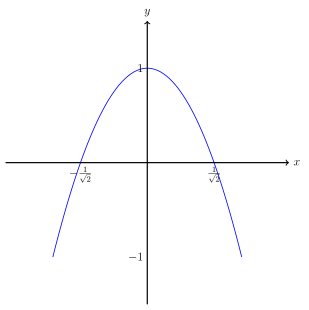
The curve \(P\) has the parametric equations $$ x= \sin\theta, \quad y=\cos2\theta \qquad\hbox{ for }-\pi/2 \le \theta \le \pi/2. $$ Show that \(P\) is part of the parabola \(y=1-2x^2\) and sketch \(P\). Show that the length of \(P\) is \(\surd (17) + {1\over 4} \sinh^{-1}4\). Obtain the volume of the solid enclosed when \(P\) is rotated through \(2\pi\) radians about the line \(y=-1\).
Solution: First notice that \(y = \cos 2 \theta = 1 - 2\sin^2 \theta = 1- 2x^2\), therefore \(P\) is lies on that parabola.
1990 Paper 1 Q8
Show that \[ \cos\left(\frac{\alpha}{2}\right)\cos\left(\frac{\alpha}{4}\right)=\frac{\sin\alpha}{4\sin\left(\dfrac{\alpha}{4}\right)}\,, \] where \(\alpha\neq k\pi\), \(k\) is an integer. Prove that, for such \(\alpha\), \[ \cos\left(\frac{\alpha}{2}\right)\cos\left(\frac{\alpha}{4}\right)\cdots\cos\left(\frac{\alpha}{2^{n}}\right)=\frac{\sin\alpha}{2^{n}\sin\left(\dfrac{\alpha}{2^{n}}\right)}\,, \] where \(n\) is a positive integer. Deduce that \[ \alpha=\frac{\sin\alpha}{\cos\left(\dfrac{\alpha}{2}\right)\cos\left(\dfrac{\alpha}{4}\right)\cos\left(\dfrac{\alpha}{8}\right)\cdots}\,, \] and hence that \[ \frac{\pi}{2}=\frac{1}{\sqrt{\frac{1}{2}}\sqrt{\frac{1}{2}+\frac{1}{2}\sqrt{\frac{1}{2}}}\sqrt{\frac{1}{2}+\frac{1}{2}\sqrt{\frac{1}{2}+\frac{1}{2}\sqrt{\frac{1}{2}}}}\cdots}\,. \]
Solution: \begin{align*} &&\sin \alpha &= 2 \sin \frac{\alpha}{2} \cos \frac{\alpha}{2} \\ &&&= 4 \sin \frac{\alpha}{4} \cos \frac{\alpha}{4} \cos \frac{\alpha}{2} \\ \Rightarrow && \frac{\sin \alpha}{4 \sin \frac{\alpha}{4}} &= \cos \frac{\alpha}{2} \cos \frac{\alpha}{4} \end{align*} We proceed by induction on \(n\). Clearly this is true for \(n = 1\) (as we just established). Assume it is true for \(n=k\). Then: \begin{align*} && \frac{\sin \alpha}{2^n \sin \frac{\alpha}{2^n}} &= \cos\left(\frac{\alpha}{2}\right)\cos\left(\frac{\alpha}{4}\right)\cdots\cos\left(\frac{\alpha}{2^{n}}\right) \\ \Rightarrow && \frac{\sin \alpha}{2^{n+1} \sin \frac{\alpha}{2^{n+1}} \cos \frac{\alpha}{2^{n+1}}} &= \cos\left(\frac{\alpha}{2}\right)\cos\left(\frac{\alpha}{4}\right)\cdots\cos\left(\frac{\alpha}{2^{n}}\right) \\ \Rightarrow && \frac{\sin \alpha}{2^{n+1} \sin \frac{\alpha}{2^{n+1}} } &= \cos\left(\frac{\alpha}{2}\right)\cos\left(\frac{\alpha}{4}\right)\cdots\cos\left(\frac{\alpha}{2^{n}}\right)\cos \left ( \frac{\alpha}{2^{n+1}} \right) \\ \end{align*} Therefore it is true for \(n=k+1\) Therefore since it is true for \(n=1\) and if it is true for \(n=k\) it is also true for \(n=k+1\) by the principle of mathematical induction it is true for all \(n \geq 1\) \begin{align*} \lim_{n \to \infty} \frac{\sin \alpha}{\cos\left(\frac{\alpha}{2}\right)\cdots\cos\left(\frac{\alpha}{2^{n}}\right)} &= \lim_{n \to \infty} 2^n \sin \frac{\alpha}{2^n} \\ &= \lim_{n \to \infty} \alpha \frac{\sin \frac{\alpha}{2^n}}{\frac{\alpha}{2^n}} \\ &= \alpha \lim_{t \to 0} \frac{\sin t}{t} \\ &= \alpha \end{align*} When \(\alpha = \frac{\pi}{2}\) notice that \(\sin \alpha =1\), \(\cos \frac{\alpha}{2} = \sqrt{\frac12}\) and \(2\cos^2 \frac{\alpha}{2^{n+1}}-1 = \cos \frac{\alpha}{2} \Rightarrow \cos \frac{\alpha}{2^{n+1}} = \sqrt{\frac12 + \cos \frac{\alpha}{2^n}}\) exactly the series we see.
1989 Paper 2 Q12
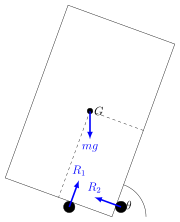
A uniform rectangular lamina of sides \(2a\) and \(2b\) rests in a vertical plane. It is supported in equilibrium by two smooth pegs fixed in the same horizontal plane, a distance \(d\) apart, so that one corner of the lamina is below the level of the pegs. Show that if the distance between this (lowest) corner and the peg upon which the side of length \(2a\) rests is less than \(a\), then the distance between this corner and the other peg is less than \(b\). Show also that \[ b\cos\theta-a\sin\theta=d\cos2\theta, \] where \(\theta\) is the acute angle which the sides of length \(2b\) make with the horizontal.
Solution:
1988 Paper 2 Q5
By considering the imaginary part of the equation \(z^{7}=1,\) or otherwise, find all the roots of the equation \[ t^{6}-21t^{4}+35t^{2}-7=0. \] You should justify each step carefully. Hence, or otherwise, prove that \[ \tan\frac{2\pi}{7}\tan\frac{4\pi}{7}\tan\frac{6\pi}{7}=\sqrt{7}. \] Find the corresponding result for \[ \tan\frac{2\pi}{n}\tan\frac{4\pi}{n}\cdots\tan\frac{(n-1)\pi}{n} \] in the two cases \(n=9\) and \(n=11.\)
Solution: Suppose \(z^7 = 1\), then we can write \(z = \cos \theta + i \sin \theta\) and we must have that: \begin{align*} 0 &= \textrm{Im}((\cos \theta + i \sin \theta)^7) \\ &= \binom{7}{6}\cos^6 \theta \sin \theta - \binom{7}{4} \cos^4 \theta \sin^3 \theta + \binom{7}{2} \cos^2 \theta \sin^5 \theta - \sin^7 \theta \\ &= 7 \cos^6 \sin \theta - 35 \cos^4 \theta \sin ^3 \theta + 21 \cos^2 \theta \sin^5 \theta - \sin^7 \theta \\ &= -\cos^7 \theta \l \tan^7 \theta - 21 \tan^5 \theta + 35 \tan^3 \theta - 7 \tan \theta\r \\ &= \cos^7 \theta \cdot t (t^7-21t^4+35t^2-7) \end{align*} Where \(t = \tan \theta\). So if \(z\) is a root of \(z^7 = 1\) and \(\cos \theta \neq 0, \tan \theta \neq 0\) then \(t\) is a root of the equation. Thererefore the roots are: \(\tan \frac{2\pi k}{7}\) where \(k = 1, 2, \ldots 6\). Noting that \(\tan \frac{\pi}7 = -\tan \frac{6\pi}{7}, \tan \frac{3\pi}{7} = -\tan \frac{4 \pi}{7}, \tan \frac{5\pi}{7} = -\tan \frac{2 \pi}{7}\) we can conclude that: \begin{align*} && 7 &= \prod_{k=1}^k \tan \frac{k \pi}{6} \\ &&&= \l \tan\frac{2\pi}{7}\tan\frac{4\pi}{7}\tan\frac{6\pi}{7} \r^2 \\ \Rightarrow&& \pm \sqrt{7} &= \tan\frac{2\pi}{7}\tan\frac{4\pi}{7}\tan\frac{6\pi}{7} \end{align*} However, we know that \(\tan \frac{2\pi}{7}\) is positive, \(\tan \frac{4\pi}{7},\tan \frac{6\pi}{7}\) are negative, therefore the result must be positive, ie \(+\sqrt{7}\) Using a similar method, we notice that: \begin{align*} 0 &= \textrm{Im} \l (\cos \theta + i \sin \theta)^n \r \\ &= \cos^n \theta \cdot t (t^{n-1} + \cdots - \binom{n}{n-1}) \end{align*} Therefore \(\prod_{k=0}^{n-1} \tan \frac{k \pi}{n} = n\) and since \(\tan \frac{(2k+1) \pi}{n} = \tan \frac{(n-2k-1)\pi}{n}\) is a map of all the odd numbers to the even numbers (and vice versa) when \(n\) is odd. We also know that the terms less where \(\tan \theta\) has \(\theta < \frac{\pi}{2}\) are positive, and the others even, we can determine the signs: \begin{align*} \tan \frac{2 \pi}{9} \tan \frac{4 \pi}{9} \tan \frac{6 \pi}{9} \tan \frac{8 \pi}{9} & = 3 \\ \tan \frac{2 \pi}{11} \tan \frac{4 \pi}{11} \tan \frac{6 \pi}{11} \tan \frac{8 \pi}{11} \tan \frac{10 \pi}{11} &= -\sqrt{11} \end{align*}
1987 Paper 2 Q2
Show that if at least one of the four angles \(A\pm B\pm C\) is a multiple of \(\pi\), then \begin{alignat*}{1} \sin^{4}A+\sin^{4}B+\sin^{4}C & -2\sin^{2}B\sin^{2}C-2\sin^{2}C\sin^{2}A\\ & -2\sin^{2}A\sin^{2}B+4\sin^{2}A\sin^{2}B\sin^{2}C=0. \end{alignat*}