Problems
Filters
137 problems found
2016 Paper 3 Q13
Given a random variable \(X\) with mean \(\mu\) and standard deviation \(\sigma\), we define the kurtosis, \(\kappa\), of \(X\) by \[ \kappa = \frac{ \E\big((X-\mu)^4\big)}{\sigma^4} -3 \,. \] Show that the random variable \(X-a\), where \(a\) is a constant, has the same kurtosis as \(X\).
- Show by integration that a random variable which is Normally distributed with mean 0 has kurtosis 0.
- Let \(Y_1, Y_2, \ldots, Y_n\) be \(n\) independent, identically distributed, random variables with mean 0, and let \(T = \sum\limits_{r=1}^n Y_r\). Show that \[ \E(T^4) = \sum_{r=1}^n \E(Y_r^4) + 6 \sum_{r=1}^{n-1} \sum_{s=r+1}^{n} \E(Y^2_s) \E(Y^2_r) \,. \]
- Let \(X_1\), \(X_2\), \(\ldots\)\,, \(X_n\) be \(n\) independent, identically distributed, random variables each with kurtosis \(\kappa\). Show that the kurtosis of their sum is \(\dfrac\kappa n\,\).
Solution: \begin{align*} &&\kappa_{X-a} &= \frac{\mathbb{E}\left(\left(X-a-(\mu-a)\right)^4\right)}{\sigma_{X-a}^4}-3 \\ &&&= \frac{\mathbb{E}\left(\left(X-\mu\right)^4\right)}{\sigma_X^4}-3\\ &&&= \kappa_X \end{align*}
- \(\,\) \begin{align*} && \kappa &= \frac{\mathbb{E}((X-\mu)^4)}{\sigma^4} - 3 \\ &&&= \frac{\mathbb{E}((\mu+\sigma Z-\mu)^4)}{\sigma^4} - 3 \\ &&&= \frac{\mathbb{E}((\sigma Z)^4)}{\sigma^4} - 3 \\ &&&= \mathbb{E}(Z^4)-3\\ &&&= \int_{-\infty}^{\infty} x^4\frac{1}{\sqrt{2\pi}} \exp \left ( - \frac12x^2 \right)\d x -3 \\ &&&= \left [\frac{1}{\sqrt{2\pi}}x^{3} \cdot \left ( -\exp \left ( - \frac12x^2 \right)\right) \right]_{-\infty}^{\infty} + \frac{1}{\sqrt{2\pi}} \int_{-\infty}^\infty 3x^2 \exp \left ( - \frac12x^2 \right) \d x - 3 \\ &&&= 0 + 3 \textrm{Var}(Z) - 3 =0 \end{align*}
- \(\,\) \begin{align*} && \mathbb{E}(T^4) &= \mathbb{E} \left [\left ( \sum\limits_{r=1}^n Y_r\right)^4\right] \\ &&&= \mathbb{E} \left [ \sum_{r=1}^n Y_r^4+\sum_{i\neq j} 4Y_iY_j^3+\sum_{i\neq j} 6Y_i^2Y_j^2+\sum_{i\neq j \neq k} 12Y_iY_jY_k^2 +\sum_{i\neq j\neq k \neq l}24 Y_iY_jY_kY_l\right] \\ &&&= \sum_{r=1}^n \mathbb{E} \left [ Y_r^4 \right]+\sum_{i\neq j} \mathbb{E} \left [ 4Y_iY_j^3\right]+\sum_{i\neq j} \mathbb{E} \left [ 6Y_i^2Y_j^2\right]+\sum_{i\neq j \neq k} \mathbb{E} \left [ 12Y_iY_jY_k^2\right] +\sum_{i\neq j\neq k \neq l} \mathbb{E} \left [ 24 Y_iY_jY_kY_l\right] \\ &&&= \sum_{r=1}^n \mathbb{E} \left [ Y_r^4 \right]+4\sum_{i\neq j} \mathbb{E} \left [ Y_i]\mathbb{E}[Y_j^3\right]+6\sum_{i\neq j} \mathbb{E} \left [ Y_i^2]\mathbb{E}[Y_j^2\right]+12\sum_{i\neq j \neq k} \mathbb{E} \left [ Y_i]\mathbb{E}[Y_j]\mathbb{E}[Y_k^2\right] +24\sum_{i\neq j\neq k \neq l} \mathbb{E} \left [ Y_i]\mathbb{E}[Y_j]\mathbb{E}[Y_k]\mathbb{E}[Y_l\right] \\ &&&= \sum_{r=1}^n \mathbb{E} \left [ Y_r^4 \right]+6\sum_{i\neq j} \mathbb{E} \left [ Y_i^2]\mathbb{E}[Y_j^2\right] \end{align*}
- Without loss of generality, we may assume they all have mean zero. Therefore we can consider the sitatuion as in the previous case with \(T\) and \(Y_i\)s. Note that \(\mathbb{E}(Y_i^4) = \sigma^4(\kappa + 3)\) and \(\textrm{Var}(T) = n \sigma^2\) \begin{align*} && \kappa_T &= \frac{\mathbb{E}(T^4)}{(\textrm{Var}(T))^2} - 3 \\ &&&= \frac{\sum_{r=1}^n \mathbb{E} \left [ Y_r^4 \right]+6\sum_{i\neq j} \mathbb{E} \left [ Y_i^2\right]\mathbb{E}\left[Y_j^2\right]}{n^2\sigma^4}-3 \\ &&&= \frac{n\sigma^4(\kappa+3)+6\binom{n}{2}\sigma^4}{n^2\sigma^4} -3\\ &&&= \frac{\kappa}{n} + \frac{3n + \frac{6n(n-1)}{2}}{n^2} - 3 \\ &&&= \frac{\kappa}{n} + \frac{3n^2}{n^2}-3 \\ &&&= \frac{\kappa}{n} \end{align*}
2015 Paper 3 Q1
- Let \[ I_n= \int_0^\infty \frac 1 {(1+u^2)^n}\, \d u \,, \] where \(n\) is a positive integer. Show that \[ I_n - I_{n+1} = \frac 1 {2n} I_n \] and deduce that \[ I_{n+1} = \frac{(2n)!\, \pi}{2^{2n+1}(n!)^2} \,. \]
- Let \[ J = \int_0^\infty \f\big( (x- x^{-1})^2\big ) \, \d x \,, \] where \(\f\) is any function for which the integral exists. Show that \[ J = \int_0^\infty x^{-2} \f\big( (x- x^{-1})^2\big) \, \d x \, = \frac12 \int_0^\infty (1 + x^{-2}) \f\big( (x- x^{-1})^2\big ) \, \d x \, = \int_0^\infty \f\big(u^2\big) \,\d u \,. \]
- Hence evaluate \[ \int_0^\infty \frac {x^{2n-2}}{(x^4-x^2+1)^n} \, \d x \,, \] where \(n\) is a positive integer.
Solution: \begin{align*} I_n - I_{n+1} &= \int_0^\infty \frac 1 {(1+u^2)^n}\, \d u - \int_0^\infty \frac 1 {(1+u^2)^{n+1}}\, \d u \\ &= \int_0^\infty \l \frac 1 {(1+u^2)^n}- \frac 1 {(1+u^2)^{n+1}} \r\, \d u \\ &= \int_0^\infty \frac {u^2} {(1+u^2)^{n+1}} \, \d u \\ &= \left [ u \frac{u}{(1+u^2)^{n+1}} \right]_0^{\infty} - \frac{-1}{2n}\int_0^{\infty} \frac{1}{(1+u^2)^n} \d u \tag{\(IBP: u = u, v' = \frac{u}{(1+u^2)^{n+1}}\)}\\ &= \frac{1}{2n} I_n \end{align*} \(\displaystyle I_1 = \int_0^{\infty} \frac{1}{1+u^2} \d u = \left [ \tan^{-1} u \right]_0^\infty = \frac{\pi}{2}\) as expected. We also have, \(I_{n+1} = \frac{2n(2n-1)}{2n \cdot 2n} I_n \), by rearranging the recurrence relation. Therefore, when we multiply out the top we will have \(2n!\) and the bottom we will have two factors of \(n!\) and two factors of \(2^n\) combined with the original \(\frac{\pi}{2}\) we get \[ I_{n+1} = \frac{(2n)! \pi}{2^{2n+1} (n!)^2} \] \begin{align*} J = \int_0^\infty f\big( (x- x^{-1})^2\big ) \, \d x &= \int_{u = \infty}^{u = 0} f((u^{-1}-u)^2)(-u^{-2} )\d u \tag{\(u = x^{-1}, \d u = -x^{-2} \d x\)} \\ &= \int^{u = \infty}_{u = 0} f((u^{-1}-u)^2)u^{-2} \d u \\ &= \int^{\infty}_{0} u^{-2}f((u-u^{-1})^2) \d u \\ \end{align*} Therefore adding the two forms for \(J\) we have \begin{align*} 2 J &= \int_0^\infty f\big( (x- x^{-1})^2\big ) \, \d x + \int_0^\infty x^{-2} f\big( (x- x^{-1})^2\big ) \, \d x \\ &= \int_0^\infty (1+x^{-2}) f\big( (x- x^{-1})^2\big ) \, \d x \end{align*} And letting \(u = x - x^{-1}\), we have \(\d u = (1 + x^{-2}) \d x\), and \(u\) runs from \(-\infty\) to \(\infty\) so we have: \begin{align*} \int_0^\infty (1+x^{-2}) f\big( (x- x^{-1})^2\big ) \, \d x &= \int_{-\infty}^\infty f(u^2) \, \d u \\ &=2 \int_{0}^\infty f(u^2) \, \d u \end{align*} Since both of these are \(2J\) we have the result we are after. Finally, \begin{align*} \int_0^\infty \frac {x^{2n-2}}{(x^4-x^2+1)^n} \, \d x &= \int_0^{\infty} \frac{x^{2n-2}}{x^{2n}(x^2-1+x^{-2})^n} \d x \\ &= \int_0^{\infty} \frac{x^{-2}}{((x-x^{-1})^2+1)^n} \d x \\ &= \int_0^{\infty} \frac{1}{(x^2+1)^n} \d x \tag{Where \(f(x) = (1+x^2)^{-n}\) in \(J\) integral} \\ &= I_n = \frac{(2n-2)! \pi}{2^{2n-1} ((n-1)!)^2} \end{align*}
2015 Paper 3 Q2
If \(s_1\), \(s_2\), \(s_3\), \(\ldots\) and \(t_1\), \(t_2\), \(t_3\), \(\ldots\) are sequences of positive numbers, we write \[ (s_n)\le (t_n) \] to mean
- \((1000n) \le (n^2)\,\).
- If it is not the case that \((s_n)\le (t_n)\), then it is the case that \((t_n)\le (s_n)\,\).
- If \((s_n)\le (t_n)\) and \((t_n) \le (u_n)\), then \((s_n)\le (u_n)\,\).
- \((n^2)\le (2^n)\,\).
Solution:
- If \(m = 1000\), then \(n \geq m \Rightarrow n^2 \geq 1000n \Rightarrow (1000n) \leq (n^2)\)
- This is false. Let \(s_i = 1,2,1,2,\cdots\) and \(t_i = 2,1,2,1,\cdots\).
- Suppose that for \(n \geq m_1, s_n \le t_n\) and for \(n \geq m_2, s_t \le u_n\), then for \(n \geq m = \max(m_1, m_2), s_n \leq t_n \leq u_n \Rightarrow s_n \leq u_n \Rightarrow (s_n) \leq (u_n)\)
- Let \(m = 6\), then if \(n \geq m, 2^n \geq 1 + n + \frac{n(n-1)}{2} + \frac{n(n-1)}{2} + n + 1 = n^2 + n + 2 \geq n^2\), so \((2^n) \geq (n^2)\)
2015 Paper 3 Q4
- If \(a\), \(b\) and \(c\) are all real, show that the equation \[ z^3+az^2+bz+c=0 \tag{\(*\)} \] has at least one real root.
- Let \[ S_1= z_1+z_2+z_3, \ \ \ \ S_2= z_1^2 + z_2^2 + z_3^2, \ \ \ \ S_3= z_1^3 + z_2^3 + z_3^3\,, \] where \(z_1\), \(z_2\) and \(z_3\) are the roots of the equation \((*)\). Express \(a\) and \(b\) in terms of \(S_1\) and \(S_2\), and show that \[ 6c =- S_1^3 + 3 S_1S_2 - 2S_3\,. \]
- The six real numbers \(r_k\) and \(\theta_k\) (\(k=1, \ 2, \ 3\)), where \(r_k>0\) and \(-\pi < \theta_k <\pi\), satisfy \[ \textstyle \sum\limits _{k=1}^3 r_k \sin (\theta_k) = 0\,, \ \ \ \ \textstyle \sum\limits _{k=1}^3 r_k^2 \sin (2\theta_k) = 0\,, \ \ \ \ \ \textstyle \sum\limits _{k=1}^3 r_k^3 \sin (3\theta_k) = 0\, . \] Show that \(\theta_k=0\) for at least one value of \(k\). Show further that if \(\theta_1=0\) then \(\theta_2 = - \theta_3\,\).
Solution:
- Let \(z \in \mathbb{R}\) and let \(z \to \pm \infty\) then \(z^3 + az^2 + bz + c\) changes sign, therefore somewhere it must have a real root.
- \begin{align*} &&z^3 + az^2 + bz + c &= (z-z_1)(z-z_2)(z-z_3) \\ && &= z^3 - (z_1+z_2+z_3)z^2 + (z_1z_2 + z_2z_3+z_3z_1)z - (z_1z_2z_3) \\ \\ \Rightarrow && S_1 &= z_1+z_2+z_3 \\ &&&= -a \\ \\ \Rightarrow && S_2 &= z_1^2+z_2^2+z_3^2 \\ &&&= (z_1+z_2+z_3)^2 - 2(z_1z_2 + z_2z_3+z_3z_1) \\ &&&= a^2 - 2b \\ \Rightarrow && a &= -S_1 \\ && b &= \frac12 \l S_1^2 - S_2\r \\ \\ && 0 &= z_i^3 + az_i^2+bz_i+c \\ \Rightarrow && 0 &= S_3 + aS_2+bS_1+3c \\ &&&= S_3 -S_1S_2 + \frac12 \l S_1^2 - S_2\r S_1 + 3c \\ \Rightarrow && 0 &= 2S_3 - 3S_1S_2 + S_1^3 + 6c \end{align*}
- Let \(z_k= r_ke^{i \theta_k}\), then we have \(\textrm{Im}(S_k) = 0\) and so the polynomial with roots \(z_k\) has real coefficients, and therefore at least one root is real. This root will have \(\theta_k = 0\). Moreover, since if \(w\) is a root of a real polynomial \(\overbar{w}\) is also a root, and therefore if \(\theta_1 = 0\), we must have that \(z_2\) and \(z_3\) are complex conjugate, ie \(\theta_2 = - \theta_3\)
2015 Paper 3 Q6
- Let \(w\) and \(z\) be complex numbers, and let \(u= w+z\) and \(v=w^2+z^2\). Prove that \(w\) and \(z\) are real if and only if \(u\) and \(v\) are real and \(u^2\le2v\).
- The complex numbers \(u\), \(w\) and \(z\) satisfy the equations \begin{align*} w+z-u&=0 \\ w^2+z^2 -u^2 &= - \tfrac 23 \\ w^3+z^3 -\lambda u &= -\lambda\, \end{align*} where \(\lambda \) is a positive real number. Show that for all values of \(\lambda\) except one (which you should find) there are three possible values of \(u\), all real. Are \(w\) and \(z\) necessarily real? Give a proof or counterexample.
Solution:
- Notice that \(u^2 = v+2wz\), so \(w,z\) are roots of the quadratic \(t^2 -ut+\frac{u^2-v}{2}\). Therefore they are both real if \(u^2 \geq 2(u^2-v) \Rightarrow 2v \geq u^2\).
- \begin{align*} && w+z &= u \\ && w^2+z^2 &= u^2 - \tfrac23 \\ && w^3+z^3 &= \lambda(u-1) \\ \\ && wz &= \frac{u^2 - (u^2-\tfrac23)}{2} = \tfrac13\\ \\ && (w+z)(w^2+z^2) &= w^3+z^3+wz(w+z) \\ &&u(u^2-\tfrac23)&= \lambda(u-1)+\frac13u \\ \Rightarrow && u^3-u&= \lambda (u-1) \\ \Rightarrow && 0 &= (u-1)(u(u+1) - \lambda) \\ \Rightarrow && 0 &= (u-1)(u^2+u - \lambda) \end{align*} Therefore there will be at most 3 values for \(u\), unless \(1\) is a root of \(u^2+u-\lambda\), ie \(\lambda = 2\). Suppose \(u = 1\), then we have: \(w+z = 1, wz = 1/3 \Rightarrow w,z = \frac{-1 \pm \sqrt{-1/3}}{2}\) which are clearly complex.
2014 Paper 1 Q1
All numbers referred to in this question are non-negative integers.
- Express each of the numbers 3, 5, 8, 12 and 16 as the difference of two non-zero squares.
- Prove that any odd number can be written as the difference of two squares.
- Prove that all numbers of the form \(4k\), where \(k\) is a non-negative integer, can be written as the difference of two squares.
- Prove that no number of the form \(4k+2\), where \(k\) is a non-negative integer, can be written as the difference of two squares.
- Prove that any number of the form \(pq\), where \(p\) and \(q\) are prime numbers greater than 2, can be written as the difference of two squares in exactly two distinct ways. Does this result hold if \(p\) is a prime greater than 2 and \(q=2\)?
- Determine the number of distinct ways in which 675 can be written as the difference of two squares.
Solution:
- \(\,\) \begin{align*} && 3 &= 2^2 - 1^2 \\ && 5 &= 3^2 - 2^2 \\ && 8 &= 3^2 - 1^2 \\ && 16 &= 5^2 - 3^2 \end{align*}
- Suppose \(n = 2k+1\), then \(n = (k+1)^2 - k^2\)
- Suppose \(n = 4k\) then \(n = (2k+1)^2 - (2k-1)^2\)
- All squares leave a remainder of \(0\) or \(1\) on division by \(4\). Therefore the difference can leave a remainder of \(0\), \(1\), \(-1 \equiv 3\), none of which are \(2\).
- Suppose \(n = pq = a^2 - b^2\) with \(a > b\) ie \((a-b)(a+b) = pq\). Since \(p\) is prime, \(p \mid (a-b)\) or \(p \mid (a+b)\). Similarly for \(q\). Suppose also (wlog) that \(p > q\) Since the factors of \(pq\) are \(1, p, q, pq\) then \(a-b = 1, p\) (which are two possibilities) and \(a+b = pq, q\), ie \(a = \frac{1+pq}{2}, \frac{p+q}{2}\) and \(b = \frac{pq-1}{2}, \frac{p-q}{2}\) \begin{align*} && pq &= \left ( \frac{1+pq}{2} \right)^2- \left ( \frac{1-pq}{2} \right)^2 \\ &&&= \left ( \frac{p+q}{2} \right)^2- \left ( \frac{p-q}{2} \right)^2 \\ \end{align*} Where everything is an integer since \(p\) and \(q\) are odd. If we have \(p > 2\) and \(q = 2\) then \(p\) is odd and the number has the form \(4k+2\) which cannot be expressed as the difference of two squares.
- \(675 = 3^3 \cdot 5^2\), each factor pair of \(675\) will lead to a different solution of \(675 = a^2-b^2\), since we will have an equation \(a-b = X, a+b = Y\) where \(X, Y\) are both odd. Therefore there are as many solution as (half) the number of factors, ie \(4 \times 3 = 12\)
2014 Paper 1 Q5
- Let \(f(x) = (x+2a)^3 -27 a^2 x\), where \(a\ge 0\). By sketching \(f(x)\), show that \(f(x)\ge 0\) for \(x \ge0\).
- Use part (i) to find the greatest value of \(xy^2\) in the region of the \(x\)-\(y\) plane given by \(x\ge0\), \(y\ge0\) and \(x+2y\le 3\,\). For what values of \(x\) and \(y\) is this greatest value achieved?
- Use part (i) to show that \((p+q+r)^3 \ge 27pqr\) for any non-negative numbers \(p\), \(q\) and \(r\). If \((p+q+r)^3 = 27pqr\), what relationship must \(p\), \(q\) and \(r\) satisfy?
Solution:
- Note that \(f(x) = (x+2a)^3 - 27a^2x\) so \(f'(x) = 3(x+2a)^2-27a^2 = 3x^2+12ax-15a^2 = (x-a)(3x+15a)\) so the turning points are at \(x = a, x = -5a\). But \(f(a) = 0\), so the curve just touches the \(x\)-axis. Note also that \(f(0) = 8a^3 \geq 0\) so:
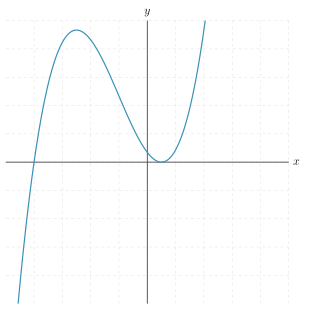
- \(\,\) \begin{align*} && 0 &\leq (x+2y)^3 - 27y^2 x \\ &&& \leq 3^3 - 27 y^2 x \\ &&&= 27(1-y^2x) \\ \Rightarrow && xy^2 &\leq1 \end{align*} with equality when \(x = y = 1\)
- Notice that \begin{align*} && 0 &\leq (p+q+r)^3 - 27\left (\frac{q+r}{2}\right)^2 p \\ \Rightarrow && (p+q+r)^3 &\geq 27\left (\frac{q+r}{2}\right)^2 p \\ &&&\underbrace{\geq}_{AM-GM} 27\left (\sqrt{qr}\right)^2 p \\ &&&= 27pqr \end{align*} Equality can only hold if \(p = \frac{q+r}{2}\), but by symmetry we must also have \(q = \frac{r+p}{2}, r = \frac{p+q}{2}\) ie \(p = q = r\). And indeed equality does hold in this case.
2014 Paper 2 Q1
In the triangle \(ABC\), the base \(AB\) is of length 1 unit and the angles at~\(A\) and~\(B\) are \(\alpha\) and~\(\beta\) respectively, where \(0<\alpha\le\beta\). The points \(P\) and~\(Q\) lie on the sides \(AC\) and \(BC\) respectively, with \(AP=PQ=QB=x\). The line \(PQ\) makes an angle of~\(\theta\) with the line through~\(P\) parallel to~\(AB\).
- Show that \(x\cos\theta = 1- x\cos\alpha - x\cos\beta\), and obtain an expression for \(x\sin\theta\) in terms of \(x\), \(\alpha\) and~\(\beta\). Hence show that \begin{equation} \label{eq:2*} \bigl(1+2\cos(\alpha+\beta)\bigr)x^2 - 2(\cos\alpha + \cos\beta)x + 1 = 0\,. \tag{\(*\)} \end{equation} Show that \((*)\) is also satisfied if \(P\) and \(Q\) lie on \(AC\) produced and \(BC\) produced, respectively. [By definition, \(P\) lies on \(AC\) produced if \(P\) lies on the line through \(A\) and~\(C\) and the points are in the order \(A\), \(C\), \(P\)\,.]
- State the condition on \(\alpha\) and \(\beta\) for \((*)\) to be linear in \(x\). If this condition does not hold (but the condition \(0<\alpha \le \beta\) still holds), show that \((*)\) has distinct real roots.
- Find the possible values of~\(x\) in the two cases (a) \(\alpha = \beta = 45^\circ\) and (b) \(\alpha = 30^\circ\), \(\beta = 90^\circ\), and illustrate each case with a sketch.
2014 Paper 2 Q13
A random number generator prints out a sequence of integers \(I_1, I_2, I_3, \dots\). Each integer is independently equally likely to be any one of \(1, 2, \dots, n\), where \(n\) is fixed. The random variable \(X\) takes the value \(r\), where \(I_r\) is the first integer which is a repeat of some earlier integer. Write down an expression for \(\mathbb{P}(X=4)\).
- Find an expression for \(\mathbb{P}(X=r)\), where \(2\le r\le n+1\). Hence show that, for any positive integer \(n\), \[ \frac 1n + \left(1-\frac1n\right) \frac 2 n + \left(1-\frac1n\right)\left(1-\frac2n\right) \frac3 n + \cdots \ = \ 1 \,. \]
- Write down an expression for \(\mathbb{E}(X)\). (You do not need to simplify it.)
- Write down an expression for \(\mathbb{P}(X\ge k)\).
- Show that, for any discrete random variable \(Y\) taking the values \(1, 2, \dots, N\), \[ \mathbb{E}(Y) = \sum_{k=1}^N \mathbb{P}(Y\ge k)\,. \] Hence show that, for any positive integer \(n\), \[ \left(1-\frac{1^2}n\right) + \left(1-\frac1n\right)\left(1-\frac{2^2}n\right) + \left(1-\frac1n\right)\left(1-\frac{2}n\right)\left(1-\frac{3^2}n\right) + \cdots \ = \ 0. \]
Solution: \begin{align*} && \mathbb{P}(X > 4) &= 1 \cdot \frac{n-1}{n} \cdot \frac{n-2}{n} \cdot \frac{n-3}{n} \\ && \mathbb{P}(X > 3) &= 1 \cdot \frac{n-1}{n} \cdot \frac{n-2}{n} \\ \Rightarrow && \mathbb{P}(X =4) &= \mathbb{P}(X > 3) - \mathbb{P}(X > 4) \\ &&&= \frac{(n-1)(n-2)}{n^2} \left (1 - \frac{n-3}{n} \right) \\ &&&= \frac{3(n-1)(n-2)}{n^3} \end{align*}
- Notice that \begin{align*} && \mathbb{P}(X > r) &= \frac{n-1}{n} \cdots \frac{n-r+1}{n} \\ \Rightarrow && \mathbb{P}(X = r) &= \frac{n-1}{n} \cdots \frac{n-r+2}{n} \left (1 - \frac{n-r+1}{n} \right) \\ &&&= \frac{(n-1)\cdots(n-r+2)(r-1)}{n^{r-1}} \\ &&&= \left (1 - \frac{1}n \right)\left (1 - \frac{2}{n} \right) \cdots \left (1 - \frac{r-2}{n} \right) \frac{r-1}{n} \\ \Rightarrow && 1 &= \sum \mathbb{P}(X = r) \\ &&&= \sum_{r=2}^{n+1} \mathbb{P}(X = r) \\ &&&= \frac 1n + \left(1-\frac1n\right) \frac 2 n + \left(1-\frac1n\right)\left(1-\frac2n\right) \frac3 n + \cdots \end{align*}
- \(\,\) \begin{align*} \mathbb{E}(X) &= \sum_{r=2}^{n+1} r\cdot\mathbb{P}(X = r) \\ &= \frac 2n + \left(1-\frac1n\right) \frac {2\cdot3} n + \left(1-\frac1n\right)\left(1-\frac2n\right) \frac{3\cdot4} n + \cdots \end{align*}
- \(\displaystyle \mathbb{P}(X \geq k) = \frac{n-1}{n} \cdots \frac{n-r+2}{n}\)
- \(\,\) \begin{align*} && \mathbb{E}(Y) &= \sum_{r=1}^N r \cdot \mathbb{P}(Y = r) \\ &&&= \sum_{r=1}^N \sum_{j=1}^r \mathbb{P}(Y = r) \\ &&&= \sum_{j=1}^N \sum_{r=j}^N \mathbb{P}(Y=r) \\ &&&= \sum_{j=1}^N \mathbb{P}(Y \geq j) \end{align*} Let \(P_k = \left(1-\frac1n\right)\left(1-\frac2n\right) \cdots \left(1-\frac1n\right)\left(1-\frac{k}n\right) \) \begin{align*} && \mathbb{E}(X) &= P_1 \frac{1 \cdot 2 }{n} + P_2 \cdot \frac{2 \cdot 3}{n} + \cdots + P_k \cdot \frac{k(k+1)}{n} + \cdots \\ && &= \sum_{k=1}^{n} \frac{k^2}{n}P_k + \sum_{k=1}^{n} \frac{k}{n}P_k \\ && \text{Using the identity } & \frac{k}{n}P_k = \frac{k}{n} \prod_{i=1}^{k-1} \left(1-\frac{i}{n}\right) = P_k - P_{k+1}: \\ && \sum_{k=1}^{n} \frac{k}{n}P_k &= (P_1 - P_2) + (P_2 - P_3) + \cdots + (P_n - P_{n+1}) \\ && &= P_1 - P_{n+1} = 1 - 0 = 1 \\ \\ \Rightarrow && \mathbb{E}(X) &= \sum_{k=1}^{n} \frac{k^2}{n}P_k + 1 \\ && &= \mathbb{P}(X \geq 1) + \mathbb{P}(X \geq 2) + \mathbb{P}(X \geq 3) + \cdots \\ && &= 1 + P_1 + P_2 + P_3 + \cdots \\ && &= 1 + \sum_{k=1}^{n} P_k \\ \\ \Rightarrow && 1 + \sum_{k=1}^{n} P_k &= \sum_{k=1}^{n} \frac{k^2}{n}P_k + 1 \\ \Rightarrow && \sum_{k=1}^{n} P_k &= \sum_{k=1}^{n} \frac{k^2}{n}P_k \\ \Rightarrow && 0 &= \sum_{k=1}^{n} P_k \left( 1 - \frac{k^2}{n} \right) \end{align*}
2014 Paper 3 Q6
Starting from the result that \[ \.h(t) >0\ \mathrm{for}\ 0< t < x \Longrightarrow \int_0^x \.h(t)\ud t > 0 \,, \] show that, if \(\.f''(t) > 0\) for \(0 < t < x_0\) and \(\.f(0)=\.f'(0) =0\), then \(\.f(t)>0\) for \(0 < t < x_0\).
- Show that, for \(0 < x < \frac12\pi\), \[ \cos x \cosh x <1 \,. \]
- Show that, for \(0 < x < \frac12\pi\), \[ \frac 1 {\cosh x} < \frac {\sin x} x < \frac x {\sinh x} \,. \] %
- Show that, for \(0 < x < \frac12\pi\), \(\tanh x < \tan x\).
2013 Paper 2 Q7
- Write down a solution of the equation \[ x^2-2y^2 =1\,, \tag{\(*\)} \] for which \(x\) and \(y\) are non-negative integers. Show that, if \(x=p\), \(y=q\) is a solution of (\(*\)), then so also is \(x=3p+4q\), \(y=2p+3q\). Hence find two solutions of \((*)\) for which \(x\) is a positive odd integer and \(y\) is a positive even integer.
- Show that, if \(x\) is an odd integer and \(y\) is an even integer, \((*)\) can be written in the form \[ n^2 = \tfrac12 m(m+1)\,, \] where \(m\) and \(n\) are integers.
- The positive integers \(a\), \(b\) and \(c\) satisfy \[ b^3=c^4-a^2\,, \] where \(b\) is a prime number. Express \(a\) and \(c^2\) in terms of \(b\) in the two cases that arise. Find a solution of \(a^2+b^3=c^4\), where \(a\), \(b\) and \(c\) are positive integers but \(b\) is not prime.
Solution:
- \((x,y) = (1,0)\) we have Suppose \(p^2-2q^2 = 1\), then \begin{align*} && (3p+4q)^2-2\cdot(2p+3q)^2 &= 9p^2+24pq + 16q^2 - 2\cdot(4p^2+12pq+9q^2) \\ &&&= p^2(9-8) + pq(24-24) + q^2(16-18) \\ &&&= p^2 - 2q^2 = 1 \end{align*} So we have: \begin{array}{c|c} x & y \\ \hline 1 & 0 \\ 3 & 2 \\ 17 & 12 \\ \end{array}
- Suppose \(x = 2m+1\) and \(y = 2n\) then \begin{align*} && 1 & = x^2 - 2y^2 \\ &&&= (2m+1)^2 - 2(2n)^2 \\ &&&= 4m^2 + 4m + 1 - 8n^2 \\ \Leftrightarrow && n^2 &= \frac{m(m+1)}{2} \end{align*}
- Suppose \(b^3 = c^4 - a^2 =(c^2-a)(c^2+a)\), since \(b\) is prime and \(c^2 + a > c^2-a\) we must have: \begin{align*} && p = c^2-a && p^2 =c^2 +a \\ \Rightarrow && c^2 = \frac{p+p^2}{2} && a = \frac{p^2-p}2\\ && 1 = c^2-a && p^3 = c^2+a \\ \Rightarrow && c^2 = \frac{p^3+1}{2} && a = \frac{p^3-1}{2} \end{align*} Note that \(c^2 = \frac{p(p+1)}{2}\) is reminicent of our first equation, so suppose \(n = c = 6\) and \(p = m = 8\) then \(6^4 = 8^3 + 28^2\)
2013 Paper 2 Q10
A particle is projected at an angle of elevation \(\alpha\) (where \(\alpha>0\)) from a point \(A\) on horizontal ground. At a general point in its trajectory the angle of elevation of the particle from \(A\) is \(\theta\) and its direction of motion is at an angle \(\phi\) above the horizontal (with \(\phi\ge0\) for the first half of the trajectory and \(\phi\le0\) for the second half). Let \(B\) denote the point on the trajectory at which \(\theta = \frac12 \alpha\) and let \(C\) denote the point on the trajectory at which \(\phi = -\frac12\alpha\).
- Show that, at a general point on the trajectory, \(2\tan\theta = \tan \alpha + \tan\phi\,\).
- Show that, if \(B\) and \(C\) are the same point, then \( \alpha = 60^\circ\,\).
- Given that \(\alpha < 60^\circ\,\), determine whether the particle reaches the point \(B\) first or the point \(C\) first.
2013 Paper 3 Q5
In this question, you may assume that, if \(a\), \(b\) and \(c\) are positive integers such that \(a\) and \(b\) are coprime and \(a\) divides \(bc\), then \(a\) divides \(c\). (Two positive integers are said to be coprime if their highest common factor is 1.)
- Suppose that there are positive integers \(p\), \(q\), \(n\) and \(N\) such that \(p\) and \(q\) are coprime and \(q^nN=p^n\). Show that \(N=kp^n\) for some positive integer \(k\) and deduce the value of \(q\). Hence prove that, for any positive integers \(n\) and \(N\), \(\sqrt[n]N\) is either a positive integer or irrational.
- Suppose that there are positive integers \(a\), \(b\), \(c\) and \(d\) such that \(a\) and \(b\) are coprime and \(c\) and \(d\) are coprime, and \(a^ad^b = b^a c^b \,\). Prove that \(d^b = b^a\) and deduce that, if \(p\) is a prime factor of \(d\), then \(p\) is also a prime factor of \(b\). If \(p^m\) and \(p^n\) are the highest powers of the prime number \(p\) that divide \(d\) and \(b\), respectively, express \(b\) in terms of \(a\), \(m\) and \(n\) and hence show that \(p^n\le n\). Deduce the value of \(b\). (You may assume that if \(x > 0\) and \(y\ge2\) then \(y^x > x\).) Hence prove that, if \(r\) is a positive rational number such that \(r^r\) is rational, then \(r\) is a positive integer.
Solution:
- Suppose \(q^nN = p^n\) then since \((p,q) =1\) we must have \(p \mid N\), and then by dividing both \(p^n\) and \(N\) by \(p\) we can repeat this process \(n\) times to find that \(N = kp^n\) and in particular \(q = 1\). Suppose \(\sqrt[n]{N} = \frac{p}q\) for \(p,q\) coprime positive integers (ie it is not irrational), then \(q^nN = p^n\) and so \(q = 1\) and in fact \(\sqrt[n]{N}\) is an integer so \(N\).
- Suppose \((a,b) = 1, (c,d) = 1\) and \(a^ad^b = b^ac^b\), then since \((a,b) = 1\) we must have \((b^a, a) = 1\) so \(b^a \mid d^b\). Similarly since \((c,d) = 1\) we must have \((d^b, c) = 1\) so \(d^b \mid b^a\). Therefore \(d^b = b^a\). Suppose \(p \mid d\) then \(p \mid d^b = b^a \Rightarrow p \mid b\). Suppose \(\nu_p(d) = m, \nu_p(b) = n\) we must have \(bm = \nu_p(d^b) = \nu_p(b^a) = an\), ie \(b = \frac{an}{m}\). Note that \(p^n \mid b \Rightarrow p^n \mid n \frac{a}{m} \Rightarrow p^n \mid n \Rightarrow p^n \leq n\). Since \((p,a) = 1\).. But since \(p^n > n\) if \(p \geq 2\) we must have that \(b = 1\). Therefore suppose \(r = \frac{a}{b}\) with \((a,b) = 1\) an \(r^r = \frac{c}{d}\) we must ahve \(a^ac^b = b^ad^b\) and so \(b = 1\) implying \(r\) is an integer.
2012 Paper 2 Q11
A small block of mass \(km\) is initially at rest on a smooth horizontal surface. Particles \(P_1\), \(P_2\), \(P_3\), \(\ldots\) are fired, in order, along the surface from a fixed point towards the block. The mass of the \(i\)th particle is \(im\) (\(i = 1, 2, \ldots\))and the speed at which it is fired is \(u/i\,\). Each particle that collides with the block is embedded in it. Show that, if the \(n\)th particle collides with the block, the speed of the block after the collision is \[ \frac{2nu}{2k +n(n+1)}\,. \] In the case \(2k = N(N+1)\), where \(N\) is a positive integer, determine the number of collisions that occur. Show that the total kinetic energy lost in all the collisions is \[ \tfrac12 mu^2\bigg( \sum_{n=2}^{N+1} \frac 1 n \bigg)\,. \]
Solution: \begin{align*} \text{COM}: && \sum_{i=1}^n im \cdot \frac{u}{i} &= \left ( km + \sum_{i=1}^n im \right) v \\ \Rightarrow && nu &= \left ( k + \frac{n(n+1)}{2} \right) v \\ \Rightarrow && v &= \frac{2nu}{2k + n(n+1)} \end{align*} If \(2k = N(N+1)\), there will be no more collisions when \(v_n > \frac{u}{n+1}\), ie \begin{align*} && \frac{u}{n+1} &<\frac{2nu}{2k + n(n+1)} \\ \Leftrightarrow && N(N+1) + n(n+1) &< 2n(n+1) \\ \Leftrightarrow && N(N+1) &< n(n+1) \\ \end{align*} Therefore \(n = N+1\) and there will be \(N+1\) collisions. The loss of kinetic energy is: \begin{align*} && \text{initial k.e.} &= \sum_{k=1}^{N+1} \frac12 im \cdot \frac{u^2}{i^2} \\ &&&= \frac12 m u^2 \left ( \sum_{k=1}^{N+1} \frac{1}{i}\right) \\ && \text{final k.e.} &= \frac12 \left ( k + \frac{(N+1)(N+2)}{2}\right)m \left ( \frac{2(N+1)u}{N(N+1)+(N+1)(N+2)} \right)^2 \\ &&&= \frac12 m u^2 \frac{2(N+1)^2}{(N+1)(2N+2)} \\ &&&= \frac12 mu^2 \\ \Rightarrow && \Delta \text{ k.e.} &= \frac12 m u^2 \left ( \sum_{k=2}^{N+1} \frac{1}{i}\right) \end{align*}
2012 Paper 3 Q5
- The point with coordinates \((a, b)\), where \(a\) and \(b\) are rational numbers,is called an integer rational point if both \(a\) and \(b\) are integers; a non-integer rational point if neither \(a\) nor \(b\) is an integer.
- \(\bf (a)\) Write down an integer rational point and a non-integer rational point on the circle \(x^2+y^2 =1\).
- [\bf (b)] Write down an integer rational point on the circle \(x^2+y^2=2\). Simplify \[ (\cos\theta + \sqrt m \sin\theta)^2 + (\sin\theta - \sqrt m \cos\theta)^2 \, \] and hence obtain a non-integer rational point on the circle \(x^2+y^2=2\,\).
- The point with coordinates \((p+\sqrt 2 \, q\,,\, r+\sqrt 2 \, s)\), where \(p\), \(q\), \(r\) and \(s\) are rational numbers, is called: an integer \(2\)-rational point if all of \(p\), \(q\), \(r\) and \(s\) are integers; a non-integer \(2\)-rational point if none of \(p\), \(q\), \(r\) and \(s\) is an integer.
- \(\bf (a)\) Write down an integer \(2\)-rational point, and obtain a non-integer \(2\)-rational point, on the circle \(x^2+y^2=3\,\).
- [\bf(b)] Obtain a non-integer \(2\)-rational point on the circle \(x^2+y^2=11\,\).
- [\bf(c)]Obtain a non-integer \(2\)-rational point on the hyperbola \(x^2-y^2 =7 \).
Solution:
- \(\bf (a)\) \((1, \sqrt2)\) is an integer \(2\)-rational point. \((\frac35 + \frac45\sqrt2, \frac45 - \frac{3}{5}\sqrt2)\) is a non-integer \(2\)-rational point.
- [\bf(b)] First notice that \((\sqrt2)^2 +3^2 = 11\) so then consider \((1 + \tfrac32\sqrt2, 1-\tfrac32\sqrt2)\) will work as \(\pi/4\) degree rotation.
- [\bf(c)] First notice \(3^2-(\sqrt2)^2 = 2\). Notice that \((k\sec \theta + \sqrt{m} \tan \theta)^2 - (k\tan \theta + \sqrt{m} \sec \theta)^2 = k^2-m\). Taking \(k= 3\) we have \((3 \cdot \frac{13}{5} + \frac{12}{5}\sqrt{2}, 3\cdot\frac{12}5+\frac{13}{5}\sqrt2)\)