Problems
Filters
49 problems found
2002 Paper 2 Q13
Let \(\F(x)\) be the cumulative distribution function of a random variable \(X\), which satisfies \(\F(a)=0\) and \(\F(b)=1\), where \(a>0\). Let \[ \G(y) = \frac{\F(y)}{2-\F(y)}\;. \] Show that \(\G(a)=0\,\), \(\G(b)=1\,\) and that \(\G'(y)\ge0\,\). Show also that \[ \frac12 \le \frac2{(2-\F(y))^2} \le 2\;. \] The random variable \(Y\) has cumulative distribution function \(\G(y)\,\). Show that \[ { \tfrac12} \,\E(X) \le \E(Y) \le 2 \E(X) \;, \] and that \[ \var(Y) \le 2\var(X) +\tfrac 74 \big(\E(X)\big)^2\;. \]
Solution: \begin{align*} && G(a) &= \frac{F(a)}{2-F(a)}\\ &&&= 0 \tag{\(F(a)= 0\)}\\ \\ && G(b) &= \frac{F(b)}{2-F(b)} \\ &&&= \frac{1}{2-1} = 1 \tag{\(F(b)=1\)}\\ \\ && G'(y) &= \frac{F'(y)(2-F(y))+F(y)F'(y)}{(2-F(y))^2} \\ &&&= \frac{2F'(y)}{(2-F(y))^2} \geq 0 \tag{\(F'(y) \geq 0\)} \end{align*} \begin{align*} && 0 \leq F(y)\leq1\\ \Leftrightarrow&& 1\leq 2-F(y) \leq 2\\ \Leftrightarrow &&1 \leq (2-F(y))^2 \leq 4\\ \Leftrightarrow && 1 \geq \frac{1}{(2-F(y))^2} \geq \frac14 \\ \Leftrightarrow && 2 \geq \frac{2}{(2-F(y))^2} \geq\frac12 \end{align*} \begin{align*} && \mathbb{E}(Y) &= \int_a^b y G'(y) \d y \\ &&&= \int_a^b y F'(y) \underbrace{\frac{2}{(2-F(y))^2}}_{\in [\frac12, 2]} \d y \\ &&&\leq 2 \E[X] \\ &&&\geq \frac12 \E[X]\\ \\ && \E[Y^2] &\leq 2\E[X^2] \\ && \E[Y^2] &\geq \frac12\E[X^2] \\ \\ \Rightarrow && \var[Y] &= \E[Y^2]-\E[Y]^2 \\ &&& \leq 2 \E[X^2] - (\tfrac12\E[X])^2 \\ &&&= 2 \var[X] + \tfrac74(\E[X])^2 \end{align*}
2002 Paper 3 Q1
Find the area of the region between the curve \(\displaystyle y = {\ln x \over x}\,\) and the \(x\)-axis, for \(1 \le x \le a\). What happens to this area as \(a\) tends to infinity? Find the volume of the solid obtained when the region between the curve \(\displaystyle y = {\ln x \over x}\,\) and the \(x\)-axis, for \(1 \le x\le a\), is rotated through \(2 \pi\) radians about the \(x\)-axis. What happens to this volume as \(a\) tends to infinity?
Solution: \begin{align*} && \int_1^a \frac{\ln x}{x} \d x &= \left [ \ln x \cdot \ln x\right ]_1^a - \int_1^a \frac{\ln x}{x} \d x \\ \Rightarrow && \int_1^a \frac{\ln x}{x} \d x &= \frac12 \left ( \ln a \right) ^2 \\ && \int_1^\infty \frac{\ln x}{x} \d x &= \lim_{a \to \infty} \frac12 (\ln a)^2 \\ &&&= \infty \end{align*} \begin{align*} && \pi \int_1^a \left ( \frac{\ln x}{x} \right)^2 \d x &= \pi \int_{u=0}^{u=\ln a} \left ( \frac{u}{e^u} \right)^2 e^u \d u \\ &&&= \pi \int_0^{\ln a} u^2 e^{-u} \d u \\ &&&= \pi \left [-u^2e^{-u} \right]_0^{\ln a} +\pi \int_0^{\ln a} 2u e^{-u} \d u \\ &&&= -\frac{\pi}{a} (\ln a)^2 + \pi \left [-2u e^{-u} \right]_0^{\ln a} + \pi \int_0^{\ln a} e^{-u} \d u \\ &&&= -\frac{\pi}{a} (\ln a)^2- \frac{2 \pi}{a}\ln a+\pi \left (1 - \frac{1}{a} \right) \\ \\ && \pi \int_1^{\infty} \left ( \frac{\ln x}{x} \right)^2 \d x &= \lim_{a \to \infty} \left ( -\frac{\pi}{a} (\ln a)^2- \frac{2 \pi}{a}\ln a+\pi \left (1 - \frac{1}{a} \right) \right) \\ &&&= \pi \end{align*}
2001 Paper 2 Q6
Show that \[ \int_0^1 \frac{x^4}{1+x^2} \, \d x = \frac \pi {4} - \frac 23 \;. \] Determine the values of
- \(\displaystyle \int_0^1 x^3 \; \tan ^{-1} \left(\frac {1-x} {1+x} \right) \,\d x \)
- \(\displaystyle \int_0^1 \frac {(1-y)^3} {(1+y)^5} \; {{\tan}^{-1} y}\, \d y\)
Solution: \begin{align*} && \int_0^1 \frac{x^4}{1+x^2} \d x &= \int_0^1 \frac{(x^2-1)(1+x^2)+1}{x^2+1} \d x\\ &&&= \int_0^1 \frac{1}{1+x^2} \d x -\int_0^1 (1-x^2) \d x \\ &&&= \left [\tan^{-1}x \right]_0^1 - \left [x - \tfrac13x^3 \right]_0^1 \\ &&&= \frac{\pi}{4} - \frac23 \end{align*}
- \(\,\) \begin{align*} && I &= \int_0^1 x^3 \; \tan ^{-1} \left(\frac {1-x} {1+x} \right) \,\d x \\ &&&= \left [ \frac{x^4}{4}\tan ^{-1} \left(\frac {1-x} {1+x} \right) \right]_0^1 -\int_0^1 \frac{x^4}{4} \frac{1}{1 +\left(\frac {1-x} {1+x} \right) ^2 } \cdot \frac{-2}{(1+x)^2} \d x \\ &&&= \frac{1}{2} \int_0^1 \frac{x^4}{(1+x)^2+(1-x)^2} \d x \\ &&&= \frac{1}{4} \int_0^1 \frac{x^4}{1+x^2} \d x \\ &&&= \frac{\pi}{16} - \frac{1}{6} \end{align*}
- \(\,\) \begin{align*} && J &= \int_0^1 \frac {(1-y)^3} {(1+y)^5} \; {{\tan}^{-1} y}\, \d y \\ &&&= \left [ \frac {(y(1+y^2)} {(1+y)^4} \tan^{-1}y \right]_0^1 - \int_0^1 \frac {(y(1+y^2)} {(1+y)^4} \frac{1}{1+y^2} \d y \\ &&&= \frac{\pi}{32} - \int_0^1 \frac{y}{(1+y)^4} \d y \\ &&&= \frac{\pi}{32} - \left[ - \frac{3y+1}{6(1+y)^3} \right]_0^1 \\ &&&= \frac{\pi}{32} +\frac{4}{6 \cdot 8} - \frac{1}{6} \\ &&&= \frac{\pi}{32} - \frac{1}{12} \end{align*}
2000 Paper 1 Q8
Show that \[ \int_{-1}^1 \vert \, x\e^x \,\vert \d x =- \int_{-1}^0 x\e^x \d x + \int_0^1 x\e^x \d x \] and hence evaluate the integral. Evaluate the following integrals:
- \(\displaystyle \int_0^4 \vert\, x^3-2x^2-x+2 \,\vert \, \d x\,;\)
- \(\displaystyle \int_{-\pi}^\pi \vert\, \sin x +\cos x \,\vert \; \d x\,.\)
Solution: \begin{align*} && \int_{-1}^1 |x e^x |\d x &= \int_{-1}^0 |xe^x| \d x + \int_0^1 |xe^x| \d x \\ &&&= \int_{-1}^0 -xe^x \d x + \int_0^1 x \e^x \d x \\ &&&= -\int_{-1}^0 xe^x \d x + \int_0^1 x \e^x \d x \\ \\ && \int xe^x \d x &= xe^x - \int e^x \d x \\ &&&= xe^x - e^x \\ \\ \Rightarrow && \int_{-1}^1 |x e^x |\d x &= \left [ xe^x - e^x \right]_0^{-1}+ \left [ xe^x - e^x \right]_0^{1} \\ &&&= -e^{-1}-e^{-1} +e^{0} + e^1 - e^1 +e^0 \\ &&&= 2-2e^{-1} \end{align*}
- \(\,\) \begin{align*} && I &= \int_0^4 | x^3-2x^2-x+2| \d x \\ &&&= \int_0^4 |(x-2)(x-1)(x+1)| \d x\\ &&&= \int_0^1( x^3-2x^2-x+2) \d x- \int_1^2 ( x^3-2x^2-x+2) \d x + \int_2^4 ( x^3-2x^2-x+2) \d x \\ &&&= \left [\frac14 x^4-\frac23 x^3- \frac12 x^2 +2x \right]_0^1 - \left [\frac14 x^4-\frac23 x^3- \frac12 x^2 +2x \right]_1^2 + \left [\frac14 x^4-\frac23 x^3- \frac12 x^2 +2x \right]_2^4 \\ &&&= 2 \left ( \frac14 - \frac23 -\frac12 + 2\right) - 2 \left ( \frac14 2^4 - \frac23 2^3 -\frac12 2^2 + 2 \cdot 2\right)+ \left ( \frac14 4^4 - \frac23 4^3 -\frac12 4^2 + 2 \cdot 4\right) \\ &&&= \frac{133}{6} \end{align*}
- \(\,\) \begin{align*} && J &= \int_{-\pi}^\pi | \sin x + \cos x | \d x \\ &&&= \int_{-\pi}^{\pi} | \sqrt{2} \sin(x + \tfrac{\pi}{4})| \d x \\ &&&= 2\sqrt{2}\int_0^\pi \sin x \d x \\ &&&= 4\sqrt{2} \end{align*}
2000 Paper 2 Q5
It is required to approximate a given function \(\f(x)\), over the interval \(0 \le x \le 1\), by the linear function \(\lambda x\), where \(\lambda\) is chosen to minimise \[ \int_0^1 \big(\f(x)-\lambda x \big)^{\!2} \,\d x . \] Show that \[ \lambda = 3 \int_0^1 x\f(x)\,\d x. \] The residual error, \(R\), of this approximation process is such that \[ R^2 = \int_0^1 \big(\f(x)-\lambda x \big)^{\!2}\,\d x. \] Show that \[ R^2 = \int_0^1 \big(\f(x)\big)^{\!2}\,\d x -\tfrac{1}{3} \lambda ^2. \] Given now that \(\f(x)= \sin (\pi x/n)\), show that (i) for large \(n\), \(\lambda \approx \pi/n\) and (ii) \(\lim_{n \to \infty}R = 0.\) Explain why, prior to any calculation, these results are to be expected. [You may assume that, when \(\theta\) is small, $\sin \theta \approx \theta-\frac{1}{6}\theta^3$ and \(\cos \theta \approx 1 - \frac{1}{2}\theta^2.\)]
Solution: \begin{align*} && g(\lambda) &= \int_0^1 \big(\f(x)-\lambda x \big)^{\!2} \,\d x \\ &&&= \int_0^1 \left ( f(x)^2 -2\lambda xf(x) + \lambda^2 x^2\right) \d x \\ &&&= \frac13\lambda^2 - 2\lambda \int_0^1 x f(x) \d x + \int_0^1 f(x)^2 \d x \\ \end{align*} Differentiating (or completing the square) it is clear the minimum occurs when \(\displaystyle \lambda = 3 \int_0^1 xf(x) \d x\) \begin{align*} && R^2 &= \int_0^1 (f(x) - \lambda x )^2 \d x \\ &&&= \frac13\lambda^2 - 2\lambda \int_0^1 x f(x) \d x + \int_0^1 f(x)^2 \d x \\ &&&= \frac13 \left (\lambda -3\int_0^1 xf(x) \d x \right)^2 -\frac13 \left ( 3\int_0^1 xf(x) \d x \right)^2+\int_0^1 f(x)^2 \d x \\ \end{align*} When \(\lambda = 3\int_0^1 xf(x) \d x \) clearly this is the desired result. \begin{align*} && \lambda &= 3\int_0^1 xf(x) \d x \\ &&&= 3\int_0^1 x \sin(\pi x /n) \d x \\ &&&= 3 \left [-x \frac{n}{\pi} \cos (\pi x /n) \right]_0^1 + \frac{3n}{\pi} \int_0^1 \cos(\pi x /n) \d x \\ &&&= -\frac{3n}{\pi}\cos(\pi/n) + \frac{3n}{\pi} \left [ \frac{n}{\pi} \sin(\pi x /n)\right]_0^1 \\ &&&= -\frac{3n}{\pi} \cos(\pi/n) + \frac{3n^2}{\pi^2} \sin(\pi /n) \\ \text{for large }n: &&&\approx -\frac{3n}{\pi}\left ( 1 - \frac12\frac{\pi^2}{n^2} + o(1/n^4)\right) + \frac{3n^2}{\pi^2} \left (\frac{\pi}{n} - \frac16 \frac{\pi^3}{n^3} +o(1/n^5) \right) \\ &&&= \left (\frac32 -\frac12\right)\frac{\pi}{n} + o(1/n^3) \\ &&&= \frac{\pi}{n} + o(1/n^2) \end{align*} Therefore for large \(n\), \(\lambda \approx \frac{\pi}n\) \begin{align*} && \int_0^1 \sin^2(\pi x/n) \d x &= \frac12\int_0^1(1- \cos(2\pi x/n)) \d x\\ &&&= \frac12\left ( 1 - \frac{n}{2\pi}\left[\sin(2\pi x/n) \right]_0^1 \right) \\ &&&= \frac12 -\frac{n}{4\pi}\sin(2\pi /n) \\ \\ && R^2 &= \frac12 -\frac{n}{4\pi}\sin(2\pi /n) - \frac13 \left ( \frac{\pi}{n}+o(1/n^2)\right)^2 \\ &&&= \frac12 - \left ( \frac{1}{2} -\frac16\frac{\pi}{n}+o(1/n^3) \right) - o(1/n^2) \\ &&& = \frac16 \frac{\pi}{n} + o(1/n^2) \\ &&&\to 0 \text{ as } n \to \infty \end{align*} We should expect these results as for \(n\) very large \(\sin(\pi x/n) \approx \frac{\pi }{n}x\) so the best linear approximation is likely to be \(\lambda = \frac{\pi}{n}\) and we should expect it to improve to the point that we cannot tell the difference, ie \(R^2 \to 0\)
1999 Paper 2 Q6
Find \(\displaystyle \ \frac{\d y}{\d x} \ \) if $$ y = \frac{ax+b}{cx+d}. \tag{*} $$ By using changes of variable of the form \((*)\), or otherwise, show that \[ \int_0^1 \frac{1}{(x+3)^2} \; \ln \left(\frac{x+1}{x+3}\right)\d x = {\frac16} \ln3 - {\frac14}\ln 2 - \frac 1{12}, \] and evaluate the integrals \[ \int_0^1 \frac{1}{(x+3)^2} \; \ln \left(\frac{x^2+3x+2}{(x+3)^2}\right)\d x \mbox{ and } \int_0^1 \frac{1}{(x+3)^2} \; \ln\left(\frac{x+1}{x+2}\right)\d x . \] [Not on original paper:] By changing to the variable \(y\) defined by $$ y=\frac{2x-3}{x+1},$$ evaluate the integral $$ \int_2^4 \frac{2x-3}{(x+1)^3}\; \ln\!\left(\frac{2x-3}{x+1}\right)\d x.$$ Evaluate the integral $$ \int_9^{25} {\big({2z^{-3/2} -5z^{-2}}\big)}\ln{\big(2-5z^{-1/2}\big)}\; \d z.$$
Solution: \begin{align*} && y &= \frac{ax+b}{cx+d} \\ &&&= \frac{\frac{a}{c}(cx+d) - \frac{da}{c} + b}{cx+d} \\ \Rightarrow && y' &= \left (b - \frac{da}{c} \right)(-1)(cx+d)^{-2} \cdot c \\ &&&= (ad-bc)(cx+d)^{-2} \end{align*} \begin{align*} && y &= \frac{x+1}{x+3} \\ && \frac{\d y}{\d x} &= \frac{2}{(x+3)^2} \\ \Rightarrow && I &= \int_0^1 \frac{1}{(x+3)^2} \; \ln \left(\frac{x+1}{x+3}\right)\d x \\ &&&= \int_{y=1/3}^{y=1/2} \frac12 \ln y \, \d y \\ &&&= \frac12 \left [ y \ln y - y \right]_{1/3}^{1/2} \\ &&&= \frac12 \left ( \frac12\ln \frac12 - \frac12 - \frac13 \ln\frac13 + \frac13 \right) \\ &&&= \frac16 \ln 3 -\frac14 \ln 2 -\frac1{12} \end{align*} \begin{align*} && J &= \int_0^1 \frac1{(x+3)^2} \ln \left ( \frac{x^2+3x+2}{(x+3)^2} \right) \d x \\ &&&= \int_0^1 \frac1{(x+3)^2} \left ( \ln \frac{x+1}{x+3} + \ln \frac{x+2}{x+3} \right) \d x \\ &&&= I + \int_0^1 \frac1{(x+3)^2} \ln \left ( \frac{x+2}{x+3} \right) \d x \\ &&&= I + \int_{y=2/3}^{y=3/4} \ln y\, \d y \\ &&&= I + \left [ y \ln y- y\right]_{2/3}^{3/4} \\ &&&= I + \left ( \frac34 \ln \frac34 - \frac34 - \frac23 \ln \frac23 + \frac23 \right) \\ &&&= I + \left ( \frac34 \ln 3 - \frac32 \ln 2- \frac1{12} - \frac23 \ln 2 + \frac23 \ln 3\right) \\ &&&= I + \left ( \frac{17}{12} \ln 3 - \frac{13}6 \ln 2- \frac1{12} \right) \\ &&&= \frac16 \ln 3 -\frac14 \ln 2 -\frac1{12} + \left ( \frac{17}{12} \ln 3 - \frac{13}6 \ln 2- \frac1{12} \right) \\ &&&= \frac{19}{12} \ln 3 -\frac{29}{12}\ln 2 - \frac16 \end{align*} \begin{align*} && K &= \int_0^1 \frac{1}{(x+3)^2} \; \ln\left(\frac{x+1}{x+2}\right)\d x \\ &&&= \int_0^1 \frac{1}{(x+3)^2} \; \left ( \ln\left(\frac{x+1}{x+3}\right) - \ln \left ( \frac{x+3}{x+2} \right) \right)\d x \\ &&&= \frac16 \ln 3 -\frac14 \ln 2 -\frac1{12} - \left ( \frac{17}{12} \ln 3 - \frac{13}6 \ln 2- \frac1{12} \right) \\ &&&= -\frac54 \ln 3 +\frac{23}{12} \ln 2 \end{align*}
1998 Paper 3 Q2
Let $$ {\rm I}(a,b) = \int_0^1 t^{a}(1-t)^{b} \, \d t \; \qquad (a\ge0,\ b\ge0) .$$
- Show that \({\rm I}(a,b)={\rm I}(b,a)\),
- Show that \({\rm I}(a,b)={\rm I}(a+1,b)+{\rm I}(a,b+1)\).
- Show that \((a+1){\rm I}(a,b)=b{\rm I}(a+1,b-1)\) when \(a\) and \(b\) are positive and hence calculate \({\rm I}(a,b)\) when \(a\) and \(b\) are positive integers.
Solution:
- Let \(u = 1-t, \d u = -\d t\), then: \begin{align*} \mathrm{I}(a,b) &= \int_0^1 t^a(1-t)^b \d t \\ &= \int_{u=1}^{u=0} -(1-u)^a u^b \d u \\ &= \int_0^1(1-u)^a u^b \d u \\ &= \mathrm{I}(b, a) \end{align*}
- \begin{align*} \mathrm{I}(a+1,b)+\mathrm{I}(a,b+1) &= \int_0^1 t^{a+1}(1-t)^b + t^a(1-t)^{b+1} \d t \\ &= \int_0^1 (t+(1-t))t^a(1-t)^b \d t \\ &= \int_0^1 t^a(1-t)^b \d t \\ &= \mathrm{I}(a,b) \end{align*}
- Integrating by parts with \(\frac{du}{dt} = t^a, v = (1-t)^{b}\)\begin{align*} \mathrm{I}(a,b) &= \int_0^1 t^a (1-t)^b \d t \\ &= \left [ \frac{t^{a+1}}{a+1} (1-t)^b \right ]_0^1 + \int_0^1 \frac{t^{a+1}}{a+1} b(1-t)^{b-1} \\ &= \frac{b}{a+1} \int_0^1 t^{a+1}(1-t)^{b-1} \d t \\ &= \frac{b}{a+1} \mathrm{I}(a+1,b-1) \end{align*} Claim: \(\mathrm{I}(a,b) = \frac{a!b!}{(a+b+1)!}\) Proof: Note that \(I(a,0) = \frac{1}{a+1}\) so the formula holds for this case. We will induct on \(b\). The base case is done. Suppose that for \(b = k\) our formula is true, ie: \(\mathrm{I}(a,k) = \frac{a!k!}{(a+k+1)!}\) for all \(a\) (and fixed \(k\)) \begin{align*} \mathrm{I}(a,k+1) &= \frac{k+1}{a+1} \mathrm{I}(a+1,k) \\ &= \frac{k+1}{a+1} \frac{(a+1)!k!}{(a+1+k+1)!} \\ &= \frac{a!(k+1)!}{(a+(k+1)+1)!} \end{align*} So the formula is true for \(b=k+1\). Therefore, since it is true if \(b=0\) and if \(b=k\) is true then \(b=k+1\) is true, it is true for all values of \(b\).
1995 Paper 2 Q4
Let \[ u_{n}=\int_{0}^{\frac{1}{2}\pi}\sin^{n}t\,\mathrm{d}t \] for each integer \(n\geqslant0\). By integrating \[ \int_{0}^{\frac{1}{2}\pi}\sin t\sin^{n-1}t\,\mathrm{d}t \] by parts, or otherwise, obtain a formula connecting \(u_{n}\) and \(u_{n-2}\) when \(n\geqslant2\) and deduce that \[ nu_{n}u_{n-1}=\left(n-1\right)u_{n-1}u_{n-2} \] for all \(n\geqslant2\). Deduce that \[ nu_{n}u_{n-1}=\tfrac{1}{2}\pi. \] Sketch graphs of \(\sin^{n}t\) and \(\sin^{n-1}t\), for \(0\leqslant t\leqslant\frac{1}{2}\pi,\) on the same diagram and explain why \(0 < u_{n} < u_{n-1}.\) By using the result of the previous paragraph show that \[ nu_{n}^{2} < \tfrac{1}{2}\pi < nu_{n-1}^{2} \] for all \(n\geqslant1\). Hence show that \[ \left(\frac{n}{n+1}\right)\tfrac{1}{2}\pi < nu_{n}^{2} < \tfrac{1}{2}\pi \] and deduce that \(nu_{n}^{2}\rightarrow\tfrac{1}{2}\pi\) as \(n\rightarrow\infty\).
Solution: \begin{align*} && u_n &= \int_0^{\tfrac12 \pi} \sin^{n} t \, \d t \\ && &= \int_0^{\tfrac12 \pi} \sin t \sin^{n-1} t \, \d t \\ && &= \left [ -\cos t \sin^{n-1} t \right]_0^{\tfrac12 \pi} + \int_0^{\tfrac12 \pi} \cos t (n-1) \sin^{n-2} t \cos t \d t \\ && &= 0 + (n-1)\int_0^{\tfrac12 \pi} \cos^2 t \sin^{n-2} t \d t \\ && &= (n-1) \int_0^{\tfrac12 \pi}(1-\sin^2 t) \sin^{n-2} t \d t \\ && &= (n-1)u_{n-2} - (n-1)u_n \\ \Rightarrow && n u_n &= (n-1)u_{n-2} \\ \end{align*} Mutplying both sides by \(u_{n-1}\) we obtain \(nu_{n}u_{n-1}=\left(n-1\right)u_{n-1}u_{n-2}\). Therefore \(nu_nu_{n-1}\) is constant, ie is equal to \(\displaystyle u_1u_0 = \int_0^{\tfrac12 \pi} \sin^{1} t \, \d t \int_0^{\tfrac12 \pi} \sin^{0} t \, \d t = 1 \cdot \frac{\pi}{2} = \frac{\pi}{2}\)

1994 Paper 2 Q2
If \(\mathrm{Q}\) is a polynomial, \(m\) is an integer, \(m\geqslant1\) and \(\mathrm{P}(x)=(x-a)^{m}\mathrm{Q}(x),\) show that \[ \mathrm{P}'(x)=(x-a)^{m-1}\mathrm{R}(x) \] where \(\mathrm{R}\) is a polynomial. Explain why \(\mathrm{P}^{(r)}(a)=0\) whenever \(1\leqslant r\leqslant m-1\). (\(\mathrm{P}^{(r)}\) is the \(r\)th derivative of \(\mathrm{P}.\)) If \[ \mathrm{P}_{n}(x)=\frac{\mathrm{d}^{n}}{\mathrm{d}x^{n}}(x^{2}-1)^{n} \] for \(n\geqslant1\) show that \(\mathrm{P}_{n}\) is a polynomial of degree \(n\). By repeated integration by parts, or otherwise, show that, if \(n-1\geqslant m\geqslant0,\) \[ \int_{-1}^{1}x^{m}\mathrm{P}_{n}(x)\,\mathrm{d}x=0 \] and find the value of \[ \int_{-1}^{1}x^{n}\mathrm{P}_{n}(x)\,\mathrm{d}x. \] {[}Hint. \textit{You may use the formula \[ \int_{0}^{\frac{\pi}{2}}\cos^{2n+1}t\,\mathrm{d}t=\frac{(2^{2n})(n!)^{2}}{(2n+1)!} \] without proof if you need it. However some ways of doing this question do not use this formula.}{]}
Solution: \begin{align*} && P(x) &= (x-a)^mQ(x) \\ \Rightarrow && P'(x) &= m(x-a)^{m-1}Q(x) + (x-a)^mQ'(x) \\ &&&= (x-a)^{m-1}(\underbrace{mQ(x) + (x-a)Q'(x)}_{\text{a polynomial}}) \\ &&&= (x-a)^{m-1}R(x) \end{align*} Therefore \(P^{(r)}(a) = 0\) for \(1 \leq r \leq m-1\) since each time we differentiate we will have a factor of \((x-a)^{m-r}\) which is zero when we evaluate at \(x = a\). If \(P_n(x) = \frac{\d^n}{\d x^n}(x^2-1)^n\) then we are differentiating a degree \(2n\) polynomial \(n\) times. Each time we differentiate we reduce the degree by \(1\), therefore the degree of \(P_n\) is \(n\). \begin{align*} && \int_{-1}^1 x^mP_n(x) \d x &= \left [x^m \underbrace{\frac{\d^{n-1}}{\d x^{n-1}}\left ( (x-1)^{n} (x+1)^{n} \right)}_{\text{has a factor of }x-1\text{ and }x+1}\right]_{-1}^1 - \int_{-1}^1 mx^{m-1}\frac{\d^{n-1}}{\d x^{n-1}}\left ( (x-1)^{n} (x+1)^{n} \right) \d x\\ &&&= 0 - \int_{-1}^1 mx^{m-1}\frac{\d^{n-1}}{\d x^{n-1}}\left ( (x-1)^{n} (x+1)^{n} \right) \d x\\ &&&= -\left [mx^{m-1} \underbrace{\frac{\d^{n-2}}{\d x^{n-2}}\left ( (x-1)^{n} (x+1)^{n} \right)}_{\text{has a factor of }x-1\text{ and }x+1}\right]_{-1}^1+ \int_{-1}^1 m(m-1)x^{m-2}\frac{\d^{n-2}}{\d x^{n-2}}\left ( (x-1)^{n} (x+1)^{n} \right) \d x\\ &&&= m(m-1)\int_{-1}^1 x^{m-2}\frac{\d^{n-2}}{\d x^{n-2}}\left ( (x-1)^{n} (x+1)^{n} \right) \d x\\ &&& \cdots \\ &&&= (-1)^m m!\int_{-1}^1 \frac{\d^{n-m}}{\d x^{n-m}} \left ( (x-1)^{n} (x+1)^{n} \right) \d x\\ &&&= 0 \end{align*} If \(n = m\), we have \begin{align*} && \int_{-1}^1 x^n P_n(x) \d x&= (-1)^nn! \int_{-1}^1 (x^2-1)^n \d x \\ && &= (-1)^{2n}n! \cdot 2\int_{0}^1 (1-x^2)^n \d x \\ x = \sin \theta, \d x = \cos \theta \d \theta: &&&= 2 \cdot n!\int_{0}^{\pi/2} \cos^{2n} \theta \cdot \cos \theta \d \theta \\ &&&= 2 \cdot n!\int_{0}^{\pi/2} \cos^{2n+1} \theta \d \theta \\ &&&= 2 \cdot n!\frac{(2^{2n})(n!)^{2}}{(2n+1)!} \\ &&&= \frac{(2^{2n+1})(n!)^{3}}{(2n+1)!} \\ \end{align*}
1994 Paper 3 Q1
Calculate \[ \int_{0}^{x}\mathrm{sech}\, t\,\mathrm{d}t. \] Find the reduction formula involving \(I_{n}\) and \(I_{n-2}\), where \[ I_{n}=\int_{0}^{x}\mathrm{sech}^{n}t\,\mathrm{d}t \] and, hence or otherwise, find \(I_{5}\) and \(I_{6}.\)
Solution: \begin{align*} && \int_0^x \mathrm{sech}\, t \d t &= \int_0^x \frac{2}{e^t+e^{-t}} \d t \\ &&&= \int_0^x \frac{2e^t}{e^{2t}+1} \d t \\ &&&= \left [2 \arctan e^t \right ]_0^x \\ &&&= 2\tan^{-1}e^x- \frac{\pi}{2} \end{align*} \begin{align*} && I_n &= \int_0^x \mathrm{sech}^n\, t \d t \\ &&&= \int_0^x \mathrm{sech}^{n-2}\, t \mathrm{sech}^2\, t \d t \\ &&&= \left [ \mathrm{sech}^{n-2}\, t \cdot \tanh t\right ]_0^x - \int_0^x (n-2) \mathrm{sech}^{n-3} \, t \cdot (- \tanh t \mathrm{sech}\, t) \tanh t \d t \\ &&&= \mathrm{sech}^{n-2}\, x \cdot \tanh x+(n-2)\int_0^x \mathrm{sech}^{n-2} t \tanh^2 t \d t \\ &&&= \mathrm{sech}^{n-2}\, x \cdot \tanh x+(n-2)\int_0^x \mathrm{sech}^{n-2} t (1-\mathrm{sech}^2 \, t) \d t \\ &&&= \mathrm{sech}^{n-2}\, x \cdot \tanh x+(n-2)I_{n-2}-(n-2)I_n \\ \Rightarrow && (n-1)I_n &= \mathrm{sech}^{n-2}\, x \cdot \tanh x+(n-2)I_{n-2} \\ \Rightarrow && I_n &= \frac{1}{n-1} \left ( \mathrm{sech}^{n-2}\, x \cdot \tanh x+(n-2)I_{n-2} \right) \\ \end{align*} \begin{align*} I_1 &= 2\tan^{-1}e^x- \frac{\pi}{2} \\ I_3 &= \frac12 \left ( \mathrm{sech}\, x \cdot \tanh x+ 2\tan^{-1}e^x- \frac{\pi}{2}\right) \\ &= \frac12 \mathrm{sech}\, x \cdot \tanh x+ \tan^{-1}e^x- \frac{\pi}{4} \\ I_5 &= \frac14 \left (\mathrm{sech}^3\, x \cdot \tanh x + 3 \left ( \frac12 \mathrm{sech}\, x \cdot \tanh x+ \tan^{-1}e^x- \frac{\pi}{4} \right) \right) \\ &= \frac14 \mathrm{sech}^3\, x \cdot \tanh x +\frac38 \mathrm{sech}\, x \cdot \tanh x+\frac34 \tan^{-1}e^x- \frac{3\pi}{16} \\ \\ I_2 &= \tanh x \\ I_4 &= \frac13 \left ( \mathrm{sech}^2 x\tanh x +2\tanh x\right) \\ &= \frac13 \mathrm{sech}^2 x\tanh x +\frac23 \tanh x \\ I_6 &= \frac15 \left ( \mathrm{sech}^4 x \tanh x+4\left ( \frac13 \mathrm{sech}^2 x\tanh x +\frac23 \tanh x \right) \right) \\ &= \frac15 \mathrm{sech}^4 x \tanh x + \frac4{15}\mathrm{sech}^2 x\tanh x + \frac{8}{15} \tanh x \end{align*}
1992 Paper 1 Q3
Evaluate
- \({\displaystyle \int_{-\pi}^{\pi}\left|\sin x\right|\,\mathrm{d}x,}\)
- \({\displaystyle \int_{-\pi}^{\pi}\sin\left|x\right|\,\mathrm{d}x},\)
- \({\displaystyle \int_{-\pi}^{\pi}x\sin x\,\mathrm{d}x},\)
- \({\displaystyle \int_{-\pi}^{\pi}x^{10}\sin x\,\mathrm{d}x.}\)
Solution:
- \begin{align*} \int_{-\pi}^\pi |\sin x | \d x &= \int_{-\pi}^{0} - \sin x \d x + \int_0^\pi \sin x \d x \\ &= \left [\cos x \right]_{-\pi}^{0} +[-\cos x]_0^{\pi} \\ &= 1-(-1)+(1)-(-1) \\ &= 4 \end{align*}
- \begin{align*} \int_{-\pi}^\pi \sin | x | \d x &= \int_{-\pi}^0 - \sin x \d x + \int_0^\pi \sin x \d x \\ &= 4 \end{align*}
- \begin{align*} \int_{-\pi}^\pi x \sin x \d x &= \left [ -x \cos x \right]_{-\pi}^\pi + \int_{-\pi}^{\pi} \cos x \d x \\ &= \pi -(-\pi) + \left [\sin x \right]_{-\pi}^\pi \\ &= 2\pi \end{align*}
- \begin{align*} \int_{-\pi}^{\pi} x^{10} \sin x \d x &\underbrace{=}_{x^{10}\sin x \text{ is odd}} 0 \end{align*}
1991 Paper 3 Q7
- Prove that \[ \int_{0}^{\frac{1}{2}\pi}\ln(\sin x)\,\mathrm{d}x=\int_{0}^{\frac{1}{2}\pi}\ln(\cos x)\,\mathrm{d}x=\tfrac{1}{2}\int_{0}^{\frac{1}{2}\pi}\ln(\sin2x)\,\mathrm{d}x-\tfrac{1}{4}\pi\ln2 \] and \[ \int_{0}^{\frac{1}{2}\pi}\ln(\sin2x)\,\mathrm{d}x=\tfrac{1}{2}\int_{0}^{\pi}\ln(\sin x)\,\mathrm{d}x=\int_{0}^{\frac{1}{2}\pi}\ln(\sin x)\,\mathrm{d}x. \] Hence, or otherwise, evaluate \({\displaystyle \int_{0}^{\frac{1}{2}\pi}\ln(\sin x)\,\mathrm{d}x.}\) You may assume that all the integrals converge.
- Given that \(\ln u< u\) for \(u\geqslant1\) deduce that \[ \tfrac{1}{2}\ln x < \sqrt{x}\qquad\mbox{ for }\quad x\geqslant1. \] Deduce that \(\dfrac{\ln x}{x}\rightarrow0\) as \(x\rightarrow\infty\) and that \(x\ln x\rightarrow0\) as \(x\rightarrow0\) through positive values.
- Using the results of parts (i) and (ii), or otherwise, evaluate \({\displaystyle \int_{0}^{\frac{1}{2}\pi}x\cot x\,\mathrm{d}x.}\)
Solution:
- \begin{align*} u = \frac{\pi}{2} - x :&& \int_0^{\tfrac12 \pi} \ln (\sin x) \d x &= \int_{\frac12\pi}^0 \ln (\cos u) (- 1)\d u \\ &&&= \int_0^{\frac12 \pi} \ln (\cos x) \d x \\ \Rightarrow && 2 \int_0^{\tfrac12 \pi} \ln (\sin x) \d x &= \int_0^{\tfrac12 \pi} \ln (\sin x) \d x +\int_0^{\tfrac12 \pi} \ln (\cos x) \d x \\ &&&= \int_0^{\tfrac12 \pi}\left (\ln (\sin x)+ \ln (\cos x) \right) \d x \\ &&&= \int_0^{\frac12 \pi} \ln \left (\frac12 \sin 2x \right) \d x \\ &&&= \int_0^{\frac12 \pi} \left ( \ln \left (\sin 2x \right) - \ln 2 \right)\d x \\ &&&= \int_0^{\frac12 \pi} \ln \left (\sin 2x \right)\d x - \frac{\pi}{2} \ln 2\\ \Rightarrow && \int_0^{\tfrac12 \pi} \ln (\sin x) \d x &= \frac12 \int_0^{\frac12 \pi} \ln \left (\sin 2x \right)\d x - \frac{\pi}{4} \ln 2 \end{align*} \begin{align*} u = 2x, \d u = 2 \d x && \int_0^{\frac12 \pi} \ln \left (\sin 2x \right)\d x &= \int_0^{\pi} \ln (\sin u) \frac12 \d u \\ &&&= \frac12 \int_0^{\pi} \ln (\sin u) \d u \\ &&&=\frac12 \left ( \int_0^{\pi/2} \ln (\sin u) \d u + \int_{\pi/2}^{\pi} \ln (\sin u) \d u \right)\\ &&&= \int_0^{\pi/2} \ln (\sin u) \d u \\ \Rightarrow && I &= \frac12 I - \frac14 \pi \ln 2 \\ \Rightarrow && I &= -\frac12 \pi \ln 2 \end{align*}
- \begin{align*} && \ln u &< u & \quad (u \geq 1)\\ \underbrace{\Rightarrow}_{u = \sqrt{x}} && \ln \sqrt{x} &< \sqrt{x} \\ \Rightarrow && \frac12 \ln x &< \sqrt{x} \\ \Rightarrow && \frac{\ln x}{x} &< \frac{2\sqrt{x}}{x} \\ &&&= \frac{2}{\sqrt{x}} \\ &&&\to 0 & (x \to \infty) \\ && x \ln x &= \frac{\ln 1/y}{y} \\ &&&= -\frac{\ln y}{y} \\ &&&\to 0 & (y \to \infty, x \to 0) \end{align*}
- \begin{align*} \int_{0}^{\frac{1}{2}\pi}x\cot x\,\mathrm{d}x &= \left [ x \ln(\sin x) \right]_0^{\pi/2} - \int_0^{\pi/2} \ln (\sin x) \d x \\ &= \left ( \frac{\pi}{2} \ln 1 - \lim_{x \to 0} x \ln (\sin x) \right) - \left ( -\frac12 \pi \ln 2 \right) \\ &= \frac12 \pi \ln 2 \end{align*}
1991 Paper 3 Q8
- The integral \(I_{k}\) is defined by \[ I_{k}=\int_{0}^{\theta}\cos^{k}x\,\cos kx\,\mathrm{d}x. \] Prove that \(2kI_{k}=kI_{k-1}+\cos^{k}\theta\sin k\theta.\)
- Prove that \[ 1+m\cos2\theta+\binom{m}{2}\cos4\theta+\cdots+\binom{m}{r}\cos2r\theta+\cdots+\cos2m\theta=2^{m}\cos^{m}\theta\cos m\theta. \]
- Using the results of (i) and (ii), show that \[ m\frac{\sin2\theta}{2}+\binom{m}{2}\frac{\sin4\theta}{4}+\cdots+\binom{m}{r}\frac{\sin2r\theta}{2r}+\cdots+\frac{\sin2m\theta}{2m} \] is equal to \[ \cos\theta\sin\theta+\cos^{2}\theta\sin2\theta+\cdots+\frac{1}{r}2^{r-1}\cos^{r}\theta\sin r\theta+\cdots+\frac{1}{m}2^{m-1}\cos^{m}\theta\sin m\theta. \]
Solution:
- \begin{align*} kI_k &= \int_0^\theta \cos^k x k\cos kx \d x \\ &= \left [\cos^k x \sin kx \right]_0^\theta - \int_0^\theta k \cos^{k-1} x \sin x \sin k x \d x \\ &= \cos^k \theta \sin k \theta - k\int_0^\theta \cos^{k-1} x \sin x \sin k x \d x \\ &= \cos^k \theta \sin k \theta + k\int_0^\theta \cos^{k-1} x (\cos (k-1) x - \cos k x \cos x) \d x \\ &= \cos^k\theta \sin k \theta + k I_{k-1} - kI_k \\ \end{align*} So \(2kI_k = kI_{k-1} + \cos^k \sin k \theta\)
- \begin{align*} && \sum_{r=0}^m \binom{m}{r} \cos 2r \theta &= \textrm{Re} \left ( \sum_{r=0}^m \binom{m}{r} \exp(i 2r \theta)\right) \\ &&&= \textrm{Re} \left ( \sum_{r=0}^m \binom{m}{r} \exp(i 2 \theta)^r\right) \\ &&&= \textrm{Re} \left ( \left (1+e^{2i \theta} \right)^m\right) \\ &&&= \textrm{Re} \left (\left (e^{i\theta}(e^{i \theta} +e^{-i\theta})\right)^m\right) \\ &&&= \textrm{Re} \left (\left (e^{i\theta}2\cos \theta\right)^m\right) \\ &&&= \textrm{Re} \left (2^m \cos^m \theta e^{im\theta}\right) \\ &&&= 2^m \cos^m \theta \cos m\theta \\ \end{align*}
- \begin{align*} \sum_{r=1}^m \binom{m}{r}\frac{\sin 2r \theta}{2r} &= \int_0^\theta \sum_{r=1}^m \binom{m}{r}\cos 2r x\d x \\ &= \int_0^\theta \left (2^m \cos^m x\cos mx- 1 \right ) \d x\\ &= 2^m I_m - \theta \\ &= \frac{2^{m-1}}{m}\cos^m \theta \sin m \theta + 2^{m-1} I_{m-1} - \theta \\ &= \frac{2^{m-1}}{m}\cos^m \theta \sin m \theta + \frac{2^{m-2}}{m-1}\cos^m \theta \sin m \theta+2^{m-2} I_{m-2} - \theta \\ &= \sum_{r=0}^{m} \frac{2^{m-1-r}}{m-r} \cos^{m-r} \theta \sin (m-r) \theta + I_0 - \theta \\ &= \sum_{r=0}^{m} \frac{2^{m-1-r}}{m-r} \cos^{m-r} \theta \sin (m-r) \theta + \int_0^\theta 1 \cdot 1 \d \theta - \theta \\ &= \sum_{r=0}^{m} \frac{2^{m-1-r}}{m-r} \cos^{m-r} \theta \sin (m-r) \theta \\ &= \sum_{r=0}^{m} \frac{2^{r-1}}{r} \cos^{r} \theta \sin r \theta \end{align*}
1990 Paper 2 Q8
The functions \(\mathrm{x}\) and \(\mathrm{y}\) are related by \[ \mathrm{x}(t)=\int_{0}^{t}\mathrm{y}(u)\,\mathrm{d}u, \] so that \(\mathrm{x}'(t)=\mathrm{y}(t)\). Show that \[ \int_{0}^{1}\mathrm{x}(t)\mathrm{y}(t)\,\mathrm{d}t=\tfrac{1}{2}\left[\mathrm{x}(1)\right]^{2}. \] In addition, it is given that \(\mbox{y}(t)\) satisfies \[ \mathrm{y}''+(\mathrm{y}^{2}-1)\mathrm{y}'+\mathrm{y}=0,\mbox{ }(*) \] with \(\mathrm{y}(0)=\mathrm{y}(1)\) and \(\mathrm{y}'(0)=\mathrm{y}'(1)\). By integrating \((*)\), prove that \(\mathrm{x}(1)=0.\) By multiplying \((*)\) by \(\mathrm{x}(t)\) and integrating by parts, prove the relation \[ \int_{0}^{1}\left[\mathrm{y}(t)\right]^{2}\,\mathrm{d}t=\tfrac{1}{3}\int_{0}^{1}\left[\mathrm{y}(t)\right]^{4}\,\mathrm{d}t. \] Prove also the relation \[ \int_{0}^{1}\left[\mathrm{y}'(t)\right]^{2}\,\mathrm{d}t=\int_{0}^{1}\left[\mathrm{y}(t)\right]^{2}\,\mathrm{d}t. \]
Solution: Consider \(\frac12 x(t)^2\) then differentiating we obtain \(x(t)x'(t) = x(t)y(t)\). Also note that \(x(0) = \int_0^0 y(u) \d u = 0\) Therefore, \begin{align*} \int_0^1 x(t)y(t) \d t &= \left [ \frac12 x(t)^2 \right]_0^1 \\ &= \frac12[x(1)]^2 \end{align*} \begin{align*} && 0 &= y'' + (y^2-1)y' + y \\ \Rightarrow && 0 &= \int_0^1 \l y'' + (y^2-1)y' + y \r \d t \\ &&&= \left [y'(t) + \frac13y^3-y+x \right]_0^1 \\ &&&= x(1) \end{align*} Therefore \(x(1) = 0\). \begin{align*} && 0 &= xy'' + (y^2-1)y' x+ yx \\ \Rightarrow && 0 &= \int_0^1 \l xy'' + (y^2-1)y'x + xy \r \d t \\ &&&= \left [ x y' +(\frac13 y^3-y)x \right]_0^1 - \int_0^1 yy'+\frac13y^4-y^2 \d t \\ &&&= 0 - \frac13 \int_0^1 [y(t)]^4 \d t - \int_0^1 [y(t)]^2 \d t \\ \Rightarrow && \int_0^1 [y(t)]^2 \d t &= \frac13 \int_0^1 [y(t)]^4 \d t \end{align*} \begin{align*} && 0 &= yy'' + (y^2-1)y' y+ y^2 \\ \Rightarrow && 0 &= \int_0^1 \l yy'' + (y^2-1)y'y + y^2 \r \d t \\ &&&= \left [ y y' +(\frac14 y^4-\frac12y^2) \right]_0^1 - \int_0^1 [y'(t)]^2 \d t + \int_0^1 y^2 \d t \\ &&&= 0 - \int_0^1 [y'(t)]^2 \d t + \int_0^1 y^2 \d t \\ \Rightarrow && \int_0^1 [y'(t)]^2 \d t &= \int_0^1 [y(t)]^2 \d t \end{align*}
1989 Paper 1 Q2
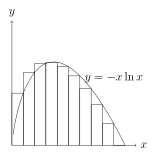
For \(x>0\) find \(\int x\ln x\,\mathrm{d}x\). By approximating the area corresponding to \(\int_{0}^{1}x\ln(1/x)\, \d x\) by \(n\) rectangles of equal width and with their top right-hand vertices on the curve \(y=x\ln(1/x)\), show that, as \(n\rightarrow\infty\), \[ \frac{1}{2}\left(1+\frac{1}{n}\right)\ln n-\frac{1}{n^{2}}\left[\ln\left(\frac{n!}{0!}\right)+\ln\left(\frac{n!}{1!}\right)+\ln\left(\frac{n!}{2!}\right)+\cdots+\ln\left(\frac{n!}{(n-1)!}\right)\right]\rightarrow\frac{1}{4}. \] {[}You may assume that \(x\ln x\rightarrow0\) as \(x\rightarrow0\).{]}
Solution: Integrating by parts we obtain: \begin{align*} \int x \ln x \, \d x &= [\frac12 x^2 \ln x] - \int \frac12x^2 \cdot \frac1x \d x \\ &= \frac12 x^2 \ln x - \frac14 x^2 + C \end{align*}