Problems
Filters
1531 problems found
2024 Paper 2 Q7
- Sketch the curve \(C_1\) with equation \[ \left(y^2 + (x-1)^2 - 1\right)\left(y^2 + (x+1)^2 - 1\right) = 0. \]
- Consider the curve \(C_2\) with equation
\[ \left(y^2 + (x-1)^2 - 1\right)\left(y^2 + (x+1)^2 - 1\right) = \tfrac{1}{16}. \]
- Show that the line \(y = k\) meets the curve \(C_2\) at points for which \[ x^4 + 2(k^2 - 2)x^2 + \left(k^4 - \tfrac{1}{16}\right) = 0. \] Hence determine the number of intersections between curve \(C_2\) and the line \(y = k\) for each positive value of \(k\).
- Determine whether the points on curve \(C_2\) with the greatest possible \(y\)-coordinate are further from, or closer to, the \(y\)-axis than those on curve \(C_1\).
- Show that it is not possible for both \(y^2 + (x-1)^2 - 1\) and \(y^2 + (x+1)^2 - 1\) to be negative, and deduce that curve \(C_2\) lies entirely outside curve \(C_1\).
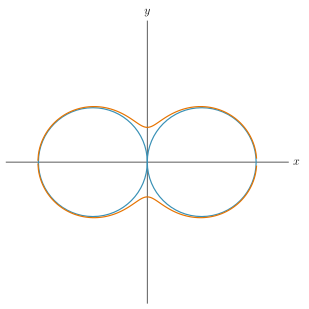
- Sketch the curves \(C_1\) and \(C_2\) on the same axes.
Solution:
- \(\,\)
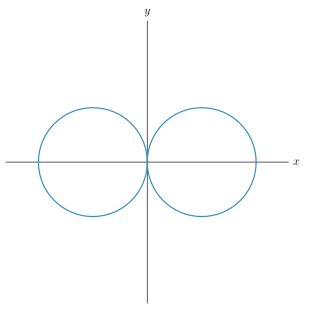
- Suppose \(y=k\) meets the curve \(C_2\) then \begin{align*} && \tfrac1{16} &= (k^2+(x-1)^2-1)(k^2+(x+1)^2-1) \\ &&&= (k^2+x^2-2x)(k^2+x^2+2x) \\ &&&= k^4+2k^2x^2+x^4-4x^2 \\ &&&= x^4+(2k^2-4)x^2+k^4 \\ \Rightarrow && 0 &= x^4+(2k^2-4)x^2+(k^4-\tfrac1{16}) \\ \\ && \Delta &= 4(k^2-2)^2 - 4 \cdot 1 \cdot (k^4-\tfrac1{16}) \\ &&&= 4(k^4-4k^2+4 - k^4 +\tfrac{1}{16}) \\ &&&= 16(1+\tfrac{1}{64} - k^2) \\ &&&= 16(\tfrac{65}{64} - k^2) \end{align*} Therefore if \(|k| < \frac{\sqrt{65}}{8}\) there are \(4\) intersections. If \(|k| = \frac{\sqrt{65}}{8}\) there are \(2\) intersections, otherwise there are \(0\).
- The greatest possible \(y\) value is \( \frac{\sqrt{65}}{8}\) and at this point \(x^2 = \frac{2(2-\frac{65}{64}}{2} =1 - \frac{1}{64} < 1\) so they are close to the \(y\)-axis.
- The regions where \(y^2+(x-1)^2-1 < 0\) and \(y^2+(x+1)^2-1 < 0\) is the interior of the two circles from the first part. However, since they don't overlap they can never both be negative. Therefore in our equation both are positive and therefore \(C_2\) is entirely outside \(C_1\)
- \(\,\)
2024 Paper 2 Q8
In this question, the following theorem may be used without proof. Let \(u_1, u_2, \ldots\) be a sequence of real numbers. If the sequence is
- bounded above, so \(u_n \leqslant b\) for all \(n\), where \(b\) is some fixed number
- and increasing, so \(u_n \leqslant u_{n+1}\) for all \(n\)
- By considering \((\sqrt{x_n} - \sqrt{y_n})^2\), show that \(y_{n+1} < x_{n+1}\), for \(n \geqslant 0\). Show further that, for \(n \geqslant 0\)
- \(x_{n+1} < x_n\)
- \(y_n < y_{n+1}\).
- Let \[ \mathrm{I}(p,q) = \int_0^{\infty} \frac{1}{\sqrt{(p^2 + x^2)(q^2 + x^2)}}\,\mathrm{d}x, \] where \(p\) and \(q\) are positive real numbers with \(q < p\). Show, using the substitution \(t = \frac{1}{2}\!\left(x - \dfrac{pq}{x}\right)\) in the integral \[ \int_{-\infty}^{\infty} \frac{1}{\sqrt{\left(\frac{1}{4}(p+q)^2 + t^2\right)(pq + t^2)}}\,\mathrm{d}t, \] that \[ \mathrm{I}(p,q) = \mathrm{I}\!\left(\mathrm{a}(p,q),\, \mathrm{g}(p,q)\right). \] Hence evaluate \(\mathrm{I}(x_0, y_0)\) in terms of \(M\).
2024 Paper 2 Q9
A long straight trench, with rectangular cross section, has been dug in otherwise horizontal ground. The width of the trench is \(d\) and its depth \(2d\). A particle is projected at speed \(v\), where \(v^2 = \lambda dg\), at an angle \(\alpha\) to the horizontal, from a point on the ground a distance \(d\) from the nearer edge of the trench. The vertical plane in which it moves is perpendicular to the trench.
- The particle lands on the base of the trench without first touching either of its sides.
- By considering the vertical displacement of the particle when its horizontal displacement is \(d\), show that \((\tan\alpha - \lambda)^2 < \lambda^2 - 1\) and deduce that \(\lambda > 1\).
- Show also that \((2\tan\alpha - \lambda)^2 > \lambda^2 + 4(\lambda - 1)\) and deduce that \(\alpha > 45^\circ\).
- Show that, provided \(\lambda > 1\), \(\alpha\) can always be chosen so that the particle lands on the base of the trench without first touching either of its sides.
2024 Paper 2 Q10
A triangular prism lies on a horizontal plane. One of the rectangular faces of the prism is vertical; the second is horizontal and in contact with the plane; the third, oblique rectangular face makes an angle \(\alpha\) with the horizontal. The two triangular faces of the prism are right angled triangles and are vertical. The prism has mass \(M\) and it can move without friction across the plane. A particle of mass \(m\) lies on the oblique surface of the prism. The contact between the particle and the plane is rough, with coefficient of friction \(\mu\).
- Show that if \(\mu < \tan\alpha\), then the system cannot be in equilibrium.
- Show that the magnitude, \(F\), of the frictional force between the particle and the prism is \[ F = \frac{m}{M+m}\left|(M+m)g\sin\alpha - P\cos\alpha\right|. \] Find a similar expression for the magnitude, \(N\), of the normal reaction between the particle and the prism.
- Hence show that the force \(P\) must satisfy \[ (M+m)g\tan(\alpha - \lambda) \leqslant P \leqslant (M+m)g\tan(\alpha + \lambda). \]
2024 Paper 2 Q11
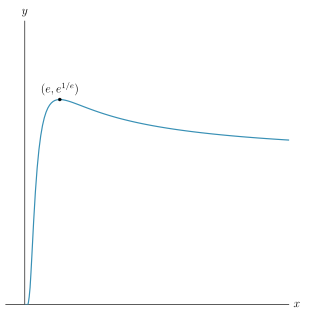
- Sketch a graph of \(y = x^{\frac{1}{x}}\) for \(x > 0\), showing the location of any turning points. Find the maximum value of \(n^{\frac{1}{n}}\), where \(n\) is a positive integer.
- The people to be tested are split into \(r\) groups of size \(k\), with \(k > 1\) and \(rk = N\).
- In every group, a sample from each person in that group is mixed into one large sample, which is then tested.
- If the enzyme is not present in the combined sample from a group, no further testing of the people in that group is needed.
- If the enzyme is present in the combined sample from a group, a second sample from each person in that group is tested separately.
- Find, in terms of \(N\), \(k\) and \(p\), the expected number of tests.
- Given that \(N\) is a multiple of \(3\), find the largest value of \(p\) for which it is possible to find an integer value of \(k\) such that \(k > 1\) and the expected number of tests is at most \(N\). Show that this value of \(p\) is greater than \(\frac{1}{4}\).
- Show that, if \(pk\) is sufficiently small, the expected number of tests is approximately \[ N\!\left(\frac{1}{k} + pk\right). \] In the case where \(p = 0.01\), show that choosing \(k = 10\) gives an expected number of tests which is only about \(20\%\) of \(N\).
Solution:
- \(\,\)
\begin{align*} && y & = x^{1/x} = \exp \left ( \tfrac1x \ln x \right ) \\ \Rightarrow && y' &= \exp \left ( \tfrac1x \ln x \right ) \cdot \left ( \frac{1}{x^2} - \frac{\ln x}{x^2} \right ) \\ &&&= \frac{\exp \left ( \tfrac1x \ln x \right ) }{x^2}(1 - \ln x) \\ y' =0: && x &= e \end{align*} Therefore the largest integer values will be \(2\) or \(3\). Comparing \((2^{\frac12})^6 = 8 < 9 = (3^{1/3})^6\) we see the maximum value of \(n^{1/n}\) where \(n\) is an integer is \(\sqrt[3]{3}\)
- The number of tests is \(r\) plus however many groups fail times \(k\). The probability of a group failing is \(g = 1-(1-p)^k\) and the number of failing groups is \(\sim B(r, g)\) so the expected number of additional groups is \(rg\) and the expected total number of tests is \[ \frac{N}{k} + N(1-(1-p)^k) \]
- \(\,\) \begin{align*} && N &\geq E = \frac{N}{k} + N(1-(1-p)^k) \\ \Rightarrow && 1 &\geq \frac{1}{k} + 1-(1-p)^k \\ \Rightarrow && (1-p)^k &\geq \frac1k \\ \Rightarrow && k \ln(1-p) &\geq - \ln k \\ \Rightarrow && \ln(1 - p) &\geq -\frac{1}{k} \ln k \geq -\frac13 \ln 3 \\ \Rightarrow && 1-p &\geq \frac{1}{\sqrt[3]{3}} \\ \Rightarrow && p &\leq 1-\frac{1}{\sqrt[3]{3}} \end{align*} (taking \(k=3\)) Claim: \(1 - \frac{1}{\sqrt[3]{3}} > \frac14\) Proof: This is equivalent to \(\sqrt[3]{3} > \frac43\) or \(81 > 4^3 = 64\) which is clearly true.
- If \(pk\) is small then \((1-p)^k \approx 1 - pk\) and so we obtain \(N \left ( \frac1k +pk \right)\) as required. If \(p = 0.01\) and \(k = 10\) then \(\frac{1}{10} + 0.01 \cdot 10 = 0.2\) so the expected number of tests is \(\sim 20\%\) of \(N\)
2024 Paper 2 Q12
In this question, you may use without proof the results \[ \sum_{i=1}^{n} i^2 = \tfrac{1}{6}n(n+1)(2n+1) \quad \text{and} \quad \sum_{i=1}^{n} i^3 = \tfrac{1}{4}n^2(n+1)^2. \] Throughout the question, \(n\) and \(k\) are integers with \(n \geqslant 3\) and \(k \geqslant 2\).
- In a game, \(k\) players, including Ada, are each given a random whole number from \(1\) to \(n\) (that is, for each player, each of these numbers is equally likely and assigned independently of all the others). A player wins the game if they are given a smaller number than all the other players, so there may be no winner in this game. Find an expression, in terms of \(n\), \(k\) and \(a\), for the probability that Ada is given number \(a\), where \(1 \leqslant a \leqslant n-1\), and all the other players are given larger numbers. Hence show that, if \(k = 4\), the probability that there is a winner in this game is \[ \frac{(n-1)^2}{n^2}\,. \]
- In a second game, \(k\) players, including Ada and Bob, are each given a random whole number from \(1\) to \(n\). A player wins the game if they are given a smaller number than all the other players or if they are given a larger number than all the other players, so it is possible for there to be zero, one or two winners in this game. Find an expression, in terms of \(n\), \(k\) and \(d\), for the probability that Ada is given number \(a\) and Bob is given number \(a + d + 1\), where \(1 \leqslant d \leqslant n-2\) and \(1 \leqslant a \leqslant n - d - 1\), and all the other players are given numbers greater than \(a\) and less than \(a + d + 1\). Hence show that, if \(k = 4\), the probability that there are two winners in this game is \[ \frac{(n-2)(n-1)^2}{n^3}\,. \] If \(k = 4\), what is the minimum value of \(n\) for which there are more likely to be exactly two winners than exactly one winner in this game?
Solution:
- Suppose Ada is given \(a\), then she wins if the other \(k-1\) players all get a number between \(a+1\) and \(n\). Since each of these choices are independent, this occurs with probability: \begin{align*} && \mathbb{P}(\text{Ada wins with }a) &= \left ( \frac{n-a}{n} \right)^{k-1} \\ \\ && \mathbb{P}(\text{Ada wins}) &= \sum_{a=1}^{n-1} \mathbb{P}(\text{Ada wins with }a) \mathbb{P}(\text{Ada has }a) \\ &&&= \sum_{a=1}^{n-1}\frac{1}{n}\left ( \frac{n-a}{n} \right)^{3}\\ &&&= \frac{1}{n^4} \sum_{a=1}^{n-1} (n-a)^3 \\ &&&= \frac{1}{n^4} \sum_{a=1}^{n-1} a^3 \\ &&&= \frac{1}{n^4} \tfrac14(n-1)^2n^2 \\ &&&= \frac{(n-1)^2}{4n^2} \end{align*} Since each the game is symmetric, each player is equally likely to win, therefore the probability anyone wins is \(\displaystyle \frac{(n-1)^2}{n^2}\)
- The probability that Ada gets \(a\), Bob gets \(a+d+1\) and the other players are in between is \begin{align*} && \mathbb{P}(\text{event}) &= \mathbb{P}(\text{Ada gets }a) \mathbb{P}(\text{Bob gets }a+d+1) \mathbb{P}(\text{everyone else between}) \\ &&&= \frac1{n^2} \cdot \left ( \frac{d}{n} \right) ^{k-2} \end{align*} Therefore the probability that Ada and Bob jointly win is \begin{align*} && \mathbb{P}(\text{Ada and Bob win}) &= \sum_{d=1}^{n-2} \sum_{a=1}^{n-d-1} \frac{1}{n^4} d^2 \\ &&&= \frac{1}{n^4} \sum_{d=1}^{n-2} (n-1-d) d^2 \\ &&&= \frac{n-1}{n^4} \frac{(n-2)(n-1)(2n-3)}{6} - \frac{1}{n^4} \frac{(n-2)^2(n-1)^2}{4} \\ &&&= \frac{(n-1)^2(n-2)}{12n^4} \left ( 2(2n-3)-3(n-2) \right) \\ &&&= \frac{(n-1)^2(n-2)}{12n^3} \\ \end{align*} There are \(4\) players so there are \(4\) ways to choose the lowest player and \(3\) remaining ways to choose the highest, so we get \(\displaystyle \frac{(n-2)(n-1)^2}{n^3}\) probability of a winner happening. The probability of there being a highest winner is the same as the probability of there being a lowest winner (both \(\frac{(n-1)^2}{n^2}\)) and the probability of there being exactly one winner is therefore \begin{align*} && P_1 &= P_{\geq1}-P_2+P_{\geq1}-P_2 \\ \end{align*} this is less than \(P_2\) iff \begin{align*} && P_{\geq1}+P_{\geq1}-2P_2 &< P_2 \\ \Leftrightarrow && 2P_{\geq 1} & < 3P_2 \\ \Leftrightarrow && \frac{2(n-1)^2}{n^2} &< \frac{3(n-1)^2(n-2)}{n^3} \\ \Leftrightarrow && 2n&<3(n-2) \\ \Leftrightarrow && 6 &< n \end{align*} So \(n = 7\)
2024 Paper 3 Q1
Throughout this question, \(N\) is an integer with \(N \geqslant 1\) and \(S_N = \displaystyle\sum_{r=1}^{N} \frac{1}{r^2}\). You may assume that \(\displaystyle\lim_{N\to\infty} S_N\) exists and is equal to \(\frac{1}{6}\pi^2\).
- Show that \[\frac{1}{r+1} - \frac{1}{r} + \frac{1}{r^2} = \frac{1}{r^2(r+1)}.\] Hence show that \[\sum_{r=1}^{N} \frac{1}{r^2(r+1)} = \sum_{r=1}^{N} \frac{1}{r^2} - 1 + \frac{1}{N+1}.\] Show further that \(\displaystyle\sum_{r=1}^{\infty} \frac{1}{r^2(r+1)} = \frac{1}{6}\pi^2 - 1\).
- Find \(\displaystyle\sum_{r=1}^{N} \frac{1}{r^2(r+1)(r+2)}\) in terms of \(S_N\), and hence evaluate \(\displaystyle\sum_{r=1}^{\infty} \frac{1}{r^2(r+1)(r+2)}\).
- Show that \[\sum_{r=1}^{\infty} \frac{1}{r^2(r+1)^2} = \sum_{r=1}^{\infty} \frac{2}{r^2(r+1)} - 1.\]
Solution:
- \(\,\) \begin{align*} && \frac1{r+1} - \frac1r + \frac1{r^2} &= \frac{-1}{r(r+1)} + \frac{1}{r^2} \\ &&&= \frac{r+1-r}{r^2(r+1)} \\ &&&= \frac{1}{r^2(r+1)} \end{align*} Therefore \begin{align*} && \sum_{r=1}^N \frac1{r^2(r+1)} &= \sum_{r=1}^N \left (\frac1{r+1} - \frac1r + \frac1{r^2} \right) \\ &&&= \sum_{r=1}^N \left (\frac1{r+1} - \frac1r\right) + \sum_{r=1}^N \frac1{r^2} \\ &&&=\frac{1}{N+1} - 1 + \sum_{r=1}^N \frac1{r^2} \\ \end{align*} therefore \begin{align*} && \sum_{r=1}^{\infty} \frac{1}{r^2(r+1)} &= \lim_{N \to \infty } \sum_{r=1}^{N} \frac{1}{r^2(r+1)} \\ &&&= \lim_{N \to \infty } \left (\frac{1}{N+1} - 1 + \sum_{r=1}^N \frac1{r^2} \right) \\ &&&= -1 +\lim_{N \to \infty } \sum_{r=1}^N \frac1{r^2} \\ &&&= -1 + \sum_{r=1}^\infty \frac1{r^2} \\ &&&= \frac{\pi^2}{6}-1 \end{align*}
- Note that \begin{align*} && \frac{1}{r^2(r+1)(r+2)} &= \frac{Ar+B}{r^2} + \frac{C}{r+1} + \frac{D}{r+2} \\ &&&= \frac{1}{2r^2} + \frac{1}{r+1} - \frac{1}{4(r+2)} - \frac{3}{4r} \end{align*} So \begin{align*} && \sum_{r=1}^N \frac{1}{r^2(r+1)(r+2)} &= \sum_{r=1}^N \left ( \frac{1}{2r^2} + \frac{1}{r+1} - \frac{1}{4(r+2)} - \frac{3}{4r} \right ) \\ &&&= \frac12 \sum_{r=1}^N \frac{1}{r^2} + \frac{1}{2} - \frac14 \cdot \frac1{3} - \frac34 \frac11 + \\ &&& \quad \quad \quad + \frac13 - \frac14\frac14 - \frac34\frac12 + \\ &&& \quad \quad \quad + \frac14 - \frac14\frac15 - \frac34\frac13 + \\ &&&\quad \quad \quad+ \cdots + \\ &&&\quad \quad \quad + \frac1{N+1} - \frac14\frac1{N+2} - \frac34\frac1N \\ &&&= \frac12 \sum_{r=1}^N \frac{1}{r^2} +\frac14\frac12 - \frac34\frac11-\frac14\frac1{N+2}+\frac34 \frac1{N+1} \\ \\ \Rightarrow && \sum_{r=1}^{\infty} \frac{1}{r^2(r+1)(r+2)} &= \lim_{N \to \infty} \left [ \frac12 \sum_{r=1}^N \frac{1}{r^2} +\frac14\frac12 - \frac34\frac11-\frac14\frac1{N+2}+\frac34 \frac1{N+1}\right] \\ &&&= \frac{\pi^2}{12} -\frac58 \end{align*}
- Notice that \(\frac{1}{r^2(r+1)^2} - \frac{2}{r^2(r+1)} = \frac{1-2(r+1)}{r^2(r+1)^2} = \frac{-1-2r}{r^2(r+1)^2} = \frac{1}{(r+1)^2} - \frac{1}{r^2}\) and so \begin{align*} && \sum_{r=1}^N \frac{1}{r^2(r+1)^2} &= \sum_{r=1}^N \left ( \frac{2}{r^2(r+1)} +\frac{1}{(r+1)^2} - \frac{1}{r^2} \right) \\ &&&= \sum_{r=1}^N \frac{2}{r^2(r+1)} +\frac{1}{(N+1)^2} - 1 \\ \end{align*} and the result follows as \(N \to \infty\)
2024 Paper 3 Q2
- Solve the inequalities
- \(\sqrt{4x^2 - 8x + 64} \leqslant |x+8|\,\),
- \(\sqrt{4x^2 - 8x + 64} \leqslant |3x-8|\,\).
- Let \(\mathrm{f}(x) = \sqrt{4x^2 - 8x + 64} - 2(x-1)\). Show, by considering \(\bigl(\sqrt{4x^2 - 8x + 64} + 2(x-1)\bigr)\mathrm{f}(x)\) or otherwise, that \(\mathrm{f}(x) \to 0\) as \(x \to \infty\).
- Sketch \(y = \sqrt{4x^2 - 8x + 64}\) and \(y = 2(x-1)\) on the same axes.
- Find a value of \(m\) and the corresponding value of \(c\) such that the solution set of the inequality \[\sqrt{4x^2 - 5x + 4} \leqslant |mx + c|\] is \(\{x : x \geqslant 3\}\).
- Find values of \(p\), \(q\), \(m\) and \(c\) such that the solution set of the inequality \[|x^2 + px + q| \leqslant mx + c\] is \(\{x : -5 \leqslant x \leqslant 1\} \cup \{x : 5 \leqslant x \leqslant 7\}\).
2024 Paper 3 Q3
Throughout this question, consider only \(x > 0\).
- Let
\[\mathrm{g}(x) = \ln\left(1 + \frac{1}{x}\right) - \frac{x+c}{x(x+1)}\]
where \(c \geqslant 0\).
- Show that \(y = \mathrm{g}(x)\) has positive gradient for all \(x > 0\) when \(c \geqslant \frac{1}{2}\).
- Find the values of \(x\) for which \(y = \mathrm{g}(x)\) has negative gradient when \(0 \leqslant c < \frac{1}{2}\).
- It is given that, for all \(c > 0\), \(\mathrm{g}(x) \to -\infty\) as \(x \to 0\).
Sketch, for \(x > 0\), the graphs of
\[y = \mathrm{g}(x)\]
in the cases
- \(c = \frac{3}{4}\),
- \(c = \frac{1}{4}\).
- The function \(\mathrm{f}\) is defined as
\[\mathrm{f}(x) = \left(1 + \frac{1}{x}\right)^{x+c}.\]
Show that, for \(x > 0\),
- \(\mathrm{f}\) is a decreasing function when \(c \geqslant \frac{1}{2}\);
- \(\mathrm{f}\) has a turning point when \(0 < c < \frac{1}{2}\);
- \(\mathrm{f}\) is an increasing function when \(c = 0\).
2024 Paper 3 Q4
- Show that if the acute angle between straight lines with gradients \(m_1\) and \(m_2\) is \(45^\circ\), then \[\frac{m_1 - m_2}{1 + m_1 m_2} = \pm 1.\]
- If \(p \neq q\), show that the tangents to the curve \(C\) at the points with \(x\)-coordinates \(p\) and \(q\) meet at a point with \(x\)-coordinate \(\frac{1}{2}(p+q)\). Find the \(y\)-coordinate of this point in terms of \(p\) and \(q\). Show further that any two tangents to the curve \(C\) which are at \(45^\circ\) to each other meet on the curve \((y+3a)^2 = 8a^2 + x^2\).
- Show that the acute angle between any two tangents to the curve \(C\) which meet on the curve \((y+7a)^2 = 48a^2 + 3x^2\) is constant. Find this acute angle.
2024 Paper 3 Q5
In this question, \(\mathbf{M}\) and \(\mathbf{N}\) are non-singular \(2 \times 2\) matrices. The \emph{trace} of the matrix \(\mathbf{M} = \begin{pmatrix} a & b \\ c & d \end{pmatrix}\) is defined as \(\operatorname{tr}(\mathbf{M}) = a + d\).
- Prove that, for any two matrices \(\mathbf{M}\) and \(\mathbf{N}\), \(\operatorname{tr}(\mathbf{MN}) = \operatorname{tr}(\mathbf{NM})\) and derive an expression for \(\operatorname{tr}(\mathbf{M}+\mathbf{N})\) in terms of \(\operatorname{tr}(\mathbf{M})\) and \(\operatorname{tr}(\mathbf{N})\).
- Show that \[\frac{1}{\det \mathbf{M}} \frac{\mathrm{d}}{\mathrm{d}t}(\det \mathbf{M}) = \operatorname{tr}\!\left(\mathbf{M}^{-1} \frac{\mathrm{d}\mathbf{M}}{\mathrm{d}t}\right).\]
- In this part, matrix \(\mathbf{M}\) satisfies the differential equation \[\frac{\mathrm{d}\mathbf{M}}{\mathrm{d}t} = \mathbf{MN} - \mathbf{NM},\] where the entries in matrix \(\mathbf{N}\) are also functions of \(t\). Show that \(\det \mathbf{M}\), \(\operatorname{tr}(\mathbf{M})\) and \(\operatorname{tr}(\mathbf{M}^2)\) are independent of \(t\). In the case \(\mathbf{N} = \begin{pmatrix} t & t \\ 0 & t \end{pmatrix}\), and given that \(\mathbf{M} = \begin{pmatrix} A & B \\ C & D \end{pmatrix}\) when \(t = 0\), find \(\mathbf{M}\) as a function of \(t\).
- In this part, matrix \(\mathbf{M}\) satisfies the differential equation \[\frac{\mathrm{d}\mathbf{M}}{\mathrm{d}t} = \mathbf{MN},\] where the entries in matrix \(\mathbf{N}\) are again functions of \(t\). The trace of \(\mathbf{M}\) is non-zero and independent of \(t\). Is it necessarily true that \(\operatorname{tr}(\mathbf{N}) = 0\)?
2024 Paper 3 Q6
- A particle moves in two-dimensional space. Its position is given by coordinates \((x, y)\) which satisfy
\[\frac{\mathrm{d}x}{\mathrm{d}t} = -x + 3y + u\]
\[\frac{\mathrm{d}y}{\mathrm{d}t} = x + y + u\]
where \(t\) is the time and \(u\) is a function of time. At time \(t = 0\), the particle has position \((x_0,\, y_0)\).
- By considering \(\dfrac{\mathrm{d}x}{\mathrm{d}t} - \dfrac{\mathrm{d}y}{\mathrm{d}t}\), show that if the particle is at the origin \((0,0)\) at some time \(t > 0\), then it is necessary that \(x_0 = y_0\).
- Given that \(x_0 = y_0\), find a constant value of \(u\) that ensures that the particle is at the origin at a time \(t = T\), where \(T > 0\).
- A particle whose position in three-dimensional space is given by co-ordinates \((x, y, z)\) moves with time \(t\) such that
\[\frac{\mathrm{d}x}{\mathrm{d}t} = 4y - 5z + u\]
\[\frac{\mathrm{d}y}{\mathrm{d}t} = x - 2z + u\]
\[\frac{\mathrm{d}z}{\mathrm{d}t} = x - 2y + u\]
where \(u\) is a function of time. At time \(t = 0\), the particle has position \((x_0,\, y_0,\, z_0)\).
- Show that, if the particle is at the origin \((0,0,0)\) at some time \(t > 0\), it is necessary that \(y_0\) is the mean of \(x_0\) and \(z_0\).
- Show further that, if the particle is at the origin \((0,0,0)\) at some time \(t > 0\), it is necessary that \(x_0 = y_0 = z_0\).
- Given that \(x_0 = y_0 = z_0\), find a constant value of \(u\) that ensures that the particle is at the origin at a time \(t = T\), where \(T > 0\).
Solution:
- \(\,\) \begin{align*} && \frac{\d x}{\d t} - \frac{\d y}{\d t} &= -2x + 2y \\ &&&= -2(x-y) \\ \Rightarrow && \dot{z} &= -2z \tag{\(z = x-y\)} \\ \Rightarrow && z &= Ae^{-2t} \\ z = 0, t : && A &= 0 \\ \Rightarrow && z &= 0 \quad \forall t \\ \Rightarrow && x &= y \quad \forall t \\ \Rightarrow && x_0 &= y_0 \end{align*}
- Since \(x = y\) for all \(t\) our equation can we written as \(\frac{\d x}{\d t} = 2x + u\). This has solution \(x = Ae^{2t} - \frac{u}{2}\) we also have \begin{align*} t = 0: && x_0 &= A - \frac{u}{2} \\ t = T: && 0 &= Ae^{2T} - \frac{u}{2} \\ \Rightarrow && x_0 &= \frac{u}{2} - e^{-2T}\frac{u}{2} \\ \Rightarrow && u &= \frac{2x_0}{1-e^{-2T}} \end{align*}
- Let \(w = y - \frac12(x+z)\) then \begin{align*} && \dot{w} &= \dot{y} - \tfrac12(\dot{x}+\dot{z}) \\ &&&= (x-2z+u) - \tfrac12(4y-5z+u+x-2y+u) \\ &&&= -y + \tfrac12(x+z) \\ &&&= -w \\ \Rightarrow && w &= Ae^{-t} \\ \text{at origin}: && w &= 0 \\ \Rightarrow && y &= \tfrac12(x+z) \end{align*}
- We now have \(\dot{x} = 2x+2z-5z+u = 2x-3z+u\) and \(\dot{z} = x - x- z +u = - z+u\) so in particular \((x - z)' = 2(x-z)\) or \(x-z = Ae^{2t}\) and since we hit the origin \(x = z\) for all \(t\) and so \(y = x = z\) for all \(t\).
- Notice we now have \(\dot{x} = -x + u\) or \(x = Ae^{-t} + u\) \begin{align*} t = 0: && x_0 &= A + u \\ t = T: && 0 &= Ae^{-T} + u \\ \Rightarrow && x_0 &= u-e^{T} u \\ \Rightarrow && u &= \frac{x_0}{1-e^{T}} \end{align*}
2024 Paper 3 Q7
In this question, you need not consider issues of convergence. For positive integer \(n\) let \[\mathrm{f}(n) = \frac{1}{n+1} + \frac{1}{(n+1)(n+2)} + \frac{1}{(n+1)(n+2)(n+3)} + \ldots\] and \[\mathrm{g}(n) = \frac{1}{n+1} - \frac{1}{(n+1)(n+2)} + \frac{1}{(n+1)(n+2)(n+3)} - \ldots\,.\]
- Show, by considering a geometric series, that \(0 < \mathrm{f}(n) < \dfrac{1}{n}\).
- Show, by comparing consecutive terms, that \(0 < \mathrm{g}(n) < \dfrac{1}{n+1}\).
- Show, for positive integer \(n\), that \((2n)!\,\mathrm{e} - \mathrm{f}(2n)\) and \(\dfrac{(2n)!}{\mathrm{e}} + \mathrm{g}(2n)\) are both integers.
- Show that if \(q\,\mathrm{e} = \dfrac{p}{\mathrm{e}}\) for some positive integers \(p\) and \(q\), then \(q\,\mathrm{f}(2n) + p\,\mathrm{g}(2n)\) is an integer for all positive integers \(n\).
- Hence show that the number \(\mathrm{e}^2\) is irrational.
2024 Paper 3 Q8
- Explain why the equation \((y - x + 3)(y + x - 5) = 0\) represents a pair of straight lines with gradients \(1\) and \(-1\). Show further that the equation \[y^2 - x^2 + py + qx + r = 0\] represents a pair of straight lines with gradients \(1\) and \(-1\) if and only if \(p^2 - q^2 = 4r\).
- Explain why the coordinates of any point which lies on both of the curves \(C_1\) and \(C_2\) also satisfy the equation \[y^2 + 2sy + s(s+1) - x + k(y - x^2) = 0\] for any real number \(k\). Given that \(s\) is such that \(C_1\) and \(C_2\) intersect at four distinct points, show that choosing \(k = 1\) gives an equation representing a pair of straight lines, with gradients \(1\) and \(-1\), on which all four points of intersection lie.
- Show that if \(C_1\) and \(C_2\) intersect at four distinct points, then \(s < -\frac{3}{4}\).
- Show that if \(s < -\frac{3}{4}\), then \(C_1\) and \(C_2\) intersect at four distinct points.
2024 Paper 3 Q9
The origin \(O\) of coordinates lies on a smooth horizontal table and the \(x\)- and \(y\)-axes lie in the plane of the table. A smooth sphere \(A\) of mass \(m\) and radius \(r\) is at rest on the table with its lowest point at the origin. A second smooth sphere \(B\) has the same mass and radius and also lies on the table. Its lowest point has \(y\)-coordinate \(2r\sin\alpha\), where \(\alpha\) is an acute angle, and large positive \(x\)-coordinate. Sphere \(B\) is now projected parallel to the \(x\)-axis, with speed \(u\), so that it strikes sphere \(A\). The coefficient of restitution in this collision is \(\frac{1}{3}\).
- Show that, after the collision, sphere \(B\) moves with velocity \[\begin{pmatrix} -\frac{1}{3}u\bigl(1 + 2\sin^2\alpha\bigr) \\ \frac{2}{3}u\sin\alpha\cos\alpha \end{pmatrix}.\]
- Show further that the lowest point of sphere \(B\) crosses the \(y\)-axis at the point \((0, Y)\), where \(Y = 2r(\cos\alpha\tan\beta + \sin\alpha)\) and \[\tan\beta = \frac{2\sin\alpha\cos\alpha}{1 + 2\sin^2\alpha}.\]
- Show that, if \(h > Y + 2r\sec\beta\), sphere \(B\) will not strike sphere \(C\) in its motion after the collision with sphere \(A\).
- Show that \(Y < 2r\sec\beta\). Hence show that sphere \(B\) will not strike sphere \(C\) for any value of \(\alpha\), if \(h > \dfrac{8r}{\sqrt{3}}\).