Problems
Filters
1531 problems found
2016 Paper 3 Q4
- By considering \(\displaystyle \frac1{1+ x^r} - \frac1{1+ x^{r +1}}\) for \(\vert x \vert \ne 1\), simplify \[ \sum_{r=1}^N \frac{x^r}{(1+x^r)(1+x^{r+1})} \] Show that, for \(\vert x \vert <1\), \[ \sum_{r=1}^\infty \frac{x^r}{(1+x^r)(1+x^{r+1})} = \frac x {1-x^2} \]
- Deduce that \[ \sum_{r=1}^\infty \textrm{sech}(ry)\textrm{sech}((r + 1)y) = 2\e^{-y} \textrm{cosech}(2 y) \] for \(y > 0\). Hence simplify \[ \sum_{r=-\infty}^\infty \textrm{sech}(ry) \textrm{sech}((r + 1)y) \] for \(y>0\).
Solution:
- \(\,\) \begin{align*} && \frac{1}{1+x^r} - \frac{1}{1+x^{r+1}} &= \frac{1+x^{r+1}-1-x^r}{(1+x^r)(1+x^{r+1})} \\ &&&= \frac{x^r(x-1)}{(1+x^r)(1+x^{r+1})} \\ \\ && \sum_{r=1}^N \frac{x^r}{(1+x^r)(1+x^{r+1})} &= \sum_{r=1}^N \frac{1}{x-1} \left ( \frac{1}{1+x^r} - \frac{1}{1+x^{r+1}}\right) \\ &&&= \frac{1}{x-1} \Bigg ( \frac{1}{1+x} + \cdots \\ &&& \qquad \qquad \quad - \frac{1}{1+x^2} + \frac{1}{1+x^2} + \cdots \\ &&& \qquad \qquad \quad - \frac{1}{1+x^3} + \frac{1}{1+x^3} + \cdots \\ &&& \qquad \qquad \quad - \cdots \\ &&& \qquad \qquad \quad - \frac{1}{1+x^{N+1}} \Bigg ) \\ &&&= \frac{1}{x-1} \left (\frac{1}{1+x} - \frac{1}{1+x^{N+1}} \right) \\ \\ && \sum_{r=1}^{\infty} \frac{x^r}{(1+x^r)(1+x^{r+1})} &= \lim_{N\to \infty} \frac{1}{x-1} \left (\frac{1}{1+x} - \frac{1}{1+x^{N+1}} \right) \\ &&&= \frac{1}{x-1} \left ( \frac{1}{1+x} - 1\right) \\ &&&= \frac{1}{x-1} \left ( \frac{-x}{1+x} \right) \\ &&&= \frac{x}{1-x^2} \end{align*}
- \(\,\) \begin{align*} && \sum_{r=1}^\infty \textrm{sech}(ry)\textrm{sech}((r + 1)y) &= \sum_{r=1}^\infty \frac{4}{(e^{ry}+e^{-ry})(e^{(r+1)y}+e^{-(r+1)y})} \\ &&&=\sum_{r=1}^\infty \frac{4e^{-(2r+1)y}}{(1+e^{-2ry})(1+e^{-2(r+1)y})} \\ x = e^{-2y}: &&&= \frac{4e^{-y}e^{-2y}}{1-e^{-4y}} \\ &&&= \frac{4e^{-y}e^{-2y}}{e^{-2y}(e^{2y}-e^{-2y})} \\ &&&=2e^{-y}\textrm{cosech}(2y) \end{align*} \begin{align*} && \sum_{r=-\infty}^\infty \textrm{sech}(ry) \textrm{sech}((r + 1)y) &= \sum_{r=1}^\infty \textrm{sech}(ry) \textrm{sech}((r + 1)y) + \sum_{r=-\infty}^0 \textrm{sech}(ry) \textrm{sech}((r + 1)y) \\ &&&= 2e^{-y}\textrm{cosech}(2y) + \sum_{r=0}^\infty \textrm{sech}(-ry) \textrm{sech}(-(r-1)y) \\ &&&= 2e^{-y}\textrm{cosech}(2y) + \sum_{r=0}^\infty \textrm{sech}((r-1)y) \textrm{sech}(ry) \\ &&&= 4e^{-y}\textrm{cosech}(2y) + \textrm{sech}(y) + \textrm{sech}(-y) \\ &&&= 4e^{-y}\textrm{cosech}(2y)+2\textrm{sech}(y) \\ &&&= 4e^{-y} \frac12 \textrm{sech}(y) \textrm{cosech}(y) + 2 \textrm{sech}(y) \\ &&&= 2\textrm{sech}(y) \left ( e^{-y} \textrm{cosech}(y)+1 \right) \\ &&&= 2\textrm{sech}(y) \left ( \frac{2}{e^{2y}-1} + 1 \right) \\ &&&= 2\textrm{sech}(y) \left ( \frac{e^{2y}+1}{e^{2y}-1} \right) \\ &&&= 2 \textrm{cosech}(y) \end{align*}
2016 Paper 3 Q5
- By considering the binomial expansion of \((1+x)^{2m+1}\), prove that \[ \binom{ 2m \! +\! 1}{ m} < 2^{2m}\,, \] for any positive integer \(m\).
- For any positive integers \(r\) and \(s\) with \(r< s\), \(P_{r,s}\) is defined as follows: \(P_{r,s}\) is the product of all the prime numbers greater than \(r\) and less than or equal to \(s\), if there are any such primes numbers; if there are no such primes numbers, then \(P_{r,s}=1\,\). For example, \(P_{3,7}=35\), \(P_{7,10}=1\) and \(P_{14,18}=17\). Show that, for any positive integer \(m\), \(P_{m+1\,,\, 2m+1} \) divides \(\displaystyle \binom{ 2m \! +\! 1}{ m} \,,\) and deduce that \[ P_{m+1\,,\, 2m+1} < 2^{2m} \,. \]
- Show that, if \(P_{1,k} < 4^k\) for \(k = 2\), \(3\), \(\ldots\), \(2m\), then \( P_{1,2m+1} < 4^{2m+1}\,\).
- Prove that \(\P_{1,n} < 4^n\) for \(n\ge2\).
Solution:
- Notice that \((1+x)^{2m+1} = 1+\binom{2m+1}{1}x+\cdots + \binom{2m+1}{m}x^{m} + \binom{2m+1}{m+1} + \cdots\). Notice also that \(\binom{2m+1}{m} = \binom{2m+1}{m+1}\). Therefore evaluating at \(x = 1\), we see \(2^{2m+1} > \binom{2m+1}{m} + \binom{2m+1}{m+1} = 2 \binom{2m+1}{m} \Rightarrow \binom{2m+1}{m} < 2^{2m}\)
- Each prime dividing \(P_{m+1, 2m+1}\) divides the numerator of \(\binom{2m+1}{m}\) since it appears in \((2m+1)!\), but not the denominator, since they wont appear in \(m!\) or \((m+1)!\), and since they are prime they have to appear to divide it. Therefore the must divide \(\binom{2m+1}{m}\) and therefore \(P_{m+1,2m+1}\) must divide that binomail coefficient. Since \(a \mid b \Rightarrow a \leq b\) we must have \(P_{m+1, 2m+1} \leq \binom{2m+1}{m} < 2^{2m}\)
- Since \begin{align*} P_{1,2m+1} &= P_{1,m+1}P_{m+1, 2m+1} \tag{split into primes below \(m+1\) and abvoe} \\ &< 4^{m+1}P_{m+1,2m+1} \tag{use the condition from the question}\\ &<4^{m+1}2^{2m} \tag{use our inequality} \\ &= 4^{2m+1} \end{align*}
- We proceed by (strong) induction. Base case: (\(n = 2\)): \(P_{1,2} = 2 < 4^2 =16\) Suppose it is true for all \(k=2,3,\cdots,2m\) then it is true for \(k=2m+1\) by the previous part of the question. However it is also true for \(k=2m+2\), since that can never be prime (as n is now an even number bigger than 2). Therefore by the principle of mathematical induction it is true for all \(n\).
2016 Paper 3 Q6
Show, by finding \(R\) and \(\gamma\), that \(A \sinh x + B\cosh x \) can be written in the form \(R\cosh (x+\gamma)\) if \(B>A>0\). Determine the corresponding forms in the other cases that arise, for \(A>0\), according to the value of \(B\). Two curves have equations \(y = \textrm{sech} x\) and \(y = a\tanh x + b\,\), where \(a>0\).
- In the case \(b>a\), show that if the curves intersect then the \(x\)-coordinates of the points of intersection can be written in the form \[ \pm\textrm{arcosh} \left( \frac 1 {\sqrt{b^2-a^2}}\right) - {\rm artanh \,} \frac a b .\]
- Find the corresponding result in the case \(a>b>0\,\).
- Find necessary and sufficient conditions on \(a\) and \(b\) for the curves to intersect at two distinct points.
- Find necessary and sufficient conditions on \(a\) and \(b\) for the curves to touch and, given that they touch, express the \(y\)-coordinate of the point of contact in terms of \(a\).
Solution: \begin{align*} && R\cosh(x + \gamma) &=R \cosh x \cosh \gamma + R \sinh x \sinh \gamma \\ \Rightarrow && R \cosh \gamma &= B \\ && R \sinh \gamma &= A \\ \Rightarrow && R^2 &= B^2 - A^2 \\ \Rightarrow && \tanh \gamma &= \frac{A}{B} \\ \end{align*} Therefore it is possible, by writing \(R = \sqrt{B^2-A^2}\) and \(\gamma = \textrm{artanh} \left ( \frac{A}{B} \right)\). This works as long as \(|B| > A > 0\). Supposing \(A >|B| \), try \(S \sinh (x + \delta) = S \sinh x \cosh \delta +S \cosh x \sinh \delta\) \begin{align*} && S \cosh \delta &= A \\ && -S \sinh \delta &= B \\ \Rightarrow && S^2 &= A^2 - B^2 \\ \Rightarrow && \tanh \delta &= \frac{B}{A} \\ \end{align*} Therefore in this case we can write \(\sqrt{A^2-B^2} \sinh \left (x + \tanh^{-1} \left ( \frac{B}{A} \right) \right)\) If \(A = \pm B > 0\) we can we have \(A \sinh x + B \cosh x = \pm Ae^{\pm x}\)
- Suppose \(y \cosh x = 1\) and \(y \cosh x = a \sinh x +b \cosh x\) so \begin{align*} && 1 & = a \sinh x + b \cosh x \\ &&&= \sqrt{b^2-a^2} \cosh(x + \textrm{artanh} \frac{a}{b} ) \\ \Rightarrow && x + \textrm{artanh} \frac{a}{b} &= \pm \textrm{arcosh} \left ( \frac{1}{\sqrt{b^2-a^2}} \right) \\ \Rightarrow && x &= \pm \textrm{arcosh} \left ( \frac{1}{\sqrt{b^2-a^2}} \right) -\textrm{artanh} \frac{a}{b} \end{align*}
- If \( a > b > 0\) we have \begin{align*} && 1 & = \sqrt{a^2-b^2} \sinh \left ( x - \textrm{artanh} \frac{b}{a} \right) \\ \Rightarrow && x &= \textrm{arsinh} \left ( \frac{1}{\sqrt{a^2-b^2}} \right) + \textrm{artanh} \left ( \frac{b}{a} \right) \end{align*}
- To intersect at distinct points we must have \(b > a\) and \(\textrm{arcosh} \left ( \frac{1}{\sqrt{b^2-a^2}} \right) \neq 0\) which is always true.
- For the curves to touch, we need them to intersect and have matching derivatives, ie \begin{align*} && -\tanh x \cdot \textrm{sech}x &= a\textrm{sech}^2 x \\ \Rightarrow && 0 &= \textrm{sech}^2 x (a + \sinh x) \\ \Rightarrow && x &= -\textrm{arsinh} \, a\\ \Rightarrow && \sinh x &= - a\\ \Rightarrow &&\cosh x &= \sqrt{1 + a^2} \\ \end{align*} So if the curves touch, we must have \(1 = -a^2+b\sqrt{1+a^2} \Rightarrow b = \sqrt{1+a^2}\) and since this does work it is a necessary and sufficient condition. We will also have the \(y\) coordinate is \(\frac{1}{\sqrt{1+a^2}}\)
2016 Paper 3 Q7
Let \(\omega = \e^{2\pi {\rm i}/n}\), where \(n\) is a positive integer. Show that, for any complex number \(z\), \[ (z-1)(z-\omega) \cdots (z - \omega^{n-1}) = z^n -1\,. \] The points \(X_0, X_1, \ldots\, X_{n-1}\) lie on a circle with centre \(O\) and radius 1, and are the vertices of a regular polygon.
- The point \(P\) is equidistant from \(X_0\) and \(X_1\). Show that, if \(n\) is even, \[ |PX_0| \times |PX_1 |\times \,\cdots\, \times |PX_{n-1}| = |OP|^n +1\, ,\] where \(|PX_ k|\) denotes the distance from \(P\) to \(X_k\). Give the corresponding result when \(n\) is odd. (There are two cases to consider.)
- Show that \[ |X_0 X_1|\times |X_0 X_2|\times \,\cdots\, \times |X_0 X_{n-1}| =n\,. \]
Solution: Notice that \(\omega^n = e^{2\pi i} = 1\), so \(\omega\) is a root of \(z^n - 1\), notice also that \((\omega^k)^n =1\) so therefore the \(n\) roots are \(1, \omega, \omega^2, \cdots, \omega^{n-1}\) and so \((z-1)(z-\omega) \cdots (z-\omega^{n-1}) = C(z^n-1)\). By considering the coefficient of \(z^n\) we can see that \(C = 1\).
- \(P\) lies on the perpendicular bisect of \(1\) and \(\omega\), so \(p = re^{\pi i/n}\), where \(r\) can be positive or negative, but \(|r| = |OP|\). \begin{align*} && |PX_0| \times |PX_1| \times \cdots \times |PX_{n-1}| &= |(p-1)(p-\omega) \cdots (p-\omega^{n-1})| \\ &&&= |p^n - 1| \\ &&&= |r^ne^{\pi i} - 1| \\ &&&= |-|OP|^n - 1| \tag{since \(n\) even} \\ &&&= |OP|^n+1 \end{align*} If \(n\) is odd, depending on the sign of \(r\) we get \(|OP|^n+1\) or \(||OP|^n-1|\).
- \(\,\) \begin{align*} && (z-\omega) \cdots(z-\omega^{n-1}) &= \frac{z^n-1}{z-1} \\ &&&= 1 + z +\cdots + z^{n-1} \\ && |X_0X_1| \times |X_0X_2| \times \cdots \times |X_0X_{n-1}| &= |(1 - \omega)\cdots(1-\omega^{n-1})| \\ &&&= 1+1+1^2+\cdots + 1^{n-1} \\ &&&= n \end{align*}
2016 Paper 3 Q8
- The function f satisfies, for all \(x\), the equation \[ \f(x) + (1- x)\f(-x) = x^2\, . \] Show that \(\f(-x) + (1 + x)\f(x) = x^2\,\). Hence find \(\f(x)\) in terms of \(x\). You should verify that your function satisfies the original equation.
- The function \({\rm K}\) is defined, for \(x\ne 1\), by \[{\rm K}(x) = \dfrac{x+1}{x-1}\,.\] Show that, for \(x\ne1\), \({\rm K(K(}x)) =x\,\). The function g satisfies the equation \[ \g(x)+ x\, \g\Big(\frac{ x+1 }{x-1}\Big) = x \ \ \ \ \ \ \ \ \ \ \ ( x\ne 1) \,. \] Show that, for \(x\ne1\), \(\g(x)= \dfrac{2x}{x^2+1}\,\).
- Find \(\h(x)\), for \(x\ne0\), \(x\ne1\), given that \[ \h(x)+ \h\Big(\frac 1 {1-x}\Big)= 1-x -\frac1{1-x} \ \ \ \ \ \ ( x\ne0, \ \ x\ne1 ) \,. \]
Solution:
- \(\,\) Let \(P(x)\) mean the proposition that \(f(x) + (1-x)f(-x) = x^2\) so \begin{align*} P(x): && f(x) + (1-x)f(-x) &= x^2 \\ P(-x): && f(-x)+(1+x)f(x) &= (-x)^2 = x^2 \\ \Rightarrow && f(x)+(1-x)\left (x^2-(1+x)f(x) \right) &= x^2 \\ \Rightarrow && f(x) \left (1 -(1-x^2) \right) &= x^2 + (x-1)x^2 \\ \Rightarrow && f(x)x^2 &= x^3 \\ \Rightarrow && f(x) &= x \end{align*} Notice that \(x + (1-x)(-x) = x^2\) so it does satisfy the functional equation.
- Let \(K(x) = \frac{x+1}{x-1}\) if \(x \neq 1\) so \begin{align*} && K(K(x)) &= \frac{K(x)+1}{K(x)-1} \\ &&&= \frac{\frac{x+1}{x-1}+1}{\frac{x+1}{x-1}-1} \\ &&&= \frac{\frac{2x}{x-1}}{\frac{2}{x-1}} \\ &&&= x \end{align*} Let \(Q(x)\) denote the proposition that \(g(x) + xg(K(x)) = x\) so \begin{align*} Q(x): && g(x) + xg(K(x)) &= x \\ Q(K(x)): && g(K(x)) + K(x)g(x) &= K(x) \\ \Rightarrow && g(x) +xK(x)[1-g(x)] &= x \\ \Rightarrow && g(x)[1-xK(x)] &= x(1-K(x)) \\ \Rightarrow && g(x) \frac{x-1-x^2-x}{x-1} &= \frac{-2x}{x-1} \\ \Rightarrow && g(x) &= \frac{2x}{x^2+1} \end{align*}. And notice that \(\frac{2x}{x^2+1} + x \frac{2\frac{x+1}{x-1}}{\left( \frac{x+1}{x-1}\right)^2+1} = \frac{2x}{x^2+1} + \frac{2x(x^2-1)}{2x^2+2} = x\)
- Consider \(H(x) = \frac{1}{1-x}\) then notice that \(H(H(x)) = \frac{1}{1-\frac{1}{1-x}} = \frac{x-1}{x}\) and \(H^3(x) = \frac{\frac{1}{1-x}-1}{\frac{1}{1-x}} = 1-(1-x) = x\). So So letting \(S(x)\) be the statement that \(h(x) + h(H(x)) = 1 - x - \frac{1}{1-x}\) we have \begin{align*} S(x): && h(x) + h(H(x)) &= 1 - x - H(x) \\ S(H(x)): && h(H(x)) + h(H^2(x)) &= 1 - H(x) - H^2(x) \\ S(H^2(x)): && h(H^2(x)) + h(x) &= 1 - H^2(x) - x \\ S(x) - S(H(x)) + S(H^2(x)): && 2h(x) &= 1 - 2x \\ \Rightarrow && h(x)& = \frac12 - x \end{align*} and notice that \(\frac12 -x +\frac12 - \frac{1}{1-x} = 1 - x - \frac{1}{1-x}\) so it does satisfy the equation.
2016 Paper 3 Q9
Three pegs \(P\), \(Q\) and \(R\) are fixed on a smooth horizontal table in such a way that they form the vertices of an equilateral triangle of side \(2a\). A particle \(X\) of mass \(m\) lies on the table. It is attached to the pegs by three springs, \(PX\), \(QX\) and \(RX\), each of modulus of elasticity \(\lambda\) and natural length \(l\), where \(l < \frac{ \ 2 }{\sqrt3}\, a\). Initially the particle is in equilibrium. Show that the extension in each spring is \(\frac{\ 2}{\sqrt3}\,a -l\,\). The particle is then pulled a small distance directly towards \(P\) and released. Show that the tension \(T\) in the spring \(RX\) is given by \[ T= \frac {\lambda} l \left( \sqrt{\frac {4a^2}3 + \frac{2ax}{\sqrt3} +x^2\; }\; -l\right) , \] where \(x\) is the displacement of \(X\) from its equilibrium position. Show further that the particle performs approximate simple harmonic motion with period \[ 2\pi \sqrt{ \frac{4mla}{3 (4a-\sqrt3 \, l)\lambda } \; }\,. \]
2016 Paper 3 Q10
A smooth plane is inclined at an angle \(\alpha\) to the horizontal. A particle \(P\) of mass \(m\) is attached to a fixed point \(A\) above the plane by a light inextensible string of length \(a\). The particle rests in equilibrium on the plane, and the string makes an angle \(\beta\) with the plane. The particle is given a horizontal impulse parallel to the plane so that it has an initial speed of \(u\). Show that the particle will not immediately leave the plane if \(ag\cos(\alpha + \beta)> u^2 \tan\beta\). Show further that a necessary condition for the particle to perform a complete circle whilst in contact with the plane is \(6\tan\alpha \tan \beta < 1\).
2016 Paper 3 Q11
A car of mass \(m\) travels along a straight horizontal road with its engine working at a constant rate \(P\). The resistance to its motion is such that the acceleration of the car is zero when it is moving with speed \(4U\).
- Given that the resistance is proportional to the car's speed, show that the distance \(X_1\) travelled by the car while it accelerates from speed \(U\) to speed \(2U\), is given by \[ \lambda X_1 = 2\ln \tfrac 9 5 - 1 \,, \] where \(\lambda= P/(16mU^3)\).
- Given instead that the resistance is proportional to the square of the car's speed, show that the distance \(X_2\) travelled by the car while it accelerates from speed \(U\) to speed \(2U\) is given by \[ \lambda X_2 = \tfrac43 \ln \tfrac 98 \,. \]
- Given that \(3.17<\ln 24 < 3.18\) and \(1.60<\ln 5 < 1.61\), determine which is the larger of \(X_1\) and \(X_2\).
Solution:
- \(\,\) \begin{align*} && F_{res} &= kv \\ && P &= Fv \\ v = 4U: && 0 &= F-F_{res} \\ \Rightarrow && 0 &= \frac{P}{4U} - 4Uk \\ \Rightarrow && k &= \frac{P}{16U^2} \\ \\ &&m v \frac{\d v}{\d x}&= \frac{P}{v} - \frac{P}{16U^2}v \\ \Rightarrow && X_1 &= \int_{v=U}^{v=2U} \frac{16U^2mv^2}{P(16U^2-v^2)} \d v \\ v = Ut&& &= \frac{16mU^2}{P} \int_{t=1}^{t=2}\left ( \frac{t^2}{16-t^2} \right)U\d t \\ &&&= \frac{16mU^3}{P} \int_1^2 \left ( -1 + \frac{16}{16-t^2} \right) \d t \\ &&&= \frac{16mU^3}{P} \int_1^2 \left ( -1 +\frac{2}{4+t} +\frac{2}{4-t} \right) \d t \\ &&&= \frac{1}{\lambda}\left (-1 + 2\ln(6)-2\ln(2)-2\ln(5)+2\ln(3) \right) \\ \Rightarrow && \lambda X_1 &= 2\ln \tfrac95-1 \end{align*}
- \(\,\) \begin{align*} && F_{res} = kv^2 \\ v = 4U: && 0 &= \frac{P}{4U} - 16U^2k \\ \Rightarrow && k &= \frac{P}{64U^3} \\ \\ && mv \frac{\d v}{\d x} &= \frac{P}{v} - \frac{P}{64U^3}v^2 \\ \Rightarrow && X_2 &= \int_{v=U}^{v=2U} \frac{64U^3mv^2}{P(64U^3-v^3)} \d v \\ &&&= \frac{64U^3m}{P} \int_{v=U}^{v=2U} \frac{v^2}{64U^3-v^3} \d v\\ v = Ut &&&= \frac{64U^3m}{P} \int_{t=1}^{t=2} \frac{U^2t^2}{64U^3-U^3v^3} U \d t\\ &&&= \frac{4}{\lambda} \int_1^2 \frac{t^2}{64-t^3} \d t \\ &&&= \frac{4}{\lambda} \left [ -\frac13\ln(64-t^3) \right]_1^2 \\ &&&= \frac{4}{3\lambda} \ln (63/56) \\ \Rightarrow && \lambda X_2 &= \tfrac43 \ln \tfrac98 \end{align*}
- \(\,\) \begin{align*} && 2\ln \tfrac95 - 1 &\overset{?}{>} \frac43 \ln \frac98 \\ \Leftrightarrow && 4 \ln 3 - 2\ln 5 - 1 &\overset{?}{>} \frac83\ln 3 -4 \ln 2 \\ \Leftrightarrow && \frac43(3\ln 3 + 3\ln 2 - 2 \ln 3) &\overset{?}{>} 2 \ln 5 + 1\\ \Leftrightarrow && \frac43\ln 24 &\overset{?}{>} 2 \ln 5 + 1\\ \end{align*} The \(LHS\) is \(>4.22\). The \(RHS\) is \(< 4.22\), and therefore our inequality holds, in particular, \(X_1 > X_2\).
2016 Paper 3 Q12
Let \(X\) be a random variable with mean \(\mu\) and standard deviation \(\sigma\). Chebyshev's inequality, which you may use without proof, is \[ \P\left(\vert X-\mu\vert > k\sigma\right) \le \frac 1 {k^2} \,, \] where \(k\) is any positive number.
- The probability of a biased coin landing heads up is \(0.2\). It is thrown \(100n\) times, where \(n\) is an integer greater than 1. Let \(\alpha \) be the probability that the coin lands heads up \(N\) times, where \(16n \le N \le 24n\). Use Chebyshev's inequality to show that \[ \alpha \ge 1-\frac 1n \,. \]
- Use Chebyshev's inequality to show that \[ 1+ n + \frac{n^2}{ 2!} + \cdots + \frac {n^{2n}}{(2n)!} \ge \left(1-\frac1n\right) \e^n \,. \]
Solution:
- Let \(N\) be the number of times the coin lands heads up, ie \(N \sim Binomial(100n, 0.2)\), then \(\mathbb{E}(N) = \mu = 20n, \mathrm{Var}(N) = \sigma^2 = 100n \cdot 0.2 \cdot 0.8 = 16n \Rightarrow \sigma = 4\sqrt{n}\). \begin{align*} && \mathbb{P}(|X - \mu| > k\sigma) &\leq \frac{1}{k^2} \\ \Rightarrow && 1 - \mathbb{P}(|X - \mu| \leq k\sigma) &\leq \frac1{k^2} \\ \Rightarrow && 1 - \mathbb{P}(|X - 20n| \leq \sqrt{n} \cdot 4\sqrt{n}) &\leq \frac1{{\sqrt{n}}^2} \\ \Rightarrow && 1 - \mathbb{P}(16n \leq N \leq 24n) &\leq \frac{1}{n} \\ \Rightarrow && 1 - \frac1n &\leq \alpha \end{align*}
- Suppose \(X \sim Pois(n)\), then \(\mathbb{E}(X) = n, \mathrm{Var}(X) = n\). Therefore \begin{align*} && \mathbb{P}(|X - \mu| > k\sigma) &\leq \frac{1}{k^2} \\ \Rightarrow && 1-\mathbb{P}(|X - n| \leq \sqrt{n} \cdot \sqrt{n}) &> \frac{1}{\sqrt{n}^2} \\ \Rightarrow && 1 - \sum_{i=0}^{2n} \mathbb{P}(X = i) & \leq \frac{1}{n} \\ \Rightarrow && \sum_{i=0}^{2n} e^{-n} \frac{n^i}{i!} \geq 1 - \frac{1}{n} \\ \Rightarrow && \sum_{i=0}^{2n} \frac{n^i}{i!} \geq \left ( 1 - \frac1n \right)e^n \end{align*}
2016 Paper 3 Q13
Given a random variable \(X\) with mean \(\mu\) and standard deviation \(\sigma\), we define the kurtosis, \(\kappa\), of \(X\) by \[ \kappa = \frac{ \E\big((X-\mu)^4\big)}{\sigma^4} -3 \,. \] Show that the random variable \(X-a\), where \(a\) is a constant, has the same kurtosis as \(X\).
- Show by integration that a random variable which is Normally distributed with mean 0 has kurtosis 0.
- Let \(Y_1, Y_2, \ldots, Y_n\) be \(n\) independent, identically distributed, random variables with mean 0, and let \(T = \sum\limits_{r=1}^n Y_r\). Show that \[ \E(T^4) = \sum_{r=1}^n \E(Y_r^4) + 6 \sum_{r=1}^{n-1} \sum_{s=r+1}^{n} \E(Y^2_s) \E(Y^2_r) \,. \]
- Let \(X_1\), \(X_2\), \(\ldots\)\,, \(X_n\) be \(n\) independent, identically distributed, random variables each with kurtosis \(\kappa\). Show that the kurtosis of their sum is \(\dfrac\kappa n\,\).
Solution: \begin{align*} &&\kappa_{X-a} &= \frac{\mathbb{E}\left(\left(X-a-(\mu-a)\right)^4\right)}{\sigma_{X-a}^4}-3 \\ &&&= \frac{\mathbb{E}\left(\left(X-\mu\right)^4\right)}{\sigma_X^4}-3\\ &&&= \kappa_X \end{align*}
- \(\,\) \begin{align*} && \kappa &= \frac{\mathbb{E}((X-\mu)^4)}{\sigma^4} - 3 \\ &&&= \frac{\mathbb{E}((\mu+\sigma Z-\mu)^4)}{\sigma^4} - 3 \\ &&&= \frac{\mathbb{E}((\sigma Z)^4)}{\sigma^4} - 3 \\ &&&= \mathbb{E}(Z^4)-3\\ &&&= \int_{-\infty}^{\infty} x^4\frac{1}{\sqrt{2\pi}} \exp \left ( - \frac12x^2 \right)\d x -3 \\ &&&= \left [\frac{1}{\sqrt{2\pi}}x^{3} \cdot \left ( -\exp \left ( - \frac12x^2 \right)\right) \right]_{-\infty}^{\infty} + \frac{1}{\sqrt{2\pi}} \int_{-\infty}^\infty 3x^2 \exp \left ( - \frac12x^2 \right) \d x - 3 \\ &&&= 0 + 3 \textrm{Var}(Z) - 3 =0 \end{align*}
- \(\,\) \begin{align*} && \mathbb{E}(T^4) &= \mathbb{E} \left [\left ( \sum\limits_{r=1}^n Y_r\right)^4\right] \\ &&&= \mathbb{E} \left [ \sum_{r=1}^n Y_r^4+\sum_{i\neq j} 4Y_iY_j^3+\sum_{i\neq j} 6Y_i^2Y_j^2+\sum_{i\neq j \neq k} 12Y_iY_jY_k^2 +\sum_{i\neq j\neq k \neq l}24 Y_iY_jY_kY_l\right] \\ &&&= \sum_{r=1}^n \mathbb{E} \left [ Y_r^4 \right]+\sum_{i\neq j} \mathbb{E} \left [ 4Y_iY_j^3\right]+\sum_{i\neq j} \mathbb{E} \left [ 6Y_i^2Y_j^2\right]+\sum_{i\neq j \neq k} \mathbb{E} \left [ 12Y_iY_jY_k^2\right] +\sum_{i\neq j\neq k \neq l} \mathbb{E} \left [ 24 Y_iY_jY_kY_l\right] \\ &&&= \sum_{r=1}^n \mathbb{E} \left [ Y_r^4 \right]+4\sum_{i\neq j} \mathbb{E} \left [ Y_i]\mathbb{E}[Y_j^3\right]+6\sum_{i\neq j} \mathbb{E} \left [ Y_i^2]\mathbb{E}[Y_j^2\right]+12\sum_{i\neq j \neq k} \mathbb{E} \left [ Y_i]\mathbb{E}[Y_j]\mathbb{E}[Y_k^2\right] +24\sum_{i\neq j\neq k \neq l} \mathbb{E} \left [ Y_i]\mathbb{E}[Y_j]\mathbb{E}[Y_k]\mathbb{E}[Y_l\right] \\ &&&= \sum_{r=1}^n \mathbb{E} \left [ Y_r^4 \right]+6\sum_{i\neq j} \mathbb{E} \left [ Y_i^2]\mathbb{E}[Y_j^2\right] \end{align*}
- Without loss of generality, we may assume they all have mean zero. Therefore we can consider the sitatuion as in the previous case with \(T\) and \(Y_i\)s. Note that \(\mathbb{E}(Y_i^4) = \sigma^4(\kappa + 3)\) and \(\textrm{Var}(T) = n \sigma^2\) \begin{align*} && \kappa_T &= \frac{\mathbb{E}(T^4)}{(\textrm{Var}(T))^2} - 3 \\ &&&= \frac{\sum_{r=1}^n \mathbb{E} \left [ Y_r^4 \right]+6\sum_{i\neq j} \mathbb{E} \left [ Y_i^2\right]\mathbb{E}\left[Y_j^2\right]}{n^2\sigma^4}-3 \\ &&&= \frac{n\sigma^4(\kappa+3)+6\binom{n}{2}\sigma^4}{n^2\sigma^4} -3\\ &&&= \frac{\kappa}{n} + \frac{3n + \frac{6n(n-1)}{2}}{n^2} - 3 \\ &&&= \frac{\kappa}{n} + \frac{3n^2}{n^2}-3 \\ &&&= \frac{\kappa}{n} \end{align*}
2015 Paper 1 Q1
- Sketch the curve \(y = \e^x (2x^2 -5x+ 2)\,.\) Hence determine how many real values of \(x\) satisfy the equation \(\e^x (2x^2 -5x+ 2)= k\) in the different cases that arise according to the value of \(k\). {\em You may assume that \(x^n \e^x\to 0\) as \(x\to-\infty\) for any integer \(n\).}
- Sketch the curve \(\displaystyle y = \e^{x^2} (2x^4 -5x^2+ 2)\,\).
Solution:
- \(y = e^x(2x^2-5x+2) = e^x(2x-1)(x-2)\), we also have \(y' = e^x(2x^2-5x+2 + 4x-5) = e^x(2x^2-x-3) = e^x(2x-3)(x+1)\)
\(y(-1) = \frac{9}{e}\), \(y(\frac32) = -e^{3/2}\)
If \(k < -e^{3/2}\) there are no solutions. If \(k = -e^{3/2}\) there is a unique solution. If \(-e^{3/2} < k \leq 0\) there are two solutions. If \(0 < k < \frac{9}{e}\) there are three solutions. Otherwise there is a unique solution.


2015 Paper 1 Q2
- Show that \(\cos 15^\circ = \dfrac{\sqrt3 +1}{2\sqrt2}\) and find a similar expression for \(\sin 15^\circ\).
- Show that \(\cos \alpha\) is a root of the equation \[ 4x^3-3 x -\cos 3\alpha =0\,, \] and find the other two roots in terms of \(\cos\alpha\) and \(\sin\alpha\).
- Use parts (i) and (ii) to solve the equation \(y^3-3y -\sqrt2 =0\,\), giving your answers in surd form.
Solution:
- \begin{align*} \cos 15^{\circ} &= \cos (45^{\circ} - 30^{\circ}) \\ &= \cos 45^{\circ} \cos 30^{\circ} + \sin 45^{\circ} \sin 30^{\circ} \\ &= \frac{1}{\sqrt{2}}\frac{\sqrt{3}}{2} + \frac{1}{\sqrt{2}}\frac{1}{2} \\ &= \frac{\sqrt{3}+1}{2\sqrt{2}} \\ \\ \sin15^{\circ} &= \sin(45^{\circ} - 30^{\circ}) \\ &= \sin45^{\circ} \cos 30^{\circ} - \cos 45^{\circ} \sin 30^{\circ} \\ &= \frac{1}{\sqrt{2}}\frac{\sqrt{3}}{2} - \frac{1}{\sqrt{2}}\frac{1}{2} \\ &= \frac{\sqrt{3}-1}{2\sqrt{2}} \\ \end{align*}
- \begin{align*} \cos 3 \alpha &= \cos 2\alpha \cos \alpha - \sin2\alpha \sin \alpha \\ &= (2\cos^2 \alpha -1)\cos \alpha - 2 \cos \alpha \sin^2 \alpha \\ &= 2\cos^3 \alpha - \cos \alpha - 2\cos \alpha (1-\cos^2 \alpha) \\ &= 4\cos^2 \alpha - 3\cos \alpha \end{align*} Therefore if \(x = \cos \alpha\) then \(4x^3 - 3x-\cos3\alpha = 0\). \begin{align*} 0 &= 4x^3 - 3x-\cos3\alpha \\ &= 4x^3 - 3x - 4\cos^3\alpha+ 3\cos \alpha \\ &= 4(x-\cos\alpha)(x^2+x\cos\alpha+\cos^2\alpha)-3(x-\cos\alpha)\\ &= (x - \cos \alpha)(4x^2+4x\cos\alpha+4\cos^2\alpha-3) \end{align*} Therefore the other roots will be solutions to the second quadratic which are: \begin{align*} \frac{-4\cos \alpha \pm \sqrt{16\cos^2\alpha - 16(4\cos^2\alpha-3)}}{8} &= \frac{-\cos \alpha \pm \sqrt{3(1-\cos^2\alpha)}}{2} \\ &= \frac{-\cos \alpha \pm \sqrt{3} \sin \alpha}{2} \end{align*}
- Suppose \(y^3-3y-\sqrt{2} = 0\) then \(4\l \frac{y}{2} \r ^3-3(\frac{y}{2}) -\frac{\sqrt{2}}{2} = 0\) or alternatively, if \(x = \frac{y}{2}\), \(4x^3-3x-\cos 45^{\circ} = 0\). Therefore \(x = \cos 15^{\circ}, \frac{-\cos 15^{\circ} \pm \sqrt{3} \sin 15^{\circ}}{2}\) Therefore \(y =2\cos 15^{\circ}, -\cos 15^{\circ} \pm \sqrt{3} \sin 15^{\circ}\) or \(y = \frac{\sqrt{6}+\sqrt{2}}{2}\), \begin{align*} y &= -\frac{\sqrt{3}+1}{2\sqrt{2}} \pm \frac{3-\sqrt{3}}{2\sqrt{2}} \\ &= \frac{-4}{2\sqrt{2}}, \frac{-2\sqrt{3}}{2\sqrt{2}} \\ &= -\sqrt{2}, -\frac{\sqrt{6}-\sqrt{2}}{2} \end{align*}
2015 Paper 1 Q3
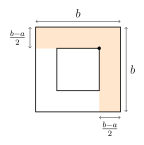
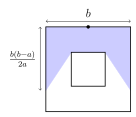
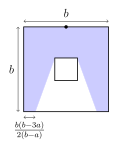
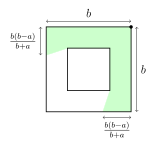
A prison consists of a square courtyard of side \(b\) bounded by a perimeter wall and a square building of side \(a\) placed centrally within the courtyard. The sides of the building are parallel to the perimeter walls. Guards can stand either at the middle of a perimeter wall or in a corner of the courtyard. If the guards wish to see as great a length of the perimeter wall as possible, determine which of these positions is preferable. You should consider separately the cases \(b<3a\) and \(b>3a\,\).
Solution:
2015 Paper 1 Q4
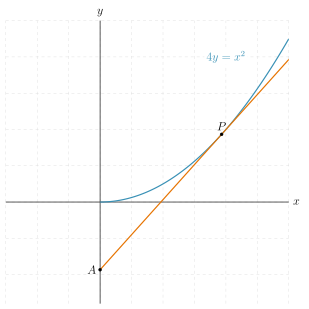
The midpoint of a rod of length \(2b\) slides on the curve \(y =\frac14 x^2\), \(x\ge0\), in such a way that the rod is always tangent, at its midpoint, to the curve. Show that the curve traced out by one end of the rod can be written in the form \begin{align*} x& = 2 \tan\theta - b \cos\theta \\ y& = \tan^2\theta - b \sin\theta \end{align*} for some suitably chosen angle \(\theta\) which satisfies \(0\le \theta < \frac12\pi\,\). When one end of the rod is at a point \(A\) on the \(y\)-axis, the midpoint is at point \(P\) and \(\theta = \alpha\). Let \(R\) be the region bounded by the following:
- the curve \(y=\frac14x^2\) between the origin and \(P\);
- the \(y\)-axis between \(A\) and the origin;
- the half-rod \(AP\).
Solution: At the point \((2t, t^2)\) the gradient is \(t\). Suppose \(\tan \theta = t\), then the point \(b\) away in each direction is \(\binom{2t}{t^2} \pm b \binom{\cos \theta}{\sin \theta}\), ie one end can be written in the form \((x,y) = (2\tan \theta - b \cos \theta, \tan^2 \theta - b \sin \theta)\). Notice we must have \(2\tan \alpha- b \cos \alpha= 0 \Rightarrow b = 2 \frac{\sin \alpha}{\cos ^2 \alpha}\), therefore the coordinates are \((2 \tan \alpha - 2 \tan \alpha, \tan^2 \alpha - 2\tan^2 \alpha) = (0, -\tan^2 \alpha)\) and \((4 \tan \alpha, 3\tan^2 \alpha)\)
2015 Paper 1 Q5
- The function \(\f\) is defined, for \(x>0\), by \[ \f(x) =\int_{1}^3 (t-1)^{x-1} \, \d t \,. \] By evaluating the integral, sketch the curve \(y=\f(x)\).
- The function \(\g\) is defined, for \(-\infty < x < \infty\), by \[ \g(x)= \int_{-1}^1 \frac 1 {\sqrt{1-2xt +x^2} \ }\, \d t \,.\] By evaluating the integral, sketch the curve \(y=\g(x)\).
Solution:
- \(\,\)
\begin{align*}
&& f(x) &= \int_1^3 (t-1)^{x-1} \d t \\
&&&= \left [ \frac1x(t-1)^{x} \right]_1^3 \\
&&&= \frac{2^x}{x}
\end{align*}

- \(\,\)
\begin{align*}
&& g(x) &= \int_{-1}^1 \frac{1}{\sqrt{1-2xt+x^2}} \d t \\
&&&= \left [ -\frac{1}{x}(1 +x^2 - 2xt)^{\frac12} \right]_{-1}^1 \\
&&&= \frac1x \left ( \sqrt{1+x^2+2x}-\sqrt{1+x^2-2x}\right) \\
&&&= \frac1x \left ( |1+x|-|1-x| \right)
\end{align*}
